The Commemorative Medal for the Imperial Constitution Promulgation

The Commemorative Medal for the Imperial Constitution Promulgation was established in 1889 to celebrate the first constitution of Japan.

The Commemorative Medal for the Imperial Constitution Promulgation was established in 1889 to celebrate the first constitution of Japan (known informally as the Meiji Constitution, 明治憲法Meiji Kenpō, which was proclaimed on February 11, 1889). Enacted after the Meiji Restoration in 1868, it provided for a form of mixed constitutional and absolute monarchy, based jointly on the German and British models.

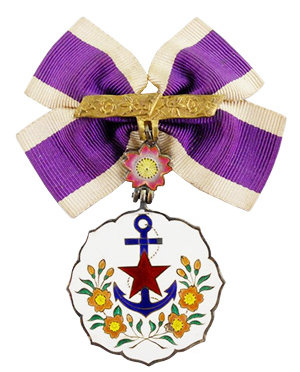
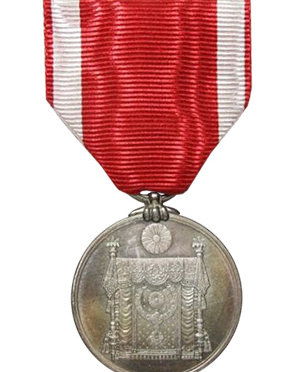
The gold medal was awarded to Imperial princes and the silver to people of chokunin or sonin rank. There was also a women’s version with a bow ribbon.

The Patriotic Women’s Association (Aikoku Fujinkai) Distinguished Service Badge

  • Time Period: Pre-WW1
  • Institution: After 1901
  • Country: Medals from Japan Japan

The Patriotic Women’s Association Distinguished Service Badge is a special merit badge awarded by the Patriotic Women’s Association or Aikoku Fujinkai. The Distinguished Service Badge (or Special Merit Badge) was the highest award.

The Patriotic Women’s Association is the oldest of the women’s associations. It was founded on March 2, 1901 by Okumara Ioko and operated under the Ministry of Home Affairs and the Ministry of Health and Welfare.

By 1940, the Association had close to 6,500,000 members in Japan and overseas. Before the outbreak of the Second World War, there were Aikoku Fujinkai branches in Canada, the United States and Brazil, as well as in different territories occupied by the Japanese armed forces. In February 1942, the Asssociation merged with the Greater Japanese Women’s Association for Protection of the Country and the Greater Japan Federation of Women’s Associations into a new association which was called the Greater Japanese Women’s Association.

The Aikoku Fujinkai Distinguished Service Badge Design

The medal is struck in silver and has red, white, blue, orange, green, pink and yellow enamels. It measures 33.5 mm (wide) x 47 mm (high), including its cherry blossom suspension.

The medal is suspended from a silver-gilt bar with pinback and has a bow-tied ribbon with silver-gilt tassels at either end. The badge was awarded in a hard-shelled case made of balsa wood with a black lacquer finish. The box has gilt characters on the lid.

Other badges were as follow:

  • Member Rosette Badge, in yellow, blue and black enamels.
  • Regular Member Badge, in silver with no enamels.
  • Special Member Badge, bronze with yellow enamel.
  • Honor Member Badge, bronze with light blue or white enamel.
  • First Class Exceptional Merit Badge, bronze with colored enamels.
  • Second and Third Class Merit Badges, bronze with a red star.
  • Patron Badge, in reddish bronze with no enamels.

The Imperial Grand Order

The Imperial Grand Order is a Chinese Order established in 1911 alongside four other medals to replace the Order of the Double Dragon.

The Imperial Grand Order is a Chinese Order established on 20 March 20 1911 (alongside four other ones) to replace the Order of the Double Dragon. Given its origins and history, it was felt that the Double Dragon was no longer adequate to meet the needs of China as a modern nation. A new system of national honors was needed to serve diplomatic protocol and, more importantly, the needs of Chinese citizens including the Emperor.

On April 2, 1909 the boy Emperor Puyi (or the regent Prince Chun) directed the Ministry of Foreign Affairs, the Army Ministry, and the Administration Bureau to develop a new system of awards. Two years later on 20 March 1911, the Emperor approved the establishment of five new awards:

  • The Grand Precious Order (Da Bao Zhang, 大宝章, also known in the West as the “Grand Order of the Throne”) intended for the Emperor.
  • The Orders of the Red Dragon and the Yellow Dragon, for members of royal families.
  • The Orders of the Blue Dragon and the Black Dragon, for nobles and high officials.

The first four existed in one class only, while the Black Dragon existed in eight classes.

The Imperial Grand Order Design

There are illustrations of this badge in the book Xun Zhang Tu (“Pictures of Orders”) or Ordres Imperiaux de Chine, which was printed for the Qing government by the royal press in Vienna.

The Order was a star comprising two rings of eight rays, one blue and one red, for a total of 16 points. The center medallion was bordered with pearls.

On the obverse, the Twelve Symbols of Imperial Authority are clearly visible as are the circle of pearls bordering the center medallion. According to the Book of Rites, one of the Five Classics of the Confucian canon, “Twelve is the number of Heaven”. The reverse bears the name of the Order (Da Bao Zhang, 大宝章) in the Chinese seal script. The breast star was the badge mounted on a star composed of eight groups of ascending diamond-cut rays.

The ribbon was Imperial yellow.

The Order of the Double Dragon

The Order of the Double Dragon was an order founded by the Guangxu Emperor on 7 February 1882 and awarded in the late Qing Dynasty.

  • Time Period: Pre-WW1 Period
  • Year of Institution: 7 February 1882
  • Country: China (Qing Dynasty)

The Imperial Order of the Double Dragon or ‘Double Dragon Precious Star’ (双龙宝星 in simplified Chinese, 雙龍寶星 in Chinese and Shuānglóng Bǎoxīng in pinyin) was an order awarded in the late Qing dynasty.

The Order was founded by the Guangxu Emperor on 7 February 1882 and awarded for outstanding services to the throne and the Qing court. It was the first Western-style Chinese order, established in the wake of the Second Opium War as part of efforts to engage with the West and adopt Western-style diplomatic practices.

Originally, the Order was bestowed only on foreigners but was extended to Chinese subjects from 1908. Traditionally the Chinese court did not have an honors system in the Western sense; however hat buttons, rank badges, feathers and plumes were routinely awarded by the Emperor to subjects and foreigners alike prior to and after the introduction of the Order of the Double Dragon.

The order was replaced in 1911 during the last days of the Qing dynasty by the Grand Order of the Throne, although this replacement was never fully implemented and the Republic of China discontinued the imperial orders after its establishment in 1912.

The order consisted of five classes, the first three of which were divided into three grades.

  • First Class, First Grade: for emperors and kings of foreign nations.
  • First Class, Second Grade: for princes, and royal family members and relatives (later limited to royal family members who had earned, and not inherited, senior positions in government).
  • First Class, Third Grade: for ministers of who had inherited their position, general ministers, and diplomatic envoys of the first rank.
  • Second Class, First Grade: for diplomatic envoys of the second rank.
  • Second Class, Second Grade: for diplomatic envoys of the third rank and customs commissioners.
  • Second Class, Third Grade: for counselors of the first rank, consul-generals and military generals.
  • Third Class, First Grade: for counselors of the second and third rank, the entourage of consul-generals, and second-tier military officers.
  • Third Class, Second Grade: for deputy consuls, and third-tier military officers.
  • Third Class, Third Grade: for translators and military officers of the fourth and fifth tiers.
  • Fourth Class: for soldiers and non-commissioned officers.
  • Fifth Class: for businessmen and traders.

The Order of the Double Dragon Design

The order took on many different designs and forms, mostly differentiated by the type and size of precious stones inlaid, the shape of the medallion, the length of the ribbon, and the material used to construct the medallion until its abolition in 1911. Gold and pearl were reserved for the higher classes of the Order, and enamel and coral for the lowest classes.

The original designs were similar in style and appearance to traditional Chinese insignia, but they proved cumbersome for many to wear and in 1897 they were redesigned in the form of a Western-style breast-badge, although the original designs were still awarded for some time afterward. Similar symbolic motifs accompanied all designs over the award’s history, most notably two dragons surrounding a central precious stone and flames which were connotative symbols of imperial authority. Other symbols of imperial authority – mountains, clouds, plum blossoms, and characters with providential meanings – were added to variations of the designs over time.

The Gold Medal of Military Valor

Institution: 21 May 1793
Country: Italy

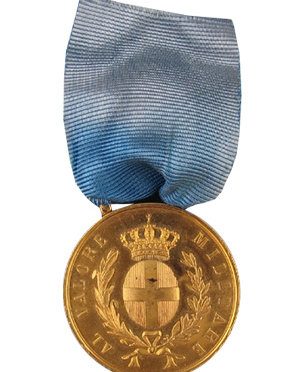
The Gold Medal of Military Valour (or Medaglia d’oro al valor militare in Italian) is a medal established on 21 May 1793 by King Victor Amadeus III of Sardinia for deeds of outstanding gallantry in war by junior officers and soldiers.

On 14 August 1815, Victor Emmanuel I of Sardinia replaced it with the Military Order of Savoy. On 26 March 1833, Charles Albert of Sardinia revived it and added to it the Silver and Bronze medals.

With the proclamation of the Republic on 2 June 1946, the coat of arms of the House of Savoy was replaced with the emblem of the Italian Republic. 

For actions performed by individuals during World War I, the Gold Medal was awarded some 368 times, as well as 37 times to military units, and once to the Unknown Soldier. Only four of the individual awards went to foreigners, one of these being Czar Nicholas II of Russia. The other three were for acts of gallantry in which the recipient was killed in action or died from his injuries (the Frenchmen John O’Byrne and Roland Morillot, and the American Coleman deWitt). 

During World War II the medal was awarded to soldiers of the Royal Italian Army; after these forces were reorganized following the Armistice with Italy in 1943, it was awarded to members of the Allies-supporting Italian Co-Belligerent forces. The Axis-affiliated Italian Social Republic created another design of the medal, with a Gladius replacing the arms of Savoy, for members of the Esercito Nazionale Repubblicano from 1943 to 1945. This version of the award was not given recognition by the postwar Italian government.

The Gold Medal for Military Valor is still awarded by the Italian state, and it, along with Silver and Bronze medals for Military Valor as well as the War Cross of Military Valor (which can only be awarded in time of war) was established by the Royal Decree of 4 November 1932.

The Gold Medal of Military Valor Design

The obverse of the medal displays the coat of arms of Savoy with laurel branches, the royal crown, and the words “For Military Valor“. On the reverse are two laurel branches enclosing the name of the decorated soldier, and the place and date of the action.

The Military Order Of The Duchy Of Warsaw

The Military Order Of The Duchy Of Warsaw 1811-1814 is a rare award from the Duchy of Warsaw, which was officially created by Napoleon I.

  • Time Period: Pre-WW1
  • Year of Institution: 1811-1814
  • Country: Poland (Duchy of Warsaw)

The Military Order Of The Duchy Of Warsaw 1811-1814 is a military medal of the Duchy of Warsaw.

The Duchy of Warsaw, also known as Napoleonic Poland, was a Polish client state of the French Empire established by Napoleon Bonaparte in 1807, during the Napoleonic Wars. It comprised the ethnically Polish lands ceded to France by Prussia under the terms of the Treaties of Tilsit. It was the first attempt to re-establish Poland as a sovereign state after the 18th-century partitions and covered the central and south-eastern parts of present-day Poland. The duchy was held in personal union by Napoleon’s ally, Frederick Augustus I of Saxony, who became the Duke of Warsaw and remained a legitimate candidate for the Polish throne.

The duchy’s armed forces were completely under French control via its war minister, Prince Józef Poniatowski, who was also a Marshal of France. The duchy was heavily militarized, bordered as it was by Prussia, the Austrian Empire, and Russia, and it was to be a significant source for troops in various campaigns of Napoleon. The duchy’s army, initially consisting of 30,000 of regular soldiers, were to rise to over 60,000 in 1810, and by the time of Napoleon’s campaign in Russia in 1812, its army totalled almost 120,000 troops (out of a total population of some 4.3 million people).

The Military Order Of The Duchy Of Warsaw Design

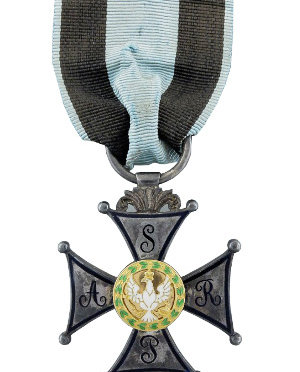
The medal is struck in silver, gold and enamels. It measures 34.5 mm (wide) by 39.9 mm (high) and has an ornate suspension hand.

The Order of Saint Stanislaus

The Order of Saint Stanislaus is a Russian dynastic order of knighthood founded in 1765 by King Stanisław II Augustus.

The Order of Saint Stanislaus (or Order św. Stanisława in Polish, Орденъ Св. Станислава in Russian) is a Russian dynastic order of knighthood founded as Order of the Knights of Saint Stanislaus, Bishop and Martyr in 1765 by King Stanisław II Augustus of the Polish–Lithuanian Commonwealth.

In 1831 after the downfall of the November Uprising, the order was incorporated into the Chapter of Russian Orders as part of the honours system of the Russian Empire by Emperor Nicholas I of Russia. In 1839, the Russian Order of Saint Stanislaus received new statutes, including granting status of nobility on its recipients in all three classes.

As a result of the Russian Revolution 1917, activities were suspended by the Soviet Union, although it has since been awarded by the head of the Imperial House of Romanov as a dynastic order. When in 1918 Poland regained its independence as the Second Polish Republic, a Polish order was introduced as a successor to the Polish Order of Saint Stanislaus, the Order of Polonia Restituta.

The heads of the Russian Imperial House in exile have continued to award Imperial and Royal Order of Saint Stanislaus. H.I.H. Grand Duchess Maria Vladimirovna, pretender to the Russian throne, and head of the Russian Imperial House, continues to award the Russian Imperial Order of Saint Stanislaus as a dynastic order of knighthood.

The Order of Saint Stanislaus Design

On the star and crosses of all classes, non-Christian recipients will have, instead of the cypher of Saint Stanislaus, a black and gold Imperial Russian double-headed Eagle. According to the Imperial Chapter of Orders and other honors, ed. 1892, the Order of Saint Stanislaus has three degrees, for which the insignia are:

Order of Saint Stanislaus 1st Class

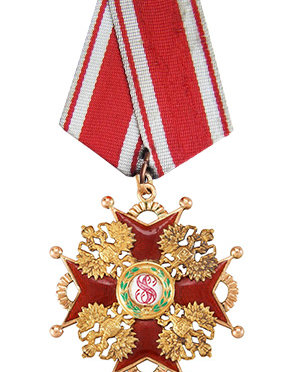
Gold cross, covered with a red enamel face, the four ends of which are further divided in two sharp points; on the edges of the cross a double gold rim; at the eight sharp points golden balls; and among these terminals, bringing them together, are gold semicircles of striped shells; in the center, on a white filigree round shield encircled by a gold border with a green wreath on it, the Latin monogram of Saint Stanislaus, a red “SS”; at each of the axillae, the state symbol of the Russian double-headed eagle in gold. On the rear side of the cross, all gold, with the verso a centered white round enameled shield, which depicts the same monogram “SS”.

It is worn on a moiré red ribbon, the breadth of two and a half inches, double white stripes at the borders, worn over the right shoulder with the star on the left side of the chest.

Silver star, the eight rays centering a white round shield circled with wide green stripes with two gold rims, the external rim wider; on the green enameled band between, gold laurel branches connected in the middle of each by two flowers; center roundel, in white enamel with red letters the cypher of Saint Stanislaus: “SS”; and around the hoop in a white box with gold letters, the motto of the order: Praemiando incitat (“rewarding encourages”) divided at the top with a golden flower.

Order of Saint Stanislaus 2nd Class

Cross of the same form, as for the first class, but of lesser magnitude, worn around the neck, on a ribbon with a width of one or two inches.

Order of Saint Stanislaus 3rd Class

Cross of the same form as the first two classes but worn in the buttonhole on the same ribbon with a width of five-eighths inches.

The War Order of Virtuti Militari

The War Order of Virtuti Militari was created in 1792 by Stanisław II August and is Poland’s highest military decoration for heroism.

  • Time Period: Pre-WW1
  • Year of Institution: 22 June 1792
  • Country: Poland

The War Order of Virtuti Militari (meaning “For Military Virtue” in Latin;  Order Wojenny Virtuti Militari in Polish) was created in 1792 by Polish King Stanisław II August to commemorate the victorious Battle of Zieleńce and is Poland’s highest military decoration for heroism and courage in the face of the enemy at war. It’s the oldest military decoration in the world still in use.

The War Order of Virtuti Militari is awarded in five classes either for personal heroism or, to commanders, for leadership. Some of the heroic actions recognized by an award of the Virtuti Militari are equivalent to those meriting the British Victoria Cross, the German Iron Cross, and the American Medal of Honor.

Since the destruction of the Polish–Lithuanian Commonwealth in 1795, the award has been reintroduced, renamed, and banned several times. Throughout the decoration’s existence, thousands of soldiers and officers, Polish and foreign, several cities (and one ship) have been awarded the Virtuti Militari for valor or outstanding leadership in war.

Poland regained its independence in 1918 as the Second Republic of Poland and the Polish Sejm reintroduced the Virtuti Militari on 1 August the following year under a new official name, the “Military Award Virtuti Militari” (Order Wojskowy Virtuti Militari). The class system as introduced under the Duchy of Warsaw was:

  • Grand Cross with Star, Class I: “for a commander who has achieved victory in a battle of strategic importance, resulting in total defeat of the enemy, or a successful defense that has decided the fate of a campaign.”
  • Commander’s Cross, Class II: “for a commander who has achieved a notable tactical victory or a valorous and successful defense of a difficult position.”
  • Knight’s Cross – Class III: for officers, NCOs, and ordinary soldiers, previously awarded the Golden Cross, for acts of outstanding bravery, risk of life, or outstanding command over his troops.
  • Golden Cross – Class IV: for officers who commanded their troops with outstanding bravery and valor, and for NCOs and ordinary soldiers, previously awarded the Silver Cross, for acts of outstanding bravery and risk of life on the field of battle.
  • Silver Cross – Class V: for officers, NCOs, and ordinary soldiers, for acts of outstanding bravery and risk of life on the field of battle.

There have been no new awards since 1989.

The War Order of Virtuti Militari Design

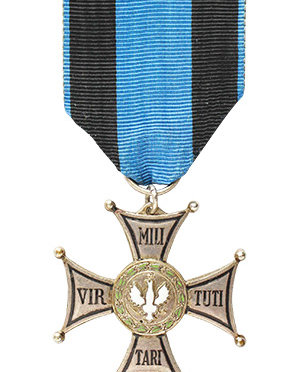
The medal is struck in silver gilt and decorated with enamels. It measures 30.75 by 40.30 mm. The obverse features a white eagle (Orzeł Biały), the national coat of arms of Poland. The reverse has the name of the order inscribed and the year of establishment.

The ribbon has a thin blue outer strip, thicker black ones, and a central blue stripe.

The Order of the White Eagle (Poland)

The Order of the White Eagle (or Order Orła Białego in Polish) is Poland’s highest order, awarded to both civilians and military for merit.

  • Time Period: Pre-WW1
  • Year of Institution: 1 November 1705
  • Country: Poland

The Order of the White Eagle (or Order Orła Białego in Polish) is Poland’s highest order and it’s awarded to both civilians and the military for their merits. The order was officially instituted on 1 November 1705 by Augustus II the Strong and bestowed on eight of his closest diplomatic and political supporters. It is awarded to the most distinguished Poles and the highest-ranking representatives of foreign countries.

Although Augustus the Strong limited the number of knights to seventy-two, he only conferred the Order forty times before his death in 1733 (his son, Augustus, awarded the Order more than three hundred times). The king may have been inspired to found the Order by the example of Peter the Great’s recent founding of the Russian Order of Saint Andrew and by the example of the prestigious French Order of the Holy Spirit.

Initially the creation of the Order was strongly opposed by many of the Polish nobility since membership in the Order conferred a distinction that violated the traditional equality of all Polish nobles. Since the Order had no patron saint, Augustus II made 2 August the feast of the Order. His son, Augustus III, however, changed the Order’s feast day to 3 August.

After the third partitioning of Poland, in 1795, the Order was abolished. It was renewed by 1807 and became the highest award of the Duchy of Warsaw, and after 1815 of the Kingdom of Poland. It was also popular among the Russian tsars, who also conferred the Order upon themselves. The Order of the White Eagle officially became Poland’s highest decoration by an act of Parliament of 4 February 1921. Following the collapse of communism, the Order was once again reinstated on 26 October 1992.

The Order of the White Eagle is one of the oldest orders in the world still in use.

The Order of the White Eagle Design

The badge Order of the White Eagle was originally a red enamel oval gold medal with an image of the Polish white eagle on its front side and bearing Augustus II’s royal cypher over crossed swords on its reverse side worn on a light blue ribbon. This was replaced by a Maltese cross in 1709.

The 1713 Insignia

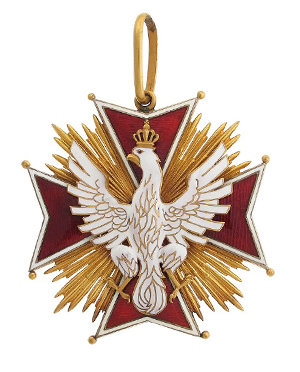
The 1713 badge was a Maltese cross enameled red with white borders with diamonds set in each of the balls at the eight points of the cross and with diamond set rays appearing between each of the points of the cross. In the center of the cross was a white enameled eagle in high relief with spread wings and facing left and with a diamond-set royal crown on its head. At the top of the cross between the two top points was a diamond-studded semi-circular link through which passed a diamond-studded ring through which, in turn, passed the light-blue ribbon from which it was worn. The reverse side was enameled white with red borders and had at its center an oval gold medallion with the founder’s crowned royal cypher above two crossed swords taken from his arms as the Arch-Marshall of the Holy Roman Empire.

The star of the order consisted of an eight-pointed gold star with straight rays which bore a red-bordered white enameled cross pattée with golden rays between the arms and with a golden rosette at its center. The arms of this cross pattée bore the motto “Pro Fide, Lege et Rege” (For Faith, Law and the King) in golden letters. The King of Poland could also wear the cross from a collar of 24 alternating links of white enameled eagles, crowned and holding scepters and orbs, and dark blue enameled ovals surrounded by gold rays.

The Medal of St. George (Russia)

The Medal of St. George for Bravery was established in 1878 and awarded to non-commissioned officers, soldiers, and sailors for acts of valor.

The Medal of St. George for Bravery was established on 3rd August 1878, during the reign of Tsar Alexander II. After the death of Emperor Alexander III in 1894 the Medal was re-issued, wearing the semblance of the new sovereign, Tsar Nicholas II.

The medal was awarded to non-commissioned officers, soldiers, and sailors as well as to civilians for exceptional acts of valor in times of war or peace.

On 10th August 1913, a sweeping amendment was introduced by which the Medal for Bravery was incorporated into the statute of the Order of Saint George and its name was changed to Saint George Medal for Bravery. From 23rd July 1915 the Gold Medals, similarly to the golden Saint George Crosses, were manufactured with a reduced content in gold. From January 1917 they were manufactured with substitute yellow or which metal.

The Cross of St. George Design

The St. George Medal came in four classes. Gold medallions for 1st and 2nd class (shown above). Silver medallions for 3rd and 4th. A bow on the ribbon denoted 1st class and 3rd. The medal was awarded for merit to other Allied soldiers as well as Russians.

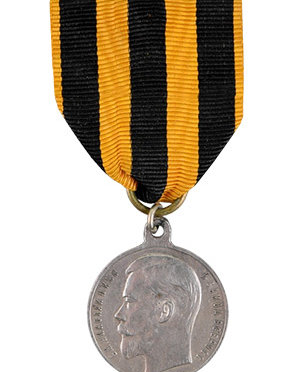
The obverse features the bust of the reigning Emperor with his title. The reverse  bears, in the center, in two lines the wording FOR BRAVERY, below the recipient’s impressed award registration number followed by the class of the award.

The ribbon is the same as the Order of Saint George; orange with three black stripes, commonly called “George’s Ribbon”. It symbolizes fire and gunpowder: the Russian “colors of military glory”, and is also thought to be derived from the colors of the original Russian imperial coat of arms (black eagle on a golden background). It was subsequently associated to the colors of the Russian Guard units.