The Distinguished Service Cross (UK)

The Distinguished Service Cross (DSC) is a military decoration awarded to officers for acts of gallantry during active operations at sea.

  • Time Period: Pre-WW1
  • Year of Institution: 15 June 1901 (as Conspicuous Service Cross, renamed 1914)
  • Country: Great Britain

The Distinguished Service Cross (or DSC) is a third level military decoration awarded to officers in recognition of an act or acts of exemplary gallantry during active operations against the enemy at sea. Ranks included officers of the British Armed Forces, Royal Fleet Auxiliary and British Merchant Navy, and formerly also of other Commonwealth countries.

The award was created in 1901 as the Conspicuous Service Cross and awarded to warrant and subordinate officers, including midshipmen, ineligible for the Distinguished Service Order. In October 1914, the award was renamed the Distinguished Service Cross and eligibility was extended to all naval officers (commissioned and warrant) below the rank of lieutenant commander. In August 1916, bars were introduced to reward further acts of gallantry meriting the Cross.

In December 1939 eligibility was extended to Naval Officers of the rank of Commander and Lieutenant-Commander, in April 1940 to equivalent ranks in the Royal Air Force serving with the Fleet, and in November 1942 to those in the Army aboard defensively equipped merchant ships.

Recipients are entitled to the post-nominal “DSC”. Since 1979, the Distinguished Service Cross can be awarded posthumously.

The Distinguished Service Cross Design

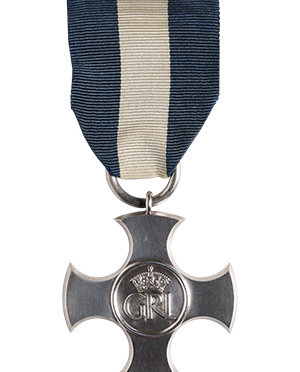
The medal is a plain silver cross with rounded ends with a width of 43 millimeters (1.7 in).

The obverse has a circular center containing the Royal Cypher of the reigning monarch at the time of award surmounted by a crown. The reverse is plain apart from the hallmark, and the ribbon is attached via a hall-marked silver ring. From 1940, the year of issue was engraved on the lower limb of the cross, and since 1984 it has been awarded named to the recipient.

The ribbon has three equal stripes of dark blue, white, and dark blue. The ribbon bar denoties a further award is plain silver, with convex ends and a central crown.

The Imperial Order of Saint Anna

The Order of Saint Anna is an Order established by Karl Friedrich in 1735 to honor his wife Anna Petrovna, daughter of Peter the Great.

The Order of Saint Anna (or Орден Святой Анны in Russian) is an Order of Chivalry and Holstein ducal established by Karl Friedrich, Duke of Holstein-Gottorp, on 14 February 1735, in honor of his wife Anna Petrovna, daughter of Peter the Great of Russia.

Originally, the Order of Saint Anna was a dynastic order of knighthood, but between 1797 and 1917 it had dual status as a dynastic order and as a state order. Membership of the Order was awarded for a distinguished career in civil service or for valor and distinguished service in the military.

The Order of Saint Anna entitled recipients of the first class to hereditary nobility, and recipients of lower classes to personal nobility. The motto is “Amantibus Justitiam, Pietatem, Fidem” (or “To those who love justice, piety, and fidelity“) and its festival day is 3 February (N.S. 16 February).

The Order continued to be awarded after the revolution and is today awarded by Grand Duchess Maria Vladimirovna as a continuation of the pre-Revolutionary order. Although it’s been approved for wear with the military uniform by the Russian Federation, it’s not recognized by some members of the Romanov Family Association.

The Imperial Order of Saint Anna Design

The insignia of the Order is a forged silver star with a red cross in its center surrounded by red enameled rim bearing Latin motto “Amantibus Justitiam, Pietatem, Fidem” (or “To Those Loving Justice, Devoutness, Loyalty“). This motto is adopted from initial letters of the name and family of the Grand Duchess Anna Petrovna: A.I.P.F. (“Anna, Imperatoris Petri Filia” or “Anna, Daughter of Emperor Peter”). An image of Saint Anna is situated on the white enameled field bordered with gold edging; blue cipher made of initial letters of the motto is situated at the reverse on the white enameled field.

The badge of the Order, first class, is a grand gold red enameled cross with gold edging, with gold ornamental decorations between its arms measuring 52×52 mm worn on a 100-110 mm wide sash over the left shoulder and attached to the right hip, together with a multi-rayed eight-pointed silver forged or cloth star (95 mm in diameter approximately) worn on the right breast.

The second class has the shape of a smaller size cross (44×44 mm approximately) and was worn as a neck award on a 45 mm wide red ribbon with yellow stripes at its edges. The third class has the shape of a smaller size cross (35×35 mm approximately) and was worn either on the left side of a breast suspended from a 22 mm wide red ribbon with yellow stripes at its edges, or in a buttonhole. When awarded for combat, it was worn on a bow as a special distinction to distinguish between military and civil divisions. For the fourth class, the badge had a shape of a crowned cross borne on the pommel of an edged weapon, together with a silver-tasseled sword-knot of the ribbon of the Order.

The Imperial Order of Saint Prince Vladimir

The Order of Saint Vladimir is an Imperial Russian order established by Empress Catherine II in memory of the deeds of Saint Vladimir.

The Order of Saint Vladimir (or орден Святого Владимира in Russian) is an Imperial Russian order established between September and October 1782 by Empress Catherine II in memory of the deeds of Saint Vladimir, the Grand Prince and the Baptizer of the Kievan Rus’. The order was awarded in four degrees for continuous civil and military service.

According to Russian laws on nobility, people who were awarded the Order of Saint Vladimir had the rights of hereditary nobility until the Emperor’s decree of 1900 was issued. After this, only three first classes of the Order gave this right.

Grand Duchess Maria Vladimirovna, pretender to the Russian throne, and Head of the Russian Imperial House continued to award the Russian Imperial Order of Saint Vladimir, but this is disputed by historians and by some members of the Romanov Family Association.

In 1957, in commemoration of the 40th anniversary of the Patriarch of Moscow’s restoration in Russia, an Order of Saint Vladimir was created by the Russian Orthodox Church. The order is to be awarded to priests and nuns of the Orthodox church for their service to the Soviet Union and later Russia.

The Imperial Order of Saint Prince Vladimir Design

The insignia of the Order is a red enameled cross pattée with black enameled borders, and a black enameled central disc bearing a crowned red and ermine mantle with the monogram of Saint Vladimir. The insignia is worn on a sash by the first degree, on a necklet by the second and third degrees, and on a chest ribbon by the fourth degree.

A four-pointed star is superimposed upon a four-pointed gold star, with a golden cross pattée and the letters “CPKB” between the arms of the cross on a black enamel background at the center surrounded by the motto of the order “Benefit, Honour and Glory“.

The Imperial Order of the White Eagle

The Order of the White Eagle (О рден Бе лого Орла) is an Imperial Russian Order established by Emperor Nicholas I of Russia in 1831.

The Order of the White Eagle (or О рден Бе лого Орла in Russian) is an Imperial Russian Order established by Emperor Nicholas I of Russia in 1831. A recipient of the Order was granted the title Knight of the Order of the White Eagle.

The white eagle had been associated with Poland even prior to statehood, first appearing on the Polish Coat of Arms in the 13th century. The original Order of the White Eagle (or “Order Orła Białego” in Polish) was established by King Władysław I in 1325. After the Third Partition of Poland in 1795, the Order briefly disappeared along with the Polish monarchy. The order was resurrected in 1807 by Napoleon I in his short-lived Duchy of Warsaw. When the Congress of Vienna divided the Polish lands among Prussia, the Austrian Empire, and the Russian Empire in 1815, the Order was officially “annexed” by Nicholas I on 17 November 1831 and became part of the Russian Imperial honors system.

The Imperial Order of the White Eagle Design

The Russian design of the Order featured significant alterations compared to its Polish predecessor.

The badge was struck in gold and decorated with red enamels. On the obverse, the original red maltese cross and white eagle were reduced in size and superimposed over the double-headed eagle of the Russian Empire. The reverse featured the original Polish badge design, superimposed over the Russian imperial eagle. The star now featured the Russian royal crown.

On 25 January 1832, a blue ribbon and sash were introduced.

The Imperial Order of Saint Alexander Nevsky

The Imperial Order of Saint Alexander Nevsky was an order of chivalry of the Russian Empire created in memory of Saint Alexander Nevsky.

The Imperial Order of Saint Alexander Nevsky was an order of chivalry of the Russian Empire first awarded by Empress Catherine I of Russia on 1 June 1725 and created in memory of the deeds of Saint Alexander Nevsky, patron Saint of Saint Petersburg to award to distinguished Russian citizens who had served their country with honor, mostly through political or military service.

The introduction of the Order was envisioned by Emperor Peter I of Russia (r. 1682–1721) for rewarding military bravery in battle, however he died before he could create it. It was first awarded on the occasion of the wedding of Grand Duchess Anna Petrovna of Russia and Charles Frederick, Duke of Holstein-Gottorp in 1725.

The Order of Saint Alexander Nevsky was abolished after the 1917 Russian Revolution, along with all other orders and titles of the Russian Empire. It was revived in 1942 by the Soviet Union as a purely military decoration and renamed it the more secular Order of Alexander Nevsky. The heads of the Russian Imperial House in exile have continued to award the Order of St. Alexander Nevsky.

The Imperial Order of Saint Alexander Nevsky Design

The star of the Order is an eight-point silver star, each arm composed of clusters of five individual smooth rays with braided borders. It measures 92 mm (w) x 92 mm (h) and weighs 80.6 grams. Its obverse features, in the center, the crowned Latin monogram of St. Alexander on a white enamel roundel, surrounded by the Order’s motto “ZA TRUDY I OTECHESTVO” (or “For Labours and Fatherland“) on a red enamel background with two green laurel branches crossed and crowned. The reverse bears a central pin assembly.

The badge of the order is a Maltese cross with red enamels and finely detailed Romanov imperial eagles in each quadrant. It measures 54.35 mm (w) x 60.31 mm (h) and weighs 31.6 grams. The obverse bears a central applique with an expertly hand-painted depiction of Alexander Nevsky mounted on a white horse, inside a stylized, hand-etched Gold ring. The reverse has central applique consisting of a white enameled medallion bearing a hand-painted monogram of Alexander Nevsky.

The ribbon is a red silk sash.

The Imperial Order of Saint Catherine

The Order of Saint Catherine is an award of Imperial Russia established in 1714 by Peter the Great for his marriage to Catherine I of Russia.

The Order of Saint Catherine (or Императорский Орден Святой Екатерины in Russian) is an award of Imperial Russia established on 24 November 1714 by Peter the Great on the occasion of his marriage to Catherine I of Russia. The Order was, for the majority of the time of Imperial Russia, the only award for women.

The order was under the patronage of Saint Catherine of Alexandria, the patron saint of the Empress. Peter the Great personally bestowed the insignia of the Order upon Empress Catherine on the Empress’ name day, making her Grand Mistress of the Order. No further members were inducted until 1726 and Dowager Empress Maria Feodorovna (who died in 1928) was the last Grand Mistress of the Order.

The award was bestowed in two classes:

  • Dame Grand Cross, and
  • Dame Lesser Cross.

Every Russian Grand Duchess was conferred the Grand Cross of the Order at her christening (or at her marriage into the Romanov family), and Princesses of the Imperial Blood were invested upon attaining their majority at 18. The 12 Dames Grand Cross were typically female members of foreign ruling houses, and the Dames Small Cross were all women of the highest nobility.

The Imperial Order of Saint Catherine Design

The badge of the Order is a cross with a large medallion set in the center of it.

On the obverse is depicted the order’s patron saint, Catherine of Alexandria, holding a large white cross, the symbol of her martyrdom. In the four quadrants formed by the cross are written the initials, “D.S.F.R.” (“Domine Salvum Fac Regem”, or “God Save the Tsar“). The Badge was attached to the riband, a sash of scarlet moiré with silver edges embroidered with the inscription: “За Любовь и Отечество” (“Za Lyubov’ i Otechestvo”, or “For Love and the Fatherland”).

The star is a medallion set on a silver, eight-pointed star with rays and encrusted with diamonds. On the obverse of the red medallion, in the center, is depicted the wheel of Saint Catherine (symbol of her martyrdom) surmounted by a cross. Encircling the medallion is the motto of the order.

On 24 December, the feast day of Saint Catherine of Alexandria, the members of the Order would wear the robes and the insignia and go in procession from the Imperial Chapel to a banqueting hall (usually the Hall of Saint Catherine in the Great Kremlin Palace in Moscow) specially prepared for the occasion. The coloring and decoration of the hall incorporate those of the Order.

The Volunteer Officers’ Decoration

The Volunteer Officers’ Decoration (or VD) is a British medal instituted in 1892 as an award for long and meritorious service by officers of the United Kingdom’s Volunteer Force.

The award was instituted by Queen Victoria’s Royal Warrant on 25 July 1892. The decoration could be awarded to efficient and thoroughly capable officers of proven capacity for long and meritorious service in the part-time Volunteer Force of the United Kingdom.

The decoration was discontinued in the United Kingdom when it was superseded by the Territorial Decoration in 1908, but it continued to be awarded throughout the British Empire, defined as being India, the Dominion of Canada, the Crown Colonies and the Crown Dependencies.

Volunteer Officers’ Decoration Design

The medal is oval skeletal and is struck in silver, with parts of the obverse in silver-gilt. It measures 43 millimeters (1.69 inches) high and 35.5 millimeters (1.4 inches) wide with a ring suspender formed of silver wire.

The obverse shows an oak leaf wreath in silver, tied with gold, with the Royal Cypher below the Royal Crown, both in gold, in the center. The reverse is plain with the hallmarks impressed at the bottom. 
The ribbon is dark green and 1 12 inches (38 millimeters) in width and is suspended from a silver bar-brooch decorated with an oak leaf pattern. The decoration was awarded unnamed but was frequently unofficially engraved in various styles.

The Territorial Force Efficiency Medal (1908)

The Territorial Force Efficiency Medal is a United Kingdom award for long service in the Territorial Force between 1908 and 1921.

It was established in 1908 following the enactment of the Territorial and Reserve Forces Act 1907, (7 Edw.7, c.9) which instigated a major re-organization of the old Volunteer Force and the remaining units of Militia and Yeomanry. 

The medal was awarded to non-commissioned officers and men for a minimum of 12 years service in the Territorial Force, providing they attended 12 annual training camps. Previous service in other part-time forces, including the Volunteer Force could count, and war service counted double. Bars were awarded for further periods of 12 years.

The Territorial Force Efficiency Medal (1908) Design

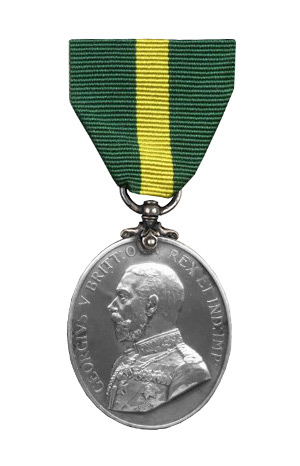
The medal is oval, struck in silver and measures 38 millimeters (1.5 inches) high and 31 millimeters (1.2 inches) wide.

The obverse shows the bust of the reigning King in Field Marshall’s uniform, facing left. Originally Edward VII was shown, with the legend, “EDWARDVS VII REX IMPERATOR“. In 1911 the image was changed to that of George V, the legend reading “GEORGIVS V BRITT: OMN: REX ET IND: IMP:“.

The reverse has a raised rim and bears the inscription “TERRITORIAL FORCE EFFICIENCY MEDAL” on four lines.

The ribbon is 32 millimeters (1.26 inches) wide and originally plain dark green with a central yellow stripe. In December 1919 was changed to plain dark green with yellow edges. For members of the Honourable Artillery Company (HAC) the ribbon is half blue, half scarlet with yellow edges.

The recipient’s service number, rank, name, and unit were impressed on the edge of the medal. The medal hangs from a ring suspension, attached to the medal by a claw fixing.

Notes

This entry was updated on 21 March 2023. The medal image was replaced to show the effigy of George V. Thank you David Wilcock for this information.

The Mobilization Cross 1912/13

The Mobilization Cross 1912/13 was awarded to military personnel who served with a mobilized unit in response to the Balkan crisis.

The Mobilization Cross 1912/13 was founded on 9 July 1913 by Emperor Franz Joseph I of Austria-Hungary and was awarded to all military personnel who served at least four weeks with a mobilized unit in response to the Balkan crisis in late September 1912.

Austro-Hungarian forces that had been mobilized as a precautionary measure during the Balkan Wars between an alliance of Bulgaria, Greece, Montenegro, and Serbia on the one hand and Ottoman Turkey on the other. Austria did not intervene in the wars but they led to Turkey being largely thrown out of Europe and a much-strengthened of Serbia, making Austria more nervous of her Slav neighbor and laying the ground for the outbreak of World War I.

The Mobilization Cross 1912/13 Design

The medal is a gilt Leopold cross, the ends of which are slightly curved inwards, with an eyelet and loop for ribbon suspension.

The obverse shows a circular central medallion bearing the dates ‘1912 1913’ in two lines. The reverse is plain.

The ribbon is yellow with two black stripes on the edges.

The Military Merit Medal (Austria-Hungary)

The Military Merit Medal is a military decoration of the Empire of Austria-Hungary only awarded to officers and officials of similar rank.

The Military Merit Medal (or Militär-Verdienstmedaille in German) is a military decoration of the Empire of Austria-Hungary founded by Emperor Franz Joseph I on March 12, 1890 and only awarded to officers and officials of similar rank.

The Military Merit Medal is often referred to as the “Signum Laudis” (Latin for “Sign of Praise”) after the inscription on the reverse of the medal. It was awarded in peacetime for meritorious service and in wartime for outstanding acts, including bravery or military merit.

The medal originally came in one class, a gilt bronze version, and repeat awards were not authorized. On March 26, 1911, a Silver Military Merit Medal was founded, intended to reward those who would have earned a second award of the Military Merit Medal. It too could be awarded on either of the two ribbons. On December 13, 1916, the addition of a pair of gilt-crossed swords on the ribbon was authorized to recognize a higher grade of wartime merit.

The Military Merit Medal became obsolete with the fall of the Austro-Hungarian monarchy in November 1918.

The Military Merit Medal Design

The medal is circular and struck in bronze, silver, or gold.

The obverse shows the bust of the reigning emperor. The reverse bears the words “SIGNUM LAUDIS” (Latin for “Sign of Praise“) surrounded by a wreath, half-laurels and half-oak leaves. The Medal is surmounted by a crown (dual crowns for the Karl I type) and worn from a tri-fold ribbon.

The peacetime awards were on the statute ribbon, a red ribbon, while wartime awards were on the ribbon of the Bravery Medal, a “laddered” pattern of red stripes edged in white and with white between the “rungs”.