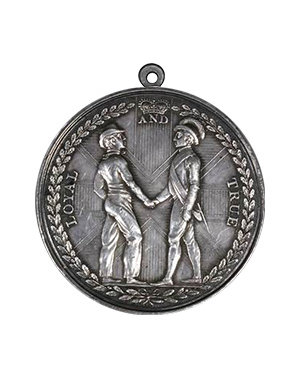
The Earl St Vincent’s Medal

The Earl St Vincent’s Medal was instituted in 1800 and presented in silver and bronze to officers and sailors who had followed Admiral Sir John Jervis from his flagship Victory to the Ville de Paris (and remained loyal to him during the mutiny at the Nore, which involved over 10% of the seamen in the Royal Navy).

When the British fleet under Admiral Sir John Jervis defeated a much larger Spanish fleet under Admiral Don José de Córdoba y Ramos near Cape St. Vincent, Portugal in February 1797, Jervis was made Baron Jervis of Meaford and Earl St Vincent and was granted a pension for life of £3,000 per year.

A specimen in gold was presented to George III and is now in the British Museum and there is also another gold example in the National Maritime Museum.

The Earl St Vincent’s Medal Design

The medal is struck in gold or silver, and measures 48 mm wide. It was designed by Lady Spencer (as recorded in correspondence to her from Jervis in June 1801).

It’s not known how many gold specimens were made, but it can only have been a couple or so.

The obverse bears the bust of the Admiral with his hair long and tied with a ribbon. The uniformed bust of Adml. Jervis l. is surrounded by the inscription “EARL ST VINCENT’S TESTIMONY OF APPROBATION 1800“.

The reverse shows a Rev. Naval Officer and enlisted sailor shaking hands, with a backdrop of the Union flag, all within an oaken wreath.

The medal was awarded without a ribbon.
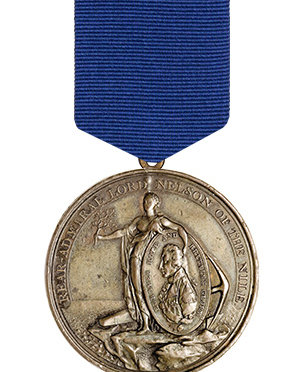
The Davison’s Nile Medal

The Davison’s Nile Medal was instituted in 1798 by Alexander Davison, who was appointed by Nelson for the captured ships after the battle of the Nile on 1 August 1798.

Davison had this medal struck and presented to all who took part in the action. It was awarded in gold to Nelson and his captains, in silver to Lieutenants and Warrant Officers, in gilt metal to Petty Officers, and in copper to seamen and marines.

Admiral Nelson’s medal was stolen in 1900 and it’s believed to have been melted down.

The Davison’s Nile Medal Design

The medal is struck in gold, silver, gilt-bronze or bronze and measures 47 mm wide.

The obverse shows, on a rock near the sea, Peace standing and holding in her right an olive branch. She supports with her left hand a medallion of Nelson, an anchor behind her. An inscription reads ‘REAR-ADMIRAL LORD NELSON OF THE NILE‘, ‘EUROPE’S HOPE AND BRITAIN’S GLORY‘, and below: ‘C.H.K‘. (C.H. Küchler).

The reverse bears a view of Aboukir Bay (the Aboukir promontory on the eastern rather than the western side of the bay), the English Fleet going into action and the French at anchor. A legend reads ‘ALMIGHTY GOD HAS BLESSED HIS MAJESTY’S ARMS‘. In the exergue is the inscription ‘VICTORY OF THE NILE AUGUST 1 1798‘, ‘M . B . SOHO‘ and ‘C . H . KUCHLER . FEC.’ The edge reads: ‘FROM ALEXR DAVISON, ESQR. ST. JAMES’ SQUARE A TRIBUTE OF REGARD.’

The award was given without a ribbon, but was used with an unofficial 32mm wide deep navy blue one and fitted with a ring.

The St Vincent’s Black Corps Medal

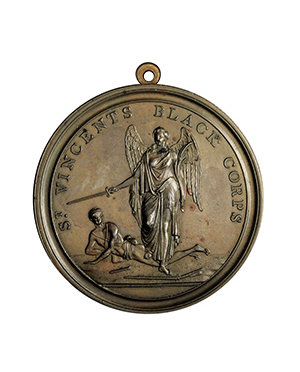
The St Vincent’s Black Corps Medal was instituted in 1795 and awarded to NCOs and men of the St. Vincent’s Black Rangers for service against rebellious Caribs and French forces in 1795.

The first Capture of Saint Vincent took place between 16 and 18 June 1779 during the American Revolutionary War. A French force commander named Charles-Marie de Trolong du Rumain landed on the island of Saint Vincent in the West Indies and quickly took over much of the British-controlled part of the island, assisted by local Black Caribs who held the northern part of the island. The area remained under Carib control until the Second Carib War of 1795, a conflict that pitted large numbers of British military forces against a coalition of Black Carib, runaway slaves, and French forces for control of the island.

British efforts to penetrate and control the interior and windward areas of the island were repeatedly frustrated by disease, incompetence and effective Carib defenses until a major military expedition by General Ralph Abercromby was eventually successful in crushing the Carib opposition in 1797.

The Corps of Natives were raised by Major Seton from among the island’s slaves for service against the rebellious forces.

The St Vincent’s Black Corps Medal Design

The medal is struck in bronze and measures 48.5 mm wide.

The obverse shows the winged figure of Victory brandishing a sword over a fallen foe who has abandoned his musket. The reverse bears a native holding a musket and a bayonet and has the inscription “BOLD ROYAL OBEDIENT” around and “H.G.FEC.” in the exergue.

The award was given without a ribbon.

The Defence of Gibraltar Medal

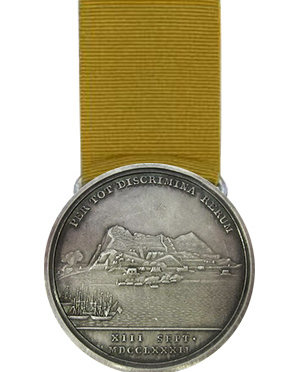
The Defence of Gibraltar Medal was instituted on 13 September 1782 by military commanders General Eliott and Sir John Picton, and awarded to British and Hanoverian troops present during the Franco-Spanish siege of 1779-1783.

Several private medals were struck to commemorate the Defence of Gibraltar during thesiege. The most commonly encountered are the ones struck in silver, which were provided by George Augustus Eliott and Sir Thomas Picton themselves.

The Defence of Gibraltar Medal Design

The medal is struck in silver and measures 49 mm wide (Eliott) and 59 mm wide (Picton).

The obverse for Eliott’s medal was designed by Lewis Pingo and shows a view of the Rock and the naval attacks of 13 September 1782, the climax of the siege. The reverse shows an inscription reading BRUDERSHAFT (“Brotherhood” in German), above a wreath containing the names of the three Hanoverian commanders and General Eliott.

The obverse of Picton’s medal shows a map of the Rock. The reverse shows a 22-line text (the most verbose British medal) above a recumbent lion crutching a shield bearing the castle and key emblem of Gibraltar.

The award was given without a ribbon or suspension, although some later examples show a yellow one.

The Carib War Medal

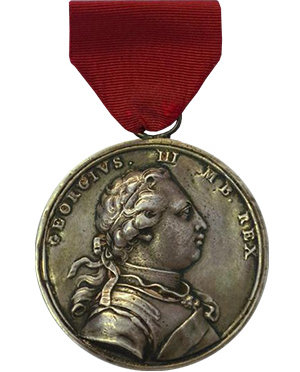
The Carib War Medal was instituted by the Legislative Assembly of St Vincent in the West Indies and awarded to British and West Indian forces (members of the militia and volunteers) who took part in fighting attempts by white settlers to seize Carib-owned land in 1772-1773, which led to a negotiated peace.

The Caribs were descended from the original Carib population of the eastern Caribbean who had intermarried with runaway African slaves. After the allocation of St Vincent to Britain in the Peace of Paris in 1763, the white planters who settled there attempted to seize Carib lands, but the latter fought a successful campaign of resistance and forced the British to sign a treaty recognizing their rights.

The Carib War Medal Design

The medal is struck in  silver and measures 52 mm wide.

The obverse shows a bust of George III in armor. The reverse bears Britannia offering an olive branch to a defeated Carib, and the date MDCCLXXIII in the exergue.

The award was given without a ribbon or suspension, although some later examples show a red one.

The Louisburg Medal

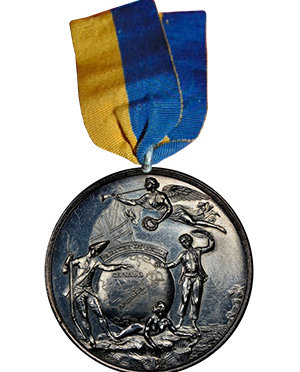
The Louisburg Medal was only given to certain recipients for acts of bravery or distinguished service in the capture of Louisburg in Canada in July 1758, during the Seven Years War. The land forces were commanded by James Wolfe and Jeffrey Amherst, while the fleet was commanded by Edward Boscawen.

The medal could be awarded to British Army and Navy.

The detail of a rare gold Louisburg medal can be seen on this page courtesy of the National Maritime Museum, Greenwich, London (not on display).

The Louisburg Medal Design

The medal is struck in gold, silver or bronze and measures 42 mm wide.

The obverse shows a globe surrounded by allegorical figures of victory and flanked by servicemen. A Grenadier on the left is turning towards a woman crushed below the globe, who points to approaching boats, while a sailor on the right waves his hat. The inscription on the globe reads “CANADA“, “AMERICA“. The reverse bears burning ships in the harbor, with batteries in the foreground firing at two French vessels, one in flames (The Prudent) and one being towed away (The Bienfaisant). The legend reads “LOVISBOVRG . TAKEN . MDCCLVIII“.

The ribbon measures 32 mm wide and is half yellow and half blue, although the medal was not initially intended for wear and has no suspension.

The Sea Gallantry Medal

The Sea Gallantry Medal (or SGM, officially ‘The Board of Trade Medal for Saving Life at Sea‘), is an award for civil gallantry at sea in Great Britain and the Commonwealth issued through the Merchant Shipping Act 1854 and first struck in 1855. This medal is exceptional in that it was authorized not by Royal Warrant but by Parliamentary legislation.

The 1856 Act made provision for monetary rewards for life-saving at sea, but in 1855 this was transmuted into medals in gold, silver or bronze. These medals were first warded either for ‘humanity‘, where there was little risk to the life of the recipient or for gallantry, where there was a significant risk to the recipient. The gold medal, if it was ever awarded, must have been of the greatest rarity.

Recipients were entitled to the post-nominal “SGM” until 29 November 2019.

There have only been two awards of the Sea Gallantry Medal (Bronze) since 1974: one in 1981 and the other in 1989. The medal was appeared to have fallen into disuse, although the award (as of 2020) has not been canceled.

The Sea Gallantry Medal Design

The medals were struck in silver or bronze (maybe in gold) and measured initially 58mm. These were not intended for wearing. In 1903 Edward VII ordered that the medal be reduced to 33mm wide and fitted with a suspension bar and ribbon for wearing. Both medals were issued with a minimum of the recipient’s name and date of rescue around the rim, and were sculpted by Bernard Wyon.

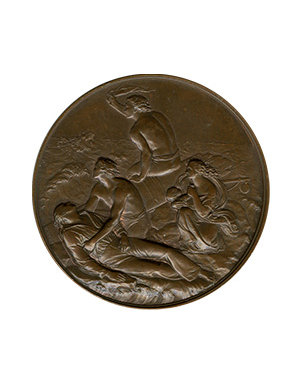
The obverse shows the profile of the reigning monarch. The reverse bears the image of a family on a storm-tossed shore reviving a drowning sailor.

The ribbon is bright red with narrow white stripes towards the edges.

The Distinguished Conduct Medal

The Distinguished Conduct Medal, or DCM, was established in 1854 and is the oldest British award for gallantry in the field by other ranks.

The Distinguished Conduct Medal, or DCM, was established in 1854, during the Crimean War, by Queen Victoria. It’s the oldest British award for gallantry in the field by other ranks (personnel who are not commissioned officers) of the British Army. The medal was also awarded to personnel of other Commonwealth Dominions and Colonies.

The Distinguished Conduct Medal ranked below the Victoria Cross, until its discontinuation in 1993 when it was replaced by the Conspicuous Gallantry Cross. Prior to its institution, there had been no official medal awarded by the British Crown in recognition of individual acts of gallantry in the Army. The Distinguished Conduct Medal was awarded with a gratuity, that varied in amount depending on rank, and given on the recipient’s discharge from the Army.

In May 1894, Queen Victoria authorized Colonial governments to adopt various military medals for awards to their local military forces. The Colony of Natal and the Cape Colony introduced this system in 1894, and the Transvaal Colony followed in 1902, while Australia, Canada and New Zealand also adopted the medal. However, only the Natal and Canada versions were finally awarded.

All awards of the Distinguished Conduct Medal were notified in the London Gazette and, during the First World War, citations were generally also included.

A bar was introduced in 1881 to be awarded in recognition of each subsequent act of distinguished conduct for which the medal would have been awarded.

The Distinguished Conduct Medal Design

The medal is struck in silver and is a disk measuring 36 millimeters (1.4 inches) in diameter and 3 millimeters (0.12 inches) thick.

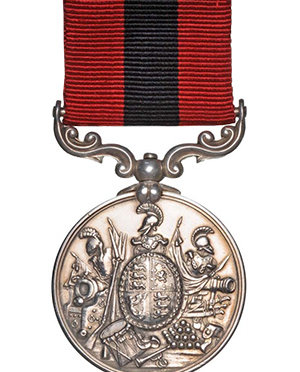
The original obverse shows a Trophy of Arms, designed by Benedetto Pistrucci, which incorporates a central shield bearing the Royal Coat of Arms without any inscription. From 1902, after the accession of King Edward VII, the effigy of the reigning monarch replaced the trophy of arms, with the respective titles of the monarch inscribed around the perimeter. There were eight variants of the obverse:

  • King Edward VII – “EDWARDVS VII REX IMPERATOR”.
  • King George V, bareheaded – “GEORGIVS V BRITT: OMN: REX ET IND: IMP:”.
  • King George V, crowned – “GEORGIVS•V•D•G•BRITT•OMN•REX•ET•INDIÆ•IMP•”.
  • King George VI – Two versions: “GEORGIVS VI D:G:BR OMN REX ET INDIAE IMP:” and “GEORGIVS VI DEI GRA: BRITT: OMN: REX FID: DEF:”.
  • Queen Elizabeth II – Two versions,: “ELIZABETH II D:G:BR:OMN: REGINA F:D:” and “ELIZABETH II DEI GRATIA REGINA F.D”.

The reverse is smooth, with a raised rim and the inscription “FOR DISTINGUISHED CONDUCT IN THE FIELD” in four lines, underlined by a laurel wreath between two spear blades.

The suspender is an ornamented scroll. The ribbon is 32 millimeters wide and dark crimson, with a 10 millimeters wide navy blue band in the center. All medals awarded bear the recipient’s number, rank, name and unit on the rim.

The Albert Medal for Lifesaving

The Albert Medal for Lifesaving is a British medal established by a Royal Warrant on 7th March 1866 and awarded to recognize the saving of life. It has since been replaced by the George Cross.

The medal was named in memory of Prince Albert and originally was awarded to recognize saving life at sea. It was discontinued in 1971 with the last two awards promulgated in the London Gazette of 31 March 1970. The first recipient was Samuel Popplestone, a tenant farmer who on 23 March 1866 helped to rescue four men after the cargo ship Spirit of the Ocean lost its battle with force eleven gales and was torn apart as it was swept onto the notorious Start Point rocks in Devon.

A Royal Warrant in 1867 created two classes of Albert Medal. The titles of the medals changed in 1917, the gold “Albert Medal, first-class” becoming the “Albert Medal in gold” and the bronze “Albert Medal, second class” being known as just the “Albert Medal”.

The decoration was discontinued in 1971 and all living recipients were invited to exchange the award for the George Cross. From the total of 64 eligible to exchange, 49 took up the option.

The Albert Medal for Lifesaving Design

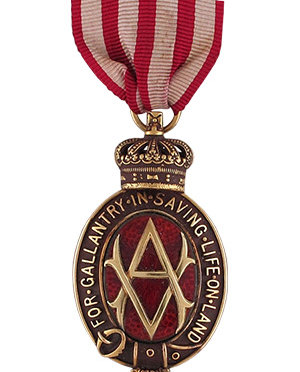
The medal was made of gold (although early examples are gold and bronze), and consists of an oval enclosing the entwined initials V and A. The sea medals have, in addition, an anchor. The oval is enclosed by a bronze garter with the words FOR GALLANTRY IN SAVING LIFE, with AT SEA or AT LAND as appropriate, and is enameled in red or crimson respectively. The medal is surmounted by a crown pierced by a ring for suspension.

The original medal had a blue ribbon 58” (16 mm) wide with two white stripes. A further Royal Warrant in 1867 created two classes of Albert Medal, and the ribbon of the first-class changed to 1 ​38” (35 mm) wide with four white stripes.

The Kaisar-I-Hind Medal

The Kaisar-i-Hind Medal for Public Service was awarded by the Emperor or Empress of India from 1900 to 1947 for significant contributions.

The Kaisar-i-Hind Medal (or Kaisar-i-Hind Medal for Public Service in India, قیصرِ ہند‎ qaisar-e-hind in Urdu, कैसर-इ-हिन्द in Hindi) was established in May 1900 (instituted by Queen Victoria on 10 April 1900) and awarded by the Emperor/Empress of India between 1900 and 1947 to “any person without distinction of race, occupation, position, or sex who shall have distinguished himself (or herself) by important and useful service in the advancement of the public interest in India.

The word kaisar, meaning “emperor” is a derivative of the Roman imperial title Caesar. The title Kaisar-i-Hind was coined in 1876 by the orientalist G.W. Leitner in a deliberate attempt to dissociate British imperial rule from that of preceding dynasties.

The last ruler to bear it was George VI. While never officially rescinded, the Kaisar-i-Hind ceased to be awarded following the passage of the Indian Independence Act 1947.

The Kaisar-I-Hind Medal Grades or Classes

The medal had three grades:

  • Gold
  • Silver
  • Bronze

The Gold Medal for Public Service in India was awarded directly by the monarch on the recommendation of the Secretary of State for India. Silver and Bronze medals were awarded by the Viceroy.

The Kaisar-I-Hind Medal Design

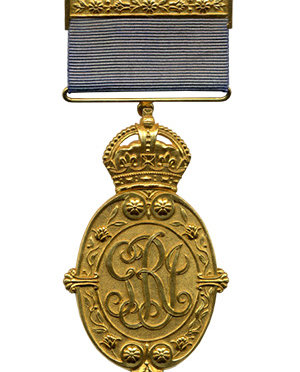
The medal measures 61 mm high and 34 mm wide. It consists of an oval-shaped badge or decoration in gold, silver or bronze with the Royal Cipher and Monarchy on the obverse, and the words “Kaisar-i-Hind for Public Service in India” on a scroll across the center against a floral background on the reverse. The badge is surmounted by the imperial crown.

The decoration was to be worn suspended from the left breast by a dark blue ribbon. The medal has no post-nominal initials.