The Order of the Golden Spur

The Order of the Golden Spur is a papal order of knighthood awarded for distinguished service in propagating the Catholic faith.

The Order of the Golden Spur (or Ordine dello Speron d’Oro in Italian and Ordre de l’Éperon d’or in French), also officially known as the Order of the Golden Militia (or Ordo Militia Aurata in Latin and Milizia Aurata in Italian), is a papal knighthood bestowed upon individuals who have demonstrated exceptional service in promoting the Catholic faith or enhancing the prestige of the Church through acts of valor, scholarly writings, or other noteworthy achievements.

Following the passing of the last surviving knight, Grand Duke Jean of Luxembourg, in 2019, the order is now considered inactive.

The History of the Order of the Golden Spur

The Order of the Golden Spur has its roots in medieval times and is believed to have been established around the 8th century. Its origins are closely linked to the papacy and the Holy See’s role in recognizing individuals who made significant contributions to the Catholic Church and its mission.

Initially, the order was associated with the accolade of knighthood, often bestowed upon knights who demonstrated exceptional bravery in battle or service to the Church. Over time, its criteria expanded to include individuals who contributed to the glory of the Church through scholarly pursuits, artistic endeavors, or other illustrious acts.

During the Middle Ages, the order gained prominence as one of the highest honors conferred by the papacy. Recipients of the Golden Spur were esteemed members of the nobility and clergy, recognized for their unwavering dedication to the Catholic faith and their exemplary service to the Church.

Throughout its history, the order underwent various reforms and modifications, adapting to the changing political and religious landscape of Europe. Over time, the Golden Spur became associated not only with military valor but also with intellectual and cultural achievements that contributed to the advancement of Christianity.

The Order of the Golden Spur Design

The badge today features an eight-pointed, enamelled gold cross. At its center lies a small white medallion, bearing the word “Maria” encircled by a golden ring. On the reverse side of the medallion, the year MDCCCCV is inscribed, surrounded by the words “Pius X Restituit” in a surrounding circle. Hanging from the bottom of the cross is a small golden spur.

The decoration is suspended from a red ribbon with white borders.

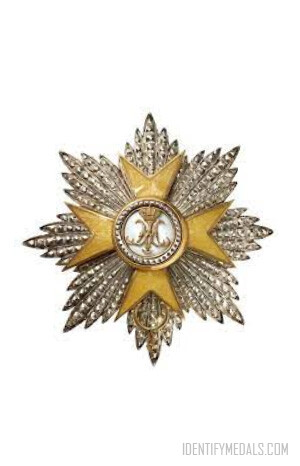
The star, worn on the left breast, retains the same cross design. It is set against the backdrop of silver star rays, enhancing its visual appeal.
The Supreme Order of Christ

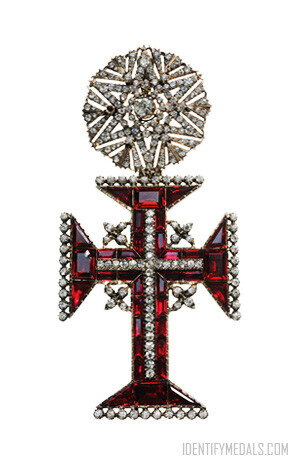
The Supreme Order of Christ is the highest order of chivalry that can be awarded by the pope. The order is currently dormant.

The Supreme Order of Christ, known in Italian as the Ordine Supremo del Cristo, holds the distinction as the highest order of chivalry that can be bestowed by the Pope. Since 1987, there have been no new appointments to this prestigious order. Following the passing of the last remaining knight, King Baudouin of Belgium, in 1993, the order entered a period of dormancy.

Scholars suggest that its origins trace back to the Order of Christ of the Knights Templar, which also gave rise to the Order of Christ awarded by the kings of Portugal and the emperors of Brazil. Originally, the Portuguese order had both secular and religious aspects, but by the 18th century, the religious aspect had faded away.

The Portuguese Controversy

The Portuguese Crown has asserted its authority to bestow the Order of Christ. However, the Papacy contends that the Portuguese monarchs’ right to confer the Order was granted by a Pope through the Bull Ad ea ex quibus issued in Avignon in 1319.

Although the Bull itself does not expressly confer upon the Pope the authority to issue the Order, successive popes from Pope John XXII onward have done so. For many years, the Portuguese monarchy contested the Papacy’s right to grant the Order, and in one notable instance, apprehended an individual for wearing the Papal Order.

The stance of the Crown of Portugal was that the sole legitimate fons honorum was the Crown. However, this claim is disputed by the Papacy.

The Supreme Order of Christ Design

The insignia of the Order is a gilt cross with enamel with a longer lower arm. In the era of monarchy, distinct badges were assigned to civil and military knights: civil knights sported a badge resembling the contemporary version but adorned with the Sacred Heart of Christ above it. Conversely, military knights bore a completely different insignia—a gilt, blue, and white enamelled Maltese Cross, featuring white enamelled oval shields between the cross arms, each bearing a design akin to the Coat of arms of Portugal minus the red border.

The Vatican Cross of Mentana

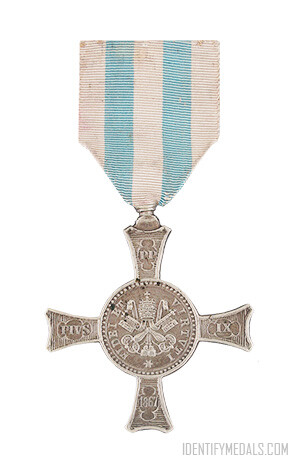
The Vatican Cross of Mentana is an order created by Pope Pius IX on 14 November 1867 to commemorate the Battle of Mentana.

The Cross of Mentana, also known as the Cross Fidei et Virtuti, was a military decoration established by the Holy See during the Italian unification period.

Pope Pius IX established the cross on November 14, 1867, following the victory of French-Papal troops in the Battle of Mentana. Although initially associated with that battle, it was later awarded to all participants in the campaign against Garibaldi’s volunteers.

On March 3, 1868, the Imperial French government permitted the wearing of the medal with French uniforms.

The Order of St. Gregory the Great Design

The Vatican Cross of Mentana is a silver cross featuring a cross pattée design with concave ends on the arms.

The obverse is a circular center medallion displaying the Papal coat of arms surrounded by the words ‘FIDEI ET VIRTUTI’. The upper, left, right, and lower arms bear the inscriptions ‘PP’, ‘PIUS’, ‘IX’, and ‘1867’ respectively. The reverse features a Latin cross encircled by a laurel wreath, with the inscription ‘HINC VICTORIA’ above it.

It hangs from a white ribbon with two light blue stripes in the center. Medal bars were affixed to the ribbon to denote the various battles for which each cross was bestowed.

The Order of St. Gregory the Great

The Order of St. Gregory the Great is one of the five orders of knighthood of the Holy See and was established in 1831 by Pope Gregory XVI.

The Order of St. Gregory the Great (or Pontifical Equestrian Order of St. Gregory the Great, known in Latin as Ordo Sancti Gregorii Magni and in Italian as Ordine di San Gregorio Magno), was founded on September 1, 1831, by Pope Gregory XVI, following his ascent to the papacy seven months prior.

This order stands among the five orders of knighthood of the Holy See. It is conferred upon Catholic individuals, as well as certain distinguished non-Catholics, in acknowledgment of their personal dedication to the Holy See and the Catholic Church. This recognition is granted for their exceptional service, unwavering support of the Holy See, and the positive influence they exert in their communities and countries.

The inaugural statement affirms that individuals honored with the Order of St. Gregory the Great are recognized for their loyalty to the Holy See, noble lineage, noteworthy deeds, or charitable contributions. Recipients must uphold their reputation through ongoing meritorious actions and demonstrate unwavering fidelity to God and the Pope.

The award imposes no specific obligations on recipients towards the Catholic Church beyond the general expectations outlined above.

The Order of St. Gregory the Great Design

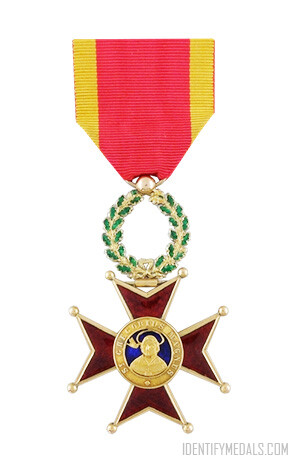
The insignia of the order is an eight-pointed cross, featuring a depiction of St. Gregory on the front and the motto “Pro Deo et Principe” (For God and Ruler) on the back. This cross is suspended from a ribbon in red and gold.

In ecclesiastical heraldry, individuals honored with the prestigious rank of Grand Cross may exhibit a red and gold ribbon encircling the shield in their personal coats of arms. However, recipients of lower ranks typically display an appropriate ribbon beneath the shield.

The civilian and military insignia differ in their presentation. Civilian recipients wear the cross suspended from a laurel wreath, while military recipients wear it suspended from a trophy of arms.

The Medal For Valor in the Field / At Sea

The Medal For Valor in the Field/Sea is a Swedish military decoration awarded to officers and soldiers of the Swedish Armed Forces.

The Medal For Valor in the Field (or För tapperhet i fält in Swedish) and Medal For Valor at Sea (För tapperhet till sjöss) are esteemed military decorations of Sweden, honoring the courage and bravery demonstrated by officers and soldiers of the Swedish Armed Forces during wartime engagements, whether on land or at sea.

Instituted by Gustav III on May 28, 1789, amid conflicts with Russia, these medals were conceived to complement the Order of the Sword, which, since its establishment on February 23, 1748, had been exclusively bestowed upon officers for acts of valor on land or at sea.

These two medals, along with the various grades of the Order of the Sword, hold the distinction of being designated as Swedish war decorations (Svenska krigsdekorationer).

Through royal decrees issued on March 24, 1807, and June 10, 1809, it was decided to institute two distinct decorations: För tapperhet i fält (abbreviated Mtf) to recognize valor in the field and För tapperhet till sjöss (Mts) to honor acts of bravery at sea. Each of these awards has gold variants (prefixed with G, such as GMtf) reserved for officers and silver variants (prefixed with S, such as SMts) designated for non-commissioned officers and privates.

The Medal For Valor in the Field / At Sea Design

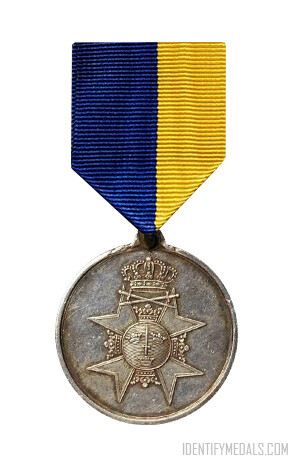
Initially crafted in silver, the medal was intended solely for non-commissioned officers and privates. However, in 1806, a gold version was introduced exclusively for higher-ranking officers.

The design of the medal is characterized by its simplicity, featuring a circular shape consistent with the modern size 8 of the Swedish medal scale established in 1773, known as Mensura magnitudinis Nummorum, with a diameter of 31 mm.

On the obverse side, the medal bears the inscription “FÖR TAPPERHET I FÄLT” or “FÖR TAPPERHET TILL SJÖSS” (or for older medals “[…] TILL SIÖS”), encircled by a wreath. Since 1809, the reverse side has been adorned with the symbol of the Order of the Sword. Prior to this, it depicted a portrait of Gustav III alongside the text “GUSTAV III SVERIGES KONUNG” (“Gustav III King of Sweden”). 

The ribbon is blue and yellow and has been presented with the award since 1819.

The Litteris et Artibus Medal

The Litteris et Artibus Medal is a Swedish royal decoration awarded to people who have made important contributions to culture.

The Litteris et Artibus Medal is a distinguished Swedish royal decoration established in 1853 by Charles XV of Sweden during his tenure as crown prince.

This prestigious accolade is bestowed upon individuals who have made significant and noteworthy contributions to the realm of culture, particularly in the domains of music, dramatic art, and literature.

The Litteris et Artibus Medal Design

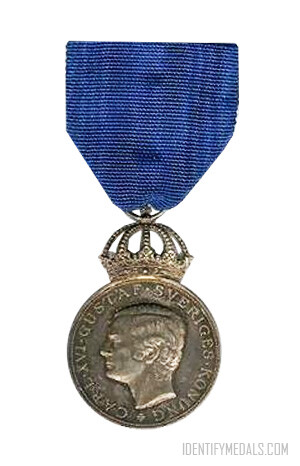
The obverse side of the medal features the likeness of the reigning monarch, while the reverse side bears the inscription “Litteris et Artibus,” which translates to “Letters and Arts” in Latin.

This emblematic representation serves as a testament to the enduring commitment of the Swedish monarchy to honor and celebrate excellence in cultural achievements.

The H. M. The King’s Medal (Sweden)

The H. M. The King’s Medal is a Swedish honor established in 1814 and awarded to Swedish and foreign citizens for special merits.

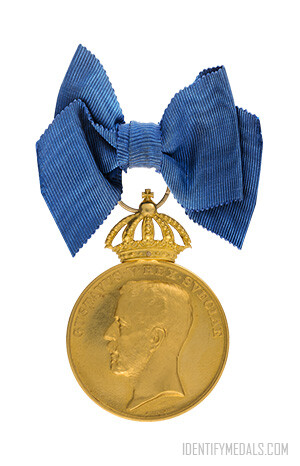
The H.M. King’s Medal (H.M. Konungens medalj in Swedish), previously known as the Court Medal (or Hovmedaljen), is a prestigious honor bestowed upon both Swedish and foreign nationals.

Established in 1814, this medal is not classified into classes but rather awarded based on size. The 12th size is the largest and is typically worn around the neck on a chain or ribbon, while the 8th and 5th sizes are worn suspended from the left breast by a ribbon, following the Seraphim Medal.

Recipients of the King’s Medal include individuals who have demonstrated exceptional merits and officials serving at the royal court. This practice became particularly common after 1975, when the conferral of Swedish Orders of Chivalry to non-royal Swedish citizens ceased, until the Orders were reopened to Swedish citizens on February 1, 2023.

The H. M. The King’s Medal Design

The King’s Medal is available in different sizes, crafted from both gold and silver, and can be worn suspended from either a ribbon or chain.

Unlike traditional classifications, Swedish medals are not divided into classes but rather into sizes. These sizes are determined by the Berch’s Scale, an 18th-century scale that assigns specific dimensions to each medal. For instance, the 12th size medal has a diameter of 43 mm, while the 8th size measures 31 mm in diameter.

The Order of Charles XIII

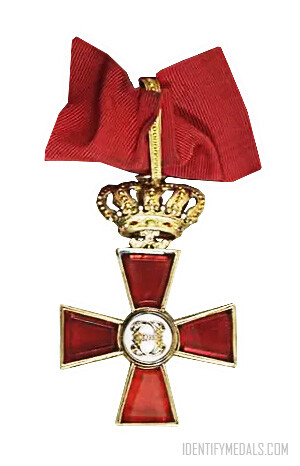
The Order of Charles XIII is a Swedish order of merit established in 1811 and awarded to Freemasons of the Protestant faith.

The Royal Order of Charles XIII (Kungliga Carl XIII in Swedish) is a distinguished Swedish order of merit established by King Charles XIII in 1811.

Membership of the order is limited to Freemasons of the Protestant faith. The King of Sweden, currently King Carl XVI Gustaf, serves as the Lord and Master of the Order. The order’s membership is structured as follows:

  • Thirty lay members, with a maximum of seven non-Swedish members, each holding the XI (highest) degree of the Swedish Rite of Freemasonry, such as regional or national heads.
  • Three clerical members, typically priests or bishops of the Church of Sweden.
  • All princes of the Royal House of Sweden are born members but only wear the insignia if they hold the Knight and Commander rank of the Red Cross of the Swedish Order of Freemasons. As a result, the King and the Duke of Värmland, both born Knights of the Order, do not wear the insignia.
  • Foreign princes of royal lineage may be granted honorary membership if they are senior Freemasons, regardless of their affiliation with the Swedish Order or another. While they enjoy full membership rights, they are not included in the order’s membership limits. Prince Edward, Duke of Kent (United Kingdom), was admitted to the Order on November 6, 2000.

The total membership cannot exceed 33 individuals concurrently. Members of royal descent are automatically included in the count but do not consume slots from the allotted 33.

The Order of Charles XIII Design

The insignia of the order features a red St. George cross, with a white globe at its center bearing the monogram of the founder, consisting of two letters “C” surrounding “XIII” in gold.

On the reverse side of the globe, there is a gold letter “B” within an equilateral triangle bordered in black and gold. A closed golden crown is mounted atop the cross. The insignia is worn around the neck on a red ribbon. Additionally, there exists a red breast cross, making the insignia equivalent to that of a Commander 1st Class, and recipients are ranked accordingly following the Commanders 1st Class of the Swedish Royal Orders.

The ribbon is red.

The Order of Vasa

The Order of Vasa is a Swedish order of chivalry awarded to citizens of Sweden for service to the state and society.

The Royal Order of Vasa (or Kungliga Vasaorden in Swedish) is an order of chivalry bestowed upon citizens of Sweden in recognition of their contributions to the state and society, particularly in fields such as agriculture, mining, and commerce.

Instituted by King Gustav III on May 29, 1772, the Order of Vasa was unique in its inclusivity. It was unrestricted by birth or education and thus open to anyone deserving of recognition. Unlike the Order of the Polar Star, which primarily honored individuals in the learned professions, the Order of Vasa had a broader scope.

In 2019, a parliamentary committee was tasked with devising guidelines for the reintroduction of the Swedish orders, including the Order of Vasa, into the national honors system and for the reappointment of Swedish citizens to these orders. The committee presented its recommendations in September 2021 and a new regulation was issued on December 20, 2022, revoking the 1974 restriction and once again permitting Swedish citizens to receive the Royal Orders.

The Order had five classes:

  • Commander Grand Cross 
  • Commander 1st Class 
  • Commander 
  • Knight 1st Class (Member 1st Class for women and clergymen) 
  • Knight (Member for women and clergymen) 

The Order of Vasa Design

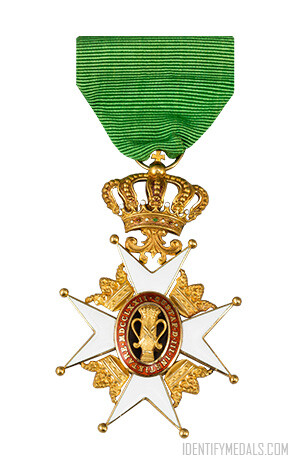
The badge of the Order is crafted as a white-enameled Maltese Cross, fashioned in silver for the Knight class and in gilt for Knight 1st Class and higher ranks, with crowns adorning the spaces between the arms of the cross. The central oval disc, which is identical on both sides, features a golden sheaf against a black enamel background, encircled by a red enamel ring bearing the inscription “Gustaf 3. Instiktare 1772″ (Instituted by Gustaf III, 1772). The badge is suspended from a royal crown.

The Badge of Vasa resembles the silver badge of the Order for knights, but lacks white enamel on the cross. The star of the Order takes the form of a silver Maltese Cross with a silver sheaf at the center. For the Grand Cross, the star additionally features the aforementioned nettle leaf emblem in silver between the arms of the cross.

The ribbon of the Order is green.

The Order of the Polar Star

The Order of the Polar Star is a Swedish order of chivalry established in 1748 as an award for civic merits, devotion to duty, science, etc.

Established on February 23, 1748, by King Frederick I, the Royal Order of the Polar Star (or Kungliga Nordstjärneorden in Swedish), alternatively known as the Royal Order of the North Star, stands as a Swedish order of chivalry.

Alongside the Order of the Sword and the Order of the Seraphim, it was introduced to honor individuals for their contributions to civic society, dedication to duty, advancements in science, literary accomplishments, scholarly pursuits, and the establishment of beneficial institutions, both within Sweden and internationally.

The Order has five degrees:

  1. Commander Grand Cross (KmstkNO) 
  2. Commander 1st Class (KNO1kl) 
  3. Commander (KNO) 
  4. Knight 1st Class (RNO1kl/LNO1kl
  5. Knight (RNO/LNO

The Order of the Polar Star Design

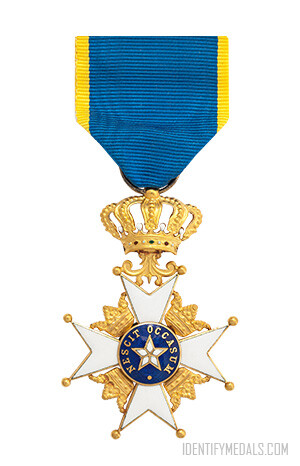
The Order’s badge features a white enamelled Maltese Cross, rendered in silver for a Knight and gilt for a Knight 1st Class and higher ranks, with crowns adorning the spaces between the arms of the cross. The central disc, identical on both sides, showcases a blue enamel background with a white-enamelled five-pointed star encircled by the Order’s motto, Nescit occasum (“It knows no decline”). The badge is suspended from a royal crown.

The star of the Order takes the form of a silver Maltese cross, with a silver five-pointed star positioned at its center. For the Grand Cross, straight silver rays extend between the arms of the cross.

The ribbon of the Order is black. However, from 1975 to 2023, it featured a blue color with yellow stripes near its borders. From 2023 onwards, the black ribbon was reinstated.