The Order of the Sword (Sweden)

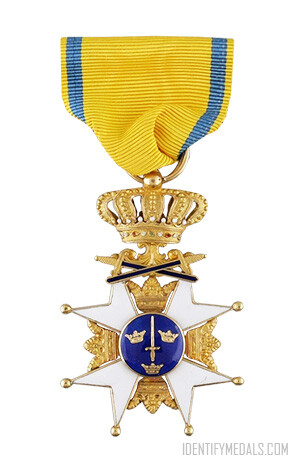
The Order of the Sword is a Swedish order of chivalry and military decoration established in 1748 as an award for bravery and long service.

The Royal Order of the Sword, officially known as the Royal Order of the Sword (or Kungliga Svärdsorden in Swedish), was established as an order of chivalry and military decoration by King Frederick I on February 23, 1748. It was created alongside the Order of the Seraphim and the Order of the Polar Star. The order’s motto, “Pro Patria,” meaning “For Fatherland,” is expressed in Latin.

Initially intended as a recognition for bravery and exceptional long or meritorious service among officers, the Order of the Sword eventually evolved into a customary award for military officers upon completing a certain number of years in service. Originally comprising three grades—Knight, Commander, and Commander Grand Cross—the order later expanded its classification into multiple classes.

On December 20, 2022, the Swedish Government issued a new regulation that overturned the 1974 restriction, thereby reinstating eligibility for Swedish citizens to receive the Royal Orders. This reactivation of the Order of the Sword, alongside the Order of Vasa, took effect on February 1, 2023.

The Grades of the Order of the Sword

In 1788, after King Frederick I established the three aforementioned orders, King Gustav III introduced two new grades of the Order of the Sword. They were both exclusively reserved for wartime conferment:

  • Knight Grand Cross First Class: The decoration was conferred upon division commanders holding the rank of at least major general in recognition of their significant triumphs in battle. Even the monarch could only don the insignia of Knight Grand Cross with the unanimous approval of his officers, as exemplified by Gustavus III, Charles XIII, and Charles XIV John.
  • Knight Grand Cross: The cross looks similar to the Knight’s cross, but is as large as the Grand Cross badge.

During peacetime, the Order of the Sword had five classes:

  •  Commander Grand Cross 
  •  Commander 1st Class 
  •  Commander 
  •  Knight 1st Class 
  •  Knight 

The Order of the Sword Design

The insignia of the Order is a white-enamelled Maltese Cross arranged in a saltire (X-shaped) formation, rendered in silver for the Knight class and in gold for the Knight 1st Class and higher ranks. Gold open crowns are positioned between the arms of the cross.

On the obverse central medallion, an upright gold sword is flanked by three gold crowns against a blue enameled background, while the reverse central medallion features an intersecting gold sword and laurel wreath, accompanied by the Latin inscription “Pro Patria” (For Fatherland) on a blue enameled backdrop.

Across the opening between the upper arms of the cross at the top of the badge, a pair of crossed gold swords in blue enamelled scabbards with downward-turned blades is depicted. Additionally, in the badges of the two highest classes, an upright gold and blue sword spans the openings at the sides of the cross, along with a pair of crossed gold and blue swords with downward-turned blades across the opening between the lower arms of the cross at the bottom of the badge. 

The badge is suspended from a gold and enamelled royal crown. 

The Order of the Seraphim

The Order of the Seraphim is a Swedish order of chivalry established in 1748, originally to supervisors of the Seraphim Hospital.

The Royal Order of the Seraphim, known in Swedish as Kungliga Serafimerorden, was established by King Frederick I on February 23, 1748, along with the Order of the Sword and the Order of the Polar Star.

The order, named after the Seraphim, a category of angels, is the highest order of chivalry in Sweden. It consists of a single class, conferring the title of Knight (referred to as Member for women and Member of the Cloth for clergymen).

In 1975, as part of a reorganization of Swedish orders, appointments of Swedish citizens to the various orders ceased (except for foreign heads of state). In 1995, revisions to the law allowed for conferrals upon members of the royal family and on December 20, 2022, the Swedish Government issued a new regulation repealing the 1974 restriction, thereby once again permitting conferrals of the Royal Orders to Swedish citizens, effective from February 1, 2023.

The History of the Order of the Seraphim

Upon its establishment in 1748, the knights of the Order of thr Seraphim were tasked with overseeing the major hospitals and mental asylums in Sweden, notably the Seraphim Hospital in Stockholm, which remained a prominent medical institution until its closure in 1980.

However, as the 19th century progressed, this obligation became obsolete due to the establishment of professional boards of physicians and other experts, rendering the supervision by the Knights of the Seraphim unnecessary.

The Order of the Seraphim Design

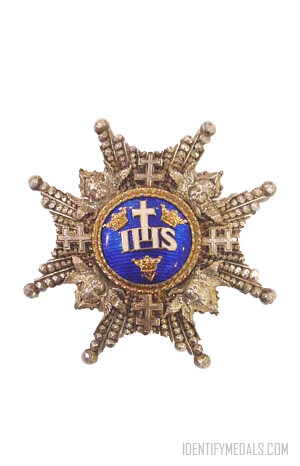
The emblem of the Order features a white-enamelled gold Maltese Cross, with a gold patriarchal cross adorning each arm and gold seraphim positioned between the arms, their wings encompassing the central medallion.

On the obverse medallion, blue enamel serves as the backdrop for a white-enamelled “IHS” Christogram, flanked by three gold crowns above and representations of the three nails used in the crucifixion of Jesus Christ below. The reverse medallion, also in blue enamel, bears the white-enamelled letters “FRS” (Fredericus, Rex Sueciae, Frederick King of Sweden), honoring the Order’s founder. The emblem is suspended from a royal crown crafted from gold and enamel. 

The star of the Order mirrors the design of the badge’s front side, excluding the royal crown. However, it is entirely crafted from silver, with the central medallion enameled like that on the badge but larger in size.

The ribbon is pale blue, a hue referred to in Sweden as seraphim blue. 

The Order of Montesa

The Order of Montesa is a Christian military order linked to the old Crown of Aragon (today Spain) and named after the order’s headquarters.

The Order of Montesa (or Orden de Montesa in Spanish) is a Christian military order linked to the old Crown of Aragon and named after the castle of the same name, which was the order’s headquarters. 

The Order of Montesa played a significant role in the ongoing struggle against Muslim forces in the Iberian Peninsula. Its knights participated in military campaigns, fortifications, and border defense, contributing to the Christian reconquest of Spain.

Founded in the 14th century, the order emerged as a merger between two prominent military orders: the Knights Templar and the Order of Saint George of Alfama.

The Order of Montesa traces its origins to the aftermath of the suppression of the Knights Templar in the early 14th century. Seeking to preserve the legacy and assets of the Templars, King James II of Aragon facilitated the transfer of their estates and holdings to the newly formed Order of Montesa in 1317. This merger allowed for the continuation of the Templar tradition within the framework of a new order.

With its headquarters established in the castle of Montesa, located in the province of Valencia, the order quickly garnered royal patronage and papal approval. It adopted the rule of the Knights Templar and pledged itself to the defense of the Kingdom of Valencia and the Christian faith.

The Order of Montesa Design

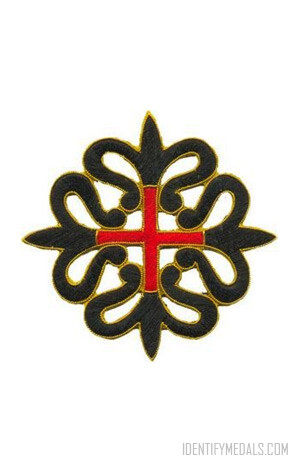
At the heart of the insignia is the distinctive cross of Montesa, which serves as the primary emblem of the order. This cross typically features arms of equal length, often adorned with ornate details and embellishments

The Spanish Orders of Knighthood

Collectively, the four Spanish military orders (the Order of Santiago, the Order of Calatrava, the Order of Montesa, and the Order of Alcántara) exemplified the spirit of medieval chivalry and Christian knighthood, dedicating themselves to the defense of the faith and the protection of Christian lands.

Their legacies endure as enduring symbols of Spain’s rich heritage and the enduring ideals of honor, valor, and service.

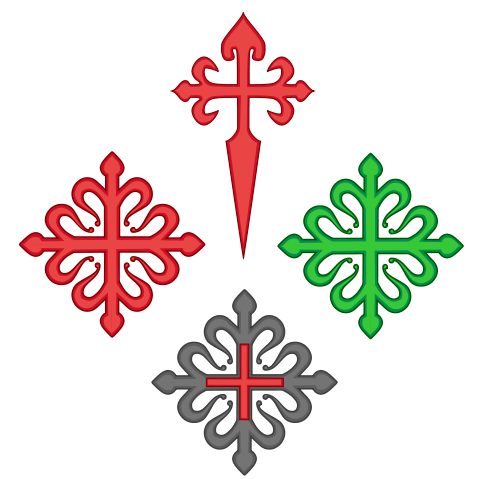
The Spanish military orders.
Badges of the Order of Santiago (top), the Order of Calatrava (left), the Order of Montesa (bottom) and the Order of Alcántara (right).

The Order of Alcántara

The Order of Alcántara or Knights of St. Julian was a military order founded in 1166 and confirmed by Pope Alexander III in 1177.

The Order of Alcántara (or Orden de Alcántara in Spanish), sometimes referred to as the Knights of St. Julian, was a military order of León (today Spain) and was founded in 1166. The Order was then confirmed in 1177 by Pope Alexander III.

Founded in the 12th century during the Reconquista, the order played a pivotal role in the Christian reconquest of the Iberian Peninsula from Muslim rule. 

The origins of this order are shrouded in mystery, yet according to a somewhat dubious tradition, St. Julian de Pereiro, a hermit from the region of Salamanca, played a pivotal role. It is said that upon his counsel, several knights constructed a fortress on the banks of the Tagus River to resist Muslim incursions. References to these knights appear as early as 1176, in a charter issued by King Fernando of León, although their military nature is not explicitly mentioned. It wasn’t until 1177, with the issuance of a papal bull by Pope Alexander III, that they were officially recognized as a military order.

The Order of Alcántara Design

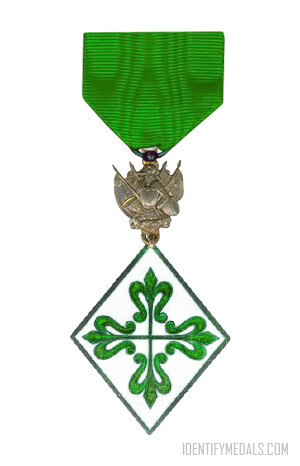
The insignia of the Order of Alcántara is a symbol of the order’s noble ideals and martial heritage. At the heart of the obverse is the distinctive cross of Alcántara, characterized by its unique shape and design. This cross features arms that widen towards the ends, often adorned with intricate details and embellishments. 

Surrounding the cross of Alcántara, the insignia may include additional elements that further enhance its visual appeal and symbolic significance, or inscriptions or mottoes that reflect the order’s ethos and mission.

The Spanish Orders of Knighthood

Collectively, the four Spanish military orders (the Order of Santiago, the Order of Calatrava, the Order of Montesa, and the Order of Alcántara) exemplified the spirit of medieval chivalry and Christian knighthood, dedicating themselves to the defense of the faith and the protection of Christian lands.

Their legacies endure as enduring symbols of Spain’s rich heritage and the enduring ideals of honor, valor, and service.

The Spanish military orders.
Badges of the Order of Santiago (top), the Order of Calatrava (left), the Order of Montesa (bottom) and the Order of Alcántara (right).

The Order of Santiago

The Order of Santiago was a religious and military order founded in the 12th century and one of the four Spanish military orders.

The Order of Santiago (or Orden de Santiago in Spanish) is one of the most renowned and prestigious chivalric orders in Spanish history.

Founded in the 12th century during the Reconquista, its origins are deeply intertwined with the Christian struggle to reclaim the Iberian Peninsula from Moorish rule.

Initially established as a religious and military brotherhood to protect the pilgrims journeying to the shrine of Saint James the Apostle in Santiago de Compostela, the order quickly evolved into a formidable military force. Comprised of noble knights known as Santiago Cavaliers, its members were bound by vows of chivalry, including the defense of the Catholic faith, the protection of pilgrims, and the expulsion of Moors from Christian territories.

Despite experiencing periods of decline and resurgence over the centuries, the Order of Santiago has maintained its status as a symbol of chivalry and honor in Spanish history. Today, it remains active as a dynastic order, preserving its traditions and heritage while continuing to uphold the values of courage, loyalty, and service to the Catholic Church and the Spanish nation.

The Order of Santiago Design

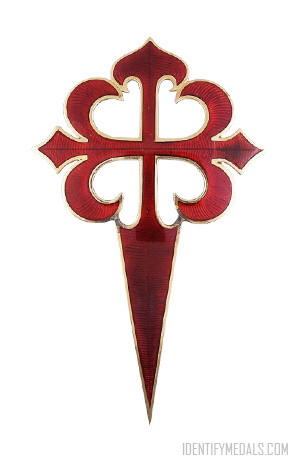
The insignia design of the Military Order of Santiago is rich in symbolism and tradition.

Central to the insignia is the distinctive red cross pattée, which serves as the primary emblem of the order. This cross, often depicted in a vibrant red hue, is characterized by its equal-length arms that taper slightly towards the ends. 

Surrounding the cross pattée, and depending on the insignia, you can often find additional elements of heraldic imagery, such as heraldic lions, castles, or fleur-de-lis, which symbolize various aspects of the order’s history, lineage, and mission.

The Spanish Orders of Knighthood

Collectively, the four Spanish military orders (the Order of Santiago, the Order of Calatrava, the Order of Montesa, and the Order of Alcántara) exemplified the spirit of medieval chivalry and Christian knighthood, dedicating themselves to the defense of the faith and the protection of Christian lands.

Their legacies endure as enduring symbols of Spain’s rich heritage and the enduring ideals of honor, valor, and service.

The Spanish military orders.
Badges of the Order of Santiago (top), the Order of Calatrava (left), the Order of Montesa (bottom) and the Order of Alcántara (right).

The Order of Calatrava

The Order of Calatrava was the first military order founded in Castile and one of the first four Spanish military orders.

The Order of Calatrava, known as Orden de Calatrava in Spanish and Ordem de Calatrava in Portuguese, stood as one of the four Spanish military orders and notably served as the premier military order established in Castile, albeit being the second to gain papal endorsement. Pope Alexander III officially sanctioned the Order of Calatrava through a papal bull issued on September 26, 1164. While much of the order’s political and military influence waned by the late 15th century, its assets were not fully dissolved until 1838.

The Order of Calatrava holds a distinguished place in the history of medieval Spain as one of the foremost military orders. Founded in the 12th century, it played a crucial role in the Reconquista, the centuries-long effort by Christian kingdoms to retake the Iberian Peninsula from Muslim rule.

Initially established as a military brotherhood to protect the Calatrava fortress in the Kingdom of Castile, the order quickly expanded its mission to defend Christian territories and combat Moorish incursions. Its members, known as knights or cavaliers, took vows of poverty, chastity, and obedience, dedicating themselves to the defense of Christendom.

The Order of Calatrava gained papal approval in 1164, solidifying its status as an official institution of the Catholic Church. With the backing of both secular and ecclesiastical authorities, it grew in power and influence, attracting nobles and warriors from across Europe to join its ranks.

In the present day, the fundamental objective of the Spanish Orders remains unchanged from their inception: the protection and promotion of the Catholic faith. While the use of the sword has ceased, their commitment to doctrine, exemplary conduct, spiritual growth, and religious observance persists, alongside their engagement in cultural and social endeavors.

The Order of Calatrava Design

In recognition of their service and valor, members of the Order of Calatrava were awarded various honors and distinctions, including medals and insignia.

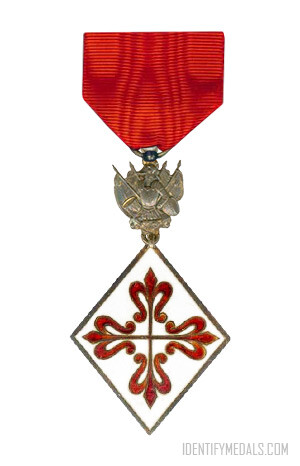
These medals often featured the emblem of the order, which typically included symbols such as a cross, sword, and shield, representing the order’s martial and religious mission.

The Spanish Orders of Knighthood

Collectively, the four Spanish military orders (the Order of Santiago, the Order of Calatrava, the Order of Montesa, and the Order of Alcántara) exemplified the spirit of medieval chivalry and Christian knighthood, dedicating themselves to the defense of the faith and the protection of Christian lands.

Their legacies endure as enduring symbols of Spain’s rich heritage and the enduring ideals of honor, valor, and service.

The Spanish military orders.
Badges of the Order of Santiago (top), the Order of Calatrava (left), the Order of Montesa (bottom) and the Order of Alcántara (right).

The New Zealand Cross (1869)

The New Zealand Cross was introduced in 1869 during the New Zealand Wars, fought between the Māori and forces raised by European settlers.

The New Zealand Cross was established in 1869, during the New Zealand Wars, a conflict between the indigenous Māori people and European settlers (Pākehā) aided by British troops. Throughout this turbulent period, marked by bravery and unwavering commitment to duty, numerous acts of gallantry and devotion were displayed by local militia, armed constabulary, and volunteers.

On March 10, 1869, without verifying the facts and under the mistaken belief that colonial troops were ineligible for the Victoria Cross unless under British command, Sir George Bowen, the Governor of New Zealand, introduced the New Zealand Cross as the highest honor in the country. This decision drew criticism in England, where it was seen as encroaching on Queen Victoria’s prerogatives. Nevertheless, Queen Victoria eventually endorsed this move.

The New Zealand Cross was awarded sparingly, with only 23 recipients. The first six awards were published in the New Zealand Gazette in 1869, followed by one award in 1870. Remarkably, the remaining 16 awards were not gazetted until between 1875 and 1910, some six to 44 years after the commendable actions they recognized.

The New Zealand Cross Design

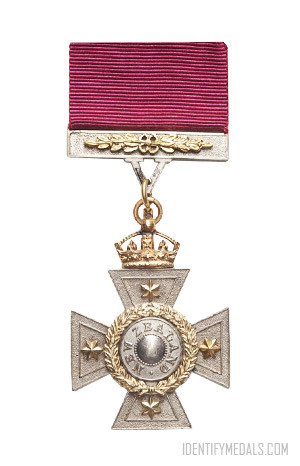
The New Zealand Cross takes the shape of a silver cross pattée, with distinctive features adorning both its obverse and reverse sides. On the obverse, the central portion proudly bears the gilded gold inscription ‘NEW ZEALAND,’ encircled by an elegant laurel wreath. Each arm of the cross boasts a six-point gold star, and atop the cross rests a regal gold Imperial State Crown.

The reverse of the medal shows two concentric circles, with the recipient’s name skillfully engraved between them and the date of the heroic action etched within the inner circle.

A crimson ribbon passes through a silver suspender clasp embellished with delicate gold laurel leaves.

The first 20 medals crafted in 1871 included a distinctive feature on the reverse of the suspender clasp – the cartouche of the goldsmiths, Messrs Phillips Brothers and Son of Cockspur Street, London. However, this detail was omitted from a subsequent batch of five medals produced in 1886.

The Marian Knight Cross (Order Of The German Knights)

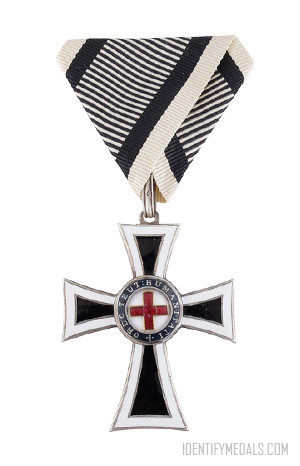
The Marian Knight Cross (Marianerkreuz) is the symbol for the military Order created in 1128 to care for sick and wounded Christian pilgrims.

The roots of this Order can be traced back to the Order of the Knights of the Hospital of St. Mary of the Teutons in Jerusalem. It was initially established in 1128 as a military Order with the purpose of providing assistance to ailing and injured Christian pilgrims and establishing hospitals in the Holy Land. On November 19, 1190, Duke Friedrich from Swabia formally founded the Order.

During its Imperial Austrian iteration, this Order was bestowed upon nobles and clergy members who demonstrated dedication to the fields of nursing and the compassionate practice of mercy.

The Order gained recognition as a Roman Catholic Order, with subsequent Popes endorsing it. However, it faced abolition by Napoleon Bonaparte in 1809. It was subsequently reinstated in 1815 under the patronage of Imperial Austria and underwent reforms under Emperor Ferdinand I in both 1840 and 1871.

The Marian Knight Cross Design

The Marian Knight Cross is struck in silver and measures 35 by 42 mm. 

Find This Medal

Right Now on eBay 
Clicking a link to eBay may result in a referral commission being paid if a purchase is made.
Loading...

The Union of South Africa Commemoration Medal

The The Union of South Africa Commemoration Medal is a military and civil medal that commemorates the opening of the first Union Parliament.

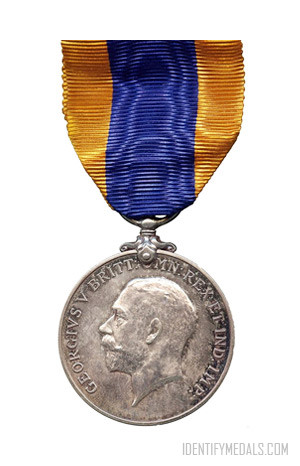
The Union of South Africa Commemoration Medal, both a military and civilian commemorative decoration, was bestowed in honor of the inauguration of the inaugural Union Parliament in 1910 by the Duke of Connaught and Strathearn. It can be regarded as one of the initial independence medals introduced across the Commonwealth during the 20th century.

The medal was conferred upon individuals from the military, naval forces, and select civilian leaders who played significant roles in the events. This recognition was based on the recommendation of the Principal Secretary of State for the Colonies. A roster was maintained, and it was to be finalized six months following the warrant’s issuance. After this period, any further awards could only be granted with Royal Approval and under highly exceptional circumstances.

The Union of South Africa Commemoration Medal Design

The medal was struck in silver and measures 36 millimetres in diameter. It also has a raised rim.

The obverse of the medal features a left-facing portrait of King George V, encircled by the inscription: “GEORGIVS V BRITT:OMN:REX ET IND:IMP:”. The medal is connected to a swiveling claw suspension, secured to the medal using a pin through its upper edge. The suspension includes a sizable ring.

On the reverse side, you can observe the representation of Mercury, symbolizing commerce and prosperity, crafting links of a chain on an anvil. Four of these links are inscribed with the names of the Union of South Africa’s provinces: “CAPE OF GOOD HOPE,” “NATAL,” “TRANSVAAL,” and “ORANGE RIVER.” Beneath this depiction, the year “1910” is intertwined with an olive branch. Surrounding the entire image is the inscription “TO COMMEMORATE THE UNION OF SOUTH AFRICA.”

The ribbon measures 38 millimeters in width and consists of two orange bands, each 10 millimeters wide, separated by a central dark blue band that is 18 millimeters wide.

Find This Medal Online

Right Now on eBay 
Clicking a link to eBay may result in a referral commission being paid if a purchase is made.
Loading...

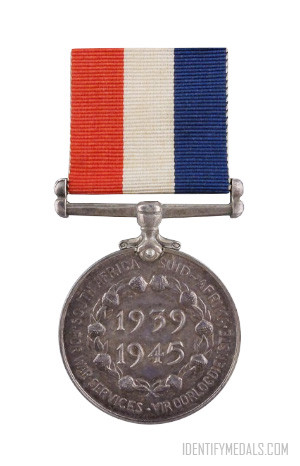
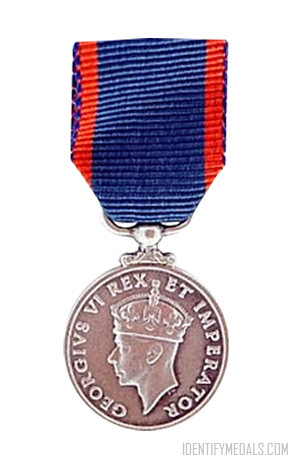
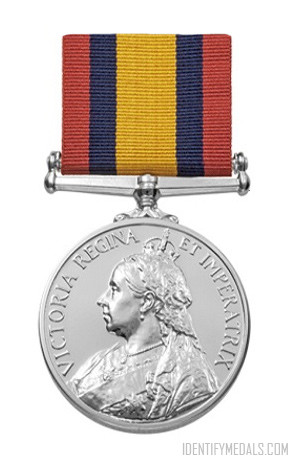
More Union of South Africa Medals

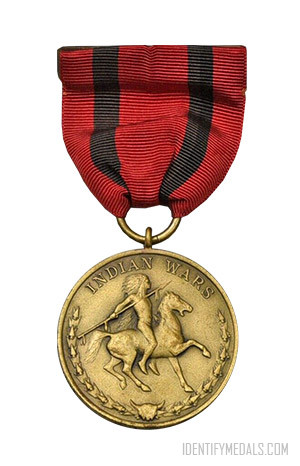
The Indian Wars Campaign Medal

The Indian Campaign Medal was a decoration established in 1907 for participants of the American Indian Wars against the Native Americans.

The Indian Campaign Medal is a distinguished decoration that was established through War Department General Orders 12 in 1907. This medal was bestowed retrospectively upon U.S. Army soldiers who had actively served in the American Indian Wars, engaging in conflicts with Native American tribes from 1865 to 1891. It recognizes the contributions and sacrifices made by those individuals during this significant period of American history.

Originally, the medal featured an all-red ribbon; however, in December 1917, two black stripes were added to avoid confusion with the ribbon of the French Legion of Honor, which bore a similar appearance.

In addition to the medal itself, campaign streamers were authorized for units that participated in Indian Wars as early as 1790. These streamers, bearing the same design as the service ribbon, are displayed as recognition of a unit’s campaign credit. The inscriptions on the streamers that are displayed on the organizational flag correspond to the unit’s lineage and honors. For the Army flag, there are 14 prescribed inscriptions for the campaign streamers, which can be found in AR 840-10 and AR 600-8-22.

The Indian Campaign Medal Design

The bronze medal measures 1 ¼ inches in diameter. The obverse side showcases a mounted Indian facing to the left, adorned with a war bonnet and holding a spear in his right hand. Positioned above the horseman are the words “Indian Wars,” while below, a buffalo skull is flanked by arrowheads arranged in a conventional manner to complete the circle.

On the reverse side, a trophy is depicted, featuring an eagle perched on a cannon supported by crossed flags and rifles. Additional elements of the trophy include an Indian shield, spear, and quiver of arrows, a Cuban machete, and a Sulu kriss. Below the trophy, the words “For Service” are inscribed. Surrounding the design is a circular border with the words “United States Army” in the upper half, while the lower half is adorned with thirteen stars.

The medal is suspended by a ring and is worn with a silk moire ribbon measuring 1 ⅜ inches in length and 1 ⅜ inches in width. The ribbon consists of a red stripe measuring ¼ inch, followed by a black stripe measuring 3/16 inch. Next is a red band measuring ½ inch, again followed by a black stripe measuring 3/16 inch, and finally, a red stripe measuring ¼ inch.