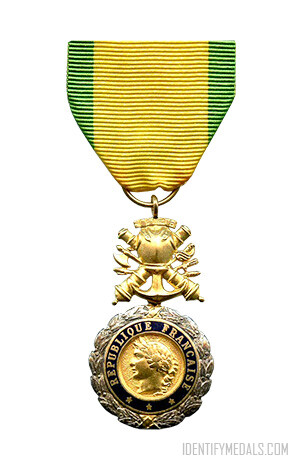
The Médaille Militaire (France)

The Médaille Militaire (or French Military Medal) was established in 1952 and awarded for meritorious service and acts of bravery.

The Médaille Militaire (or Military Medal) is a distinguished military decoration of France, awarded for acts of bravery and meritorious service in action against an enemy. Reserved for non-commissioned ranks, it stands as the third-highest honor in the French Republic, following the Legion of Honour, which serves both civil and military purposes, and the Order of Liberation, an order established solely for the Second World War. This makes the Médaille militaire the highest exclusively military decoration still awarded in France.

During World War I, over 230,000 Médaille militaire honors were conferred, a testament to the sacrifices made, with 1.4 million French soldiers killed and 3 million wounded. By comparison, the British Military Medal was awarded approximately 115,000 times, and the Victoria Cross, the UK’s highest military decoration, was awarded to 627 recipients.

Established in 1852 by Louis-Napoléon Bonaparte, then-President of France, the award may have drawn inspiration from a similar medal created by his father, Louis Bonaparte, King of Holland. Following World War I, the Médaille militaire was briefly awarded to soldiers wounded in combat, adding a unique dimension to its legacy.

The Médaille Militaire Design

The Médaille militaire is a distinguished silver medal adorned with a laurel wreath, measuring 28 mm (1.1 in) across, encircling a central gold medallion. The medallion displays the left-facing profile of Marianne, symbolizing the French Republic, although earlier versions from the Second Empire featured Emperor Napoleon III’s profile instead. Encircling the medallion is a blue enamel ring inscribed in gold with “RÉPUBLIQUE FRANÇAISE” (“FRENCH REPUBLIC”), accompanied by a small gold star at the bottom. The number of stars varies by era, with one star for the Fourth Republic version and three stars for the Fifth Republic; the Third Republic medal bore the year “1870,” while the Second Empire version included “LOUIS-NAPOLEON” instead of “RÉPUBLIQUE FRANÇAISE” and floral embellishments beside the star.

Originally, the medal was topped with a silver imperial eagle, while later versions are adorned with a design combining a breastplate over crossed cannons, an anchor, sabres, swords, and battle axes, with a looped ring for attaching the ribbon. The reverse of the medal remains consistent across all versions, displaying the inscription “VALEUR ET DISCIPLINE” (“VALOUR AND DISCIPLINE”) in relief, surrounded by the blue enamel ring.

The Médaille militaire ribbon is 37 mm (1.5 in) wide, yellow with green edges measuring 6 mm (0.24 in) each. This ribbon design was inspired by the Order of the Iron Crown, which the Médaille militaire succeeded in France.
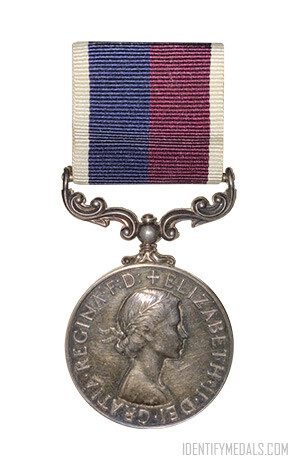
The Royal Air Force Long Service and Good Conduct Medal

The Royal Air Force Long Service and Good Conduct Medal was instituted by King George V in 1919 and awarded to officers and airmen.

The Royal Air Force Long Service and Good Conduct Medal is awarded to regular members of the Royal Air Force in recognition of their long service and exemplary conduct.

Instituted by King George V in 1919, following the establishment of the world’s first independent air force, the medal was initially awarded to non-commissioned officers and airmen. The criteria were later broadened to include officers who had served a minimum period in the ranks before being commissioned. Since 2016, all regular members of the RAF, including officers who have never served in the ranks, are eligible for this medal.

Originally, the medal was awarded after eighteen years of unblemished service, later reduced to fifteen years from December 1, 1977. An airman became eligible upon completing the requisite service period, provided there were no disqualifying offenses. Recommendations for the medal required a commanding officer’s endorsement and were awarded only to serving personnel. Before 1944, up to four years of service in the Royal Navy or British Army could count towards the RAF service requirement. During wartime or emergencies, the medal could be awarded for distinguished service without the usual time or conduct requirements.

The Royal Air Force Long Service and Good Conduct Medal Design

The silver medal is a 36-millimeter disk, with the obverse featuring the effigy of the reigning monarch.

The reverse displays the RAF eagle with outstretched wings, surmounted by the crown, and the inscription “FOR LONG SERVICE AND GOOD CONDUCT.” The clasp features an eagle with outstretched wings and a crown, with a silver rosette on the ribbon bar denoting the award in undress uniform.

The ribbon is 32 millimeters wide with distinct bands of white, dark blue, and crimson.

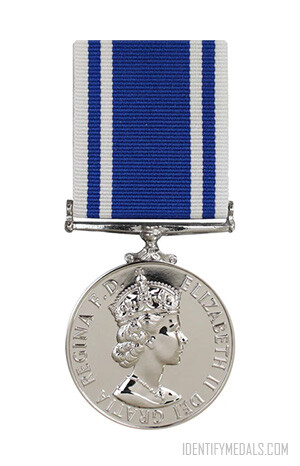
More British Long Service and Good Conduct Decorations

The British military has instituted several Long Service and Good Conduct Decorations, each honoring the dedication and exemplary service of its personnel across different branches. Here are some other ones from different time periods:

Find these medals online:

Right Now on eBay 
Clicking a link to eBay may result in a referral commission being paid if a purchase is made.
Loading...

The Campaign Service Medal (Portugal)

The Campaign Service Medal was established on 30 November 1916 to recognize wartime service and issued with a clasp for each campaign.

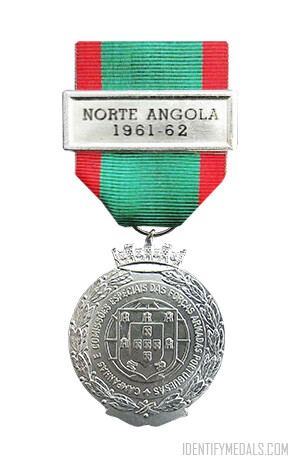
The Campaign Commemorative Medal (or in Portuguese) was created on November 30, 1916, by Decree No. 2870, alongside the War Cross, commemorates the campaigns of the Portuguese Armed Forces outside mainland Portugal, particularly in the context of Portugal’s entry into World War I.

The medal is awarded to military personnel who have served in a campaign situation (Art. 46 of the 2002 Regulations).

This medal functions as a general campaign medal, with each specific campaign indicated by a clasp on the ribbon, with the most recent campaign above the older ones. The following clasps have been approved:

  • South Angola, 1914-1915 (Decree No. 2941, 18/1/1917)
  • Mozambique, 1897-1898 (Decree No. 2965, 1/2/1917)
  • Timor, 1912-1913 (Decree No. …, 23/9/1918)
  • Mozambique, 1914-1918 (Decree No. 5060, 30/11/1918)
  • At Sea, 1916-1917-1918 (Decree No. 5086, 3/1/1919)
  • France, 1917-1918 (Decree No. 5400, 12/4/1919)
  • Lunda, 1911 (Decree No. …, 14/5/1919)
  • Congo, 1914-1915 (Decree No. …, 14/5/1919)
  • Maritime Defense, 1914-1918 (Decree No. 5799, 28/5/1919)
  • At Sea, 1916-1917-1918 + Maritime Defense, 1914-1918 (Decree No. 5983, 31/7/1919)
  • Occupation of Mozambique District, 1906-1913 (Decree No. 6546, 8/4/1920)
  • Cuanza-Sul, 1917-1918 (Decree No. …, 30/4/1920)
  • Cuanhama, 1915 (Decree No. 7433, 25/6/1920)
  • Beyond Cunene, 1904 (Decree No. 6731, 8/7/1920)
  • Satary, 1912 (Decree No. 7434, 18/7/1920)
  • Bissau, 1915 (Decree No. …, 10/9/1920)
  • CEL, Maritime Defense, 1916-1918 + Funchal, Maritime Defense, 1916-1918 + Ponta Delgada, Maritime Defense, 1916-1918 (Decree No. 1123, 4/3/1921)
  • Cape Verde, 1917-1918 (Decree No. 8613, 3/2/1923)
  • Dembos, 1918-1919 (Decree No. 8791, 1/5/1923)
  • Lunda, 1922-1923 (Decree No. …, 12/7/1924)
  • Lunda, 1920 (Decree No. 10442, 31/12/1924)
  • Congo, 1918 (Decree No. 15026, 13/1/1928)
  • Northern Angola (since 15/3/1961) (Decree No. 19683, 4/2/1963)
  • Guinea (since 1/3/1963) (Decree No. 20564, 7/5/1964)
  • Mozambique (since 1/8/1965) (Decree No. 21941, 6/4/1966)
  • Angola (since 23/12/1966) (Decree No. 22838, 21/8/1967) (extinguishes the legend Northern Angola)
  • Afghanistan 2008 (Decree No. …, …)
  • Somalia / Africa 2009-2013 (Anti-Piracy Operations) (Decree No. …, …)
  • Kosovo 2012-2013 (Decree No. …, …)
  • Central African Republic 2012-2019 (Civil War) (Decree No. …, …)

The Campaign Service Medal Design

The obverse features the national emblem surrounded by a circular strip with the inscription “CAMPANHAS E COMISSÕES ESPECIAIS DAS FORÇAS ARMADAS PORTUGUESAS” in capital Elzevir type letters, encircled by two laurel branches with fruits, tied at the top with a wide bow. Above this ensemble is a mural crown with five towers.

The reverse bears a disc featuring a National Flag at the top. Superimposed on the flag are the figures of an Army soldier (right), an Air Force soldier (center), and a Navy sailor (left), standing on a pedestal. The disc is surrounded by the inscription “ESTE REINO É OBRA DE SOLDADOS” (“This kingdom is the work of soldiers“), a quote from Joaquim Augusto Mouzinho de Albuquerque in a letter to Prince Royal D. Luís Filipe, in capital Elzevir type letters, within a circular strip, concluded at the bottom by a wide bow. Above this ensemble is a mural crown identical to the one on the obverse.

The War Cross (Portugal)

The War Cross is a military decoration established in 1916 and awarded to officers and soldiers who showed courage and determination.

The War Cross is a Portuguese military decoration established by Decree No. 2:870 of the President of the Republic of Portugal on November 30, 1916.

It was created to honor officers and soldiers who demonstrated bravery, determination, composure, and other commendable qualities in the face of the enemy during combat operations.

The Minister of War was designated to award this decoration, with the official statute and design issued on July 26, 1917. Originally, the War Cross had four classes and was awarded to Portuguese soldiers participating in World War I. Later, it was extended to those serving in battles in Portuguese colonies. On May 28, 1946, the statute and design of the decoration were revised, and further changes were made by the Minister of Defense on December 20, 1971.

The War Cross' Award Criteria

According to the 1917 statute, the War Cross could be awarded to Portuguese army officers and soldiers for acts of valor, determination, and composure on the battlefield. The 1946 decree expanded eligibility to include soldiers from allied armies, as well as Portuguese and foreign civilians.

The 1971 decree further specified that the decoration could be awarded to Portuguese soldiers and civilians, both domestic and foreign, who cooperated with the Portuguese army.

The Order 's Design

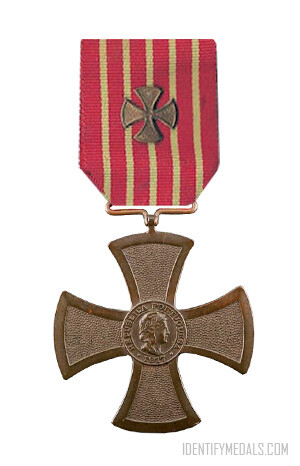
The War Cross badge is made of bronze and resembles a Maltese cross, formed by the intersection of five circles. The design is consistent across all classes.

The obverse features a central depiction of a woman’s head with a laurel wreath, symbolizing the Republic, surrounded by the inscription “REPÚBLICA PORTUGUESA 1917.” This design is inspired by the French medal of the same name.

Initially, the reverse displayed the coat of arms of Portugal. In the 1946 redesign, the obverse adopted the coat of arms, and the reverse featured the inscription “Cruz de Guerra” (War Cross). The 1971 redesign added two crossed swords and a laurel wreath to the reverse, while the obverse remained as per the 1946 design.

The medal is worn on a red ribbon with seven narrow green stripes. Symbols on the ribbon denote the class:

  • Class I: Golden cross with a laurel wreath
  • Class II: Golden cross
  • Class III: Silver cross
  • Class IV: No additional device

The Order of the Immaculate Conception of Vila Viçosa

The Order of the Immaculate Conception of Vila Viçosa is a dynastic order of knighthood of the House of Braganza established in 1818.

The Order of the Immaculate Conception of Vila Viçosa (or Ordem de Nossa Senhora da Conceição de Vila Viçosa in Portuguese), also known as the Order of Our Lady of Conception of Vila Viçosa, is a dynastic order of knighthood of the House of Braganza, the former Portuguese Royal Family.

The Order was established by King John VI of Portugal in Rio de Janeiro on 6 February 1818, the day of his acclamation, to honor those who protected the spiritual sovereignty of the Kingdom. The Blessed Virgin Mother, under the title of the Immaculate Conception and venerated in the Ducal Chapel of the Palace of Vila Viçosa, had been proclaimed “Queen” and Patroness of Portugal by King John IV in 1646. Following a six-year referendum, the people confirmed their belief in her Immaculate Conception and her role as the reigning Queen of Portugal. This led to the Kings of Portugal no longer wearing a crown.

The Order honored individuals who demonstrated loyalty to the Portuguese Royal House during the war against Bonapartist forces. Initially, it was awarded in four classes: Grand Cross, Commander, Knight, and Servant, with limitations on the number of recipients. Grand Crosses were typically awarded to high-ranking nobles, while lower grades were given to lesser nobles who had provided personal service to the King.

The current Grand Master of the Order is Duarte Pio, Duke of Braganza, Head of the House of Braganza.

The Order 's Organization

Primarily bestowed upon Portuguese nobles, the Order is occasionally given to Heads of State and Royal Houses. It has also been awarded to individuals who have significantly contributed to the expansion of the Cult of the Blessed Virgin Mary, the Message of Our Lady of Fátima, or the Roman Catholic Church. However, these recipients are not listed as active members of the Portuguese order and do not participate in its functions.

The Order is unofficially acknowledged by the Portuguese government and may be worn by Portuguese citizens, though not on military uniforms.

It is divided into four grades:

  • Grand Cross (GCNSC)
  • Commander (ComNSC)
  • Knight/Dame (CvNSC/DmNSC)
  • Serving Brother or Sister (SNSC)

The Order 's Design

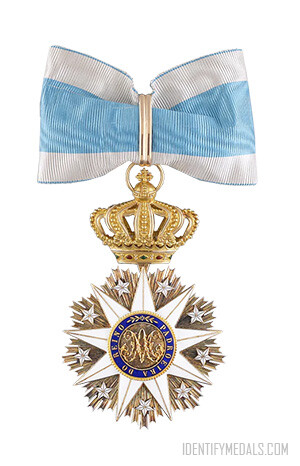
Designed by French painter Jean-Baptiste Debret, the insignia includes a star-shaped and crowned medallion with the monogram “AM” at its center. Surrounding the monogram is the inscription “Padroeira do Reino” (“Patroness of the Kingdom”).

The sash of the Order is light blue and white.

The Lint voor Wonden Award

The Lint voor Wonden Medal was instituted on 21 December 1920 as a retrospective award for Boer veteran officers and men.

The Lint voor Verwonding, or Wound Riband, is a military campaign decoration in South Africa. Established on December 21, 1920, it was a retrospective honor for Boer veteran officers and soldiers of the 1899–1902 Second Boer War who had sustained injuries in combat.

The Lint voor Wonden, also known as Lint voor Verwonding, was officially designated as Lint voor Verwonding Opgedaan Gedurende de Anglo-Boere Oorlog, 1899–1902 (Riband for Wounds Sustained During the Anglo-Boer War, 1899–1902). It was instituted through Government Notice no. 2307 on December 21, 1920, and published in the Union of South Africa Government Gazette on December 24, 1920.

This honor was retroactively conferred upon Boer veteran officers and soldiers who were wounded in action while serving in the combat forces of the South African Republic and the Orange Free State during the Second Boer War, spanning from October 11, 1899, to May 31, 1902.

The Lint voor Wonden Award Design

The Lint voor Wonden or Lint voor Verwonding was accompanied by a certificate upon issuance. The initial version of this certificate was simple and unadorned, filled out by hand with details such as the recipient’s rank, name, and the Republican Force they served with. Additionally, the recipient’s file number was included in the top left corner of the document.

In a later version, the certificate featured a full-color reproduction of the riband. While the Republican Force was pre-printed on this version, it did not include space for the recipient’s file number.

The riband itself measured 1+1⁄2 inches (38 millimeters).

The Medalje voor de Anglo-Boere Oorlog

The Medalje voor de Anglo-Boere Oorlog is a retrospective South African military campaign medal instituted on 21 December 1920.

The Medalje voor de Anglo-Boere Oorlog, a South African military campaign medal, was established on December 21, 1920. It was intended as a retrospective honor for Boer veteran officers and men who fought in the 1899–1902 Second Boer War.

Originally designated as the De Zuidafrikaanse Republiek- en Oranje Vrijstaat Oorlogsmedalje (the South African Republic and Orange Free State War Medal), and commonly known as the Anglo-Boere-Oorlog Medalje, it was instituted via Government Notice no. 2307 on December 21, 1920.

Published in the Union of South Africa Government Gazette on December 24, 1920, the medal was created to provide recognition to Boer veteran officers and men who served in the combat forces of the South African Republic and the Orange Free State during the Second Boer War from October 11, 1899, to May 31, 1902. These individuals remained in service of the Republican forces until May 31, 1902, without surrendering, taking parole, or swearing allegiance before that date.

The Medalje voor de Anglo-Boere Oorlog Design

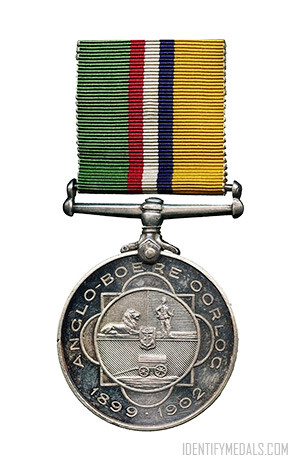
The medal is crafted in silver and measures 1+7⁄16 inches (37 millimeters) in diameter and 1⁄8 inch (3 millimeters) in thickness at the raised rim. It is attached to a fixed bar suspender using claws and a pin inserted through the upper edge. The recipient’s rank, initials, and surname are impressed in block capitals on the rim.

Both sides of the medal feature an ornamental frame encircled by the inscription “ANGLO-BOERE OORLOG” above and the years “1899 • 1902” below. One side displays the coat of arms of the South African Republic at the center of the frame, while the other side features the coat of arms of the Orange Free State. This design allows recipients to wear the medal to display the coat of arms of the state under which they served.

The ribbon, measuring 1+1⁄4 inches (32 millimeters) wide, combines the colors of the two former Republics.

The Dekoratie voor Trouwe Dienst

The Dekoratie voor Trouwe Dienst is a South African military decoration established in 1920 for Boer officers of the Second Boer War.

The Dekoratie voor Trouwe Dienst, abbreviated as DTD, is a military decoration in South Africa. Established in 1920, it serves as a retrospective honor for Boer officers who served during the Second Boer War from 1899 to 1902.

Neither the South African Republic (Transvaal) nor the Orange Free State had their own official honors systems. Hence, the decoration was created to provide Boer veteran officers, serving within the Union Defence Forces, with recognition parallel to their compatriots who fought on the British side during the conflict.

Throughout the Second Boer War, Republican commanders were directed to record the names of individuals within their ranks who displayed exceptional valor on the battlefield. These names were to be submitted to the War Council for verification and publication in the Staats Courant (Government Gazette) with the intention of awarding a medal post-war. However, as the Republican forces were defeated, the proposed medal never came to fruition.

It was later, in 1920, that King George V instituted the Dekoratie voor Trouwe Dienst, alongside the Medalje voor de Anglo-Boere Oorlog and the Lint voor Verwonding.

The Dekoratie voor Trouwe Dienst Design

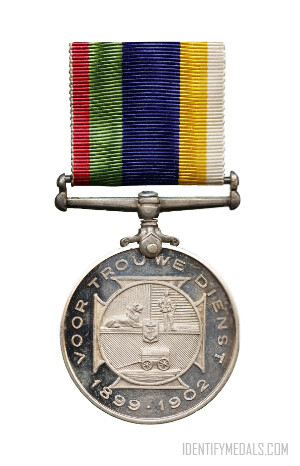
The decoration, crafted in silver, takes the form of a disk measuring 1+7⁄16 inches (37 millimeters) in diameter and 1⁄8 inch (3 millimeters) in thickness at the raised rim. It is attached to a fixed bar suspender using claws and a pin inserted through the upper edge of the medal. The recipient’s rank and name are impressed on the rim.

Both sides of the medal feature an encircled coat of arms on a cross pattée, surrounded by the inscription “VOOR TROUWE DIENST” above and the years “1899 • 1902” below. The coat of arms of the South African Republic is depicted on one side of the cross, while that of the Orange Free State is shown on the other. This design allows recipients to wear the medal to display the coat of arms of the state under which they served.

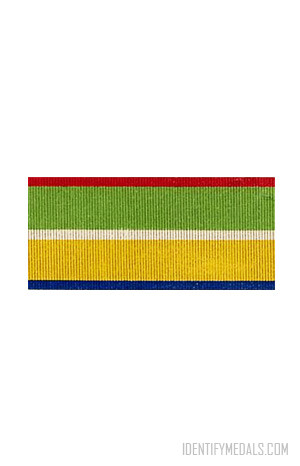
The ribbon measures 1+1⁄4 inches (32 millimeters) wide and combines the colors of the two former Republics. While officially designated as red, green, white, blue, and orange, the orange hue appears as yellow on the actual ribbons.

The WW1 Royal Tank Corps Cap Badge

The Royal Tank Corps Cap Badge is a First World War brass King’s crown cap badge for members of the Tank Corps.

The Royal Tank Corps Cap Badge is a First World War brass King’s crown cap badge for members of the Tank Corps.

The Royal Tank Regiment (RTR) is a division of the British Army specializing in armored warfare. Previously referred to as the Tank Corps and the Royal Tank Corps, it operates under the Royal Armoured Corps. On July 5, 2012, plans were announced to merge the operational regiments—1st Royal Tank Regiment (1RTR) and 2nd Royal Tank Regiment (2RTR)—into a unified regiment named The Royal Tank Regiment, effective 2014.

Tanks made their debut at the Battle of Flers-Courcelette in September 1916, part of the larger Battle of the Somme in World War I. During this period, the six tank companies were organized under the Heavy Section of the Machine Gun Corps (MGC).

The Royal Tank Corps Cap Badge Design

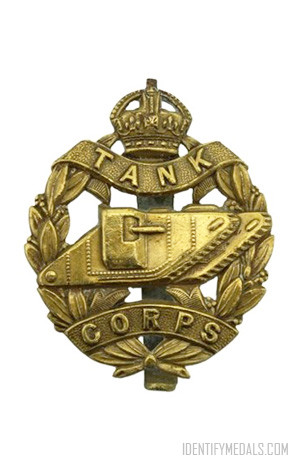
The cap badge measures 48 millimeters by 40 millimeters and is stuck in brass. The obverse features a Mark I tank and the words “Tank” and “Corps”. The reverse has a slider.

The Civil Merit Medal (Austria-Hungary)

The Civil Merit Medal (Austria-Hungary) is a medal established by Emperor Karl I in 1918 to recognize extraordinary service in war or peace.

The Civil Merit Medal is an Austro-Hungarian medal established by Emperor Karl I in 1918 to recognize extraordinary service in time of war or outstanding service in peace time by civil servants of all ranks or other civilians in support of the empire or the emperor. The medal could be awarded retroactively.

There are two classes of this award:

  • Gold Civil Merit Medal
  • Silver Civil Merit Medal

The Civil Merit Medal Design

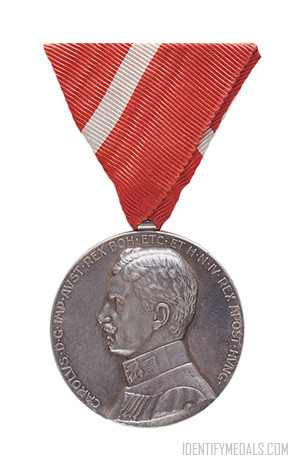
The medal is round with an attached wedge shaped suspension eye. It measures 42 mm in diameter and is struck in silver gilt bronze and gold gilt bronze.

The obverse features the image of Emperor Karl in a Field Marshal’s uniform with decorations facing to the viewers left. Surrounding the image is the inscription: “CAROLVS D G IMP AVST RX BOH ETC ET H N IV APOST HVNG”. The reverse is a laurel on the left and an oak bough on the right within which is the inscription “SIGNVM LAVDIS” (“A token of esteem”) in two lines.

The ribbon is red with a white center stripe and measures 38-40 mm wide.