The Medal for Civilian Prisoners, Deportees and Hostages

The Medal for Civilian Prisoners, Deportees and Hostages of the 1914-1918 Great War is a commemorative medal awarded to French civilians.

  • Time PeriodThe Great War
  • Institution: 14 March 1936
  • Country: France

The Medal for civilian prisoners, deportees and hostages of the 1914-1918 Great War (or Médaille des prisonniers civils, déportés et otages de la Grande Guerre 1914-1918) is a commemorative medal awarded to French civilians who were interned in camps during World War I after being deported from the German occupied French territories.

The medal was created by law on 14 March 1936, officially recognizing the sacrifices and patriotism of the French civilians that were forced to leave their homes to be detained or serve as hostages. The medal could also be awarded posthumously for civilian prisoners that were killed or that died of wounds product of their internment.

The Medal for civilian prisoners, deportees and hostages of the 1914-1918 Great War Design

The medal measures 32 mm in diameter, is circular and is struck from bronze.

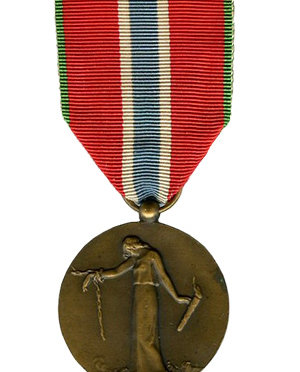
Its obverse shows a relief image of a woman walking slowly, with her head lowered and her right wrist chained. Her left hand drops a torch symbolizing the home she must abandon. The reverse bore the relief inscription “PRISONNIERS” “CIVILS” “DÉPORTÉS” “ET” “OTAGES” “DE LA” “GRANDE GUERRE” over two closed flowers and surrounded by the circular relief image of a chain along the medal’s circumference.
The Dardanelles Campaign Medal

The Dardanelles campaign medal is a French military medal awarded for participation in the Battle of the Dardanelles or Gallipoli campaign.

The Dardanelles campaign medal (or “Médaille commémorative des Dardanelles”  in French) is a French military medal awarded between 25 April 1915 and 9 January 1916 for participation in the Battle of the Dardanelles, also known as the Gallipoli campaign (which was held against the Central Powers by the Corps expéditionnaire d’Orient and supported by the Royal Navy and French Navy).

The Dardanelles campaign medal was awarded to military and civilian personnel and no minimum time of service is mentioned in the award statute.

The Dardanelles Campaign Medal Design

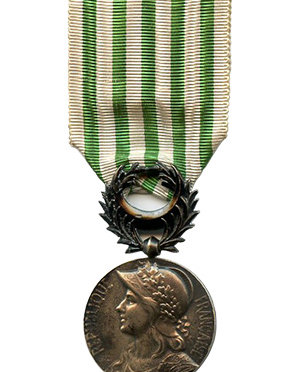
The Dardanelles campaign medal is circular, measures 30mm in diameter and is struck from bronze.

The obverse of the medal shows a relief image of the “warrior republic” in the form of the left profile of a helmeted woman’s bust. The relief inscription along the circumference “FRENCH REPUBLIC”. The reverse represents both the army and navy, with a relief image of an infantry rifle crossed with a naval anchor. There are two military banners and lances below, surmounted by the inscription “DARDANELLES” (or sometimes “HONNEUR ET PATRIE 1915 1918”).

The medal hung from a ribbon through a ring adorned by a 24mm in diameter bronze laurel wreath and half crescent. The silk moiré ribbon is 37mm wide and is white with four equidistant 3mm wide green stripes beginning 3mm from the edges. A gilt clasp with oriental ornamentation and the inscription “DARDANELLES” is sometimes worn on it, although it is a privately purchased item and unofficial.

The 1914–1918 Commemorative War Medal

The 1914–1918 Commemorative war medal was awarded to soldiers, sailors, and some civilians for service in World War I.

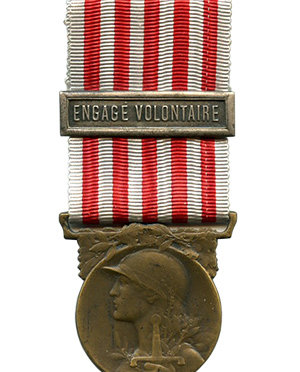
The 1914–1918 Commemorative war medal (or “Médaille commémorative de la guerre 1914–1918” in French) was awarded to soldiers and sailors for service in World War I, and to civilians who met certain requirements, for service between 2 August 1914 and November 11, 1918.

The 1914–1918 Commemorative War Medal Design

The design of the medals was decided by an open contest that had invited many engravers of the time. A total of 73 models were presented to the jury, and Pierre-Alexandre Morlon’s was ultimately adopted.

The medal is made of bronze, round and measures 33 mm in diameter. The obverse shows an effigy of a youthful Minerva in profile, wearing the helmet of 1914 which represents France. She is crowned with laurels and holds a sword in her left hand. On the reverse is the legend: GRANDE GUERRE 1914-1918, surrounded by the inscription REPUBLIQUE FRANÇAISE.

The Silver War Badge

The Silver War Badge was issued to service personnel honorably discharged due to wounds or sickness during World War I.

  • Time PeriodThe Great War
  • Year of Institution: September 1916
  • Country: Great Britain

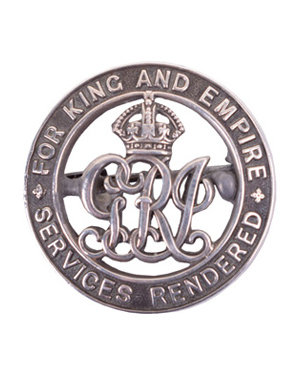
The Silver War Badge was issued to service personnel who had been honorably discharged due to wounds or sickness from military service in World War I in the United Kingdom and the British Empire. The badge is sometimes called the “Discharge Badge”, the “Wound Badge” or “Services Rendered Badge”.

This sterling silver lapel badge was intended to be worn on civilian clothes. As the war had developed, a substantial number of servicemen had been discharged with wounds that rendered them unfit for service, but were sometimes not obvious from their outward appearance. As they could be sometimes harassed by women who confronted men of fighting age they saw in public places without a military uniform by ostentatiously presenting them with white feathers as a suggestion of cowardice; this acted as a secondary causation for the introduction of this medal.

The Silver War Badge Awardees

Approximately 1,150,000 badges were issued, which had to be claimed and then approved.

Here are the names of five individuals who received the Silver War Badge:

  1. Harry Patch: Harry Patch was a British soldier who served in World War I and was known as the “Last Tommy” due to being one of the last surviving veterans of the war. He received the Silver War Badge after being wounded in combat.

  2. Wilfred Owen: Wilfred Owen is one of the most famous poets of World War I, known for his powerful anti-war poems. He received the Silver War Badge after suffering from shell shock and being declared unfit for further service.

  3. Siegfried Sassoon: Another renowned World War I poet, Siegfried Sassoon, received the Silver War Badge. He was initially awarded the Military Cross for his bravery but later protested against the continuation of the war and was sent to a hospital, where he received the badge.

  4. Vera Brittain: Vera Brittain was a British writer and feminist who served as a nurse during World War I. She received the Silver War Badge after being injured and returning to civilian life.

  5. Eric Liddell: Eric Liddell, the Scottish athlete and missionary depicted in the film “Chariots of Fire,” received the Silver War Badge. He served as a missionary in China during World War II and was interned in a Japanese civilian internment camp during the war, where he received the badge due to his internment.

The Silver War Badge Design

The badge bears the royal cipher of “GRI” (for Georgius Rex Imperator; George, King and Emperor) and around the rim “For King and Empire – Services Rendered”. 

The reverse side of the Silver War Badge is engraved with the recipient’s unique service number, rank, name, and regiment or unit. This information helps in identifying and confirming the recipient’s service, as each badge was uniquely numbered (Silver War Badges issued by the Empire’s dominion nations had their identification numbers on the reverse prefixed with the first letter of the issuing nation).

The Silver War Badge is typically suspended from a simple pin or brooch mechanism, allowing it to be worn on a civilian’s clothing.

The ribbon of the Silver War Badge is usually a solid, muted silver-gray color, complementing the badge’s purpose as a symbol of honor for those who had suffered wounds or illness in service to their country during World War I.

Find This Medal

Right Now on eBay 
Clicking a link to eBay may result in a referral commission being paid if a purchase is made.
Loading...

The Distinguished Service Order

The Distinguished Service Order (DSO) is a United Kingdom military decoration awarded for distinguished service during wartime.

The Distinguished Service Order (DSO) is one of the highest military decorations awarded by the United Kingdom, primarily for acts of meritorious or distinguished service by officers of the armed forces during wartime.

Instituted in 1886 by Queen Victoria and typically awarded to officers ranked major, the first DSOs awarded were dated 25 November 1886. Recipients of the order are officially known as Companions of the Distinguished Service Order and are entitled to use the post-nominal letters “DSO”.

The DSO is typically awarded to officers ranked Major and above for meritorious or distinguished service in combat or other significant contributions to military operations. It is often awarded for leadership, courage, and exceptional service under fire.

 Over the years, the DSO has been awarded to numerous officers for their outstanding leadership, gallantry, and devotion to duty in various conflicts, including World War I, World War II, and subsequent military operations. During the First World War, 8,981 DSOs were awarded, each award being announced in The London Gazette.

The Distinguished Service Order Precedence and Clasps

The DSO ranks below only the Victoria Cross (VC) and the George Cross (GC) in the order of precedence for British military decorations. It is considered a prestigious honor and is highly respected within the military community.

In addition to the standard DSO, there are several variants and clasps that may be awarded in recognition of additional acts of distinguished service or multiple awards.

The Distinguished Service Order Design

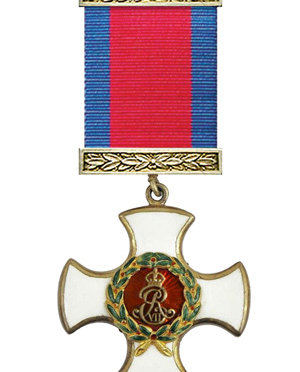
The DSO is a cross patonce, which means it has arms that narrow towards the center and end in a floriated decoration. It is crafted from silver gilt, enameled white and edged in gold.

In the obverse and the center, within a wreath of green laurel, is the imperial crown in gold upon a red enameled background. The reverse shows the royal cypher in gold upon a red enameled ground, within a wreath of laurel, enameled green. 

The ribbon of the DSO is crimson with narrow dark blue edges.

The Mercantile Marine War Medal

The Mercantile Marine War Medal was awarded by the Board of Trade of the United Kingdom to mariners of the Merchant Navy during WW1.

The Mercantile Marine War Medal was awarded by the Board of Trade of the United Kingdom to mariners of the Merchant Navy for one or more voyages through a war or danger zone during the course of the First World War.

During the period between 5 August 1914 and the armistice of 11 November 1918, 2,479 British merchant vessels and 675 British fishing vessels were lost as a result of enemy action. 14,287 and 434 lives were lost. Along with the medal, the next-of-kin of those men and women who lost their lives as a result of enemy action, were presented with a memorial plaque and memorial scroll.

The Mercantile Marine War Medal Design

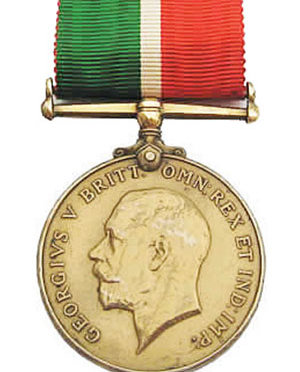
The design of the medal is a disk, struck in bronze and measuring 36 millimeters in diameter. The straight clasp non-swiveling suspender is attached to the medal with a single-toe claw mount and a pin.

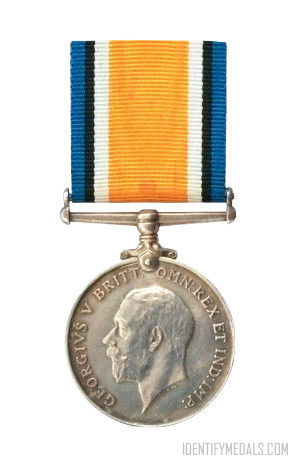
The obverse is (like the British War Medal) shows Sir Bertram Mackennal’s bareheaded effigy of King George V facing left, and the legend “GEORGIVS V BRITT: OMN: REX ET IND: IMP:”. The reverse shows a merchant steamship plowing through heavy seas, with an enemy submarine sinking on port side and a sailing ship in the background.

The text of the condolence slip which accompanied the plaque reads: “Buckingham Palace. I send you this Memorial on behalf of my people and myself. We all desire that the brave and loyal service of the Mercantile Marine in war-time shall be gratefully recorded, and that the names of those who gave their lives for us shall be handed down with honor from one generation to another. (Signed) George RI“.

The recipient’s name is impressed on the rim in sans-serif capital letters and the first given name is often in full.

The Territorial Force War Medal

The Territorial Force War Medal is a campaign medal awarded to members of the British Territorial Force and Nursing Service from WW1.

Time PeriodThe Great War

Year of Institution: April 1920
Country: Great Britain

The Territorial Force War Medal is a campaign medal awarded to members of the British Territorial Force and Territorial Force Nursing Service who volunteered or served overseas on or before 30 September 1914 and is the rarest of the five British Great War medals.

Those who received the award had to have been serving with the Force on 4 August 1914 or have completed four years service with the Force before 4 August 1914 and rejoined on or before 30 September 1914. They also had to not have qualified for the 1914 Star or 1914-15 Star.

A total of 33,944 Territorial Force War Medals were awarded, including 227 to nurses of the Territorial Force Nursing Service (the only women to receive the medal).

The Territorial Force War Medal Design

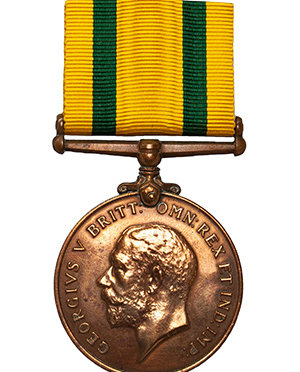
The medal is a circular, made of bronze and measures 36mm (1.42 in) in diameter.

The obverse shows a King George V bareheaded effigy, facing left, with the legend: “GEORGIVS V BRITT : OMN : REX ET IND : IMP :“. The reverse displays a wreath with the text “FOR / VOLUNTARY / SERVICE / OVERSEAS / 1914-19′ in the center, and ‘TERRITORIAL WAR MEDAL” around the upper outer edge.

The ribbon is yellow with two green stripes and measures 32 mm (1.25 in) wide. The suspender is a straight bar.

The Military Cross

The Military Cross (MC) is the third-level military decoration awarded for acts of exemplary gallantry during active operations.

The Military Cross (MC) is a prestigious third-level military decoration awarded in recognition of “an act or acts of exemplary gallantry during active operations against the enemy on land to all members, of any rank in Our Armed Forces.”

It is awarded to officers of the British Armed Forces and Commonwealth forces for acts of exemplary gallantry and leadership in combat and it’s one of the highest awards for bravery and valor that an officer can receive. The Military Cross is also open to officers of all ranks, including commissioned officers, non-commissioned officers, and warrant officers.

The award was created on 28 December 1914 for commissioned officers of the substantive rank of Captain or below and for Warrant Officers. In August 1916, Bars were awarded to the MC in recognition of the performance of further acts of gallantry meriting the award and recipients of a bar continue to use postnominal letters MC. In 1931 the award was extended to Majors and also to members of the Royal Air Force for actions on the ground.

Military Cross Awardees

During World War I, Acting Captain Francis Wallington of the Royal Field Artillery was the first person to be awarded the MC. Throughout its history, though, the Military Cross has been awarded in various conflicts, including both World Wars and more recent military operations. Recipients of the Military Cross are recognized for their exceptional bravery and leadership in the service of their country.

Here are five individuals who have received the Military Cross:

  1. Captain Charles Upham – He was a New Zealand soldier who received the Military Cross twice during World War II for his bravery and leadership in the Battle of Crete and the North African campaign.

  2. Captain Tom Moore – Captain Tom Moore, a British Army officer, was awarded the Military Cross during World War II for his outstanding courage and service in the Burma Campaign.

  3. Lieutenant Colonel Herbert “H” Jones – He received the Military Cross posthumously during the Falklands War in 1982 for his exceptional leadership and bravery during the Battle of Goose Green.

  4. Captain Guy Gibson – Captain Gibson was a British Royal Air Force pilot who was awarded the Military Cross for his leadership in the famous “Dambusters” raid during World War II.

  5. Major Charles Whittlesey – An American officer, Major Whittlesey was awarded the Military Cross for his valor during the Meuse-Argonne Offensive in World War I.

The Military Cross Design

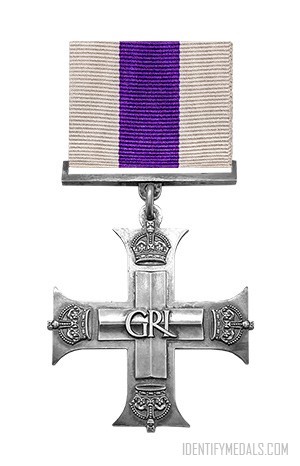
The Military Cross measures 46 mm max height and 44 mm max width, and shows an ornamental silver cross with straight arms terminating in broad finials.

The obverse is decorated with imperial crowns and the Royal Cypher in the center. The reverse is plain, but from 1938 the name of the recipient and year of issue has been engraved on the lower limb of the cross.

The ribbon for the Military Cross is 32 mm wide and shows three vertical moire stripes of white, purple, and white, all of the same width.

  • Military Cross Without Bar
  • Military Cross With One Bar
  • Military Cross With Two Bars
Find This Medal

Right Now on eBay 
Clicking a link to eBay may result in a referral commission being paid if a purchase is made.
Loading...

The 1914-15 Star

The 1914–15 Star is a British Empire campaign medal awarded to officers and men of British and Imperial forces during the First World War.

The 1914–15 Star is a British Empire campaign medal awarded to officers and men of British and Imperial forces who had served in any theatre of the First World War against the Central European Powers during 1914 and 1915.

Excluded from eligibility for the medal were the people who had already qualified for the award of the 1914 Star, the Africa General Service Medal, and the Khedive’s Sudan Medal of 1910.

The medal was never awarded singly, and recipients were also awarded the British War Medal and the Victory Medal.

The 1914-15 Star Awardees

Some 2,366,000 medals were awarded to soldiers and supporting personnel of British military forces and the various forces of the British Dominions, India, and the Colonies. The 1914-15 Star was awarded to a significant number of British and Imperial servicemen who served in specified theaters of World War I, particularly those who served in France and Belgium during the early years of the conflict.

While many received this medal, here are five notable individuals who received the 1914-15 Star:

  1. Winston Churchill: Winston Churchill, who would later become Prime Minister of the United Kingdom during World War II, served as First Lord of the Admiralty during World War I. He received the 1914-15 Star for his service in the Royal Navy during the conflict.

  2. T.E. Lawrence (Lawrence of Arabia): Thomas Edward Lawrence, better known as Lawrence of Arabia, served as a British liaison officer in the Arab Revolt against the Ottoman Empire during World War I. He received the 1914-15 Star for his contributions to this campaign.

  3. John McCrae: Lieutenant Colonel John McCrae was a Canadian physician and soldier best known for writing the famous war poem “In Flanders Fields.” He served as a medical officer and received the 1914-15 Star for his service on the Western Front.

  4. Douglas Haig: Field Marshal Douglas Haig was the commander of the British Expeditionary Force on the Western Front during World War I. He played a significant role in the early years of the conflict and received the 1914-15 Star for his leadership.

  5. Wilfred Owen: Wilfred Owen is a renowned English poet known for his powerful and poignant war poetry. He received the 1914-15 Star for his service as a soldier on the Western Front, an experience that profoundly influenced his poetry.

The 1914-15 Star Design

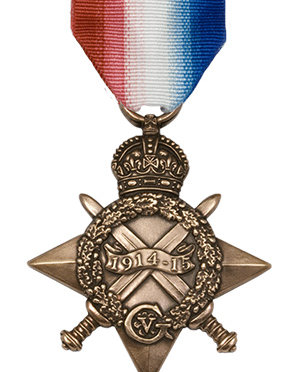
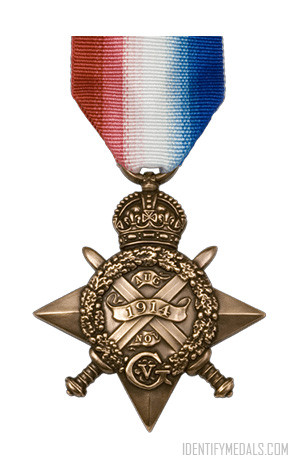
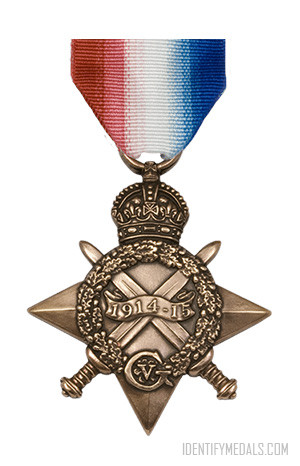
The medal is a four-pointed star of bright bronze, ensigned with a crown. It measures 50 millimeters high (62 millimeters including the ring suspension) and 44 millimeters wide.

The central motif of the 1914-15 Star’s obverse features a large, raised, and five-pointed star with the year “1914” on the top arm and “1915” on the bottom arm, separated by a horizontal scroll-like line. The years represent the time period for which the medal was awarded, covering the early years of World War I. There are also two crossed gladii (swords) with their blades upwards and overlaid by a wreath of oak leaves. In the center of the star, beneath the year “1915,” there is a royal cipher. The cipher typically consists of the reigning monarch’s initials.

The reverse is plain, unadorned, and is impressed with the recipient’s number, rank, and name.

Suspension: The medal is attached to a ribbon by a small ring at the top of the star. This ribbon is used to wear the medal, typically on the left breast. 

Ribbon: The ribbon for the 1914-15 Star is a watered ribbon with a central red stripe flanked by two narrow white stripes, which are themselves flanked by two narrow blue stripes. The red stripe represents the British Army, the blue stripes the Royal Navy, and the white stripes the French Republic. The combination of these colors symbolizes the cooperation between British and French forces in the theaters of operation for which the medal was awarded.

Related Medals

The ‘Pip’, ‘Squeak’, and ‘Wilfred’ medals were British military decorations established during World War I. The Pip Squeak was the 1914 Star, the Wilfred was the British War Medal, and the Pip was the Victory Medal. 

WW1 Medals and Awards: The 1914 Star

The 1914 Star

The 1914 Star, ‘Mons’ Star or ‘Pip’ is a British Empire campaign medal instituted in 1917 and presented for service during World War I.

Read More »

Find This Medal

Right Now on eBay 
Clicking a link to eBay may result in a referral commission being paid if a purchase is made.
Loading...

The Inter Allied Victory Medal (Great Britain)

The Victory Medal (also known as Inter-Allied Victory Medal) is a United Kingdom and British Empire First World War campaign medal.

The Victory Medal (also known as Inter-Allied Victory Medal) is a United Kingdom and British Empire First World War campaign medal. The medal was not awarded single, but to all those who received the 1914 Star or the 1914–15 Star, and to most of those who were awarded the British War Medal.

The three First World War medals, either one of the 1914 Star or the 1914-15 Star, the British War Medal and the Victory Medal, were collectively irreverently referred to as Pip, Squeak and Wilfred, after three comic strip characters, a dog, a penguin and a rabbit, which were popular in the immediate post-war era.

Recipients had to be mobilized for war service in the United Kingdom or the British Empire, in any service, and to have entered a theatre of war between 5 August 1914 and 11 November 1918 to qualify for the Victory Medal. Women qualified for service in nursing homes and other auxiliary forces. It was also awarded to members of the British Naval mission to Russia 1919 – 1920, and for mine clearance in the North Sea between 11 November 1918 and 30 November 1919.

The Victory Medal issued within the British Empire was a result of an international agreement at the Inter-allied Peace Conference preceding the Treaty of Versailles. Some 6,334,522+ medals were awarded in Great Britain.

The UK Inter-Allied Victory Medal Design

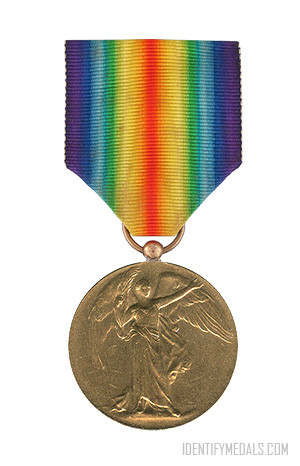
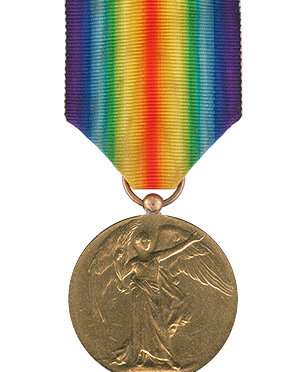
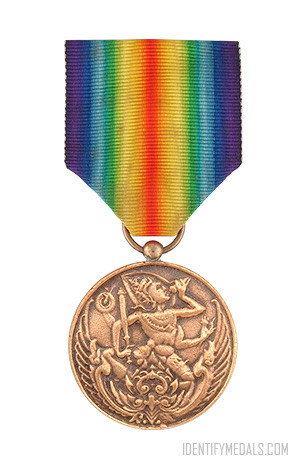
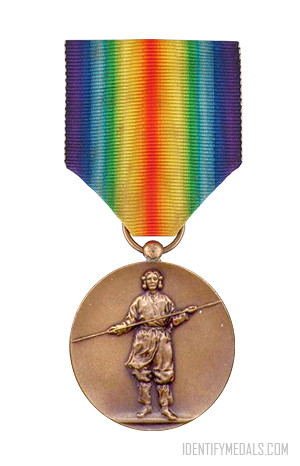
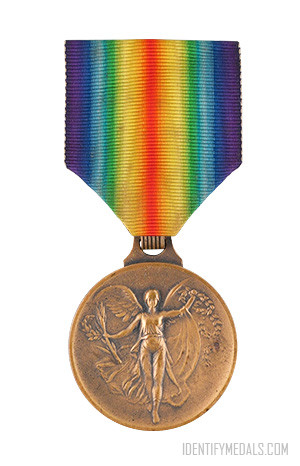
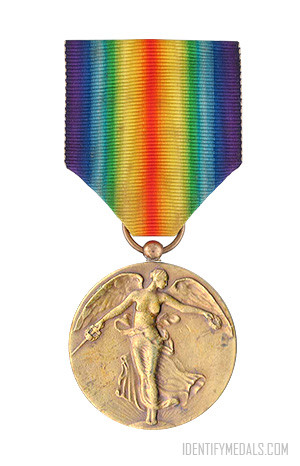
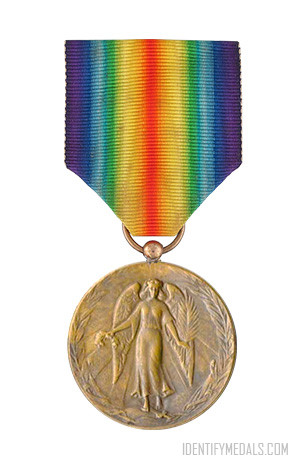
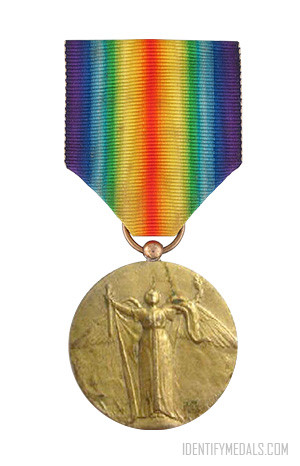
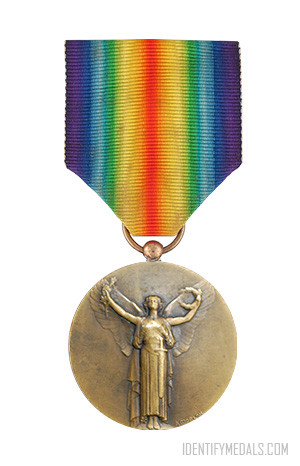
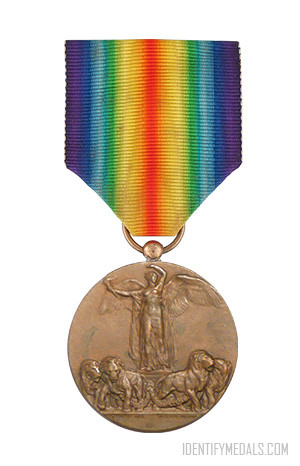
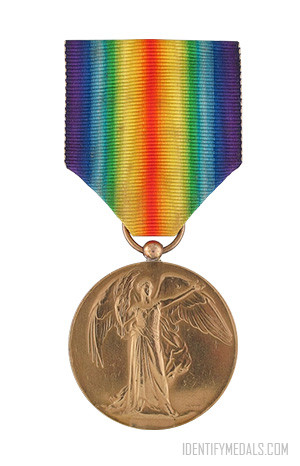
The Victory Medal measures 36 millimeters (1.4 in) in diameter and was designed by William McMillan. The design and ribbon was also adopted by Belgium, Brazil, Cuba, Czechoslovakia, France, Greece, Italy, Japan, Portugal, Romania, Siam, Union of South Africa and the USA. Each allied nation would design a ‘Victory Medal’ for award to their own nationals, all issues having certain common features, including a winged figure of victory on the obverse and the same ribbon.

The obverse of the medal shows the winged, full-length, full-front, figure of ‘Victory‘ with her left arm extended and holding a palm branch in her right hand. The reverse shows the words ‘THE GREAT / WAR FOR / CIVILISATION / 1914-1919‘  surrounded by a laurel wreath.

The 39 millimeters (1.5 in) wide watered ribbon has an iridescent color scheme, with the violet moving through to a central red stripe where both schemes meet. It attaches to the medal through a ring suspender. The recipient’s name, rank, service number and unit were impressed on the edge of the medal. The name of the regiment or corps was omitted on medals awarded to Army officers.

Related Medals

The ‘Pip’, ‘Squeak’, and ‘Wilfred’ medals were British military decorations established during World War I. The Pip Squeak was the 1914 Star, the Wilfred was the British War Medal, and the Pip was the Victory Medal. 

WW1 Medals and Awards: The 1914-15 Star

The 1914-15 Star

The 1914–15 Star is a British Empire campaign medal awarded to officers and men of British and Imperial forces during the First World War.

Read More »
WW1 Medals and Awards: The 1914 Star

The 1914 Star

The 1914 Star, ‘Mons’ Star or ‘Pip’ is a British Empire campaign medal instituted in 1917 and presented for service during World War I.

Read More »

All the Inter-Allied Victory Medal Variations

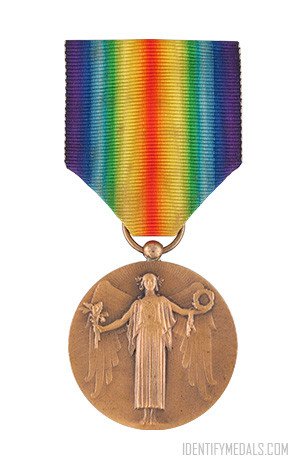
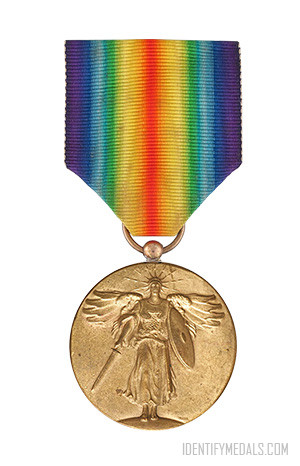
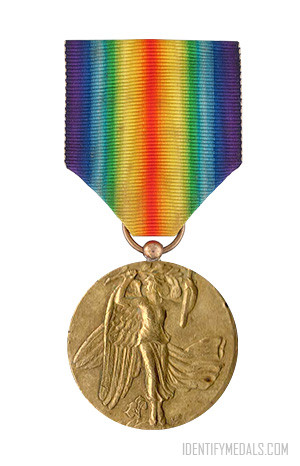
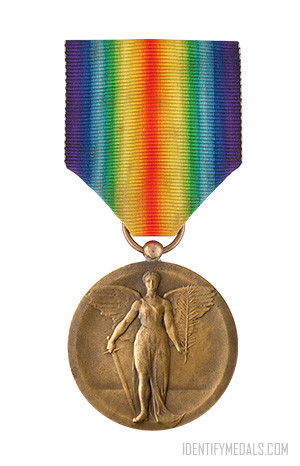
Although each country designed its own version of the Inter-Allied Victory Medal, all of them shared some common elements, such as a winged victory figure on the obverse and a similar ribbon with rainbow colors symbolizing unity among the Allies. Here are the versions for all countries:

Find an Inter-Allied Victory Medal Online

Right Now on eBay 
Clicking a link to eBay may result in a referral commission being paid if a purchase is made.
Loading...