The Royal Order of the Crown of Hawaiʻi

The Royal Order of the Crown of Hawaiʻi is an order instituted in 1848 and awarded to the head of states and supporters of the royal family.

The Royal Order of the Crown of Hawaiʻi is a Hawaiian order instituted in July 1848 and is awarded to the head of states/dynasties, as awards of merit to loyal supporters of the royal family and those who provide excellent services in the field of cultural achievement and education.

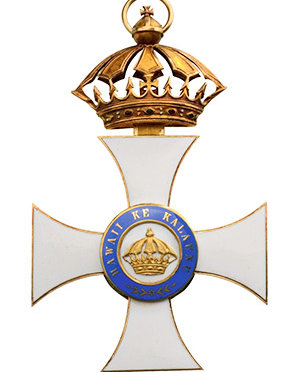
The Order was first introduced and created as the Order of the Crown and Cross by H.M. King Kamehameha III in July 1848, on the advice of his Minister of Foreign Affairs, Robert C. Wyllie. In 1883, H.M. King Kalākaua created the Order of the Crown and its statutes written with the motto “Hawaiʻi Ke Kalaunu”, and the ribbon colors of blue and white.

The Royal Order of the Crown of Hawaiʻi Design

The insignia of the Order bears the motto “Hawaiʻi Ke Kalaunu” on the obverse.

The ribbon of the order is blue and white. The revised 2016 order installs the ribbon colors of gold with purple edges; the shield has a purple ring surrounding the Hawaiian crown with the motto “Onipaʻa“.

The Royal Order of Kapiolani

The Royal Order of Kapiolani was instituted in 1880 by King Kalākaua to recognize services in the cause of humanity, science and the arts.

The Royal Order of Kapiolani is a Hawaiian order instituted in 1880 by King Kalākaua to recognize services in the cause of humanity, Science and the Arts, or for special services rendered to the Kingdom of Hawaiʻi.

The Order is named in honor of his ancestor High Chiefess Kapiʻolani the Great, an early exponent of Christianity in the Hawaiian Islands. It also honored his wife Queen Kapiʻolani, the namesake of the first Kapiʻolani.

The Royal Order of Kapiolani was awarded 177 times in all grades during Kalākaua’s reign, and three more times by his successor, Queen Liliʻuokalani. The last award of the Order took place on June 2, 1892.

The Order was awarded in six grades:

  • Grand Cross – 12 recipients
  • High Grand Officer – 15 recipients
  • Grand Officer – 20 recipients
  • Commander – 30 recipients
  • Officer – 50 recipients
  • Companion (Knight) – 60 recipients
  • Medal of Honor – no limit to recipients, 1st (silver) and 2nd-degree (bronze)

In 1893 the Order became obsolete.

The Royal Order of Kapiolani Design

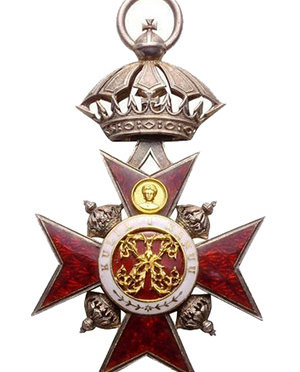
The insignia of the Grand Cross includes a badge, a breast star and grand cordon.

The badge comprises a red enamelled gold Maltese cross, surmounted by a gold Hawaiian crown. Between the arms of the cross are gold Hawaiian crowns in angles. A center disc of red and white enamel displays a gold double-K monogram, surrounded by a white enamel band, on which is inscribed “KULIA I KANUU” or  “Strive to Reach the Summit“. At end of the cross is a small, gold locket with the portrait of Queen Kapiʻolani. On the reverse is a single red disc, with the motto “KULIA”.

The star of the Grand Cross of Order is an octagonal silver star, on which is superimposed the badge without the surmounted crown.

The grand cordon is yellow, bordered by narrow stripes of the colors the Hawaiian flag: white, red and dark-blue. The badge is fastened to the sash’s bow and rests on the hip.

For High Grand Officers, the badge is not worn on a sash but on a neck ribbon of alternating yellow and red strips. Grand Officers wear only the breast star. The Commander wears only the sash the crowns between the arms of the cross on the badge are silver, not gold. The Officer and Companion cross use a smaller badge. The Medals of Honor lack the crowns between the arms of the cross and the badge’s crown surmounting the cross. The medal of the 1st-degree is made of silver, and the 2nd-degree of bronze.

The Royal Order of Kalākaua I

The Royal Order of Kalākaua I is a Hawaiian order instituted in 1874 by King Kalākaua I to commemorate his accession to the throne.

The Royal Order of Kalākaua I is a Hawaiian order instituted on 28 September 1874 by King Kalākaua I to commemorate his accession to the throne of the Kingdom of Hawaiʻi on 12 February 1874.

This order was granted to both native Hawaiians and foreigners for superlative service to the monarch and to the kingdom. It was last conferred by Queen Liliʻuokalani on 1 August 1892.

In the duration of the Order, it was granted 239 times by King Kalākaua I, and 15 times by his sister Queen Liliʻuokalani. In 1893, the Order became abeyant.

The Order was awarded in four grades:

  • The Royal Order of Kalakaua I Grand Cross.gif Knights Grand Cross with Collar (only given for head of states)
  • The Royal Order of Kalakaua I Grand Cross.gif Knights Grand Cross – 12 individuals
  • Order of Kalakaua Companion.gif Grand Officer – 20 individuals
  • Order of Kalakaua Companion.gif Commander – 50 individuals
  • Order of Kalakaua Companion.gif Companion – 60 individuals

The Royal Order of Kalākaua I Design

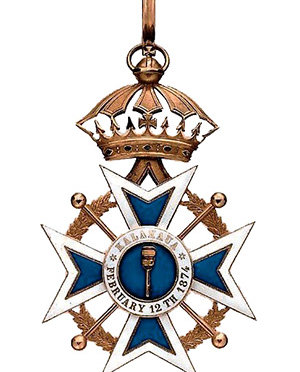
The badge of the order is a Maltese cross in gold or silver.

The obverse is decorated with Prussian blue and white enamel, surmounted by a Hawaiian crown. The arms of the cross have a border strip of white enamel, with a blue centre separated by a thin band of gold or silver. There is a gold or silver wreath and a pūloʻuloʻu (kapu sticks – ball and stick insignia) between the arms connecting them. On the cross is a blue and white enamel locket. On a white stripe, the inscription KALAKAUA FEBRUARY 12 1874 circles a kāhili (feathered standard of royalty) on a background of blue.

The reverse comprises a locket of blue and white. At the centre of the locket is the date 1874, surrounded by the inscription KEOLA (eternal life) – both in gold.

The insignia for the Knights Grand Cross with Collar is a collar chain composed of alternating monograms “K.I.K.” and kahili of red and yellow enamel and a breast star. The breast star is identical to that of the Knights Grands Cross – an octagonal silver star to which is affixed the badge of Order without the crown and struck in gold. The sash is deep blue. The badge of the Order is fastened to a bow on the sash on a bow, resting on the left hip.

The insignia of Grand Officer Star is only a breast star. The wreath of Grand Officer Star is silver. The insignia of the Commander Cross is identical to that of the Grand Officer Star, except it is worn on a neck ribbon of five alternating white and blue stripes. The Companion Cross comprises a breast badge suspended by a ribbon of white and blue stripes.

The Royal Order of Kamehameha I

The Order of Kamehameha I is an order of knighthood established by Kamehameha V in 1865 to promote and defend the sovereignty of Hawaiʻi.

The Order of Kamehameha I is an order of knighthood established by Kamehameha V in 1865 to promote and defend the sovereignty of the Kingdom of Hawaiʻi.

After Lot Kapuāiwa took the throne as King Kamehameha V, he established the Order of Kamehameha I by special decree on April 11, 1865. The name is in recognition of his grandfather Kamehameha I, who was the founder of the Kingdom of Hawaii and the House of Kamehameha. The Order was awarded 57 times by King Kamehameha V, and 82 times by King Kalākaua.

Both native Hawaiians and foreigners could be appointed to the Order. Its purpose ise to promote and defend the sovereignty of the Kingdom of Hawaii.

The grades of the Order were determined by the number of living members in each of them. At any given time there could only be:

  • Royal Order of Kamehameha I Grand Cross.gif Knight Grand Cross with Collar (CGCOK) – Only for heads of state.
  • Royal Order of Kamehameha I Grand Cross.gif Knight Grand Cross (KGCOK) – 10 individuals.
  • Royal Order of Kamehameha I Commander and Companion.gif Knights Commander (KCOK) – 30 individuals.
  • Royal Order of Kamehameha I Commander and Companion.gif Knights Companion (KOK) – 50 individuals.

The Royal Order of Kamehameha I Design

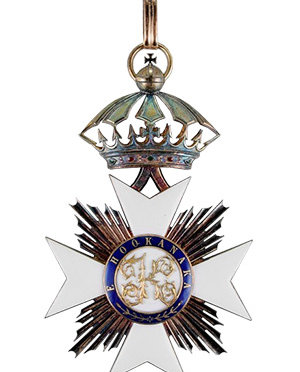
The badge/medal is a Maltese cross in gold or silver with white enamel, surmounted by the Hawaiian crown. Rays of gold or silver are placed between the arms of the cross.

A white-enamelled disc imposed upon the cross bears an elaborate golden “K” at its centre; the blue-enamelled band surrounding the disc is inscribed “KAMEHAMEHA I” in golden letters, together with two golden laurel branches. A comparable disc on the reverse of the badge is inscribed “E HOOKANAKA” (“Order of Fraternity”, in Hawaiian).

Members of this grade wore the badge of the Order attached to a golden collar, the decorative links of which alternated the monogram “K”, surrounded by a green-enamelled laurel crown, with the royal crown and a small enamelled badge of the Order. The breast star was identical to that worn by Knights Grands Cross, suspended from a broad red sash edged by a narrow white stripe on each side.

The sash is worn over the bearer’s right shoulder, its bow (from which the badge, sometimes decorated with brilliants, depended) resting on his left hip. The breast star was an octagonal silver star bearing the uncrowned badge of Order in gold and enamels.

Knights Commander wore the badge of the Order dependent from a red neck ribbon, which was edged in white and bore three white stripes. Knights of the Order wore the badge on the left breast, suspended from a ribbon of red and white stripes.

The Order Of The Imperial Dragon or Bao Xing Merit Medal

The Order Of The Imperial Dragon or Bao Xing Merit Medal is a military award given to British and French government officials and civilians.

The Order Of The Imperial Dragon, also known as the Bao Xing Merit Medal is a Chinese military award given to British and French government officials and civilians. The medal was authorized by Imperial Decree in 1862, designed in the Western Style and awarded to those who contributed to the defeat of the Taiping Rebellion between 1850 to 1864.

The Bao Xing Merit Medal was influential in the design and creation of the later instituted Order of the Double Dragon in 1882.

The Bao Xing Merit Medal Design

The medal is struck in 24ct gold and it has a unique high handcrafted quality with exquisite attention to detail. All figures and characters are hand-carved from a single gold disc.

For the First Class, the obverse depicts two dragons pursuing a central red cabochon. The outer border is a stylized “thunder scroll” design. The reverse features the Chinese characters for Da Qing Yu Xi (Great Qing Imperially Awarded First Class Award).

The medal measures 381. mm (w) by 54 mm (including the suspension) and weights 46.6 grams. It was awarded with a tassel consisting of a green braided knot (Yun Tou or Cloud Head knot) with parallel blue and red tassels, upper suspension composed of a secondary braided blue Yun Tou.

The Wu Pei Fu Qualification Award For Public Affairs

The Wu Pei Fu Qualification Award For Public Affairs is a Chinese medal established c. 1912 and awarded for “virtuous behavior”.

The Wu Pei Fu Qualification Award For Public Affairs is a Chinese medal established c. 1912 and awarded for “virtuous behavior”.

Wu Peifu was an important figure and warlord who played a significant role in the Republic of China (in the struggles between the warlords who dominated Republican China) between 1916 and 1927.

This medal was issued in the region of Hebei during the War Lords Era (1912-1928).

The Wu Pei Fu Qualification Award For Public Affairs Design

The medal is a three-piece construction, struck in silver and decorated with enamels. It measures 50.7 by 51 millimeters.

The obverse features Chinese characters, which changes depending on what the medal was awarded for.

The Anzac Commemorative Medal

The Anzac Commemorative Medallion was instituted in 1967 and awarded to surviving members of the Australian forces who served on the Gallipoli Peninsula, or in direct support of the operations from close offshore. The time frame is any time during the period from the first Anzac Day in April 1915 to the date of final evacuation in January 1916.

Next of kin, or other entitled persons, are entitled to receive the medallion on behalf of their relatives if the medallion has not been issued.

The Anzac Commemorative Medallion Design

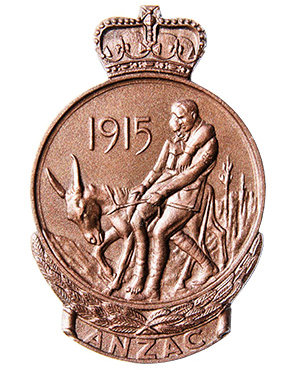
The medal is cast in bronze and measures approximately 75 millimeters high and 50 millimeters wide.

The obverse depicts Simpson and his donkey carrying a wounded soldier to safety. It is bordered on the lower half by a laurel wreath above the word ANZAC. The reverse shows a map in relief of Australia and New Zealand superimposed by the Southern Cross. The lower half is bordered by New Zealand fern leaves.

Surviving members were also issued with a lapel badge in the form of a small replica of the medallion to recognise their Gallipoli service.

The name and initials of the recipient is engraved on the reverse. The medallion is issued in a presentation box.

The Gold Medal of Military Valor

Institution: 21 May 1793
Country: Italy

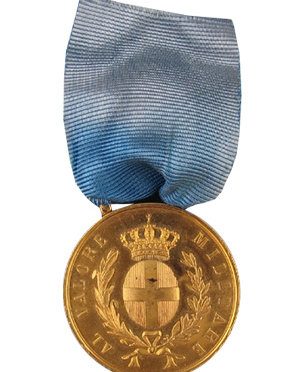
The Gold Medal of Military Valour (or Medaglia d’oro al valor militare in Italian) is a medal established on 21 May 1793 by King Victor Amadeus III of Sardinia for deeds of outstanding gallantry in war by junior officers and soldiers.

On 14 August 1815, Victor Emmanuel I of Sardinia replaced it with the Military Order of Savoy. On 26 March 1833, Charles Albert of Sardinia revived it and added to it the Silver and Bronze medals.

With the proclamation of the Republic on 2 June 1946, the coat of arms of the House of Savoy was replaced with the emblem of the Italian Republic. 

For actions performed by individuals during World War I, the Gold Medal was awarded some 368 times, as well as 37 times to military units, and once to the Unknown Soldier. Only four of the individual awards went to foreigners, one of these being Czar Nicholas II of Russia. The other three were for acts of gallantry in which the recipient was killed in action or died from his injuries (the Frenchmen John O’Byrne and Roland Morillot, and the American Coleman deWitt). 

During World War II the medal was awarded to soldiers of the Royal Italian Army; after these forces were reorganized following the Armistice with Italy in 1943, it was awarded to members of the Allies-supporting Italian Co-Belligerent forces. The Axis-affiliated Italian Social Republic created another design of the medal, with a Gladius replacing the arms of Savoy, for members of the Esercito Nazionale Repubblicano from 1943 to 1945. This version of the award was not given recognition by the postwar Italian government.

The Gold Medal for Military Valor is still awarded by the Italian state, and it, along with Silver and Bronze medals for Military Valor as well as the War Cross of Military Valor (which can only be awarded in time of war) was established by the Royal Decree of 4 November 1932.

The Gold Medal of Military Valor Design

The obverse of the medal displays the coat of arms of Savoy with laurel branches, the royal crown, and the words “For Military Valor“. On the reverse are two laurel branches enclosing the name of the decorated soldier, and the place and date of the action.

The World War I Gold Medal Commemorative

The World War I Gold Medal Commemorative Medal was instituted by the President of the Republic of Italy on the 50th Anniversary of Victory.

The World War I Gold Medal Commemorative Medal (or Medaglia-ricordo in oro della I Guerra Mondiale in Italian) was an award instituted by the President of the Republic of Italy on the 50th Anniversary of Victory.

The medal was awarded in 1968 to all veterans of World War I (or of previous conflicts) who served in arms for at least 6 months before 2.8.1920.

The World War I Gold Medal Commemorative Design

The medal is small, round, and struck in solid gold. It weighs 5 grams and has a mirror finish.

The obverse bears a small star and an “Adrian” helmet over a laurel and oak wreath. On the reverse is the inscription “50° ANNIVERSARIO DELLA VITTORIA 1918 1968” (“50th Anniversary of the Victory – 1918 1968).

The ribbon is a reduced-size one, with twelve narrow vertical stripes in green-white-red repeated four times.

The Commemorative East Balkan Expeditionary Corps Cross

The Orient Balkan Cross was an unofficial medal awarded to the expeditionary corps that fought in the Balkans from 1914 to 1919.

The Orient Balkan Cross (or Croce Commemorativa del Corpo di Spedizione dell’Oriente Balcanico in Italian) was an unofficial medal awarded to the expeditionary corps that had taken part in war operations in the Balkans (Albania and Macedonia) from 1914 to 1919, during the First World War.

The medal was advertised on nr. 8 of the Domenica del Corriere on 23 March 1924, with an announcement that specified that the first specimens would be offered in homage to the king, to generals Diaz and Cadorna and to all general officers who had had a command in Albania and Macedonia. The cross was put up for sale, equipped with a special ribbon, for the benefit of the “National Union of Veterans East Balkan”, Turin, via S. Tomaso, 6.

The Commemorative East Balkan Expeditionary Corps Cross Design

The medal was designed by the painter Adolfo Caly, and advertised in the popular magazine “Domenica del Corriere” and coined by the Fassino firm of Turin. The shape is a Greek cross and it was struck in gilded bronze. The ends of the arms are crenelated and intersected by a ribbon with eyelets and corners.

The obverse has a central medallion with golden beads and a representation of a mosque with a minaret in and orange enameled background. The arms of the cross have blue enamel and black and white borders around the cross arms.

The reverse has no enamels and bears the inscription “ORIENTE BALCANICO / 1914 = 1919 / ALBANIA = MACEDONIA”. Some versions have a trademark on the lower arm.

The ribbon has a black central stripe measuring one-third of the overall width, flanked on both sides by five narrow stripes in red-orange-blue-orange-red.