The Italian Army Commemorative Crosses 1915-1018

The Italian Army Crosses 1915-1018 were a series of crosses awarded to specific members of the Army for their participation in WW1.

The Italian Army Crosses 1915-1018 were awarded after the war to members of specific Italian Armies for their participation in the Great War. The crosses were instituted in 1924 and awarded to various Italian units.

While awarded by the army, recipients often had to purchase the medal itself. Some variations in the crosses exist, but the basic designs remained fairly consistent. The different cross designs were created by different makers and feature various designs.

The Italian Army Crosses 1915-1018 Design

The medals are shaped like a cross and measure approximately 33 mm wide by 44.5 mm high. They were struck in silver or bronze gilt. Some were decorated with enamels.

The Medal for Mothers and Widows of the Fallen

Time Period: The Great War, Second World War

Institution: 24 May 1919
Country: Italy

The Medal for Mothers and Widows of the Fallen (or Medaglia di Madri e Vedove Dei Caduti in Italian) is an Italian medal instituted on 24 May 1919 (with Royal decree no. 800 of 1919) as a token of national gratitude to Italian mothers who had lost one or more children during the First World War.

Both legitimate and natural mothers who had recognized the fallen son were entitled to the badge, but only if it was indubitable that the soldier had fallen in combat or as a result of injuries sustained in combat. It was granted by the Ministry of War or the Navy, depending on whether the fallen soldier was part of the land or sea army.

The medal was established by the Kingdom of Italy and reconfirmed by the Italian Republic for the Second World War. A similar recognition was established in 1887 for the mothers of the fallen of the Battle of Dogali. The recognition was also extended to the African Campaign, the Spanish Campaign, thje Expedition to Albania, The 1940/43 War, and WW2.

The Medal for Mothers and Widows of the Fallen Design

The medal is circular and could be cast in bronze of the guns taken from the enemy. It was designed by G. Prini and measures 32 mm in diameter.

The obverse shows an allegorical design of a woman offering a laurel wreath to a dying soldier while another woman stands in the background. The reverse is bears the inscription “IL FIGLI / CHE TI NACQVE / DAL DOLORE / TI RINASCE “O BEATA” / NELLA GLORIA / E IL VIVO EROE / “PIENA DI GRAZIA ” / E TECO” (“The son which was born out of you in pain, is reborn to you, o blessed one, full of glory and he lives as a hero. With gratitude“).

There are several variants produced by private industries. Some of these show, under the left arm of the fallen, the name of the model maker “G. PRINI – MOD.” and the name of the manufacturer: Sacchini, S. Johnson or Lorioli and Castelli.

The ribbon is dark grey, with thin green, white, and red stripes in the center and measures 37 mm wide. A ministerial circular dated March 23, 1921 established that each fallen child was represented by an equivalent number of bronze crowns on the ribbon.

The Medal for the War Volunteer 1915-1918

The Medal for the War Volunteer 1915-1918 is an Italian medal instituted in 1924 and awarded to Italian armed volunteers of the Great War.

The Medal for the War Volunteer 1915-1918 (or Medaglia di Volontario di Guerra 1915-1918 in Italian) is an Italian medal instituted on 24 May 1924 and awarded to those who entered the Italian armed volunteer forces during WW1. It was established with Royal Decree n. 1163 by the Italian government.

The medal was awarded to those who had participated in the war operations in a way worthy of commendation and who gave proof of belonging to one of the following categories:

  1. Former reformers who spontaneously enlisted as officers, non-commissioned officers or troop soldiers or of the CRE at least one month before the date of the decree that would have called them for a review visit;
  2. Soldiers who, declared unsuitable for war service due to injuries sustained in the war or due to infirmities, spontaneously returned to be part of the operating army or navy;
  3. Second and third category military personnel who had spontaneously taken up military service as officers, non-commissioned officers or militaries of the troop or the CRE at least four months before the date of the decree calling their class or category and actually were incorporated into the operating army or navy before the said recall;
  4. Spontaneously enrolled at least four months before being called to visit before the conscript councils and actually left to be incorporated into the army or navy operating before the date on which they would normally have passed the visit;
  5. Exempted by law from military service who, at least five months before November 4, 1918, spontaneously renounced the dispensation to be incorporated into the operating army or navy;

The fallen, the wounded in combat and those decorated with the military Order of Savoy or the value for war actions carried out during the voluntary service, were entitled to the medal even if the service itself had started within a time limit lower than those indicated above. With art. 4 of the Royal Decree n. 1529 of 1925 merit was also granted to maritime members who had sailed on merchant steamers without having military service obligations and who had obtained the War Merit Cross or were in the conditions to obtain it. With RD n. 2127 of 1925, the eligibility criteria were regulated in a more detailed manner and the exclusion from the granting of those who, despite possessing the qualifications, were deemed, in the opinion of the competent issuing authorities, unworthy to boast of them for having in the meantime he received criminal convictions or for serious moral reasons.

The same medal was later issued for the Second World War and for a number of colonial wars. It was abolished in 2010.

The Medal for the War Volunteer 1915-1918 Design

The medal is circular. The obverse depicts the crowned head of “Italia” and the inscription “PER L’ITALIA” (or “For Italy“). The reverse bears a naked warrior bearing a shield and a veiled woman behind him. Around the rim of the medal is the inscription “VOLONTARIO DI GVERRA MCMXV-MCMXVIII” (“War volunteer” and the dates of the war).

The WW2 version of the medal has the dates 1936-1939 in Roman figures in the obverse, and the letters A.O.I (Africa Orientale Italiana, Italian East Africa) on the reverse. Many medals had no dates inscribed on them.

The ribbon is plain red.

The 1915-1918 War Medal

The War Medal 1915-1918 is an Italian medal instituted in 1920 and awarded for participation in WW1. It replaced a previous ribbon bar.

The War Medal 1915-1918 (or Commemorative Medal for the Italo-Austrian War 1915–1918) is an Italian medal instituted on 29 July 1920 and awarded for participation in WW1 – or service during and immediately after World War I in the national territory of Italy, in the Dodecanese, in Albania, Syria, and Palestine.

The medal replaced a previous ribbon bar that had been introduced on 21 May 1916 and was awarded for one year of service in a war zone. When the medal replaced the ribbon bar, a number of new bars were attached to the ribbon according to the recipient’s service. The bars were covered in laurel leaves and could be:

  • 1915
  • 1916
  • 1917
  • 1918
  • Albania 1919
  • Albania 1920

Approximately 1,800,000 War Medal 1915-1918 medals were awarded.

The War Medal 1915-1918 Design

The medal is circular and struck in bronze.

The obverse shows the helmeted head of King Victor Emanuel II. Around the rim is the inscription “GVERRA PER L’VNITA D’ITALIA 1915 1918” (“War for the Unity of Italy“). The reverse bears the figure of an upright Victory standing on shields born by two soldiers. Around the rim is the inscription “CONIATA ‘NEL BRONZO NEMICO” (“Made from enemy bronze“).

The ribbon has alternating thin stripes of green, white, and red.

The Volunteer Cross for War 1918-1921

Time Period: Interwar Period, WW1

Year of Institution: 15 June 1939
Country: Poland

The Volunteer Cross for War and the Volunteer Medal for War (or Krzyż i Medal Ochotniczy za Wojnę in Polish) were military decorations from Poland introduced just before the start of World War II and later awarded by the Polish government in exile.

The Volunteer Cross for the War could be awarded to volunteers serving in the years 1918-1921, if they met one of the following criteria:

  • Fallen or wounded on the battlefield,
  • Decorated with the Virtuti Militari Cross or the Cross of Valor,
  • They actively served 3 months, including at least 2 months in units fighting at the front or 6 months as instructors in military schools of weapons and school camps.

The Cross and the Volunteer Medal for War were introduced by an act of the Sejm on 15 June 1939. It was to be awarded to people who volunteered for duty in the years 1918 to 1921 and helped to strengthen the independence of the Polish Republic, covering mainly the Polish-Ukrainian War and Polish-Soviet war.

Because of the German invasion of Poland in 1939 and the outbreak of World War II no decorations were awarded at the time. It was only after 1945 that the Polish government in exile was able to award the decorations. The communist authorities of the People’s Republic of Poland refused to recognize the decoration. After the fall of communism, a very similar decoration, Krzyż za udział w Wojnie 1918-1921, was introduced.

The Volunteer Cross for War 1918-1921 Design

The medal has the form of a straight isosceles cross made of steel and measures 42 by 42 mm. It consists of four equal arms, extended at the ends, with a flattened octagonal cross-section and tied in the centre by a cube.

On the cross arms of the Cross, in the obverse, there is a horizontal inscription: “OCHOTNIKOWI WOJENNEMU”, and on the vertical arms the dates: 1918 and 1921. In the middle of the crossing of the arms there is an image of a white enamel eagle.

The cross and medal were to be worn on a 37 mm wide ribbon in red with two narrow white vertical stripes.

The Military Medal (MM)

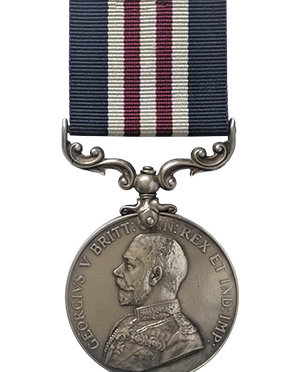
The Military Medal (or MM) was a military decoration established in 1916 and awarded for bravery in battle to personnel of the British Army.

The Military Medal (or MM) was a military decoration established in 1916 and awarded for bravery in battle on land. The award is given to personnel of the British Army and other arms of the armed forces, and to personnel of other Commonwealth countries, below commissioned rank.

The award had retrospective application to 1914, and was awarded to other ranks for “acts of gallantry and devotion to duty under fire“. It was discontinued in 1993 when it was replaced by the Military Cross, which was extended to all ranks, while other Commonwealth nations instituted their own award systems in the post-war period.

When the medal was first introduced, it was unpopular among regular soldiers wrote MM and DCM recipient Frank Richards who stated “the Military Medal, which without a shadow of a doubt had been introduced to save awarding too many DCMs. The old regular soldiers thought very little of the new decoration“.

Since 1918 recipients of the Military Medal have been entitled to the post-nominal letters “MM”.

The Military Medal Design Design

The medal is circular, struck in silver and measures 1.4 inches (36 mm) in diameter.

The obverse bears the effigy of the reigning monarch and an appropriate inscription. The reverse shows the inscription “FOR BRAVERY IN THE FIELD” in four lines, surrounded by a laurel wreath, and surmounted by the Royal Cypher and Imperial Crown.

The ribbon is dark blue, 1.25 inches wide with five equal center stripes of white, red, white, red, and white, each 0.125 inches wide. The suspender is of an ornate scroll type and the name and service details of the recipient were impressed on the rim of the medal, although honorary awards to foreign recipients were issued unnamed. Silver, laurelled bars were authorized for subsequent awards, with a silver rosette worn on the ribbon bar to indicate the award of each bar.

The Civilian Wartime Merit Cross

The War Cross for Civil Merits is a civil award of Austria-Hungary awarded in recognition of civilian war service during World War I.

The War Cross for Civil Merits (or Kriegskreuz für Zivilverdienste in German) is a civil award of Austria-Hungary established on 16 August 1915 by Emperor Franz Joseph I of Austria to recognized civilian war service during World War I.

The cross could also be awarded to military officers for their contributions to the war when they were not directly involved in combat operations – for example when they had shown outstanding zeal and willingness to make sacrifices, and have given special support to the Austro-Hungarian government.

The Civilian Wartime Merit Cross Design

The medal has the shape of a Cross pattée and measures 55 mm high and 55 mm across. The first and second Class crosses are gilded, the third class is silver, and the fourth class is bronze. The first through third classes had white enamel on the arms of the cross.

The obverse shows a laurel wreath surrounding the center medallion, passing under the horizontal arms of the cross, and in front of the vertical arms. The center medallion, also enameled white, bears the Emperor’s monogram FJI (Franz Joseph Imperator), surrounding the letters is the inscription “Merito Civili tempore belli MCMXV” (or “Civil merit in time of war 1915“).

The cross was worn as a breast cross directly on the coat or uniform.

The Canadian Memorial Cross

The Canadian Memorial Cross was first instituted in 1919 and awarded to mothers and widows of Canadian soldiers who died on active duty.

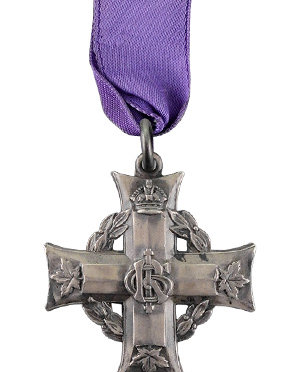
The Canadian Memorial Cross was first instituted by Order-in-Council 2374, dated December 1, 1919, and awarded to mothers and widows of Canadian soldiers who died on active duty or whose death was consequently attributed to such duty.

This gift of Canada was issued as a memento of personal loss and sacrifice on the part of widows and mothers of Canadian sailors, soldiers and airmen who died for their country during the war.

The crosses could be worn by the recipients anytime and were engraved with the name, rank and service number of the son or husband.

The Canadian Memorial Cross Design

The medal is in the form of a cross pattee, struck in silver and measures 32 millimeters in diameter.

The obverse shows, at the end of the upright, a crown. At the foot and the end of either arm is a maple leaf and in the center, within a wreath of laurel, is the royal cipher of the reigning monarch: GRI for King George the Fifth, GVIR for King George the Sixth, or EIIR for Elizabeth the Second. The reverse of the Cross is engraved with the name and service number of the individual commemorated.

The medal is suspended by a bar brooch, although prior to 1945 it was suspended from a light purple ribbon 11 mm wide.

The Memorial Plaque Medallion

The Memorial Plaque was issued after WW1 to the next-of-kin of all British and Empire service personnel who were killed during the war.

The Memorial Plaque was issued after the First World War to the next-of-kin of all British and Empire service personnel who were killed as a result of the war.

The plaques are about 4.75 inches (120 mm) in diameter, cast in bronze, and came to be known as the “Dead Man’s Penny“, because of the similarity in appearance to the much smaller penny coin.

A total of 1,355,000 plaques were issued, which used a total of 450 tons of bronze, and continued to be issued into the 1930s to commemorate people who died as a consequence of the war.

The Memorial Plaque Design

Over 800 designs were submitted in a public competition for the design of the plaque. The winner was the sculptor and medallist Edward Carter Preston using the pseudonym Pyramus, who received two first-place prizes of £250 for his winning and also an alternative design.

The obverse includes an image of Britannia holding a trident and standing with a lion. The designer’s initials, E.CR.P., appear above the front paw. In her outstretched left hand Britannia holds an olive wreath above the rectangular tablet bearing the deceased’s name cast in raised letters. Below the name tablet, to the right of the lion, is an oak spray with acorns. Two dolphins swim around Britannia, symbolizing Britain’s sea power, and at the bottom a second lion is tearing apart the German eagle.

The reverse is blank, making it a plaquette rather than a table medal. Around the picture the legend reads “HE DIED FOR FREEDOM AND HONOUR“, or for the 1500 plaques issued to commemorate women, “SHE DIED FOR FREEDOM AND HONOUR“.

Smaller or miniature unofficial bronze plaques were produced by other manufacturers, for example Wright and Sons of Edgware, Middlesex, who sold them for 13 shillings and sixpence each.

The Medal for Bravery (Austria)

The Medal for Bravery (or Tapferkeitsmedaille in German) was a military decoration of Austria-Hungary established in 1789.

Institution: 19 July 1789
 

The Medal for Bravery (or Tapferkeitsmedaille in German) was a military decoration of Austria-Hungary established in 1789 and awarded for bravery in battle until the dissolution of the Austro-Hungarian Empire in 1918.

The medal was created by Emperor Joseph II on 19 July 1789 in order to recognize courage in combat by personnel below commissioned rank. From 1789 to 1915, the Medal for Bravery existed in three classes:

  • Golden Medal for Bravery,
  • Silver Medal for Bravery 1st Class,
  • Silver Medal for Bravery 2nd Class.

A fourth class, the Bronze Medal for Bravery, was introduced on 14 February 1915 during World War I. It was the same size as the Silver Medal 2nd Class. Bars denoting subsequent awards within the same class were introduced on 29 November 1915.

On 26 September 1917, Emperor Charles I amended the statutes of the Medal for Bravery and decreed that the Golden Medal for Bravery and the Silver Medal for Bravery 1st Class could now also be awarded to commissioned officers, particularly in cases where their services were not sufficient for the Military Order of Maria Theresa.

After World War I and the dissolution of Austria-Hungary, the newly established Kingdom of Hungary instituted in 1922 the Medal of Bravery in silver only. By 14 April 1939, gold, large silver, small silver and bronze awards were issued to non-commissioned officers and men and, on 12 September 1942, the gold medal for bravery award for officers was added.

The Medal for Bravery Design

All versions of the Medal for Bravery bear, on the obverse, the portrait of the reigning monarch on the obverse and the inscription “Der Tapferkeit” (“To Bravery“) on the reverse.

Medals awarded during World War I were minted with the portrait of Emperor Franz Josef on the obverse until some months after his death. Starting in April 1917, the visage of his successor, Emperor Charles I, was substituted.

Commissioned officers after WW1 wore the same medals as the ranks, plus the letter “K” (in gold or silver, depending on the class of the award) superimposed on the triangular ribbon.