The Order of the Crown

The Order of the Crown (Ordre de la Couronne / Kroonorde) is a national order of the Kingdom of Belgium established on 15 October 1897. It’s one of Belgium’s highest honors.

The Order was established by King Leopold II and initially intended to recognize heroic deeds and distinguished service achieved for service in the Congo Free State. In 1908, the Order of the Crown was made a national honor of Belgium, junior to the Order of Leopold.

Currently, the Order is awarded (by Royal Decree) for meritorious service in public employment and for distinguished artistic, literary or scientific achievements, as well as for commercial or industrial services in Belgium or Africa.

The Order of the Crown is awarded in five classes, plus two palms (golden and silver) and three medals (gold, silver and bronze):

  • Grand Cross.
  • Grand Officer.
  • Commander.
  • Officer.
  • Knight.

The Order of the Crown Design

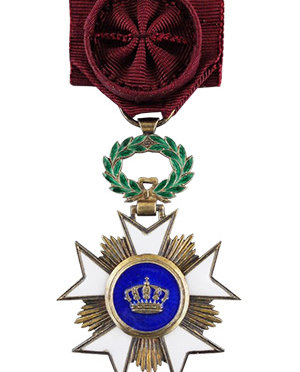
The badge is a white-enameled Maltese cross with silver or gold straight rays. The obverse bears a gold crown on a blue enameled background and the reverse the monogram “L” (for King Leopold II) on a blue enameled background. It’s suspended from a green-enameled wreath of laurel and oak leaves.

The medal is round with a suspension in the form of a royal crown with two pendelia and a ribbon ring. The obverse shows a finely ribbed central area with bead surround, with the royal crown superimposed and the motto of the Belgian Congo: Travail et Progrès (work and progress). The reverse is a stylized ‘double L’ crowned Leopold II monogram within a palm wreath.

The ribbon is plain maroon, although some exceptions have been made such as added crossed swords when awarded in wartime and a vertical gold border on both sides for a special act of valor.
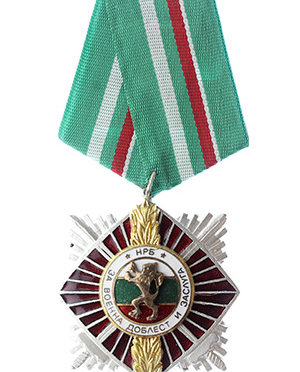
The Order of Military Valor And Merit

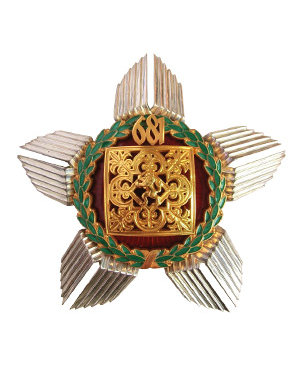
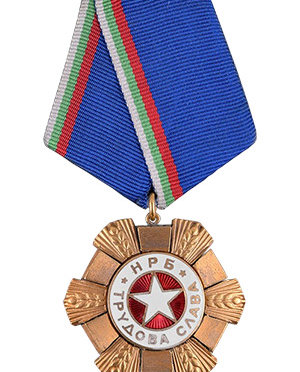
The Order of Military Valor And Merit is a Bulgarian medal established on 28 May 1974 and awarded to Military personnel, Workers of the Ministry Of Defence and reservists for long distinguished and honorable service or for merit in the strengthening of the power of armed forces and national security or for merit in combat training.

The award was designed by B. Kozarev and M. Markov.

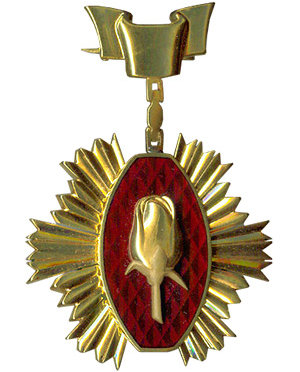
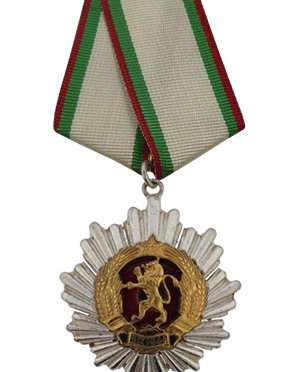
The Order Of The Rose

The Order Of The Rose is a Bulgarian medal established on 4 August 1966 by Decree No. 606 of the Presidium of the National Assembly of the People’s Republic of Bulgaria. It’s awarded to female foreigners for merit in establishing friendly international relationships with The People’s Republic Of Bulgaria.

The Order was designed by Dechko Uzunov, and the insignia are made at the State Mint in Sofia. Oval in shape, it measures 40.5 mm in diameter. In the center is a gilded embossed rose form. The rays are gold for the first degree and silver for the second degree. The plate is mounted on a rosette consisting of 10 bundles of rays, each of which is formed by three beams. The silver order differs from the gold only in that with the exception of the rose, which is gilded, is silver.

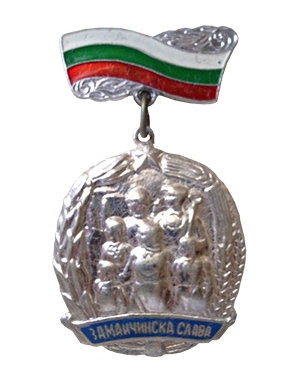
The Order Of Maternal Glory (Bulgaria)

The Order Of Maternal Glory is a Bulgarian medal established on 13 December 1950 and awarded to Bulgarian mothers for raising numerous children.

Three variations of this award exist: One on a ribbon which is numbered, latterly one on a ribbon which is unnumbered and then finally one on a metal suspension.

Classes:

  • 1st Class: Awarded to Bulgarian mothers for raising 8 or 9 children.
  • 2nd Class: Awarded to Bulgarian mothers for raising 6 or 7 children.
  • 3rd Class: Awarded to Bulgarian mothers for raising 4 or 5 children.

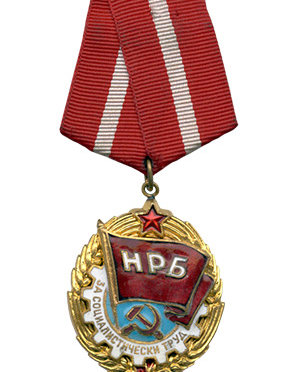
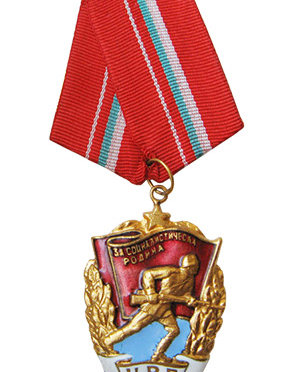
The Order Of The Red Banner of Labor (Bulgaria)

The Order Of The Red Banner of Labor is a Bulgarian medal awarded to Bulgarian and Foreign civilians and associations for success in the development of the national economy or the state or public/scientific/cultural services of the country.

There are five variations of this award:

  • The first variation (1950) is numbered and of multi-part construction with a nut and an angular recess in the reverse.
  • The second (1950-1969) is numbered and of a multi-part construction with a nut and a circular recess in the reverse.
  • The third (1970) is unnumbered a has a small nipple on the reverse.
  • The fourth (1970-1974) is unnumbered of a single part construction with a smooth reverse on a large ribbon.
  • The fifth (1974-1991) is unnumbered with a smooth reverse and on a small ribbon.

The Order Of The Red Banner (Bulgaria)

The Order Of The Red Banner is a Bulgarian medal awarded to Bulgarian and Allied military personnel for distinction in battle or for merit in the strengthening of power and structure of the Bulgarian People’s Army.

It was established on 13 December 1950.

There are two variations of this award, originally one which is numbered and then issued later, one which is unnumbered. Designed by O. Odabashyan.

The Order of the Medjidie

The Order of the Medjidie is a military and knightly order of the Ottoman Empire instituted in 1851 by Sultan Abdülmecid I.

The Order of the Medjidie (or Mecidiye Nişanı in Turkish) is a military and knightly order of the Ottoman Empire instituted in 1851 by Sultan Abdülmecid I. It was given as a reward for distinguished service to members of the British Army and the Royal Navy and the French Army who came to the aid of the Ottoman Empire during the Crimean War against Russia.

The Order was issued in considerable numbers and awarded in five classes, with the First Class being the highest. It was usually conferred on officers although there have been cases of a few enlisted soldiers receiving it as well, and during World War I it was also awarded to a number of German and Austrian officers.

Among notable recipients are Napoleon III Emperor of France and Pedro II of Brazil Emperor of Brazil.

Owners of the order:

  • First Class Order – 50 people (Given by Sultan)
  • Second Class Order – 150 people (Given by Sultan)
  • Third Class Order – 800 people
  • Fourth Class Order – 3,000 people
  • Fifth Class Order – 6,000 people

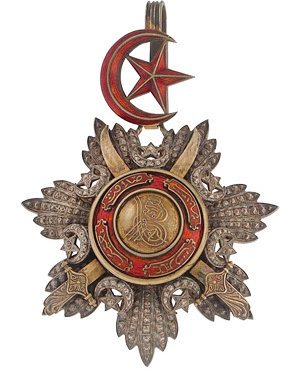
The Order of the Medjidie Design

On the obverse of the star is Sultan Abdul Mejid’s royal cipher measuring 75.3 mm and surrounded by an inscription on a gold-bordered circle of red enamel. The star has seven triple quills with small crescents and five-pointed stars between them, suspended from a red enameled crescent and star suspender with green enameled edges.

First, second, third and fourth classes are gold. Fifth (lower) class is silver.