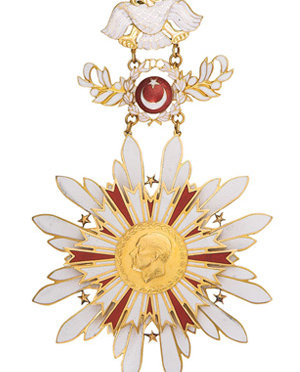
The Order of the State of Republic of Turkey

The Order of the State of Republic of Turkey is conferred by the President to foreign nationals, and is the highest state order of its type.

The Order of the State of Republic of Turkey (or Türkiye Cumhuriyeti Devlet Nişanı in Turkish) is the highest state order awarded to foreign nationals. It was first introduced in 14 July 1994. The medal is conferred by the President of the Republic of Turkey to Heads of State and presidents in recognition of their contributions for enhancing the amicable relations between their countries and Turkey.

The medal is:

Given to people for the development of friendly relations with the Republic of Turkey.”

There are two grades:

  • Order of the State, and
  • Order of the Gold Star

The Order of the Liberator General San Martin

The Order of the Liberator General San Martin (or Orden del Libertador General San Martín in Spanish) is the highest decoration awarded by the Governement of Argentina. It is given to foreign politicians or military, deemed as worthy of the highest recognition by the country and it’s granted by the sitting President of Argentina.

The order receives its name from José de San Martín, Father of the Land and Liberator. The award was established in 1943 (Decree 5000 from August 17th, 1943) and modified on May 21st 1948 (Decree 16628 from 1957, which creates the Order). The rules used today date from December 18th, 1967.

The Grand Master of the Order presides over a national council and is the President of the Nation, same who confers the award. The Order headquarters is the Ministry of Foreign Relations, International Commerce and Cult.

The grades of the Order are:

  • Collar (Collar)
  • Grand Cross (Gran CruzARG Order of the Liberator San Martin - Grand Cross BAR.png
  • Grand Officer (Gran OficialARG Order of the Liberator San Martin - Grand Officer BAR.png
  • Commander (ComendadorARG Order of the Liberator San Martin - Commander BAR.png
  • Officer (OficialARG Order of the Liberator San Martin - Officer BAR.png
  • Member (CaballeroARG Order of the Liberator San Martin - Knight BAR.png

The Order of the Liberator General San Martin Medal Design

The medal was designed by Ángel Eusebio Ibarra García. It’s struck in gold and shows a condor, the sable and General San Martin’s portrait in a frame made of sun rays.

Only one Order with the Extraordinary grade was awarded: to Eva Perón in 1952. It was made of 3821 pieces of gold and platinum, and 753 precious stones. It was made by the jewelers joyería Ghiso S.A. and designed by Aída Louzao. After the Military Dictatorship of 1955, the collar was disassembled and the pieces went to auction.

The reverse of the Argentinian $5 bill shows the collar of the Order.

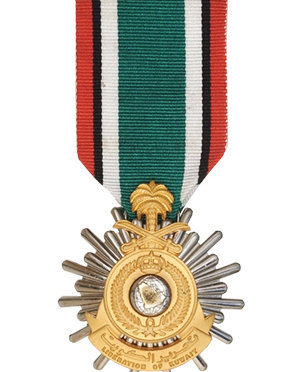
The Medal for the Liberation of Kuwait (Saudi Arabia)

The Medal for the Liberation of Kuwait was instituted by King Fahd ibn Abdulaziz of Saudi Arabia for service during the Gulf War.

The Medal for the Liberation of Kuwait (or Naut Tahrir al-Kuwait نوط تحرير الكويت‎ in Arabic) was instituted by King Fahd ibn Abdulaziz of Saudi Arabia for service during the Liberation of Kuwait campaign.

The Saudi Arabian version of the medal was awarded to members of the Coalition Forces who participated in Operation Desert Storm and the liberation of Kuwait between the dates of January 17, 1991 and February 28, 1991. Unlike other medals, it recognizes service in a relatively short period of time whereas the Kuwaiti version of the medal is granted for service over three years. The Saudi Arabian version is also senior in U.S. precedence, owing to its having been authorized for several years before the Kuwaiti version was offered.

The Medal for the Liberation of Kuwait Design

The Saudi version of the Kuwait Liberation Medal consists of a silver star of fifteen rounded points (with shorter rounded points between them) surmounted by a gilt medallion which contains a wreath tied at its based and a crown at its top. In the center of the gilt medallion is a silver representation of the Earth, over which is superimposed a gilt representation of the Kingdom of Saudi Arabia.

Above the gilt medallion are the crossed swords and palm tree taken from the Royal Cypher. Beneath the gilt medallion is a swallow-tailed scroll with its ends folded back and point upward so they follow the contour of the gilt medallion. On the scroll are the words, LIBERATION OF KUWAIT in English, and the same inscription above it in Arabic.

Buy a Medal for the Liberation of Kuwait

Note: As an eBay partner, I earn from qualifying purchases. This is all done automatically when you use a link and at no extra cost to you.

Right Now on eBay 
Clicking a link to eBay may result in a referral commission being paid if a purchase is made.
Loading...

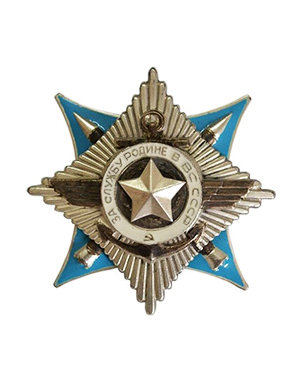
The Order for Service to the Homeland in the Armed Forces of the USSR

The Order for Service to the Homeland in the Armed Forces of the USSR was a Soviet military order created in 1974 in three classes.

The Order for Service to the Homeland in the Armed Forces of the USSR (or Орден За службу Родине в Вооружённых Силах СССР in Russian) was was a Soviet military order created on October 28, 1974 and awarded in three classes for excellence to military personnel. It’s also known as the Order for Service to the Motherland in the Armed Forces of the USSR.

The Order was awarded to soldiers of the Soviet Army, Navy, of Border or Internal Troops for achievements in combat and political training, for maintaining high combat readiness and developing new military equipment; for high performance in service; for the successful fulfillment of special command tasks; for courage and dedication displayed during the performance of military duties; for other services to the nation while serving in the Armed Forces.

The Order for Service to the Homeland in the Armed Forces of the USSR was divided into three classes, first, second and third, the first class being the highest.

Recipients of all classes had the right to priority in the choice of living quarters, yearly free round trip personal travel, free personal use of all types of urban passenger transport, free vouchers to a sanatorium or rest home and a 15% increase in pension.

The Order for Service to the Homeland in the Armed Forces of the USSR Design

The Order consisted of two 58mm by 58mm four pointed stars crossed at a 90° angle, the top star having the vertical and horizontal points. The rear star was enameled light blue with gilt edges and two crossed convex oxidized silver rockets pointing towards the upper left and upper right. The rockets’ nose cones and tail sections were gilded.

The top star was made up of diverging rays, at its center, a circular medallion containing a convex five pointed star within an oak wreath on a blue background, surrounded by a white enameled ribbon with the inscription: “For Service to the Motherland in the Armed Forces of the USSR” (За службу Родине в ВС СССР) on the sides and top, and the image of the hammer and sickle at the bottom. The central medallion was superimposed over an oxidized silver anchor and wings protruding from the top, bottom and both sides. The Order weighed 64,5 grams.

The three classes of the Order:

  • 1st class – top four pointed star and central five pointed star were gilded;
  • 2nd class – top four pointed star was silver and the central five pointed star was gilded;
  • 3rd class – top four pointed star and central five pointed star were silver.

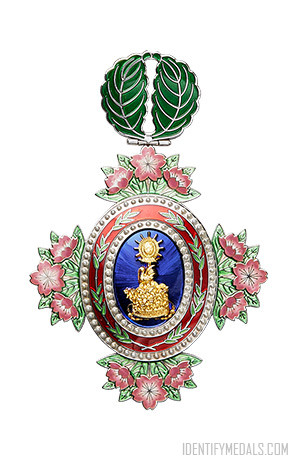
The Order of the Precious Crown

The Order of the Precious Crown (Hōkan-shō) is an Order from Japan established in 1888 by Emperor Meiji and usually reserved for females.

  • Time Period: Pre-WW1
  • Institution: 4 January 1888
  • Country: Medals from Japan Japan

The Order of the Precious Crown (or 宝冠章 Hōkan-shō in Japanese) was established on January 4, 1888, by Emperor Meiji. It’s the lowest ranking of the Japanese orders currently awarded and conventionally reserved for female recipients (such as female members of the royal family).

Until 2003, the Order of the Precious Crown ranked below the Order of the Rising Sun but above the Order of the Sacred Treasure, and was bestowed as a female-only version of the Order of the Rising Sun. The Order of the Precious Crown is now only bestowed upon female members of the Imperial Family and foreign ladies of distinction.

Originally the order had five classes, but on April 13, 1896, the sixth, seventh, and eighth classes were added. Unlike many European counterparts can be awarded posthumously. 

The Order of the Precious Crown is given by the Emperor of Japan at the monarch’s pleasure and, since 2003, no longer uses numbers to represent rank.

The Classes of the Order of the Precious Crown

The Order of the Precious Crown had eight classes (today, it has six. The 7th and 8th classes were abolished in 2003). The First Class is usually awarded to female royalty or, occasionally, to the royal family in foreign countries. This typically happens when necessary for diplomatic ceremonies. 

These are the ribbon bars of the order:

  • JPN Hokan-sho 1Class BAR.svg Grand Cordon, Paulownia 
  • JPN Hokan-sho 2Class BAR.svg Second Class, Peony
  • JPN Hokan-sho 3Class BAR.svg Third Class, Butterfly
  • JPN Hokan-sho 4Class BAR.svg Fourth Class, Wisteria
  • JPN Hokan-sho 5Class BAR.svg Fifth Class, Apricot
  • JPN Hokan-sho 6Class BAR.svg Sixth Class, Ripples
  • JPN Hokan-sho 7Class BAR.svg Seventh Class, Medal
  • JPN Hokan-sho 8Class BAR.svg Eighth Class, Medal 

The Order of the Precious Crown Badge Design

The badge of the order is a gold oval medallion with floral designs at its four ends. Aat the centre is an ancient Japanese crown on a blue background, surrounded by a red ring. It is suspended from a smaller badge, its design varies according to class. 

The ribbon of the Order of the Precious Crown is yellow with red stripes near the borders. For the 1st class, a sash is worn on the right shoulder (all other classes use a bow on the left shoulder).

The star of the order is worn only by the first class and has five rays studded with pearls, with floral designs between the rays. The central disc features a Ho-o or phoenix on a blue background, surrounded by a red ring emblazoned with a laurel wreath.

The medal for the 6th and 7th classes is golden bronze. The face presents the crossed flags of Japan and the Emperor, both surmounted by the Rising Sun. The obverse presents a conventional monumental shaft flanked by a branch of laurel and a palm branch.

The Order of Culture (Japan)

The Order of Culture (Bunka-kunshō) is an order of Japan established in 1937 and conferred by the Emperor of Japan in person.

The Order of Culture (or 文化勲章 Bunka-kunshō in Japanese) is an order of Japan established on February 11, 1937 and conferred by the Emperor of Japan in person on Culture Day (November 3) each year.

Candidates for the Order of Culture are selected from the Persons of Cultural Merit by the Minister of Education, Culture, Sports, Science, and Technology, upon hearing the views of all the members of the selection committee for the Persons of Cultural Merit. The Minister then recommends the candidates to the Prime Minister so that they can be decided by the Cabinet.

The order only has one class and may be awarded to men and women of any country for contributions to Japan’s art, literature, science, technology, or anything related to culture in general. Those that receive the order are also entitled to an annuity for life.

The Order of Culture Design

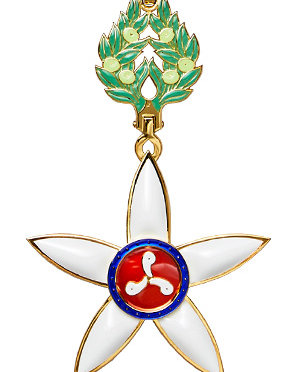
The badge of the Order of Culture is made in gold with white enamel. It has the form of a Tachibana orange blossom, with the central disc bearing three crescent-shaped jades (magatama).

The badge is suspended on a gold and enamel wreath of mandarin orange leaves and fruit, which is in turn suspended on a purple ribbon worn around the neck.

The Navy and Marine Corps Medal

The Navy and Marine Corps Medal is the highest non-combat decoration awarded for heroism to the members of the U.S. Navy and Marine Corps.

The Navy and Marine Corps Medal is the highest non-combat decoration awarded for heroism to the members of the United States Navy and United States Marine Corps.

The medal was established by an act of Congress on 7 August 1942 and it was first bestowed during World War II (as retroactive to 6 December 1941). During the mid-20th century, the Navy and Marine Corps Medal was awarded instead of the Silver or Gold Lifesaving Medal, for sea rescues involving risk to life.

For heroic performance to rise to this level it must be clearly established that the act involved very specific life-threatening risk to the awardee.

The Navy and Marine Corps Medal Criteria

The Navy and Marine Corps Medal is typically awarded for actions taken to save or attempt to save the lives of others, such as rescuing individuals from drowning, providing aid during a disaster, or protecting others from harm. It is also presented to those who display significant courage in non-combat situations, such as when risking their lives to protect naval or marine assets or personnel.

The Navy and Marine Corps Medal Design

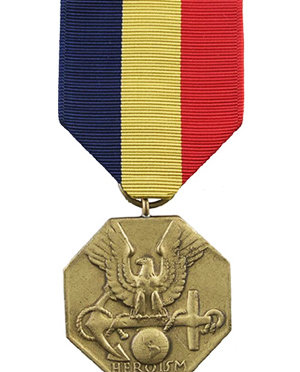
The Navy and Marine Corps Medal is an octagonal bronze medal.

The obverse of the Navy and Marine Corps medal depicts an eagle holding a fouled anchor over a globe. The word Heroism is inscribed below the globe. 

The medal’s ribbon is three equal stripes of navy blue, old gold, and apple red.

Additional awards of the medal are denoted by gold or silver ​516 inch stars.

Buy a Navy and Marine Corps Medal

Note: As an eBay partner, I earn from qualifying purchases. This is all done automatically when you use a link and at no extra cost to you.

Right Now on eBay 
Clicking a link to eBay may result in a referral commission being paid if a purchase is made.
Loading...

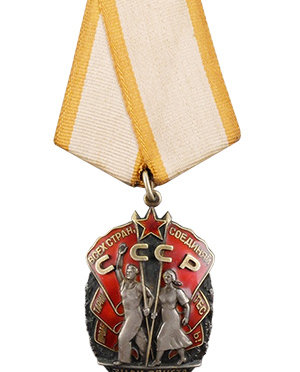
The Order of the Badge of Honor

The Order of the Badge of Honor (орден «Знак Почёта») was a civilian award of the Soviet Union established on 25 November 1935.

The Order of the Badge of Honor (or орден «Знак Почёта» in Russian) was a civilian award of the Soviet Union established on 25 November 1935.

The order was conferred on citizens of the USSR for outstanding achievements in production, scientific research and social, cultural and other forms of social activity; for promotion of economic, scientific, technological, cultural and other ties between the USSR and other countries; and also for significant contribution to basic and applied research.

The “Order of the Badge of Honor” was awarded 1,574,368 times and later replaced by the “Order of Honor” (Орден Почёта) by a Decree of the Presidium of the USSR on 28 December 1988. Following the USSR dissolution, it was replaced by the “Order of Honor” of the Russian Federation, established by Presidential Decree no. 442 of 2 March 1994.

The Order of the Sacred Treasure

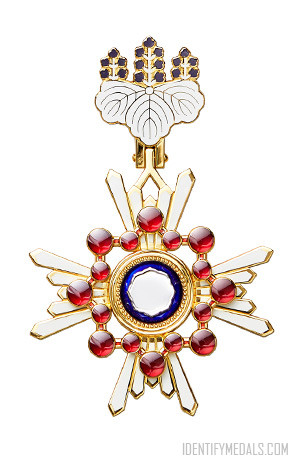
The Order of the Sacred Treasure (or 瑞宝章 Zuihō-shō) is the most widely conferred Japanese order. It was established in 1888 by Emperor Meiji.

The Order of the Sacred Treasure (or 瑞宝章 Zuihō-shō in Japanese) is the most widely conferred Japanese order and it was established on 4 January 1888 by Emperor Meiji and originally called the Order of Meiji. It is awarded for both civil and military merit, though of a lesser degree than that required for the conferment of the Order of the Rising Sun.

It was initially awarded in eight classes, but since 2003 this has been changed to six classes (the lowest two medals were abolished that year). The Order is awarded to those who have made distinguished achievements in research fields, business industries, healthcare, social work, state/local government fields or the improvement of life for handicapped/impaired persons.

Although the order was originally only given to males, it’s been made available to women since 1919. Conventionally, a diploma is prepared to accompany the insignia of the order. In some rare instances, the personal signature of the emperor will have been added.

The Order of the Secret Treasure Design

The insignia of the order incorporates symbols for the three imperial treasures: the Yata Mirror, so sacred that not even the Emperor is allowed to look at it; the Yasakani Jewel, which is made of the finest jade; and the Emperor’s personal sword.

The star for the Grand Cordon and Second Class has two sets of Maltese crosses, one in gilt and one placed diagonally in silver.

The badge for the first through sixth classes is a Maltese cross, in gilt (1st–4th classes), gilt and silver (5th class) and silver (6th class), with white enameled rays (representing the sword). The central disc is blue, bearing an eight-pointed silver star (representing the mirror), surrounded by a wreath with red-enameled dots (representing the jewel).

Until 2003, when it was abolished, the badge of the seventh and eighth classes was an eight-pointed silver medal, partially gilded for the 7th class.

The Order of the Rising Sun

The Order of the Rising Sun (Kyokujitsu-shō) was the first national decoration awarded by the Japanese government, established in 1875.

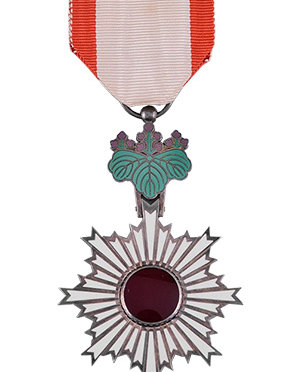
The Order of the Rising Sun (旭日章 Kyokujitsu-shō) is a Japanese order established on 10 April 1875 by decree of the Council of State. The Order was the first national decoration awarded by the Japanese government.

The order is conferred upon those who have made distinguished achievements in international relations, promotion of Japanese culture, advancements in their field, development in welfare, or preservation of the environment. Prior to the end of World War II, it was also awarded for exemplary military service. 

While it is the third highest order bestowed by the Japanese government, it is however generally the highest ordinarily conferred order. The highest Japanese order, the Order of the Chrysanthemum, is reserved for heads of state or royalty, while the second highest order, the Order of the Paulownia Flowers, is mostly reserved for politicians.

The awarding of the Order is administered by the Decoration Bureau of the Cabinet Office headed by the Japanese Prime Minister. It is awarded in the name of the Emperor and can be awarded posthumously.

The Order of the Rising Sun Medal Classes

The Order was awarded in nine classes until 2003 and from then on in six classes.

  • ribbon bar 1st Class: Grand Cordon
  • ribbon bar 2nd Class: Gold and Silver Star (Rays, Principal Grade)
  • ribbon bar 3rd Class: Gold Rays with Neck Ribbon (Cordon, Middle Grade)
  • ribbon bar 4th Class: Gold Rays with Rosette (Cordon, Junior Grade)
  • ribbon bar 5th Class: Gold and Silver Rays (Double Rays)
  • ribbon bar 6th Class: Silver Rays (Single Ray)
  • ribbon bar 7th Class: Green Paulownia Leaves
  • ribbon bar 8th Class: White Paulownia Leaves

The Order of the Rising Sun Medal Design

The badge features rays of sunlight from the rising sun. The design symbolizes energy as powerful as the rising sun in parallel with the “rising sun” concept of Japan (“Land of the Rising Sun“).

The star for the Grand Cordon and Second Class is a silver star of eight points, each point having three alternating silver rays; the central emblem is identical to the badge. It is worn on the left chest for the Grand Cordon, on the right chest for the 2nd Class.

The badge for the Grand Cordon to Sixth Classes is an eight-pointed badge bearing a central red enameled sun disc, with gilt points (1st–4th Classes), with four gilt and four silver points (5th Class), or with silver points (6th Class); each point comprises three white enameled rays. It is suspended from three enameled paulownia leaves on a ribbon in white with red border stripes, worn as a sash from the right shoulder for the Grand Cordon, as a necklet for the 2nd and 3rd Classes and on the left chest for the 4th to 6th Classes (with a rosette for the 4th Class).

The badge for the Seventh and Eighth Classes consisted of a silver medal in the shape of three paulownia leaves, enameled for the 7th Class and plain for the 8th Class. Both were suspended on a ribbon, again in white with red border stripes, and worn on the left chest. Both classes were abolished in 2003 and replaced by the Order of the Paulownia Flowers, a single-class order that now ranks above the Order of the Rising Sun.

The ribbon of the Order references the colors of the Japanese flag (a red disc on a white background) but are represented in stripes (a central large white stripe and smaller red ones on the edges).

Where to Find an Order of the Rising Sun Medal

Right Now on eBay 
Clicking a link to eBay may result in a referral commission being paid if a purchase is made.
Loading...