The Coast Guard Commendation Medal

The Coast Guard Commendation Medal is a United States military decoration presented for sustained acts of heroism or meritorious service.

The Coast Guard Commendation Medal is a mid-level United States military decoration that is presented for sustained acts of heroism or meritorious service within the Coast Gard forces. Each branch of the United States Armed Forces has its own version of this medal, with a fifth version existing for acts of joint military service performed under the Department of Defense.

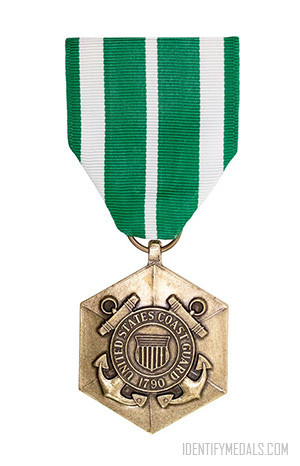
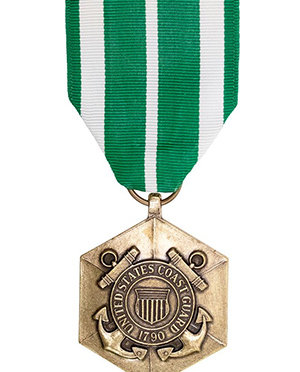
The U.S. Coast Guard awards a separate Coast Guard Commendation Medal, with a ribbon similar in design to that of its Navy and Marine Corps counterparts. This was initially established as the Coast Guard Commendation Ribbon in 1947, and redesignated as the Coast Guard Commendation Medal in 1959. 

The Coast Guard Commendation Medal Design

The Commendation Medal was originally only a service ribbon awarded by the U.S. Navy and U.S. Coast Guard (this was around 1943). In 1949, the Navy, Coast Guard, and Army Commendation ribbons were renamed the “Commendation Ribbon with Metal Pendant” and by 1960, the ribbons were authorized as full medals.

The Coast Guard Commendation Medal is gold with silver 5/16 inch stars to denote additional awards. 

Other Commendation Medals

The different versions of the Commendation Medal in the United States military are typically associated with specific branches of service. While the criteria for receiving the Commendation Medal remain similar across branches, the designs may vary to reflect the unique identity and traditions of each service.

Buy a Commendation Medal

Note: As an eBay partner, I earn from qualifying purchases. This is all done automatically when you use a link and at no extra cost to you.

Right Now on eBay 
Clicking a link to eBay may result in a referral commission being paid if a purchase is made.
Loading...

The Army Commendation Medal

The Army Commendation Medal is a mid-level U.S. military decoration presented for sustained acts of heroism or meritorious service.

The Army Commendation Medal is a mid-level United States military decoration that is presented for sustained acts of heroism or meritorious service. Each branch of the United States Armed Forces has its own version of this medal, with a fifth version existing for acts of joint military service performed under the Department of Defense.

The Army Commendation Medal is awarded to any member of the Armed Forces of the United States other than General Officers who, while serving in any capacity with the U.S. Army after December 6, 1941, distinguished themselves by heroism, meritorious achievement or service. The medal can also be awarded to a member of another branch of the U.S. Armed Forces or of a friendly foreign nation who, after June 1, 1962, distinguishes themselves by an act of heroism, extraordinary achievement, or significant meritorious service which has been of mutual benefit to the friendly nation and the United States.

The Army Commendation Medal Design

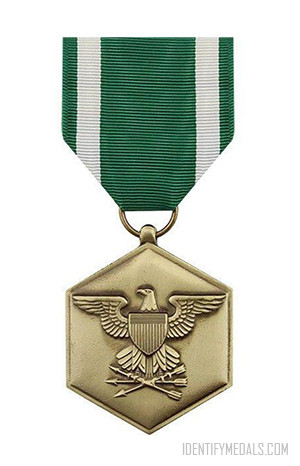
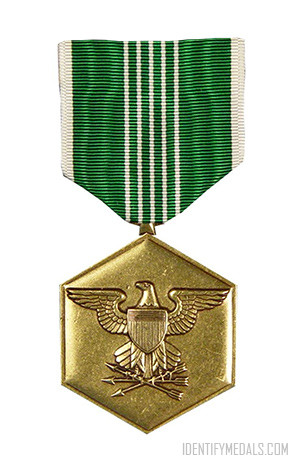
The medallion of the Army Commendation Medal is a bronze hexagon, 1​38 inches wide. On the obverse of the medallion is an American bald eagle with wings spread horizontally, grasping in its talons three crossed arrows. On its breast is a shield paly of thirteen pieces and a chief.

The reverse bears a panel for naming between the words FOR MILITARY above and MERIT below, all placed above a laurel sprig. The ribbon is 1​38 inches wide, primarily of myrtle green. It is edged in white, and in the center are five thin white stripes spaced equally apart.

Devices:
  • Oak leaf cluster (for subsequent awards)
  • “V” Device (for valorous actions in direct contact with an enemy)
Combat Commendations:
 
  • “C” Device (for meritorious service or achievement under combat conditions. Unofficially called the Combat Commendation. Retroactive Awards are not authorized for medals awarded before 7 January 2016) 
  • “R” Device (for direct and immediate impact on combat operations from a remote location) 

Other Commendation Medals

The different versions of the Commendation Medal in the United States military are typically associated with specific branches of service. While the criteria for receiving the Commendation Medal remain similar across branches, the designs may vary to reflect the unique identity and traditions of each service.

Buy a Commendation Medal

Note: As an eBay partner, I earn from qualifying purchases. This is all done automatically when you use a link and at no extra cost to you.

Right Now on eBay 
Clicking a link to eBay may result in a referral commission being paid if a purchase is made.
Loading...

The Joint Service Commendation Medal

The Joint Service Commendation Medal is a mid-level United States military decoration presented for sustained acts of heroism or service.

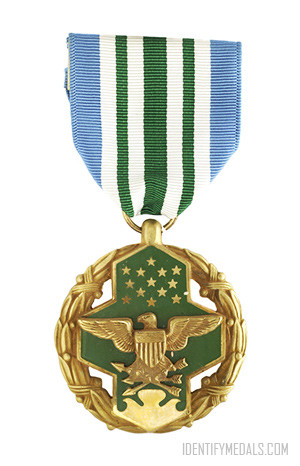
The Joint Service Commendation Medal is a military decoration of the United States that is presented for meritorious service and/or sustained acts of heroism. It is a mid-level decoration, which each branch of the Armed Forces having its own version.

The medal was established on 25 June 1963. It is given in the name of the Secretary of Defense to members of the United States Armed Forces who have distinguished themselves in a joint duty capacity. The award i designed to recognize senior service and precedes server-specific Commendation Medals (therefore, it’s worn above them in the uniform).

How Many Commendation Medals Are There?

Each branch of the United States Armed Forces issues its own version of the Commendation Medal, with a fifth version existing for acts of joint military service performed under the Department of Defense. These are:

Joint Service Commendation Medal Devices

There is a Commendation Medal with “V” Device or Combat “V” given for valorous actions in direct contact with an enemy. It is of a lesser degree than the Bronze Star Medal. A “C” Device or Combat “C” was created on January 7, 2016 for wear on the service and suspension ribbon of the Commendation Medal (it’s awarded for meritorious service or achievement under arduous combat conditions; for example, when someone was personally exposed to hostile action. The Operational Distinguishing Device (or “O” device)can be worn on the Coast Guard Commendation Medal upon approval. Its Order of Precedence is following the Air Medal but before the Prisoner of War Medal and all campaign medals. 

The Joint Service Commendation Medal Design

The Commendation Medal consisted of, initially, just a service ribbon awarded to the Navy and Coast Guard (1943). In 1949, the Navy, Coast Guard, and Army Commendation ribbons were renamed to the “Commendation Ribbon with Metal Pendant,” but by 1960 the ribbons were changed into full medals.

The Navy and Marine Corps Commendation Medal and the Coast Guard Commendation Medal are gold, with silver 5/16 inch stars to denote additional awards.

Additional awards are denoted by bronze and silver oak leaf clusters.

Buy a Commendation Medal

Note: As an eBay partner, I earn from qualifying purchases. This is all done automatically when you use a link and at no extra cost to you.

Right Now on eBay 
Clicking a link to eBay may result in a referral commission being paid if a purchase is made.
Loading...

The Air Force and Space Force Commendation Medal

The Air Force & Space Force Commendation Medal is a United States military decoration presented for sustained acts of heroism and service.

The Air Force & Space Force Commendation Medal is a mid-level United States military decoration that is presented for sustained acts of heroism or meritorious service. Each branch of the United States Armed Forces has its own version of this medal, with a fifth version existing for acts of joint military service performed under the Department of Defense.

The U.S. Air Force began issuing its own Air Force Commendation Medal in 1958, with additional awards denoted by oak leaf clusters. Prior to this time, USAF recipients received the Army Commendation Medal. It was not until 1996 that the “V” device was authorized on the Air Force Commendation Medal; prior to 1996, there was not a valor distinction in effect for the Air Force Commendation Medal. On January 7, 2016, the “C” device and “R” device was authorized on the Air Force Commendation Medal as well. For USAF enlisted personnel, the Air Force Commendation Medal is worth three points under the Air Force enlisted promotion system.

The Air Force Commendation Medal is awarded to both American and foreign military personnel of any service branch in the U.S. military grade of O-6 and below, the NATO grade of OF-5 and below, or of any other Allied or Coalition nation in the grade of Colonel or equivalent or below, or the naval grade of Captain or equivalent or below, who have performed noteworthy service in any capacity with the United States Air Force.

The Air Force & Space Force Commendation Medal Design

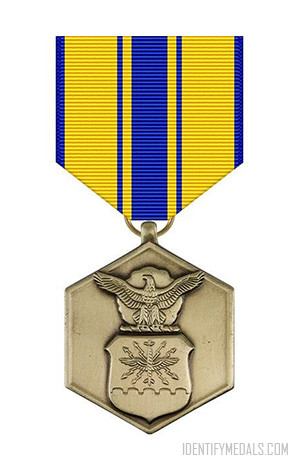
The Air Force Commendation Medal is a bronze hexagonal medallion. On the medallion is a shield surmounted by an eagle superimposed over clouds. On the shield bears a pair of flyer’s wings and a vertical baton with an eagle’s claw at either end; behind the shield are eight lightning bolts. The design on the shield is derived from the Seal of the Department of the Air Force. The ribbon of the Air Force Commendation Medal is golden yellow with blue edges. In the center are three bands of blue, the outer stripes are thin with the center stripe being wider.

Devices:
  • Oak leaf cluster (for subsequent awards)
  • “V” device (for valorous actions in direct contact with an enemy)
  • “C” device (for meritorious service in direct contact with an enemy)
  • “R” device (for employment of a remote weapon system during military operations)

Other Commendation Medals

The different versions of the Commendation Medal in the United States military are typically associated with specific branches of service. While the criteria for receiving the Commendation Medal remain similar across branches, the designs may vary to reflect the unique identity and traditions of each service.

Buy a Commendation Medal

Note: As an eBay partner, I earn from qualifying purchases. This is all done automatically when you use a link and at no extra cost to you.

Right Now on eBay 
Clicking a link to eBay may result in a referral commission being paid if a purchase is made.
Loading...

The Navy & Marine Corps Commendation Medal

The Navy & Marine Corps Commendation Medal is a United States military decoration presented for sustained acts of heroism and service.

The Commendation Medal is a mid-level United States military decoration that is presented for sustained acts of heroism or meritorious service. Each branch of the United States Armed Forces has its own version of this medal, with a fifth version existing for acts of joint military service performed under the Department of Defense.

After the First World War, the Department of the Navy authorized the Navy Commendation Star, a ribbon device to be placed on the World War I Victory Medal. An independent Navy Commendation Ribbon was established in November 1943. On 22 March 1950 a metal pendant (of the same design as the pendant of the Army Commendation Medal) was authorized and the Commendation Ribbon was renamed the Navy Commendation Ribbon with Metal Pendant. This award was re-designated as the Navy Commendation Medal in September 1960, and renamed the Navy and Marine Corps Commendation Medal in 1994.

In contrast to the Army and the Air Force, in the U.S. Navy and U.S. Marine Corps, the Navy and Marine Corps Commendation Medal has historically considered its commendation medal to be a higher level and less frequently awarded decoration.

The Navy & Marine Corps Commendation Medal Design

The Commendation Medal was originally only a service ribbon and was first awarded by the U.S. Navy and U.S. Coast Guard in 1943. An Army Commendation Ribbon followed in 1945, and in 1949, the Navy, Coast Guard, and Army Commendation ribbons were renamed the “Commendation Ribbon with Metal Pendant”. By 1960, the Commendation Ribbons had been authorized as full medals and were subsequently referred to as Commendation Medals.

Additional awards of the Army and Air Force Commendation Medals are denoted by bronze and silver oak leaf clusters. The Navy and Marine Corps Commendation Medal and Coast Guard Commendation Medal are authorized gold and silver 5/16 inch stars to denote additional awards. The Operational Distinguishing Device (“O” device) is authorized for wear on the Coast Guard Commendation Medal upon approval of the awarding authority. Order of Precedence is following the Air Medal but before the Prisoner of War Medal and all campaign medals. Each of the military services also awards separate Achievement Medals which are below the Commendation Medals in precedence.

Other Commendation Medals

The different versions of the Commendation Medal in the United States military are typically associated with specific branches of service. While the criteria for receiving the Commendation Medal remain similar across branches, the designs may vary to reflect the unique identity and traditions of each service.

Buy a Commendation Medal

Note: As an eBay partner, I earn from qualifying purchases. This is all done automatically when you use a link and at no extra cost to you.

Right Now on eBay 
Clicking a link to eBay may result in a referral commission being paid if a purchase is made.
Loading...

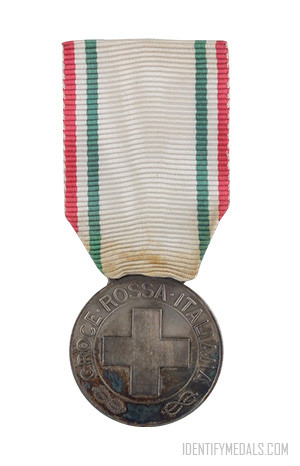
The Florence Nightingale Medal

The Florence Nightingale Medal was instituted in 1912 by the Red Cross as the highest distinction a nurse can achieve.
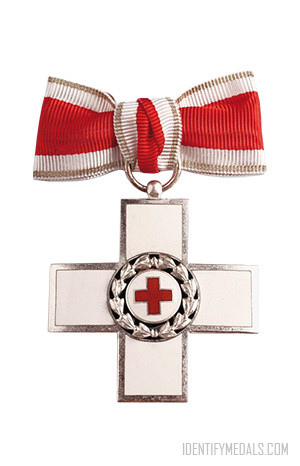
The Florence Nightingale Medal was instituted in 1912 by the International Committee of the Red Cross. It is the highest international distinction a nurse can achieve and is awarded to nurses or nursing aides for “exceptional courage and devotion to the wounded, sick or disabled or to civilian victims of a conflict or disaster” or “exemplary services or a creative and pioneering spirit in the areas of public health or nursing education“.

The assembled delegates of the Eighth International Conference of Red Cross Societies in London in 1907 decided to create a commemorative International Nightingale Medal to be awarded to those distinguished in the nursing field. It was initially set up to be awarded to six nurses annually, although the first 42 awards were only made in 1920 due to the disruption of the First World War. Among the first recipients were six American nurses: Florence Merriam JohnsonHelen Scott HayLinda K. MeirsMartha M. RussellMary E. Gladwin, and Alma E. Foerster.

The medal was restricted to female nurses until regulation changes in 1991. Under the new regulations, it is open to both women and men and is awarded every two years to a maximum number of fifty recipients worldwide. 

In 2007, the 41st set of medals were awarded to 35 recipients from 18 countries. In 2009, the 42nd set of medals were awarded to 28 recipients from 15 countries, including one for the first time to a nurse in Afghanistan. In 2011, the 43rd set of medals were awarded to 39 recipients from 19 countries, (including for the first time to two Kenyan nurses). In 2013, the 44th set of medals were awarded to 32 recipients from 16 countries, including one posthumously to a delegate from the British Red Cross. In 2015, the 45th set of medals were awarded to 36 recipients from 18 countries, including one posthumously to a Sierra Leonian nurse who had worked in an Ebola treatment center.

In 2017, the 46th set of medals were awarded to 39 recipients from 22 countries, including one to Rear Admiral Sylvia Trent-Adams, the Acting Surgeon General of the United States.

The medal and a diploma are usually presented by the Head of State at a ceremony in their own country, which is required to have “a formal character, in keeping with the founders’ wishes“.

The Florence Nightingale Medal Design

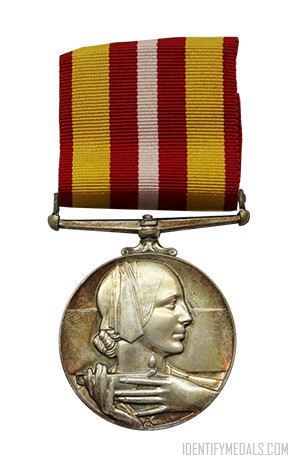
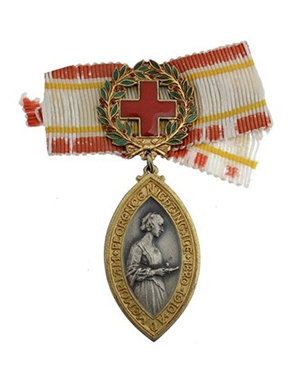
The vesica piscis-shaped medal is composed of gold and silver-gilt and bears, on the obverse, a portrait of Florence Nightingale surrounded by the words ‘Ad memoriam Florence Nightingale 1820-1910‘.

On the reverse, the name of the recipient and the date of the award are engraved, surrounded by the inscription ‘Pro vera misericordia et cara humanitate perennis décor universalis‘ (‘true and loving humanitarianism – a lasting general propriety‘).

The medal is attached to a white and red ribbon by a clasp featuring a red enamel cross encircled by a green laurel crown.

Recipients are also presented with a parchment diploma of the award and, from 1927, a miniature version of the medal that could be more easily worn. 

Find Red Cross Medals Online

More Red Cross Medals

The Badge of Military Merit

The Badge of Military Merit is considered the first military award of the U.S. Armed Forces. Its official successor is The Purple Heart.

The Badge of Military Merit is considered the first military award of the United States Armed Forces. The Purple Heart is its official successor decoration.

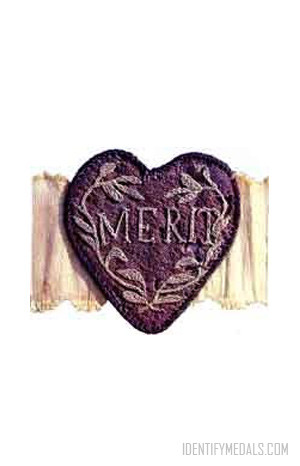
The Badge of Military Merit was first announced in General George Washington‘s general orders to the Continental Army issued on August 7, 1782 at the Headquarters in Newburgh. Designed by Washington in the form of a purple heart, it was intended as a military order for soldiers who exhibited, “not only instances of unusual gallantry in battle, but also extraordinary fidelity and essential service in any way.”

This is thought to be the first time in modern history that military awards had been presented to common soldiers. The practice in Europe was to honor high-ranking officers who had achieved victory, rather than honoring common soldiers. But in America, as General Washington said, the “road to glory in a patriot army and a free country is…open to all.”

Most historians indicate that only three people received the Badge of Military Merit during the American Revolutionary War, all of them non-commissioned officers, and the only ones who received the award from General Washington himself.

Those soldiers are:

On May 3, 1783

On June 10, 1783

Of the Badge of Military Merit, Washington said:

The General ever desirous to cherish virtuous ambition in his soldiers, as well as to foster and encourage every species of Military merit, directs that whenever any singularly meritorious action is performed, the author of it shall be permitted to wear on his facings over the left breast, the figure of a heart in purple cloth, or silk, edged with narrow lace or binding. Not only instances of unusual gallantry, but also of extraordinary fidelity and essential service in any way shall meet with a due reward. Before this favour can be conferred on any man, the particular fact, or facts, on which it is to be grounded must be set forth to the Commander in chief accompanied with certificates from the Commanding officers of the regiment and brigade to which the Candadate for reward belonged, or other incontestable proofs, and upon granting it, the name and regiment of the person with the action so certified are to be enrolled in the book of merit which will be kept at the orderly office. Men who have merited this last distinction to be suffered to pass all guards and sentinals which officers are permitted to do. The road to glory in a patriot army and a free country is thus open to all. This order is also to have retrospect to the earliest stages of the war, and to be considered as a permanent one.

The Badge of Military Merit Medal Design

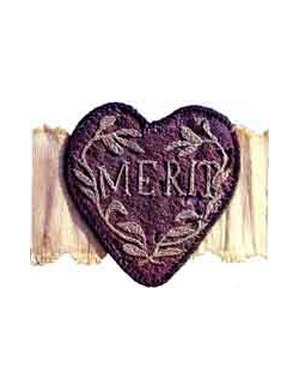
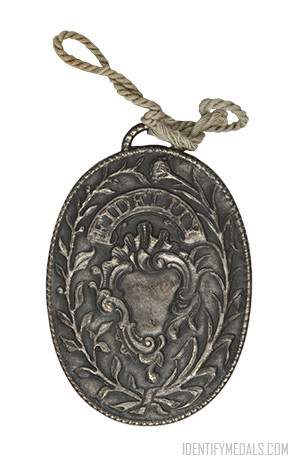
The medal was designed by Washington in the form of a purple heart. The writings of General Washington indicate that three badges, two Honorary Badges of Distinction and a Badge of Military Merit, were created on August 7, 1782. 

Brown’s badge (image above) was found in a Deerfield, New Hampshire barn in the 1920s. There is disagreement in published sources about what became of Brown’s badge after that. A badge on display at the American Independence Museum in Exeter, New Hampshire on behalf of the Society of the Cincinnati, New Hampshire Branch is stated to be Brown’s. Other sources say that Brown’s badge was reported lost in 1924 while in the possession of Bishop Paul Matthews, and that the badge on display in Exeter belongs to a fourth, unknown recipient.

As of 2015, Churchill’s badge was owned by the National Temple Hill Association and on display at the New Windsor Cantonment State Historic Site. Churchill’s badge was rediscovered when H. E. Johnson, a Michigan farmer and one of Churchill’s descendants, wrote to the National Temple Hill Association about the badge.

Bissell’s badge was reportedly lost when his house burned in July 1813.

The Purple Heart

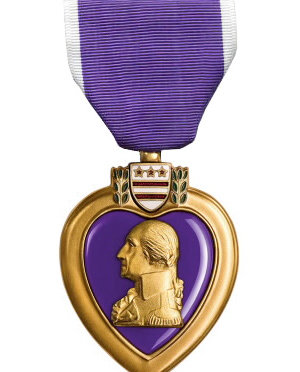
The Purple Heart is a military decoration from the United States awarded to those wounded or killed while serving with the U.S. military.
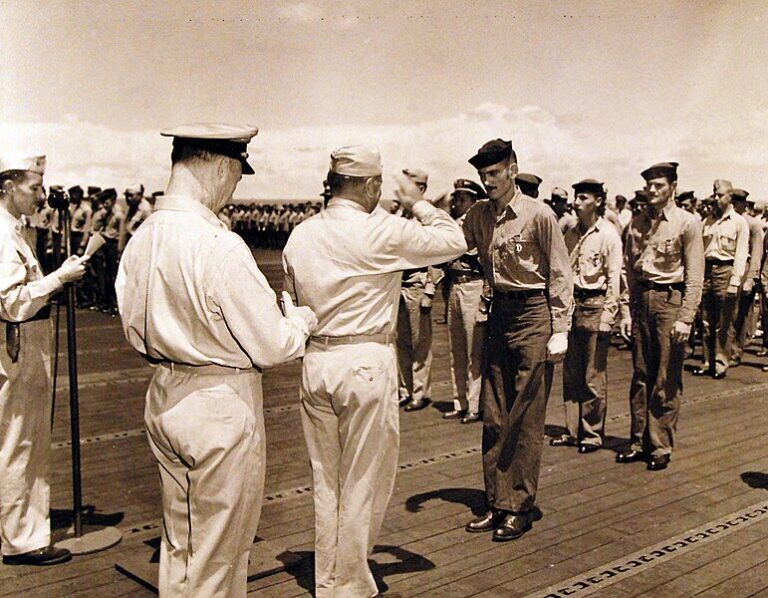
The Purple Heart is a military decoration from the United States awarded in the name of the president to those wounded or killed while serving, on or after April 5, 1917, with the U.S. military. 

The Purple Heart is the oldest military award still given to U.S. military members. The Purple Heart differs from most other decorations in that an individual is not “recommended” for the decoration; rather he or she is entitled to it upon meeting specific criteria.

Criteria: [For] “Being wounded or killed in any action against an enemy of the United States or as a result of an act of any such enemy or opposing armed forces”

The Establishment of the Purple Heart (1782)

The original Purple Heart was established by George Washington on August 7, 1782. The (then called) Badge of Military Merit was only awarded to three Revolutionary War soldiers by Gen. George Washington himself. From then on, as its legend grew, so did its appearance. 

On October 10, 1927, Army Chief of Staff General Charles Pelot Summerall directed that a draft bill be sent to Congress “to revive the Badge of Military Merit“. A number of private interests sought to have the medal re-instituted in the Army and on January 7, 1931, Summerall’s successor, General Douglas MacArthur, confidentially reopened work on a new design, involving the Washington Commission of Fine Arts.

The Purple Heart Revived (1932)

By Executive Order of the President of the United States, the Purple Heart was revived on the 200th Anniversary of George Washington’s birth, out of respect to his memory and military achievements, by War Department General Order No. 3, dated February 22, 1932. The first Purple Heart was awarded to MacArthur. During the early period of American involvement in World War II (December 7, 1941 – September 22, 1943), the Purple Heart was awarded both for wounds received in action against the enemy and for meritorious performance of duty. 

After the award was re-authorized in 1932 some U.S. Army wounded from conflicts prior to the first World War applied for, and were awarded, the Purple Heart: “…veterans of the Civil War and Indian Wars, as well as the Spanish–American War, China Relief Expedition (Boxer Rebellion), and Philippine Insurrection” also were awarded the Purple Heart.

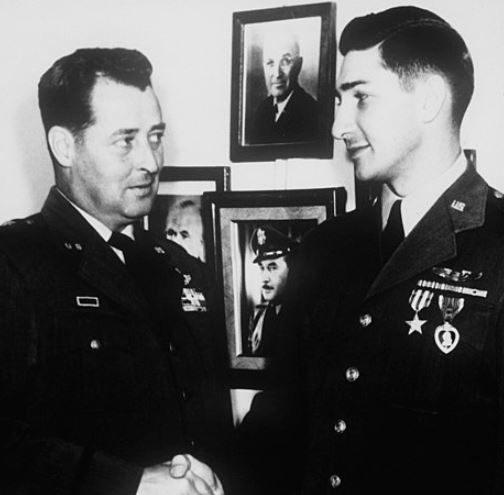
Rear Admiral Ralph Davidson presenting the Purple Heart to personnel onboard a carrier in July 7, 1944. Image courtesy of the National Archives.

The Purple Heart Medal Design

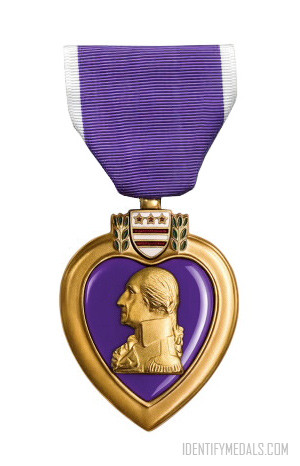
Elizabeth Will, an Army heraldic specialist in the Office of the Quartermaster General, was named to redesign the newly revived medal, which became known as the Purple Heart. Using general specifications provided to her, Will created the design sketch for the present medal of the Purple Heart. The new design, which exhibits a bust and profile of George Washington, was issued on the bicentennial of Washington’s birth. Will’s obituary, in the edition of February 8, 1975 of The Washington Post newspaper, reflects her many contributions to military heraldry. The Commission of Fine Arts solicited plaster models from three leading sculptors for the medal, selecting that of John R. Sinnock of the Philadelphia Mint in May 1931.

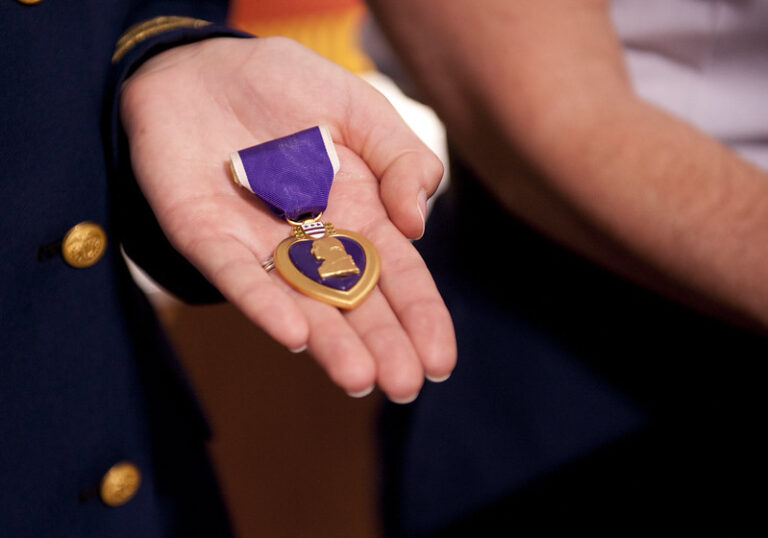
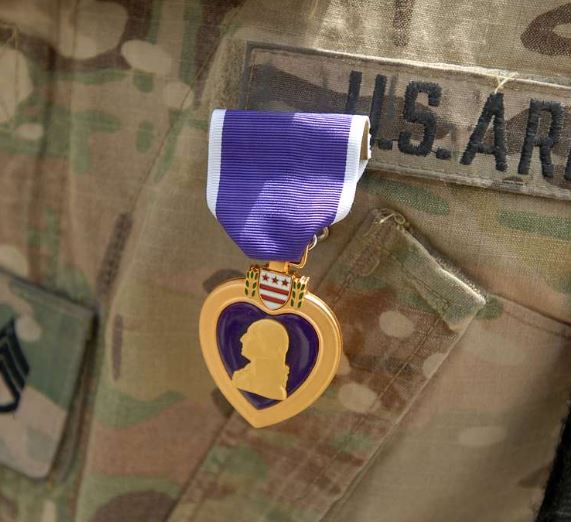
The Purple Heart award is a heart-shaped medal within a gold border, 1 38 inches (35 mm) wide, containing a profile of General George Washington. On the obverse and above the heart appears a shield of the coat of arms of George Washington (a white shield with two red bars and three red stars in chief) between sprays of green leaves. The reverse consists of a raised bronze heart with the words FOR MILITARY MERIT below the coat of arms and leaves.

The ribbon is 1 38 inches (35 mm) wide and consists of the following stripes: 18 inch (3.2 mm) white 67101; 1 18 inches (29 mm) purple 67115; and 18 inch (3.2 mm) white 67101. Additional awards of the Purple Heart are denoted by oak leaf clusters in the Army and Air Force, and additional awards of the Purple Heart Medal are denoted by ​516 inch stars in the Navy, Marine Corps, and Coast Guard.

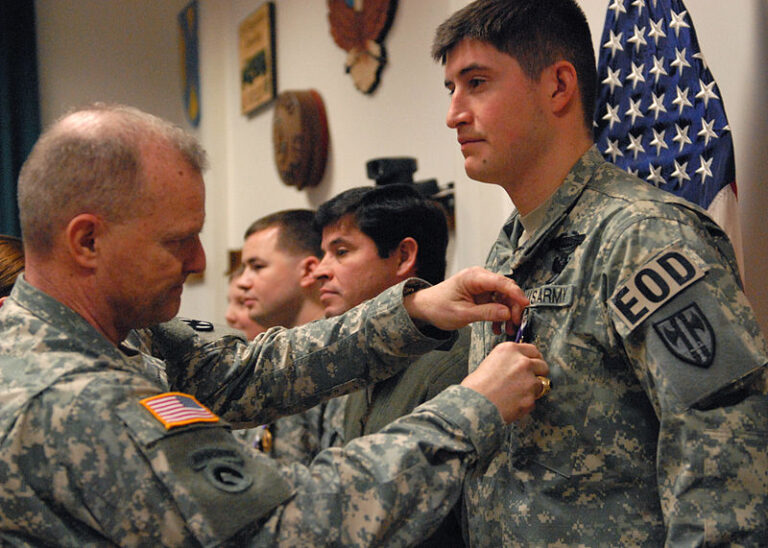
A soldier is awarded the Purple Heart during a ceremony on Coleman Barracks.
A soldier is awarded the Purple Heart during a ceremony on Coleman Barracks. Image courtesy of Wikipedia.

More About the Purple Heart

Do you want to learn more about this prestiguous American award? Here are some details that explore the history of the medal, its design,a nd symbolism:

Related Medals and Awards

The Purple Heart has a long history. So, it’s no surprise there were previous versions or medals that served as inspiration to establishing the 1932 version. These include:

Find This Medal

Right Now on eBay 
Clicking a link to eBay may result in a referral commission being paid if a purchase is made.
Loading...

The Order of the White Eagle (Serbia)

Order of the White Eagle was a Royal Order in the Kingdom of Serbia (1883–1918) and the Kingdom of Yugoslavia (1918–1945) instituted by King Milan I of Serbia on 23 January 1883. In the period between 1883 and 1898 Order of the White Eagle was the highest award in the Kingdom of Serbia.

The Order had five classes and was conferred on Serbian and Yugoslav citizens for achievements in peace or war, or for special merits to the Crown, the state and nation.  In 1898 the Royal Order of Miloš the Great took precedence over the White Eagle and in 1904 the former was replaced by the Order of the Karađorđe’s Star.

After his accession to the throne in 1903, King Peter I of Serbia continued awarding the Order of the White Eagle, but the reverse of the medallion had the year of the proclamation of the Kingdom (1883) instead of the cipher of Milan I.

The Order is conferred by the Crown. Recent awards include last Grand Master of the Sovereign Order of St. John (Fr. Angelo de Mojana di Cologna), as well as posthumous conferment upon three Crown Council Members.

The Order of the White Eagle Design

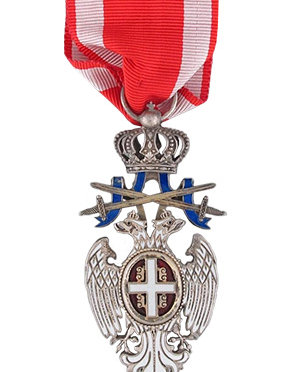
The Order of the White Eagle is made in silver gilt with red, white and blue enamels. It measures 31.8 mm (w) x 68 mm (h) inclusive of its crown suspension.

The Order had five degrees, and could be awarded with swords for the military services, with or without swords for civil merit. The classes were:

  • SRB-SHS-YUG Orden Belog Orla VKrst BAR.svg 1st Class – Grand Cross
  • SRB-SHS-YUG Orden Belog Orla VOficir BAR.svg 2nd Class – Grand Officer’s Cross
  • SRB-SHS-YUG Orden Belog Orla Komandir BAR.svg 3rd Class – Commander’s Cross
  • SRB-SHS-YUG Orden Belog Orla Oficir BAR.svg 4th Class – Officer’s Cross
  • SRB-SHS-YUG Orden Belog Orla Kavalir BAR.svg 5th Class – Knight’s Cross

The sash of the Order is worn from the left shoulder to the right hip.

The Cross for Loyalty to the Assassinated President Venustiano Carranza

The Cross for Loyalty to Carranza is a medal issued during 1910 and 1920 when control of Mexico’s government was attempted by several parties. 
The Cross for Loyalty to the Assassinated President Venustiano Carranza is a medal issued during the early years of the twentieth century, between 1910 and 1920 when control of Mexico’s government was attempted by several parties.
The United States involvement in the Mexican Revolution was varied and seemingly contradictory, first supporting and then repudiating Mexican regimes during the period 1910-1920. For both economic and political reasons, the U.S. government generally supported those who occupied the seats of power, whether they held that power legitimately or not.

When Francisco I. Madero was elected president in October 1911, the U.S. president was a lame duck. The U.S. Ambassador to Mexico, Henry Lane Wilson was initially sympathetic to the new regime, but quickly came into conflict with it. Ambassador Wilson conspired with General Victoriano Huerta to oust Madero.

The United States government under newly inaugurated president Woodrow Wilson refused to recognize Huerta’s government and sent troops to occupy Veracruz. President Wilson’s government recognized the government of Venustiano Carranza in 1915.

The Cross for Loyalty to the Assassinated President Venustiano Carranza Design

The Cross for Loyalty is typically designed in the shape of a cross, which is a common motif for many military medals and decorations. At the center of the cross, there is usually a circular medallion. This medallion features a depiction of President Venustiano Carranza. The image of Carranza may vary in detail but typically includes his profile or bust.

Around the outer edge of the central medallion, there may be an inscription. This inscription may include Carranza’s name, title, and dates of birth and death, as well as the words “Por la Lealtad” (For Loyalty) or similar phrases. The cross often has arms that radiate outward from the central medallion, creating a cross-like shape. These arms are usually plain but may sometimes feature decorative elements or symbols.

The medal is typically suspended from a ribbon that allows it to be worn around the neck or pinned to a uniform. The ribbon’s color and design may vary but often incorporate the national colors of Mexico, which are green, white, and red.