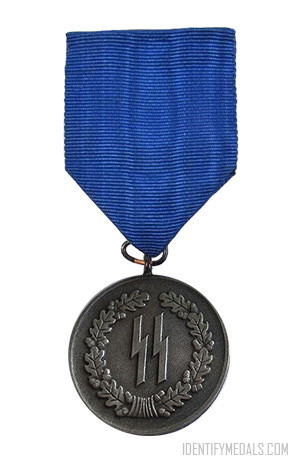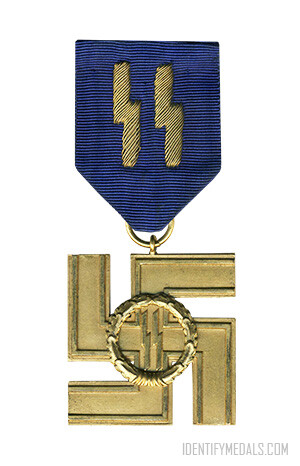
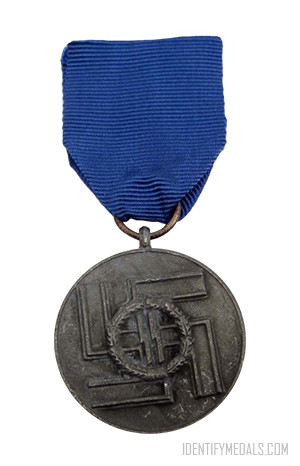
The SS Long Service Award (12 Years of Service)

The SS Long Service Awards were given to SS members in grades of four, eight, twelve, and twenty-five years of service.
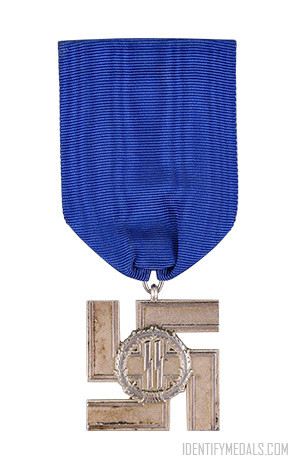
The SS Long Service Awards (or SS-Dienstauszeichnungen in German) were given in grades of four years, eight years, twelve years, and twenty-five years as an acknowledgment for faithful and true services of SS members in the SS-Verfügungstruppen (SS Dispositional Troops), SS-Totenkopfverbänden (Death’s Head Units) und SS-Junkerschulen (Junker Schools). It was first introduced by Adolf Hitler on 30 January 1938.

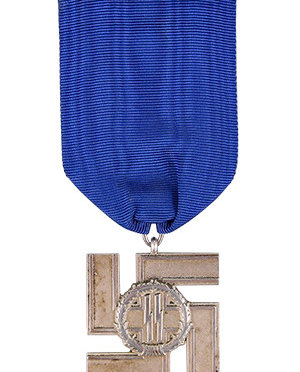
The four and eight-year service awards were in the form of circular medals while the 12 and 25-year service awards were in the form of swastikas.  According to historian Chris Ailsby the awards ceased to be given at the end of 1941.

The SS Long Service Awards Grades or Classes

The grades are awarded to the respective ranks as follows:

  • 1st Class (Gold) for 25 years true service awards to eligible Officers, NCO’s and Men
  • 2nd Class (Silver) for 12 years true service awards to eligible Officers, NCO’s and Men
  • 3th Class (Bronze) for 8 years true service awards to eligible Officers, NCO’s and Men
  • 4th Class (Black) for 4 yrs true service for eligible NCO’s and Men.

The four-year and eight-year awards were the most common awards, and despite the fact that the Nazi movement lasted for little over 25 years, awards of the 25-year version were made well before 25 years of actual service were completed. This was because Kampfzeit (or “Time of Struggle”) counted double. Nevertheless, this was one of the rarer awards given out by Nazi Germany.

The SS Long Service Awards Design

The SS service awards were designed in Munich by Professor Karl Diebitsch, an artist and the Schutzstaffel (SS) officer responsible for designing much of the SS regalia in the Third Reich, including the chained SS officer’s dagger scabbard.

On its reverse side, each award had emblazoned the inscription, in German: FÜR TREUE DIENSTE IN DER SS (“For Loyal Service in the SS”). 

The awards varied in design depending on the length of service of the recipient, and the branches of the Wehrmacht (LuftwaffeHeer and Kriegsmarine) had different insignia. The Nazi Party and German Police also had a similar service award.

The twelve-year service award was in the shape of the swastika, had a silver finish and was awarded to all Officers, NCOs and enlisted men.

The Supreme Order of the Most Holy Annunciation

The Supreme Order of the Most Holy Annunciation was the pinnacle of the honors system in the Kingdom of Italy.

The Supreme Order of the Most Holy Annunciation (or Ordine Supremo della Santissima Annunziata in Italian) is a Roman Catholic order of knighthood, originating in Savoy.

It was the pinnacle of the honors system in the Kingdom of Italy, which ceased to be a national order when the kingdom became a republic in 1946.

The origins of the Supreme Order of the Most Holy Annunciation begin in 1362, when Amadeus VI, Count of Savoy (1343-1383) instituted the order’s earliest designation, under the title of Order of the Collar. Even at this time, the order was dedicated to the Blessed Virgin Mary, who is celebrated as “Our Lady of the Annunciation.” Thus, the order is a dynastic religious (or Catholic) order of chivalry. Under its first formulation, the order had fifteen knights.

Today, the order holds the following other regulations:

  • The number of knights of the Supreme Order of the most Holy Annunciation shall be, as in the past, twenty.
  • The right to appoint knights and officers of the Order appertains exclusively to the Sovereign Head. Nevertheless, when there are vacancies, the Sovereign Head meets with the Chapter of knights to hear their advice on the proposal of candidates whom he alone may select.
  • The knights shall be chosen from distinguished individuals in recognition of their eminent services in high military positions, as well as from those who have distinguished themselves in senior positions in the civil service, and from those who, as private citizens have brought distinction upon Italy as exemplary benefactors of the Nation or of Mankind, or have rendered particularly noteworthy services to the Royal House of Savoy.
  • Knights must have already been awarded the Order of Saints Maurice and Lazarus.
  • Knights must be Catholic. In rare occasions, a non-Catholic may be awarded the order. However, they may only be honorary members of the order.

The order has only one class, i.e. Knight. The full Italian title is Cavaliere dell’Ordine Supremo della Santissima Annunziata.

The Supreme Order of the Most Holy Annunciation Design

Although the order has only one class, it has two sets of insignia, the Piccola Collana and the Grande Collana. The two hold similar designs, though the Grande Collana has some different features than the Piccola Collana and is worn only on the most special of occasions.

The insignia of the order has the following regulations:

  • The large collar (Grande Collana) is worn on the first day of the year, on the feast of the Most Holy Annunciation, and on all of the principal national holidays and at important royal functions.
  • The small collar (Piccola Collana) is worn on every other occasion which necessitates the display of order insignia.
  • Knights also wear, on the left breast, a star badge bearing the image of Holy Mary of the Annunciation.

Today, the order continues as a dynastic order under the jurisdiction of the Head of the House of SavoyVittorio Emanuele, Prince of Naples, who is the order’s hereditary Sovereign and Grand Master.

The German Cross (Post-WW2 Version)

The German Cross (or Deutsches Kreuz in German) was instituted by Adolf Hitler on 28 September 1941 and awarded in gold and silver.

The German Cross (also known as The War Order of the German Cross, or Der Kriegsorden Deutsches Kreuz in German) was instituted by Adolf Hitler on 28 September 1941 and awarded in gold and silver, depending on the division.

The German Cross in Gold (ranked higher than the Iron Cross First Class but below the Knight’s Cross of the Iron Cross) was awarded for repeated acts of bravery or achievement in combat. The German Cross in Silver, on the other hand (which ranked higher than the War Merit Cross First Class with Swords but below the Knight’s Cross of the War Merit Cross with Swords) was awarded for distinguished non-combat war service.

The German Cross Eligibility

In order to qualify for the German Cross, the recipient had to be a holder of the Iron Cross or the War Merit Cross.

Civilians were not eligible for this medal, although awards could be made to specific members of uniformed formations, such as railway workers or the police. In 1942, eligibility for the German Cross in Gold was also extended to the armed forces of allied countries.

The German Cross Design

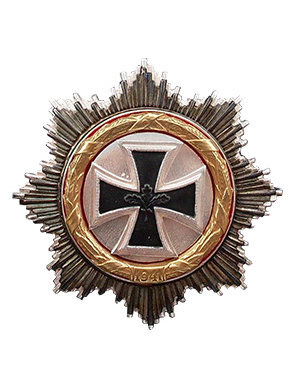
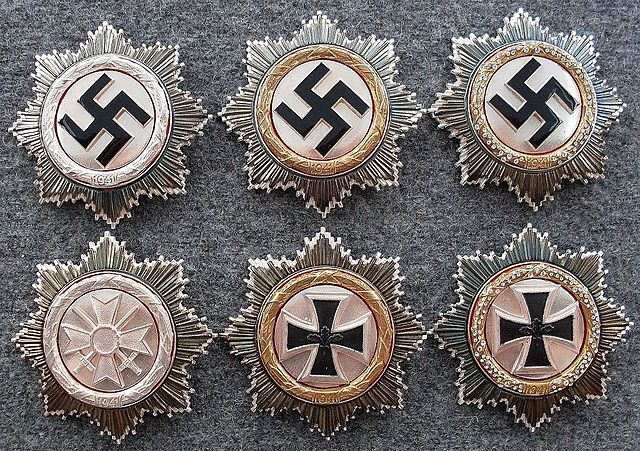
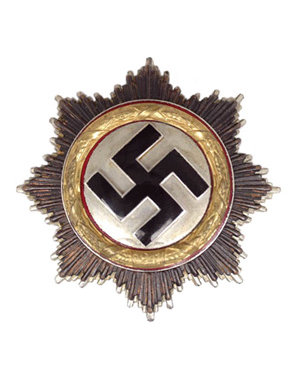
The original order consisted of a star badge with a swastika (in German a Hakenkreuz or “hooked cross”, hence the medal’s name). In 1957, however, alternative de-nazified replacement versions of the German Cross were authorized for wear by the Federal Republic of Germany. These medals replaced the swastika with a representation of the Iron Cross for the gold division, and the War Merit Cross with Swords for the silver division.

The German Cross has a diameter of 6.5 cm and was worn on the right-hand side of the tunic. If a recipient had been awarded both the silver and gold divisions, the gold division should be worn only.

German Cross in Silver, Gold, and with Diamonds. Post-war denazified versions shown below.

Find a German Cross 

Right Now on eBay 
Clicking a link to eBay may result in a referral commission being paid if a purchase is made.
Loading...

The German Cross (Nazi-Germany)

The German Cross (Deutsches Kreuz) was instituted by Adolf Hitler on 28 September 1941 and awarded in gold and silver.

The German Cross (or Deutsches Kreuz in German) was instituted by Adolf Hitler on 28 September 1941 and awarded in gold and silver.

The German Cross in Gold (ranked higher than the Iron Cross First Class but below the Knight’s Cross of the Iron Cross), was awarded for repeated acts of bravery or achievement in combat. The German Cross in Silver (ranked higher than the War Merit Cross First Class with Swords but below the Knight’s Cross of the War Merit Cross with Swords) was awarded for distinguished non-combat war service.

The German Cross Classes

The German Cross was available in two versions: gold and silver, distinguished by the color of the laurel wreath surrounding the swastika.

  • The Gold German Cross: The gold version was conferred upon military personnel for repeated acts of bravery in combat or for exceptional military leadership, typically requiring 6–8 such acts.
  • The Silver German Cross: The silver version was awarded for multiple distinguished services to the war effort and served as a continuation of the War Merit Cross with swords. When a recipient was awarded both versions, only the gold version was authorized for wear.

The German Cross Design

The order consists of a star badge with a swastika (in German a Hakenkreuz or “hooked cross”, hence the medal’s name). The German Cross has a diameter of 6.5 cm and was worn on the right-hand side of the tunic. If a recipient had been awarded both the silver and gold divisions, the gold division should be worn only.

In 1957 alternative de-nazified replacement versions of the German Cross were authorized for wear by the Federal Republic of Germany. These medals replaced the swastika with a representation of the Iron Cross for the gold division, and the War Merit Cross with Swords for the silver division.

Colonel Hans von Luck called the German Cross “Hitler’s fried egg“, in response to its gaudiness.

German Cross in Silver, Gold, and with Diamonds. Post-war denazified versions shown below.

Find a German Cross 

Note: As an eBay partner, I earn from qualifying purchases. This is all done automatically when you use a link and at no extra cost to you.

Right Now on eBay 
Clicking a link to eBay may result in a referral commission being paid if a purchase is made.
Loading...

The National Order of Merit (France)

The National Order of Merit (or Ordre national du Mérite in French) is an order of merit with membership established to replace the large number of ministerial orders previously awarded by the ministries and to create an award that can be given at a lower level than the Legion of Honour, which is generally reserved for French citizens.

The National Order of Merit was awarded by the President of the French Republic, founded on 3 December 1963 by President Charles de Gaulle. It comprises about 187,000 members worldwide. The President of the French Republic is the Grand Master of the order and appoints all its members by convention on the advice of the Government of France.

The order has a common Chancellor and Chancery with the Legion of Honour. Every Prime Minister of France is made a Grand cross of the order after 24 months of service.

The National Order of Merit Design

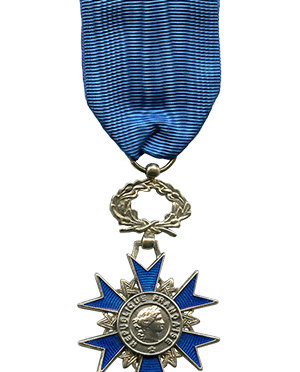
The medal of the order is a six-armed Maltese asterisk in gilt enamelled blue, with laurel leaves between the arms.

The obverse central disc of the National Order of Merit medal features the head of Marianne, surrounded by the legend République française (French Republic). The reverse central disc has a set of crossed tricolores, surrounded by the name of the order and its foundation date. The badge is suspended by a laurel wreath.

The Order has five classes:

  • Three ranks:
    • Knight (Chevalier): to be of a minimum age of 35, minimum of 10 years of public service and “distinguished merits”;
    • Officer (Officier): minimum of 5 years in the rank of Knight;
    • Commander (Commandeur): minimum of 5 years in the rank of Officer;
  • Two dignities:
    • Grand Officer (Grand Officier): minimum 3 years in the rank of Commander; and
    • Grand Cross (Grand-Croix): minimum 3 years in the rank of Grand Officer.

The Order of Liberation

The Order of Liberation (or “Ordre de la Libération” in French) is a high honor Order awarded to heroes of the Liberation of France during World War II. It is second only after the Légion d’Honneur (Legion of Honour). The Order of Liberation was established by General de Gaulle in order n° 7, signed in Brazzaville on November 16, 1940 to “reward people, of the military or civilian communities, who will have distinguished themselves in the task of liberating France and her Empire”.

Very few people, military units and communes were ever awarded it, and only for their deeds during World War II. There were no restrictions as to age, sex, rank, origin or nationality; nor about the nature of the deeds, other than their exceptional quality.

The Order has a single rank, the title of Compagnon de la Libération (“Companion of the Liberation”). General de Gaulle, founder of the Order, was the only Grand Maître (“Grand Master”) of the Order.

The Order of Liberation Design

The medal of the Order or Croix de la Libération (“Cross of Liberation”), measures 31 mm wide by 33 mm high and is made of a rectangular bronze shield bearing a 60 mm high vertical gladius on its obverse.

On the blade of the gladius: a black enamelled Cross of Lorraine. On the reverse, a relief inscription in bold letters and in Latin reads, on four rows, “PATRIAM SERVANDO VICTORIAM TULIT” (“By serving the Fatherland, he/she achieved Victory”).

A total of 1061 Crosses of Liberation were awarded: 1038 to individuals, 18 to units of the Army, Air Force and Navy and five to cities: Nantes, Grenoble, Paris, Vassieux-en-Vercors, and l’Île de Sein.

The Legion of Honor

The Legion of Honor (or Ordre national de la Légion d’honneur in French) is the highest French order of merit for military and civil merits.

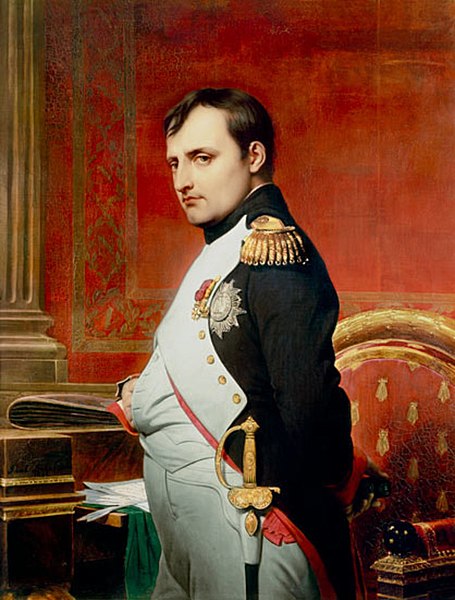
The Legion of Honour (National Order of the Legion of Honour; or Ordre national de la Légion d’honneur in French) is the highest French order of merit for military and civil merits. The Legion of Honour was established in 1802 by Napoleon Bonaparte and retained by all the divergent governments and regimes later holding power in France.

The Légion d’honneur is a body of men and not an order of chivalry, for Napoleon believed that France wanted a recognition of merit rather than a new system of nobility. The order’s motto is Honneur et Patrie (“Honour and Fatherland”), and its seat is the Palais de la Légion d’Honneur on the left bank of the River Seine in Paris.

Since the establishment of the Legion, the Grand Master of the order has always been the Emperor, King or President of France. 

The Legion of Honor Degrees or Classes

The order is divided into five degrees of increasing distinction: ChevalierOfficierCommandeur, Grand-officier, and Grand-croix.

  • Chevalier (Knight): The lowest rank of the Legion of Honor is awarded to individuals who have made notable contributions to French society or who have shown exceptional dedication and service to their profession. Recipients are entitled to wear the insignia badge.
  • Officier (Officer): The next rank is bestowed upon individuals who have demonstrated significant achievements or leadership in their field of expertise. Officers wear the same insignia but with a small rosette on the ribbon.
  • Commandeur (Commander): The third degree is awarded to individuals who have distinguished themselves through exceptional contributions to French society, culture, or the nation. Commanders wear the same insignia with the addition of a larger rosette on the ribbon.

  • Grand Officier (Grand Officer): This higher degree is reserved for individuals who have achieved extraordinary accomplishments or held high-ranking positions of responsibility. Recipients wear a badge with a silver star suspended from the ribbon.
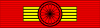
  • Grand Croix (Grand Cross): The highest and most prestigious degree of the Legion of Honor, this rank is reserved for heads of state, senior government officials, and individuals who have rendered exceptional services to France or humanity. Grand Cross recipients wear a badge with a silver star and a sash over the right shoulder.
The Legion of Honor Design

The badge of the Légion is a five-armed “Maltese Asterisk” in gilt (made in silver for chevalier) enameled white, with an enameled laurel and oak wreath between the arms.

The obverse of the Legion of Honour medal central disc is in gilt, featuring the head of Marianne, surrounded by the legend République Française on a blue enamel ring. The reverse central disc is also in gilt, with a set of crossed tricolores, surrounded by the Légion’s motto Honneur et Patrie (Honour and Fatherland) and its foundation date on a blue enamel ring. The badge is suspended by an enameled laurel and oak wreath.

The star (or plaque) is worn by the Grand Cross (in gilt on the left chest) and the Grand Officer (in silver on the right chest) respectively; it is similar to the badge, but without enamel, and with the wreath replaced by a cluster of rays in between each arm. 

As Emperor, Napoleon always wore the Cross and Grand Eagle of the Legion of Honor.

Find This Medal

Right Now on eBay 
Clicking a link to eBay may result in a referral commission being paid if a purchase is made.
Loading...

The 1939–1945 Commemorative War Medal (France)

The 1939–1945 Commemorative War Medal is a medal of France established in 1946 to recognize individual participation in the Second World War.

The 1939–1945 Commemorative War Medal (or “Médaille commémorative de la guerre 1939–1945” in French) is a commemorative medal of France established in 1946 to recognize individual participation in the Second World War.

The medal was awarded to all soldiers serving under French authority or under a French government in a state of war against the Axis nations, as well as present on board a warship or armed merchant vessel, to French citizens, military or civilian, who fought against the Axis forces or their representatives, and to foreign military who served as Frenchmen in formations at war against the Axis forces.

The 1939–1945 Commemorative War Medal Design

The 1939–1945 Commemorative war medal is hexagonal in shape and struck from bronze. It measures 28mm wide and 38mm high excluding the suspension loop.

The obverse of the medal bears the relief image of a rooster superimposed in front of a Cross of Lorraine. The reverse shows a relief semi circular inscription “RÉPUBLIQUE FRANÇAISE” over a sprig of laurel leaves and the inscription on three lines “GUERRE” “1939” “1945”.