The Ordre de l’Union Parfaite

The Ordre de l’Union Parfaite was established in 1732 and given to women to celebrate the tenth anniversary of Sophie Magdalene’s marriage.

The Ordre de l’Union Parfaite was established by Queen consort Sophie Magdalene of Denmark and Norway on 7 August 1732 to mark the tenth anniversary of her marriage to King Christian VI. 

The French name translates to the Order of the Perfect Union or Order of Friendship, reflecting the common use of French in royal courts of the time.

This order, awarded to both men and women, bore the motto “In felicissimæ Unionis Memoriam” (“In Commemoration of the Happiest [Marital] Union”). Conferral of the Order ceased after the Queen’s death on 7 May 1770.

The Ordre de l’Union Parfaite Design

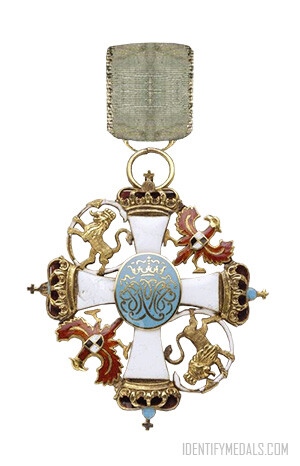
The badge or “jewel” of the Order was a white enamelled cross with each arm capped by a golden crown. Between the arms were alternating golden Norwegian lions holding a halberd and red-enamelled, golden-headed Brandenburg eagles.

The center featured a blue oval medallion, encircled by diamonds, displaying the crowned intertwined monograms of Sophie Magdalene and Christian VI.

The dark blue silk ribbon, edged with silver, was worn differently by gender: gentlemen wore the cross in a left buttonhole of their coats, while ladies wore it on their left breasts.
The Order of the Armed Arm

The Order of the Armed Arm was an order of chivalry of Denmark established in 1616 and later merged with the Order of the Elephant.

The Danish Order of the Armed Arm (or den Væbnede Arms Orden in Danish) was a chivalric order established by Christian IV of Denmark in 1616, with the knighting of twelve noblemen.

It was created to honor those who had distinguished themselves in the Kalmar War and was first and only bestowed on 2 December 1616 during celebrations in Kolding for the enfeoffment of Slesvig to Frederick III, Duke of Holstein-Gottorp.

The order was later merged with the Order of the Elephant in 1633-1634 and is considered a predecessor of the Order of the Dannebrog. The badges of the Order of the Elephant issued in 1633 were augmented on the reverse with the badge of the Order of the Armed Arm. This addition was removed in the following year’s issue. In 1634, Christian IV offered the two surviving knights, Christen Friis and Albret Skeel, the option to exchange their Armed Arm badges for the Elephant. There exists a specimen with the monogram of Christian V, indicating he considered reviving the order, but he ultimately established the Order of the Dannebrog in 1671.

The Order of the Armed Arm Design

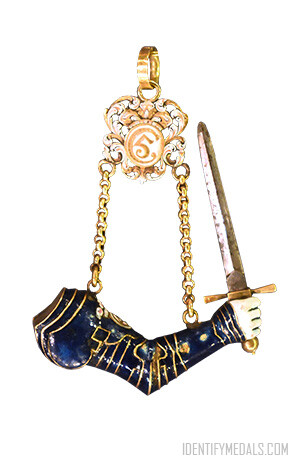
The badge of the Order was worn around the neck on a blue ribbon and featured two chains hanging from a clasp. At the ends of the chains was a diamond-studded, armor-plated arm holding a drawn sword, earning the order the names “Order of the Drawn Sword” or “Order of the Sword.”

It bears the year 1617, marking the centenary of Martin Luther’s 95 Theses, symbolizing the struggle for Protestantism. 

The Badge of Honor of the League of Civil Defense

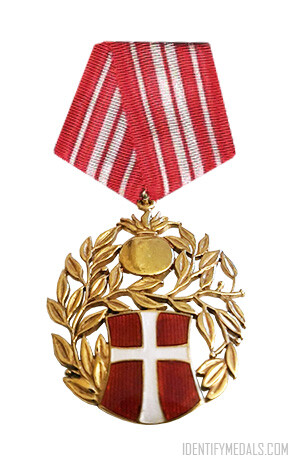
The Badge of Honor of the League of Civil Defense was instituted in 1956 by King Frederik IX and is awarded for noteworthy deeds.

Instituted in 1956 by King Frederik IX, the Badge of Honor of the League of Civil Defense (or Beredskabsforbundets Hæderstegn in Danish) recognizes individuals who have made significant contributions to civil defense over at least 15 years.

Awarded by the President of the Danish Civil Defense Association, the badge honors noteworthy service, volunteer efforts, and exceptional support for civil defense initiatives.

The idea for the medal originated in 1953 from the Association of Police Chiefs. The Civil Defense Association finalized the award, which was first bestowed on June 17, 1957. The association, originally named CivilforsvarsForbundet, rebranded in the mid-2000s, and in 2007, the medal’s name was updated to Beredskabsforbundets Hæderstegn.

The medal is awarded in three categories:

  1. Individuals with at least 15 years of exemplary service within civil defense.
  2. Those who have made significant contributions to civil defense initiatives, such as fire chiefs.
  3. Politicians and public figures who have notably supported civil defense.

Annually, up to 12 medals are awarded, ensuring the recognition of outstanding dedication to civil defense efforts.

The Badge of Honor Design

The medallion is suspended from a ribbon, the colors and patterns of which denote the specific award category.

The Order of the Elephant

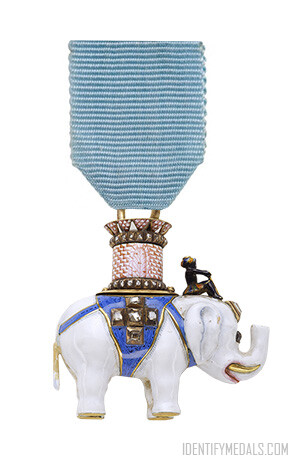
The Order of the Elephant is an order of chivalry established in Denmark during the 15th century. The badge is a white elephant.

The Order of the Elephant (or Elefantordenen in Danish) is Denmark’s highest honor and a prestigious order of chivalry. Though it has roots in the 15th century, it was officially established in its current form in 1693.

The Order traces back to a 15th-century religious confraternity, the Fellowship of the Mother of God, limited to Danish aristocrats. The confraternity’s badge depicted the Virgin Mary and Child within a crescent moon, hung from an elephant-themed collar. Although the confraternity dissolved after the Reformation in 1536, King Frederick II continued using an elephant badge, inspired by the confraternity’s chaplain’s insignia.

In its current form, the Order was established on 1 December 1693 by King Christian V, limited to 30 noble knights plus the Grand Master (the king) and his sons. In 1958, the statutes were amended to allow both men and women to join.

The Order’s emblem, featuring an elephant and a castle, is inspired by the Indian howdah, a carriage mounted on an elephant’s back, a design the Danes encountered during their colonial rule in parts of India. The Indian howdah has been replaced with a European castle, but the elephant rider remains.

The Order of the Elephant Design

The Order of the Elephant features a gold collar made up of alternating elephants and towers. The elephants’ covers bear the letter “D” for Dania, the medieval Latin name for Denmark. The collar is typically worn only on New Year’s Day during the Danish monarch’s New Year’s Court and on major occasions like coronations or jubilees.

Originally, knights wore a distinctive habit on very solemn occasions, consisting of a white doublet, breeches, stockings, and shoes, with a red mantle lined in white and embroidered with the Order’s star. A short white shoulder cape with gold flames and the Order’s collar was worn over this. The ensemble was completed with a black hat featuring a plume of white and red ostrich feathers.

The Badge

The badge is a white-enameled gold elephant with blue housings, approximately 5 cm high. It carries a pink-enameled watch tower adorned with diamonds. A colorfully attired Moorish mahout sits in front of the tower, holding a golden rod. The elephant has a diamond on its forehead and smaller diamonds for eyes, a cross of five diamonds on its right side, and the reigning monarch’s crowned monogram on its left. The badge can be hung from the collar or tied to the sash via a large enameled gold ring at the top of the tower. About 72 such elephants exist at the Order’s chancery or in circulation, with an estimated total of around 100, including those in museums.

The Star

The star of the Order is an eight-pointed silver star with smooth rays. It features a red enamel disc with a white cross at the center, surrounded by a silver laurel wreath, and is worn on the left side of the chest.

The Sash

The sash is made of light-blue silk moiré, 10 cm wide for men and 6 cm wide for women. It is worn over the left shoulder, with the elephant resting on the right hip. The collar is not worn when the sash is used.

The Canadian Forces’ Decoration

The Canadian Forces’ Decoration is awarded to members of the Canadian Armed Forces who have completed twelve years of military service.

The Canadian Forces’ Decoration (post-nominal letters “CD”) is a Canadian award granted to members of the Canadian Armed Forces who have completed twelve years of military service (under specific conditions).

The decoration is awarded to officers and non-commissioned members of the Regular and Reserve forces, including honorary appointees within the Canadian Armed Forces, excluding time on the Supplementary Reserve List. It can be granted to individuals who already hold long service, good conduct, or efficiency awards, as long as the full qualifying periods for each are completed and service for one award does not count towards another.

Service in the regular and reserve or auxiliary forces of the Commonwealth nations is eligible if the final five years are with the Canadian Armed Forces, and no other similar medal has been awarded for that service.

The first governor general to receive the CD was Viscount Alexander of Tunis in 1951. Initially, the medal was awarded to all members of the Royal Family who served in the Canadian Forces, regardless of whether they had completed twelve years of service; however, this practice has not been automatic since 1953.

The Canadian Forces’ Decoration Design

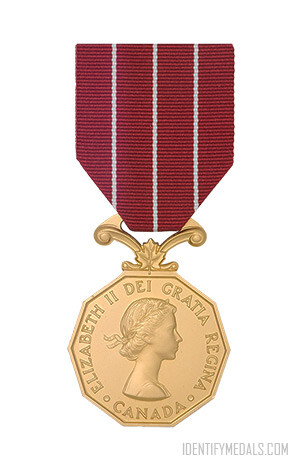
The medal is ten-sided, representing the ten provinces, and measures 36 millimeters across. The King George VI version is made of .800 fine silver and gilded, featuring an uncrowned bust of the King facing left with the inscription “Georgivs VI D: G: Britt: omn: Rex Fid: Def” around the edge.

The Queen Elizabeth II version, made of tombac (a copper-zinc alloy) and later introduced in a gilded copper variant in 2008, has an uncrowned bust of the Queen facing right with “Elizabeth II Dei gratia Regina” around the edge and “Canada” at the bottom.

The reverse of both medals features a naval crown, three maple leaves, and an eagle representing the navy, army, and air force, respectively, with the word “service” on a scroll at the base and a fleur-de-lis on each side of the crown. The King George VI medal includes the royal cypher in the center, which is omitted from the Queen Elizabeth II medal. The King George VI medal has the recipient’s name and rank engraved on the reverse of the solid bar, while the Queen Elizabeth II medal has them engraved around the edge, with early versions stamped rather than engraved.

A clasp, or bar, is awarded for every 10 years of additional service. The clasp is tombac, 1⁄4 inch (6.4 mm) high, with the Canadian coat of arms in the center, crowned and gold in color. On the undress ribbon, this is indicated by a rosette.

The Philippine Liberation Medal

The Philippine Liberation Medal was created in 1944 and presented to those who participated in the liberation of the Philippine Islands.

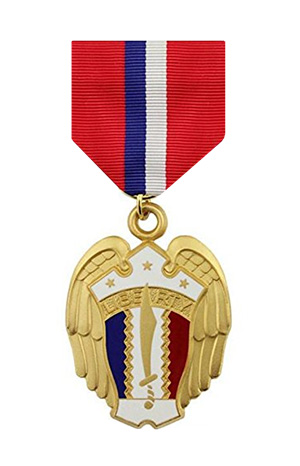
The Philippine Liberation Medal, a military honor of the Republic of the Philippines, was established by an order from the Commonwealth Army of the Philippines Headquarters on December 20, 1944, initially known as the Philippine Liberation Ribbon. This decoration was bestowed upon any service member, whether from the Philippine Commonwealth or allied militaries, who partook in the liberation of the Philippine Islands spanning from October 17, 1944, to September 2, 1945. A full-sized medal was later authorized and introduced on July 22, 1945.

The purpose of the Philippine Liberation Medal is to acknowledge military service during the final eleven months of World War II, marked by the expulsion of the Japanese military from the Philippines preceding their surrender in September 1945.

The Philippine Liberation Medal Criteria

To qualify for the Philippine Liberation Medal, a service member must have fulfilled one of the following conditions:

  1. Participation in the initial landing operation of Leyte and adjacent islands occurring from October 17 to 20, 1944. This entails being part of the landing forces on Leyte or adjacent islands, serving aboard a vessel in Philippine waters, or being a crew member of an aircraft that flew over Philippine territory during that period.
  2. Engagement in any combat against hostile Japanese forces on Leyte and adjacent islands throughout the Philippine Liberation Campaign from October 17, 1944, to September 2, 1945.
  3. Participation in any combat against hostile Japanese forces on islands beyond the aforementioned ones during the Philippine Liberation Campaign from October 17, 1944, to September 2, 1945.
  4. Service in the Philippine Islands or aboard ships in Philippine waters for a minimum of 30 days within the specified period.

Individuals awarded the medal for their involvement in any of the above operations are entitled to add a bronze 3⁄16″ service star to the Philippine Liberation Medal for each additional qualifying action.

Members of the United States Armed Forces, including the Philippine Commonwealth Army and Philippine Constabulary, were also eligible for the Asiatic-Pacific Campaign Medal, often accompanied by a service star, for their participation in the liberation of the Philippines.

The Military Commendation Medal (Philippines)

The Military Commendation Medal is a military decoration presented for exemplary execution of military duty.

The Military Commendation Medal is bestowed upon members of the Armed Forces of the Philippines in recognition of their outstanding performance of military duties.

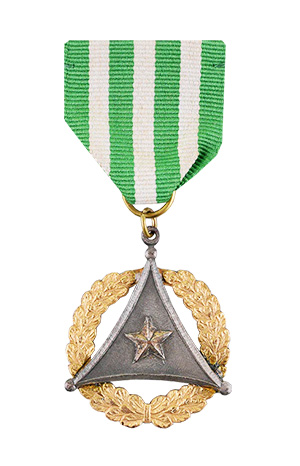
As for its design, the medal takes the form of an upward-pointing, bronze-colored three-pointed star, with a small five-pointed star positioned at its center. Adorning the bottom of the star is a golden wreath, which extends upwards, passing under and appearing between the arms of the star.

It is worn suspended from a green ribbon featuring three wide central stripes in white.

The Sagisag ng Ulirang Kawal Medal

The Sagisag ng Ulirang Kawal Medal is a military decoration awarded to the personnel of the Philippine’s Armed Forces.

The Sagisag ng Ulirang Kawal is a military honor bestowed by the Armed Forces of the Philippines.

It is conferred upon members of the Armed Forces in recognition of exceptional contributions to non-military endeavors such as community development programs, or other related activities deserving of commendation.

The Military Merit Medal (Philippines)

The Military Merit Medal is awarded for heroic achievement or meritorious service during, or in support of military action against an enemy.

The Military Merit Medal is a military honor bestowed by the Armed Forces of the Philippines, recognizing acts of heroism or commendable service rendered during military operations against an adversary.

The Military Merit Medal Criteria

Recipients of the Military Merit Medal include military personnel of the Armed Forces of the Philippines. The criteria for eligibility are diverse, encompassing heroic deeds in combat as well as meritorious service unrelated to direct engagement with the enemy, provided such service significantly contributes to military operations against a Philippine adversary. The actions or services considered must be performed with exceptional distinction.

Authority to award the Military Merit Medal lies with high-ranking officials such as the Chief of Staff of the Armed Forces of the Philippines, Area Commanders, Commanders of the Philippine Army, Navy, or Air Force, and Division and major subordinate unit commanders holding at least the rank of Brigadier General.

The medal may be awarded posthumously to members of the Armed Forces of the Philippines who perish either in combat against a Philippine enemy or as a direct consequence of enemy actions, while serving in any capacity within the armed forces.

The Military Merit Medal Design

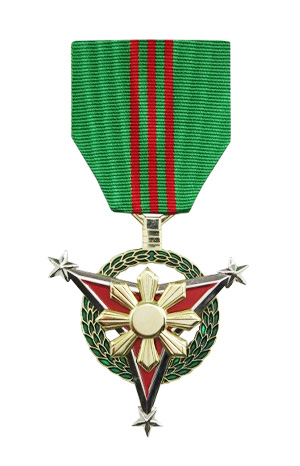
The medal adopts an irregular shape resembling a downward-pointing equilateral triangle, featuring red enamel. Positioned at each point of the triangle are gold stars. At the center of the triangle lies the “Philippines sun,” depicted in gold with eight pointed rays. Encircling and partially concealed by the triangle is a green laurel wreath, visible between each of its points.

For suspension, the medal employs a green ribbon embellished with three narrow red stripes running centrally.

The Silver Wing Medal

The Silver Wing Medal is a military decoration awarded for meritorious achievement while participating in aerial flight.

The Silver Wing Medal is a military honor conferred by the Armed Forces of the Philippines upon both Filipino and allied military personnel. It is awarded in a single class and can be bestowed by the Chief of Staff of the Armed Forces of the Philippines, the Commanding General of the PAR Area Command, and Major Service Commanders.

This distinction is granted for “meritorious achievement during aerial flight, a single act of merit, or participation in sustained operational activities against the enemy while airborne.

The Silver Wing Medal Design

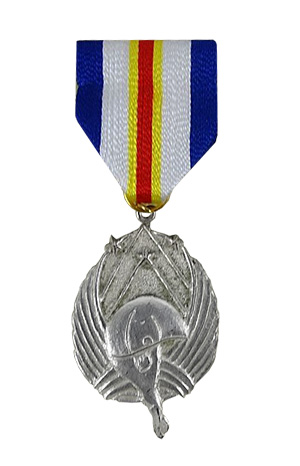
The Silver Wing medal is crafted from silver-colored metal. It features a pair of silver wings extending from the bottom to nearly the top of the medal. Positioned between the tips of these wings are three raised five-pointed stars arranged over two chevrons, one below the other. At the center of the medal is a relief of a paratrooper helmet placed above three arched bands located at the base of the wings.

The accompanying ribbon is white with a central red stripe flanked by yellow edges, bordered by blue stripes on either side.