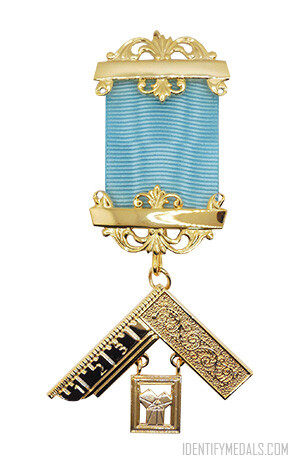
The Masonic Craft Past Masters Jewel

The Masonic Craft Past Masters Jewel is a decoration that signifies leadership and accomplishment among Freemasons.

The Masonic Craft Past Masters Jewel is a decoration that signifies leadership and accomplishment among Freemasons.

In Freemasonry, a Past Master refers to an individual who has previously served as the Worshipful Master of a Masonic Lodge. The title “Worshipful Master” is the formal designation for the presiding officer of a Masonic Lodge during their term of office. Once a Worshipful Master completes their tenure, they are referred to as a Past Master.

A Masonic Craft Past Master, therefore, is a Freemason who has held the position of Worshipful Master in a Masonic Craft Lodge. Past Masters often play important roles within their lodges and the broader Masonic community, providing guidance, wisdom, and leadership based on their experience in the chair. They may also participate in Masonic rituals and ceremonies, offering their knowledge and expertise to support the lodge and its members.

The Masonic Craft Past Masters Jewel Design

The jewel’s crest is made of metal gilt. It consists of the Square, the Compasses, and an Arc of a Circle in Scotland, the Square and Compasses with the capital ‘G’ in the center in Ireland, and in England, it has been the Square with the 47th Proposition of Euclid pendent within it. The shape of this jewel varies slightly depending on the region, but it commonly includes these symbolic elements.

The light blue or turquoise ribbon that accompanies the jewel is significant as well, as the color is one of the primary colors associated with Freemasonry. It represents the virtues of friendship, fidelity, and truth, which are central to the Masonic ethos.
The Order of Secret Monitor Jewel

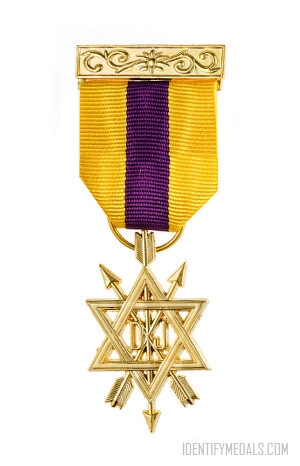
The Order of Secret Monitor Jewel is a decoration of the Brotherhood of David and Jonathan, a fraternal organization within Freemasonry.

The Order of Secret Monitor Jewel is a decoration of the Brotherhood of David and Jonathan, a fraternal organization within Freemasonry.

The Order of the Secret Monitor is based on the biblical story of the friendship between David, the future king of Israel, and Jonathan, the son of King Saul. In Freemasonry, this story is interpreted as a symbol of fidelity, loyalty, and brotherly love.

This is a Society framed upon the principles of self sacrifice; of mutual trust, watchful Brotherly care; of warning in time of danger; solace in time of sorrow; and skillful and effective friendly advice in every circumstance of life: A Society that meets a great and crying need in human affairs and is calculated to benefit those who act up to its tenets.

The primary aim of the Order of the Secret Monitor is to promote these values among its members and within the broader community. It does so through ritual ceremonies, lectures, and discussions that explore the themes of friendship, loyalty, and mutual support.

Membership in the Order of the Secret Monitor is open to Master Masons who are in good standing with their respective lodges. The organization is structured into individual units called Conclaves, each led by a Supreme Ruler. 

The Order consists of three Degrees:

  • Induction ceremony
  • Princes or admission Degree
  • Third Degree, during which a Brother is Installed as the Supreme Ruler of his Conclave.

The Order of Secret Monitor Jewel Design

The Order’s jewel is suspended from a collar of yellow and violet hues and a sash of matching colors.

The Supreme Ruler’s rank, along with the name and number of the Conclave, is embroidered in silver wire.

The Masonic Royal Arch Jewel

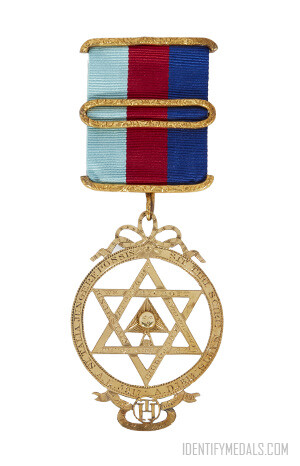
The Royal Arch Jewel is the most important of all Masonic jewels and depicts the Royal Arch, a key component of Royal Arch Masonry.

The Royal Arch Masonic medal, often referred to simply as the Royal Arch Jewel, is a significant emblem within Freemasonry, particularly in Royal Arch Masonry. It typically consists of a jewel suspended from a ribbon and worn around the neck or pinned to the wearer’s clothing.

The Royal Arch Jewel holds deep symbolic meaning within Freemasonry, representing the journey of spiritual enlightenment and the search for hidden truths. It serves as a reminder of the lessons learned in the Royal Arch degree, emphasizing the importance of fidelity, virtue, and reverence to the Supreme Being.

In addition to its symbolic significance, the Royal Arch Jewel is also a mark of distinction and recognition within the Masonic fraternity. It is often awarded to members who have attained a certain degree of proficiency or leadership within Royal Arch Masonry, serving as a symbol of their dedication and commitment to the principles of Freemasonry.

About Royal Arch Masonry or Capitular Masonry

Royal Arch Masonry, also recognized as “Capitular Masonry,” constitutes the initial segment of the American York Rite sequence of Masonic degrees. Members of Royal Arch Masonry convene in Chapters, where four degrees are conferred:

  • The Mark Master Mason degree, to some extent, extends the teachings of the Fellowcraft or Second degree. In certain jurisdictions, this degree is granted within a lodge of Fellowcraft Masons, which corresponds to the Second degree of the Blue Lodge.

  • The Past Master (Virtual) degree is conferred due to the traditional prerequisite that only Past Masters of a Blue Lodge could gain admission to Royal Arch Masonry. Due to the high number of applicants for this degree, the Virtual Past Master degree is necessary to qualify them for it. The rituals involved largely mirror those performed to install the Worshipful Master of a Blue Lodge. This requirement and procedure are not observed outside the United States.

  • In the Most Excellent Master degree, the construction of King Solomon’s Temple, which plays a significant role in Blue Lodge rituals, has been completed. In England and Wales, this degree is granted by Cryptic Councils, along with three other degrees (referenced below).

  • Regarded by many as the most aesthetically appealing degree in Freemasonry, the Royal Arch Mason degree is esteemed. Freemasons who attain this degree may progress to Cryptic Masonry or proceed directly to Knights Templar, depending on jurisdictional requirements.

The Masonic Royal Arch Jewel Design

The design of the Royal Arch Jewel can vary, but it commonly features a symbolic depiction of the Royal Arch, which is a key component of Royal Arch Masonry.

The insignia comprises two concentric circles, with the outer circle representing Eternity and the inner circle symbolizing the Deity. Enclosed within these circles are two intertwined equilateral triangles, with a central triangle surrounded by rays, signifying the Creator, and a pair of Compasses positioned over the Globe, representing the Great Architect of the Universe.

The interlaced triangles serve as a reminder of our dual nature—spiritual and material. At the base of the Jewel lies a scroll featuring another circle containing a Triple Tau symbol. Positioned at the top of the Jewel is an ornamental scroll.

The Jerusalem Pilgrim’s Cross

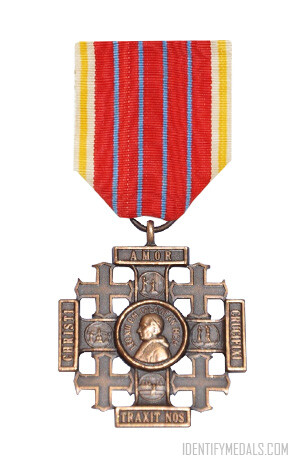
The Jerusalem Pilgrim’s Cross is an honor of the Holy See awarded in the name of the Pope for merit to pilgrims to the Holy Land.

The Jerusalem Pilgrim’s Cross, known in Latin as Signum Sacri Itineris Hierosolymitani, is a distinction bestowed by the Holy See in the name of the Pope, recognizing the merit of pilgrims to the Holy Land.

This decoration is traditionally worn on the left side of the chest and is reserved for religious occasions, processions, pilgrimages, or in the presence of the Pope. Established by Pope Leo XIII on May 2, 1901, the Signum Sacri Itineris Hierosolymitani was created to honor and endorse pilgrimages to the Holy Places of Christianity in Palestine.

Initially, candidates needed a certificate from their parish priest to attest to their moral character and confirm their sincere intent for the pilgrimage. However, as of 2015, this certificate requirement has been abolished. The medal itself is not distributed but rather conferred in person at the office of the Custodian of the Holy Land in Jerusalem, which is under the care of the Franciscan Order. It is presented in the name of the Sovereign Pontiff. The grade of the medal depends on the number of trips the recipient has made to the city and whether they have made appropriate suggested donations to the Franciscans.

The Jerusalem Pilgrim’s Cross Design

The medal features a Jerusalem cross crafted in gold, silver, or bronze. At the center of the front is a small portrayal of Pope Leo XIII, surrounded by the Latin inscription “LEO XIII CREAVIT ANNO MCM” (Leo XIII created [this medal] in 1900).

Within the crossbars, four biblical scenes depicting the early life and ministry of Jesus are depicted, along with the inscription “CHRISTI AMOR CRUCIFIXI TRAXIT NOS” (The love of Christ crucified has attracted us).

The Benemerenti Medal

The Pro Ecclesia et Pontifice Medal is awarded by the Pope to members of the clergy and laity for service to the Church and the Pope.

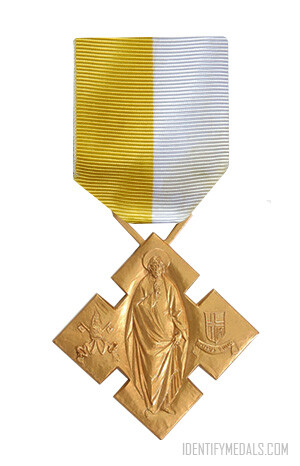
The Benemerenti Medal is bestowed by the Pope upon clergy and laity in recognition of their service to the Catholic Church. Initially established as an honor for soldiers in the Papal Army, it has since evolved into a civil decoration, although it remains eligible for members of the Pontifical Swiss Guard.

Originally instituted by Pope Pius VI (1775–1799) as a military honor, the Benemerenti Medal took on a special significance under Pope Gregory XVI (1831–1846). In 1831, a distinctive Benemerenti medal was created to honor those who demonstrated valor in the Papal army during battles in Ferrara, Bologna, and Vienna.

In 1925, the scope of this award expanded to include individuals serving the Catholic Church, regardless of their military or civilian status, whether lay or clergy. Notably, members of the Swiss Guard may also qualify for the medal after completing three years of faithful service.

The Benemerenti Medal Design

The Benemerenti medal’s present rendition was crafted under the direction of Pope Paul VI. It features a gold Greek Cross portraying Christ with His hand raised in blessing. The left arm of the cross showcases the tiara and crossed keys emblem of the papacy, while the coat of arms of the current Pope adorns the right arm. Suspended from a ribbon of yellow and white—symbolizing the Papacy—the medal exudes a distinctive elegance.

Earlier versions and variations primarily consisted of a round medal bearing the portrait of the reigning Pope on the obverse side and a laurel wreath encircling an inscription of “BENEMERENTI” or “BENE MERENTI” on the reverse.

The Pro Ecclesia et Pontifice Medal

The Pro Ecclesia et Pontifice Medal is awarded by the Pope to members of the clergy and laity for service to the Church and the Pope.

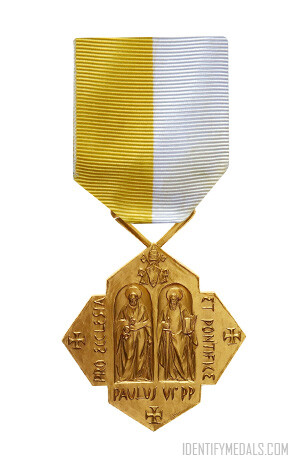
The Pro Ecclesia et Pontifice Medal, which translates to “For Church and Pope” in Latin, is an esteemed decoration of the Holy See. It is currently awarded to individuals, both lay people and clergy, who have rendered distinguished service to the Catholic Church.

Established by Leo XIII on 17 July 1888, the medal initially commemorated his golden sacerdotal jubilee. It was originally conferred upon men and women who contributed to the success of the jubilee and the Vatican Exposition. In 1898, it became a permanent papal distinction, and Pius X streamlined the classes to a single one in 1908.

For nearly a century, until 1993, it held the distinction of being the highest honor attainable by women.

The Pro Ecclesia et Pontifice Medal Design

1888 version of Leo XIII

In the 1888 version established by Leo XIII, the cross was initially crafted in gold and silver, later adding a bronze version. The cross features fleurs-de-lis fixed in its angles, forming an octagonal shape. At the center, there’s a small medal depicting Leo XIII, encircled by the words “Leo XIII P. M. Anno X” (tenth year of his pontificate). The reverse side displays the papal emblems with the motto “Pro Ecclesia et Pontifice” encircling them.

On the obverse side, the cross’s branches are shaped like comets, representing the Pecci family coat of arms. The words “Pridie,” “Kal,” and “Januar” along with the year “1888” are stamped on the reverse side. The ribbon is red with delicate lines of white and yellow on each border. The cross is worn on the left side of the breast.

Current version since Paul VI

The current version, introduced by Pope Paul VI, is only awarded in gold. The obverse depicts the Apostles Saint Peter and Saint Paul in the center, with the inscriptions “Pro Ecclesia” (For Church) on the left arm and “Et Pontifice” (And Pope) on the right. Three small crosses are positioned at the end of the left, bottom, and right cross arms. The ribbon displays yellow and white colors, symbolizing the Papacy.

Under Benedict XVI’s modification, the individual coat of arms on the top arm of the decoration was replaced by a small cross, while the coat of arms of the Holy See took its place on the bottom arm. The name of the reigning pope no longer appears on the front side.

The Order of the Holy Sepulchre

The Order of the Holy Sepulchre is a Catholic order of knighthood established in 1099 and under the protection of the Holy See.

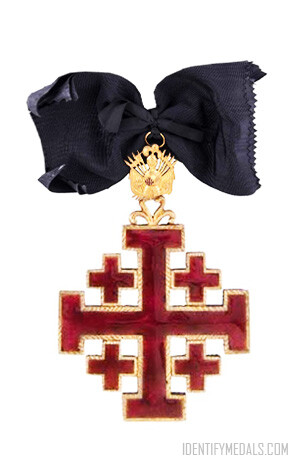
The Equestrian Order of the Holy Sepulchre of Jerusalem (OESSH or Ordo Equestris Sancti Sepulcri Hierosolymitani in Latin), commonly known as the Order of the Holy Sepulchre or Knights of the Holy Sepulchre, is a Catholic knighthood order under the patronage of the Holy See, with the Pope serving as its sovereign.

The order, which includes canons as well as knights, is primarily dedicated to supporting the Christian presence in the Holy Land. It holds international recognition as a chivalric order and currently boasts approximately 30,000 knights and dames across 60 jurisdictions worldwide.

Fernando Filoni has served as the Cardinal Grand Master since 2019, while the Latin Patriarch of Jerusalem serves as the Order’s Grand Prior by virtue of office. The headquarters of the order are located at the Palazzo Della Rovere and its official church at Sant’Onofrio al Gianicolo, both situated in Rome near Vatican City.

The Order of the Holy Sepulchre Design

The emblem of the Order follows a time-honored tradition, featuring the Cross Potent, named after Godfrey of Bouillon. Specifically, it is a gold Cross Potent, adorned with enamel resembling the color of blood.

At each of its four sides, red crosslets with gold borders are attached, enhancing its symbolic significance.

The Cross is suspended from a ribbon made of black watered silk, further adding to its distinguished appearance.

The Nigeria Police Star

The Nigeria Police Star is a decoration awarded to members of the police force for conspicuous acts of gallantry in the course of duty.

The Nigeria Police Star is a decoration awarded to members of the police force for conspicuous acts of gallantry in the course of duty.

The Nigeria Police Force serves as the primary law enforcement and leading security agency in Nigeria. Established by the 1999 constitution as the national police with exclusive jurisdiction across the nation, it boasts a staff strength of approximately 371,800 as of 2016. Plans are underway to expand the force to 650,000, including the addition of 280,000 new recruits to the existing 370,000.

Organized into 36 State commands and the Federal Capital Territory (FCT), it operates within 17 zones and 8 administrative units. Currently, the force is under the leadership of IGP (Inspector General) Kayode Egbetokun. Major reforms were implemented in 2020, signifying significant changes within the organization.

The Order of Mendi for Bravery

The Order of Mendi for Bravery is a South African order created to award citizens who have performed acts of bravery to save lives or property.

The Order of Mendi for Bravery is a civilian honor in South Africa bestowed upon individuals who have displayed acts of bravery in endeavors to rescue lives or property. Authorized by the President of South Africa, this recognition is conferred upon South African citizens for their courageous actions, regardless of the location of the incident. Established on November 30, 2003, initially known as the Mendi Decoration for Bravery, it was later designated as an order on October 22, 2004.

The order pays homage to the SS Mendi, a troopship tragically sunk in 1917 following a collision, resulting in the loss of over 600 black South African troops. Despite being a civilian distinction, it has been presented to military units, including those involved in the rescue operations during the 1991 MTS Oceanos disaster and the 2000 Mozambican floods.

The Order of Mendi has three classes:

  • Gold (OMBG), for conspicuous bravery;
  • Silver (OMBS), for exceptional bravery; and
  • Bronze (OMBB), for outstanding bravery.

The Order of Mendi for Bravery Design

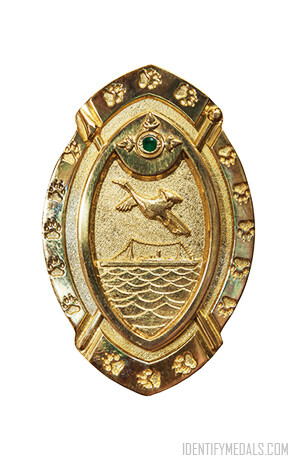
The insignia of the order is designed in the shape of a traditional African shield, oval in form. Its front side features an image of the SS Mendi, accompanied by a blue crane flying overhead. Above this depiction, a green emerald is sealed, encircled by depictions of the bitter aloe on three sides. Crossed assegai and knobkierrie adorn the background of the shield, while lion pawprints decorate the border.

The reverse side showcases the Coat of Arms of South Africa. Alongside the neck badge, the award includes a miniature medallion and a lapel rosette.

More South African Orders

The Order of the Companions of O. R. Tambo

The Order of the Companions of O.R. Tambo is a South African order created to award heads of state and senior diplomats for friendship to SA.

The Order of the Companions of O. R. Tambo (SCOT/GCOT/COT) is a distinguished South African accolade. Established on December 6, 2002, it is conferred by the President of South Africa upon foreign citizens who have advanced South African interests and aspirations through cooperation, solidarity, and support.

Named in honor of the late Oliver Tambo, who served as the president-in-exile of the African National Congress for numerous years, the order pays tribute to his enduring legacy and commitment to the advancement of South Africa’s ideals.

There are currently three classes of appointment. In descending order of precedence, they are:

  • Supreme Companion of OR Tambo in gold, for heads of state and, in special cases, heads of government (SCOT)
  • Grand Companion of OR Tambo in silver, for heads of government, ministers of state, supreme court judges, presidents of legislatures, secretaries of state, ambassadors, commanders-in-chief (GCOT)
  • Companion of OR Tambo in bronze, for legislators, envoys, senior military officers (COT)

The Order of the Companions of O. R. Tambo Design

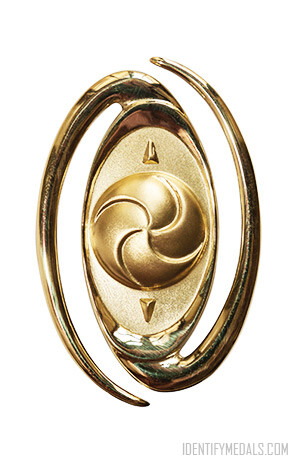
The insignia of the order is oval-shaped and features a symbol reminiscent of the Taijitu, flanked by two arrowheads and framed by two mole snakes. This symbolizes the convergence of diverse spiritual energies, while the snakes represent unity and assistance. On the reverse side, the South African coat of arms is prominently displayed.

The ribbon, worn around the neck, is white and adorned with recurring grey symbols down the center. All three classes of the order are worn in this manner.

In addition to the badge, recipients are presented with a carved wooden walking stick. The walking stick is embellished with a serpent winding around the shaft and a spoon-shaped head displaying the order’s emblem and the national coat of arms. This walking stick serves as a symbol of support, solidarity, and a commitment to stand by the recipient in return.

More South African Orders