The Queen Elizabeth II Silver Jubilee Medal

The Queen Elizabeth II Silver Jubilee Medal was established in 1977 to commemorate the 25th anniversary of Queen Elizabeth II’s accession.

The Queen Elizabeth II Silver Jubilee Medal (or Médaille du jubilé d’argent de la reine Elizabeth II in French) was created in 1977 to commemorate the 25th anniversary of Queen Elizabeth II’s accession in 1952.

The medal is identical across all realms where it was awarded, with the exception of Canada, which features unique elements. As an internationally distributed award, the Queen Elizabeth II Silver Jubilee Medal occupies a distinct position in each country’s order of precedence for honors.

The Queen Elizabeth II Silver Jubilee Medal was established by a Royal Warrant from the Queen.

Prior to 1977, the practice for coronation and jubilee medals involved the United Kingdom authorities deciding on the total number of medals to be produced and then allocating quantities to each Dominion and possession across the British Empire, and later, to each Commonwealth country. Starting in 1977, the distribution of the medals was at the discretion of each national government. Consequently, 30,000 medals were distributed in Britain, 1,507 in New Zealand, 6,870 in Australia, and 30,000 in Canada.

The Queen Elizabeth II Silver Jubilee Medal Design

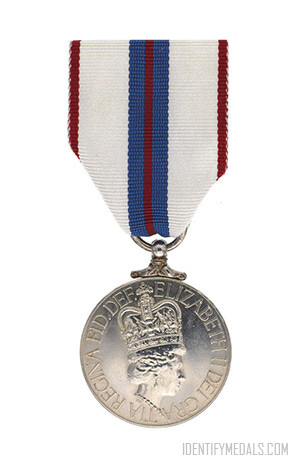
The Queen Elizabeth II Silver Jubilee Medal in the UK was designed by David Wynne. It is a 32 millimeter (1.3 inch) diameter silver disc.

The obverse features the inscription “ELIZABETH II DEI GRA. REGINA FID. DEF.” (Latin for “Elizabeth II, by the Grace of God, Queen, Defender of the Faith”) surrounding an effigy of Queen Elizabeth II, symbolizing her role as the fount of honor. The reverse side displays a crown atop a wreath containing the words “THE 25th YEAR OF THE REIGN OF QUEEN ELIZABETH II 6 February 1977” arranged in six lines.
The Queen Elizabeth II Coronation Medal

The medal, established in 1953, was given as a personal memento from the Queen to members of the Royal Family and selected officers of state.

The Queen Elizabeth II Coronation Medal is a commemorative medal established on 2 June 1953 and instituted to celebrate the coronation of Queen Elizabeth II.

This medal was given as a personal memento from the Queen to members of the Royal Family and selected officers of state, including members of the Royal Household, government officials, mayors, public servants, local government officials, and members of the navy, army, air force, and police in Britain, as well as her colonies and Dominions. It was also awarded to members of the Mount Everest expedition, two of whom reached the summit four days before the coronation. The medal was struck at the Royal Mint and distributed immediately after the coronation.

For Coronation and Jubilee medals, up until 1977, the practice was for the authorities in the United Kingdom to decide on the total number to be produced and then allocate a proportion to each of the Commonwealth countries, Crown dependencies, and other possessions of the Crown. The government of each territory had the discretion to decide who would receive a medal and for what reasons.

In total, 129,051 medals were awarded, including:

  • 11,561 to Australians.
  • 12,500 to Canadians.

The Queen Elizabeth II Coronation Medal Design

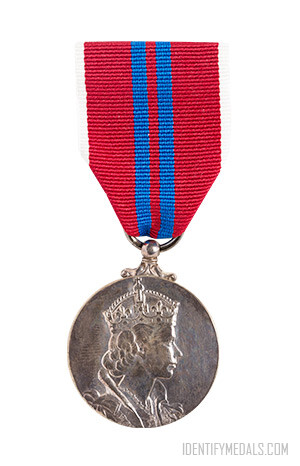
The Queen Elizabeth II Coronation Medal is a silver disk measuring 1.25 inches in diameter. The obverse features a crowned effigy of Queen Elizabeth II, facing right, adorned in a high-collared ermine cloak and wearing a Tudor Crown along with the Collar of the Garter and Badge of the Bath. It lacks a raised rim and any inscriptions.

The reverse displays the Royal Cypher “EiiR” topped by a large crown, with the inscription “QUEEN ELIZABETH II CROWNED 2nd JUNE 1953” around the edge. The medal was designed by Cecil Thomas.

The dark red ribbon is 1.25 inches (32 mm) wide, featuring 2 mm wide white edges and two narrow dark blue stripes in the center, each 2 mm wide and 1.6 mm apart.

The Philippine Independence Medal

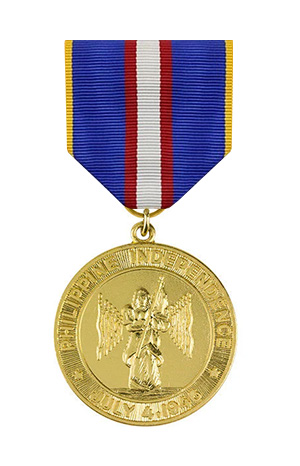
The Philippine Independence Medal is a military award for members of the military who participated in military operations during WW2.

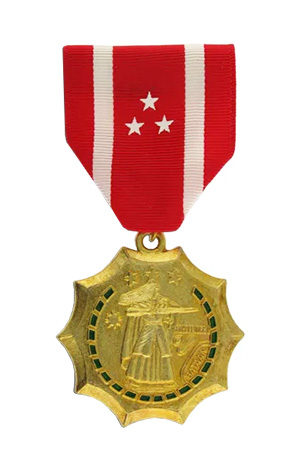
The Philippine Independence Medal is a military decoration established by the Philippine Army Headquarters on July 3, 1946, initially as the Philippine Independence Ribbon.

The addition of the medal occurred in 1968. It honors individuals who served in various Philippine Commonwealth military operations during World War II.

The Philippine Independence Medal Criteria

To qualify for the Philippine Independence Medal, a service member must have previously been awarded both the Philippine Defense Medal and the Philippine Liberation Medal. The eligibility for wearing these awards must have been recorded before November 24, 1954. This criterion effectively encompassed individuals who participated in the initial resistance against Japanese invasion and contributed to the campaigns to liberate the Philippines from Japanese occupation between October 1944 and September 1945.

The decoration was also open for authorization to the United States and other foreign military personnel, resulting in several retroactive awards presented between 1945 and 1948. Notably, General of the Army Douglas MacArthur was among the distinguished American recipients.

Initially, the Philippine Independence Medal was bestowed as a service ribbon only. It wasn’t until 1968 that President Ferdinand Marcos authorized the addition of a full-sized medal.

The Philippine Defense Medal

The Philippine Defense Medal is a military decoration awarded to recognize the initial resistance against Japanese invasion 1941-1942.

The Philippine Defense Medal, a military decoration of the Republic of the Philippines, acknowledges the initial resistance against the Japanese invasion spanning from December 8, 1941, to June 15, 1942.

Initially established as the Philippine Defense Ribbon in December 1944, it was later upgraded to a full-sized medal in July 1945.

The Philippine Defense Medal was awarded to United States and Philippine Commonwealth troops who defended the Philippines at Bataan and subsequently endured the Bataan Death March.

The Philippine Defense Medal Criteria

The Philippine Defense Medal is bestowed upon any service member, whether from the Philippine military or an allied armed force, who took part in defending the Philippine Islands during the specified period. This includes engagement against the enemy on Philippine territory, in Philippine waters, or in the airspace above. Individuals qualify if they:

(A) Participated in any engagement against the enemy, such as:

  1. Serving in the defense garrison of the Bataan Peninsula or fortified islands at the entrance to Manila Bay.
  2. Being present with a unit under enemy fire or air attack.
  3. Serving on a ship under enemy fire or air attack.
  4. Being a crewmember or passenger in an aircraft under enemy aerial or ground fire.

(B) Were assigned or stationed in Philippine territory or waters for at least 30 days during the period.

(C) Those meeting the conditions of (A) and (B) are authorized to wear a bronze service star on the ribbon.

The Armed Forces Conduct Medal (Philippines)

The Armed Forces Conduct Medal is a military decoration warded to enlisted personnel of the Armed Forces for serving two successive terms.

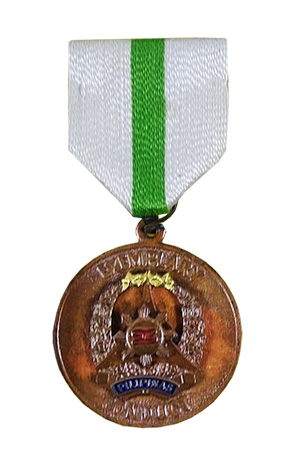
The Armed Forces Conduct Medal is a military honor conferred by the Armed Forces of the Philippines.

It is granted to enlisted members who have completed two consecutive terms of service without any disciplinary infractions on their record.

The Military Civic Action Medal

The Military Civic Action Medal is a military decoration awarded for meritorious achievement in the conduct of humanitarian civic actions.

The Military Civic Action Medal, a distinction within the Armed Forces of the Philippines, acknowledges commendable efforts in executing humanitarian civic actions that directly support military operations.

This medal is conferred upon both military and civilian members of the Armed Forces of the Philippines, and may extend to allied foreign nationals. It recognizes outstanding achievements in civic action either as part of duty responsibilities or in direct aid to military operations.

Awarding Authority Recipients of the Military Civic Action Medal are selected by the Chief of Staff of the Armed Forces of the Philippines, Area Commanders, Armed Forces of the Philippines-Wide Support and Separate Units, as well as Commanders of the Philippine Army, Philippine Navy, or Philippine Air Force. Division and Brigade commanders, along with their counterparts in the Philippine Air Force and Navy, also possess the authority to bestow this honor.

The Military Civic Action Medal Design

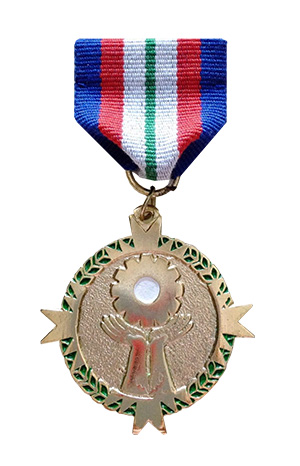
The medal features a golden disc depicting a stylized image of a gear held aloft by a pair of hands, encircled by a green wreath on its front. Behind the medal, four rays extend in the cardinal directions, overlapping the wreath.

It hangs from a blue ribbon, featuring a central green stripe flanked on either side by equal stripes of white and red

The Order of Lapu-Lapu

The Order of Lapu-Lapu is a national order of merit established in 2017 and conferred by the President of the Philippines.

The Order of Lapu-Lapu (or Orden ni Lapu-Lapu in Filipino) is a prestigious national honor bestowed by the President of the Philippines upon government officials, personnel, and private individuals. It recognizes exceptional contributions or remarkable service related to a specific campaign or advocacy initiated by the President.

Unlike awards included in the Honors Code of the Philippines, this presidential accolade is positioned below the Presidential Medal of Merit in terms of precedence.

The Order of Lapu-Lapu Ranks

According to Executive Order No. 17 signed by President Rodrigo Duterte, the Order of Lapu-Lapu originally consisted of three ranks: the Lapu-Lapu Medal, the Kalasag Medal, and the Kampilan Medal. However, this was expanded to four ranks with the issuance of Executive Order No. 35. The new ranks are as follows:

  1. Magalong Medal: Awarded to government officials, personnel, and private individuals who have demonstrated exceptional service or made outstanding contributions to the success of an activity aligned with a campaign or advocacy of the President.
  2. Kalasag Medal: Conferred upon government officials, personnel, and private individuals who lost their lives directly due to their involvement in an activity connected to a campaign or advocacy of the President.
  3. Kampilan Medal: Granted to government officials, personnel, and private individuals who sustained serious injuries, wounds, or significant property loss as a direct consequence of their participation in an activity related to a campaign or advocacy of the President.
  4. Kamagi Medal: Presented to government officials, personnel, and private individuals who actively participated in and made substantial contributions to an activity associated with a campaign or advocacy of the President but do not fall under any of the aforementioned ranks.

The Order of Lapu-Lapu Design

The medals for the Order of Lapu-Lapu are crafted by the Bangko Sentral ng Pilipinas using 99.9% silver, with specific ranks featuring selective gold plating.

The ribbon is fashioned from Philippine cotton, hand-woven by a cooperative foundation located in Bontoc, Mountain Province.

  1. Magalong Medal: Awarded to government officials, personnel, and private individuals who have demonstrated exceptional service or made outstanding contributions to the success of an activity aligned with a campaign or advocacy of the President.
  2. Kalasag Medal: Conferred upon government officials, personnel, and private individuals who lost their lives directly due to their involvement in an activity connected to a campaign or advocacy of the President.
  3. Kampilan Medal: Granted to government officials, personnel, and private individuals who sustained serious injuries, wounds, or significant property loss as a direct consequence of their participation in an activity related to a campaign or advocacy of the President.
  4. Kamagi Medal: Presented to government officials, personnel, and private individuals who actively participated in and made substantial contributions to an activity associated with a campaign or advocacy of the President but do not fall under any of the aforementioned ranks

The Turkish Medal of Independence

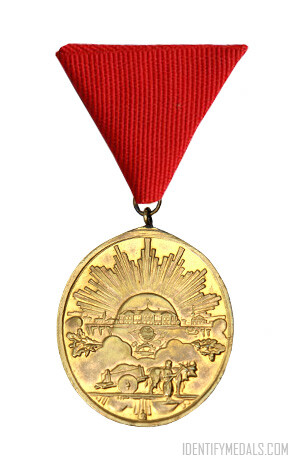
The Turkish Medal of Independence was issued in 1920 in limited number and awarded for contributions during the Turkish War of Independence.

The Medal of Independence (or İstiklal Madalyası in Turkish) holds a distinctive place as a military decoration of great significance, issued in limited numbers by the Grand National Assembly of Turkey in accordance with Act 66 of November 29, 1920.

This prestigious award was reserved for military personnel and civilians who made noteworthy contributions to the country’s cause during the Turkish War of Independence, a pivotal period in Turkey’s history. Notably, in recognition of their valiant efforts and sacrifices, the flags of all regiments belonging to the Turkish National Forces that participated in campaigns during the occupation of Izmir between May 15, 1919, and September 9, 1922, were also honored with this esteemed medal.

The Medal of Independence symbolizes the spirit of resilience, courage, and unity that characterized Turkey’s struggle for independence during this tumultuous period. It serves as a testament to the bravery and dedication of those who fought tirelessly for the nation’s sovereignty and freedom, both on the battlefield and on the home front.

The Turkish Armed Forces Medal of Merit

The Turkish Armed Forces Medal of Merit is awarded to those who show great skill in the achievement of the tasks assigned to them.

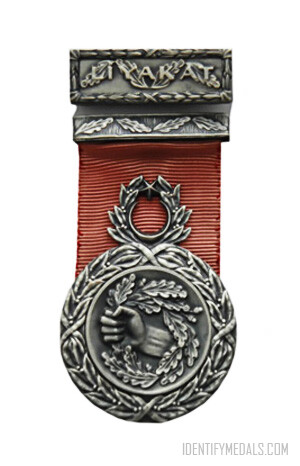
The Turkish Armed Forces Medal of Merit (or TSK Liyakat Madalyası in Turkish) is presented to individuals who demonstrate exceptional proficiency in accomplishing their assigned tasks or who achieve success in diverse undertakings, the medal also honors those who foster the advancement of amicable relations between the Turkish Armed Forces and the armed forces of allied nations.

Furthermore, the medal is bestowed upon individuals who play a pivotal role in bridging the gap between nations, thereby fostering mutual understanding and cooperation on an international scale.

The Turkish Armed Forces Medal of Merit Design

The insignia is made of bronze and consists of three parts  (the medal itself, a rosette, and a miniature).

The total weight for the medal is 60 grams.

The Turkish Armed Forces Medal of Achievement

The Turkish Armed Forces Medal of Achievement is awarded for exceptional success in the performance of important missions during war time.

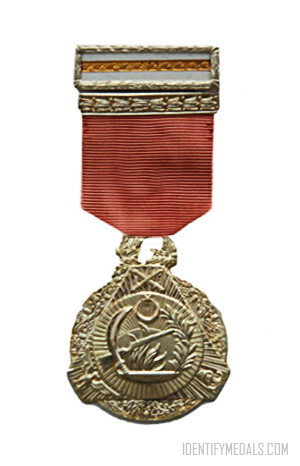
The Turkish Armed Forces Medal of Achievement (or TSK Başarı Madalyası in Turkish) holds a significant place among the honors bestowed upon individuals who demonstrate outstanding performance and dedication in their service to the nation.

In times of war, this accolade is reserved for individuals who exhibit remarkable success in executing crucial missions with unparalleled skill and valor. Whether facing the rigors of combat or navigating complex military operations, recipients of this medal exemplify the highest standards of excellence and courage on the battlefield.

In periods of tranquility, the Turkish Armed Forces Medal of Achievement is awarded to those whose contributions and achievements in service surpass the expectations placed upon them. Whether through innovative leadership, exemplary professionalism, or extraordinary commitment to duty, recipients of this honor distinguish themselves through their unwavering dedication to upholding the values and principles of the Turkish Armed Forces.