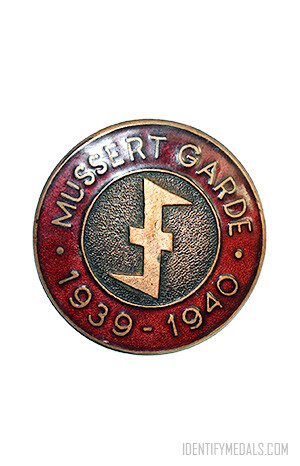
The Mussert Garde Pin 1939-1940

The Mussert Garde Pin, created in 1939-1940, was a symbol of loyalty and service to the National Socialist Movement in the Netherlands (NSB).

The Mussert Garde Pin, created in 1939-1940, was a symbol of loyalty and service to the National Socialist Movement in the Netherlands (NSB), led by Anton Mussert.

This pin was awarded to members of the Mussert Garde, an elite guard unit responsible for protecting NSB leaders and significant events. The design of the pin typically featured the NSB emblem, reflecting the organization’s ideology and dedication to the Nazi cause.

These pins are now rare historical artifacts, providing insight into the collaborationist activities in the Netherlands during World War II.

The Mussert Garde Pin Design

The badge features a central shield with a black Wolfsangel, a symbol used by the NSB, on a white background. This central element is surrounded by a red enamel border.
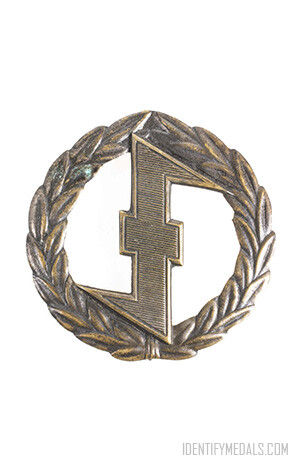
The W.A. Military Sports Badge

The W.A. Military Sports Badge was awarded to members of the “Weer Afdeelingen” (Defense Sections) for military sporting events.

The W.A. Military Sports Badge was awarded to members of the “Weer Afdeelingen” (Defense Sections) or stormtroopers of the NSB. This decoration was instituted on 13 September 1941.

The National Socialist Movement in the Netherlands (Dutch: Nationaal-Socialistische Beweging in Nederland; NSB) was a Dutch fascist organization that evolved into a Nazi political party. Initially successful in the 1930s parliamentary elections, the NSB became the sole legal party under German occupation during most of World War II.

Military sporting events were held for W.A. troops and successful winners were awarded with the military sport badge.

The W.A. Military Sports Badge Design

The sport badge shows in the background a Laurel with the NSB emblem “wolf hook” in front. The reverse is hollow with two small loop rings that holds the pin. This die stamped badge was awarded in two classes- silver and bronze gilt. The badge is very large it measures 53mm in diameter.

Note: I could only find limited information about this medal. If you know more, please use the contact form to let me know.

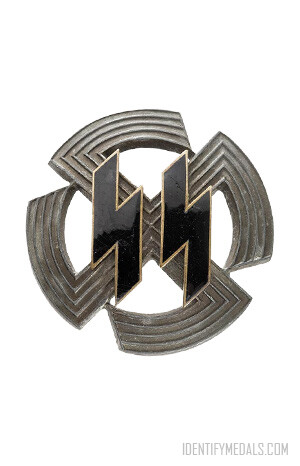
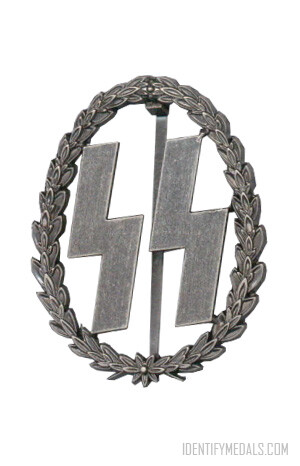
The SS Dutch Sports Badge

The SS Dutch Sports Badge was awarded to members of the Dutch SS for demonstrating athletic prowess and physical fitness.

The SS Dutch Sports Badge was awarded to members of the Dutch SS for demonstrating athletic prowess and physical fitness.

This badge was part of the efforts to promote physical conditioning among the SS members.

The design typically included elements symbolizing strength and athletic achievement, often incorporating Nazi insignia and symbols to reflect the regime’s ideology. These badges were awarded during World War II, making them historical artifacts of that era. Collectors value them for their historical significance and the insight they provide into the period’s propaganda and values.

Note: I could only find limited information about this medal. If you know more, please use the contact form to let me know.

The Germanic Proficiency Runes

The Nazi regime introduced a sports badge for non-Germans who were part of the Germanic-SS and Waffen-SS, known as the runes.

The Germanic Proficiency Runes Badge, established on August 15, 1943, was awarded to non-German members of the Germanic-SS and Waffen-SS who demonstrated exceptional physical fitness and adherence to Nazi ideology.

The Germanic Proficiency Runes were awarded in two grades: bronze and silver. The distinction between these grades was based on the level of physical achievement demonstrated by the recipients.

The tests for these awards were similar to those required for the SA Sports Badge, ensuring a standardized measure of physical fitness across both German and non-German SS members.

The creation of the Germanic Proficiency Runes served several purposes. It was a tool for promoting physical fitness and readiness among non-German SS members. Additionally, it reinforced the ideology of the Germanic-SS, which sought to include ethnically Germanic volunteers from occupied and neutral countries in Europe.

The Germanic Proficiency Runes Tests

Recipients of the Germanic Proficiency Runes had to undergo rigorous physical tests that were on par with the requirements for the SA Sports Badge. These tests included a variety of athletic and endurance challenges designed to assess overall physical fitness, agility, strength, and stamina. The aim was to maintain a high level of physical preparedness among the SS troops, irrespective of their nationality.

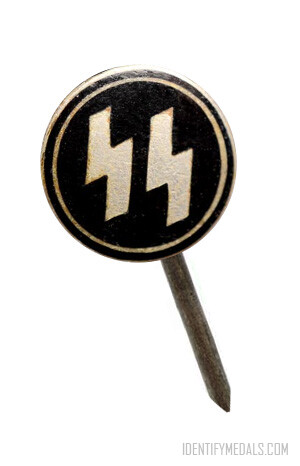
The SS Zivilabzeichen Badge

The SS Zivilabzeichen Badge, also known as the SS Civil Badge, was a lapel pin issued to SS members between 1933 and 1938.

The SS Zivilabzeichen, also known as the SS Civil Badge, was a lapel pin issued to SS members between 1933 and 1938. This badge, displaying the SS runes, was worn on civilian clothing to signify membership in the SS.

The badge was predominantly awarded to veteran SS members within the Sicherheitspolizei, though there was no strict criteria for its issuance. Members simply had to apply to the SS-Hauptamt to receive it.

Known Badge Numbers

  • Adolf Hitler: Honorary SS number “1”. His badge was kept in his Munich apartment and later taken by 1st Lieutenant Philip Ben Lieber in 1945. This badge, along with other items owned by Hitler, was sold through Mohawk Arms to collectors Stephen Wolfe and Neil Hardin, and eventually acquired by collector Craig Gottlieb in 2013.
  • Heinrich Himmler: Badge number 2.
  • Adolf Eichmann: Badge number 6,375.
  • Gustav Lombard: Badge number 72,723.
  • Karl Freiherr Michel von Tüßling: Badge number 106,983.
  • Ernst Kaltenbrunner: Badge number 160,180.
  • Hermann Senkowsky: Badge number 169,582.

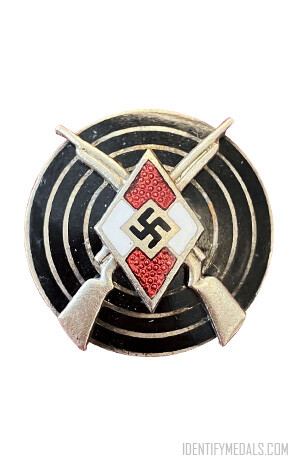
The Hitler Youth Shooting Badge

The Hitler Youth Shooting Badge was awarded in three grades to recognize proficiency in marksmanship within the Hitler Youth.

The Hitler Youth Shooting Badges (or Hitler Jugend Schiessauszeichnungen in German) were awarded in three grades to recognize proficiency in marksmanship within the Hitler Youth.

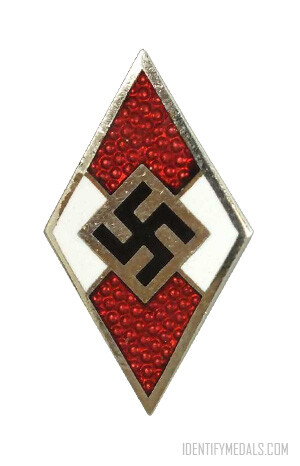
Each badge was worn on the left breast pocket of the Hitler Youth uniform and had specific design elements to denote the level of proficiency.

The Hitler Youth Shooting Badge Grades and Design

Proficient Shooters (Für Schützen)

    • Instituted: 1936
    • Design: Circular silver and enamel badge shaped like a target, featuring the Hitler Youth emblem in the center, flanked by two crossed rifles.
    • Awards: By the end of 1943, a total of 273,545 badges had been awarded.

Sharpshooters (Für Scharfschützen)

    • Instituted: 1938
    • Design: Similar to the proficient shooters badge but edged with a silver wreath.
    • Awards: By the end of 1943, 31,904 badges had been awarded.

Champion Shots (Für Meisterschützen)

    • Instituted: 1938
    • Design: Similar to the sharpshooters badge but edged with a gilt wreath.
    • Awards: By the end of 1943, only 852 badges had been awarded.

Jungvolk Shooting Badge (Schiessauszeichnunge des Deutsches Jungvolks)

    • Design: Similar to the proficient shooters badge but includes the Jungvolk emblem in front of crossed rifles, with the letters ‘D’ ‘J’ flanking the design.
    • Awards: By the end of 1943, 580,872 badges had been awarded.

Other Hitler Youth Badges

The variety of Hitler Youth badges arose from the organization’s desire to recognize different levels of achievement, service, and merit among its members. These included:

Hitler Youth Information

Right Now on eBay 
Clicking a link to eBay may result in a referral commission being paid if a purchase is made.
Loading…

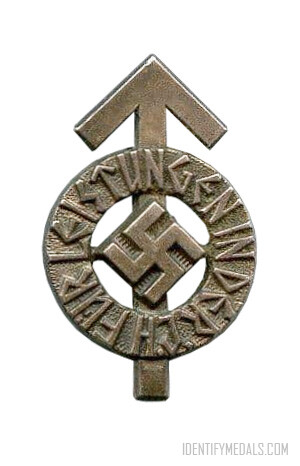
The Hitler Youth Proficiency Badge

The Hitler Youth Proficiency Badge was established to recognize members for proficiency in athletics, field craft, and political knowledge.

The Hitler Youth Proficiency Badge (or Leistungsabzeichen der Hitler Jugend in German) was established in June 1934 to recognize Hitler Youth members who demonstrated proficiency in athletics, field craft, and basic political knowledge.

The badge was awarded in different versions based on the age and achievement level of the recipient. It was presented in silver for boys over 17 and in bronze for 16-year-olds. Members of the Jungvolk initially received a black version until 1937 when a distinct Jungvolk badge was introduced.

By the end of 1943, a significant number of these badges had been awarded:

  • Bronze Badges: 103,061
  • Silver Badges: 217,093

These figures highlight the widespread implementation of this award within the Hitler Youth organization as a means to encourage and reward physical and ideological training.

The Hitler Youth Proficiency Badge Design

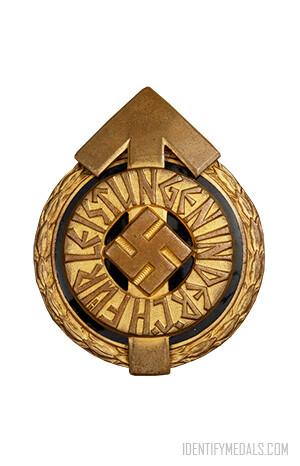
The obverse of the badge features a swastika encircled by a ring inscribed with ‘Für Leistungen in der HJ’ (For achievements in the HJ) in runic-style script. This design is set against a large tiwaz rune.

The reverse of the badge is numbered and equipped with a pin for attachment to the breast pocket.

Other Hitler Youth Badges

The variety of Hitler Youth badges arose from the organization’s desire to recognize different levels of achievement, service, and merit among its members. These included:

Hitler Youth Information

Right Now on eBay 
Clicking a link to eBay may result in a referral commission being paid if a purchase is made.
Loading…

The Hitler Youth Leader’s Sports Badge

The Hitler Youth Leader’s Sports Badge was designed to recognize those in the Hitler Youth and Jungvolk who excelled in an annual fitness test.

Instituted in January 1937, the Hitler Youth Leader’s Sports Badge in Gold (or Goldenes Führersportabzeichen der Hitler Jugend in German) was designed to recognize officers in the Hitler Youth and Jungvolk who excelled in an annual fitness test. These tests covered a range of sports and physical activities to assess the fitness and proficiency of the officers. In May 1938, this prestigious badge was officially established to honor those who achieved the highest scores.

Over 11,000 of these badges were awarded, making it a relatively common yet highly regarded decoration among Hitler Youth officers. Each badge was individually numbered, adding a layer of uniqueness to every awarded piece.

The Hitler Youth Leader’s Sports Badge Design

The badge is crafted from copper gilt and features, in the obverse, a prominent swastika at its center. Surrounding the swastika is a ring with the inscription ‘Für Leistungen in der HJ’ (For achievements in the HJ) in runic-style script. This is set in front of a large tiwaz rune, symbolizing the warrior god Tyr, and encircled by a narrow laurel wreath.

The reverse side of the badge is numbered and equipped with a pin, allowing it to be worn on the left breast pocket.

Other Hitler Youth Badges

The variety of Hitler Youth badges arose from the organization’s desire to recognize different levels of achievement, service, and merit among its members. These included:

Hitler Youth Information

Right Now on eBay 
Clicking a link to eBay may result in a referral commission being paid if a purchase is made.
Loading…

The Hitler Youth Badge for Distinguished Foreigners

The Hitler Youth Badge for Distinguished Foreigners was a special honor authorized in 1941 and specifically designed for non-German citizens.

The Hitler Youth Badge for Distinguished Foreigners (or Ehrenzeichen der Reichsjugendführung der Hitler-Jugend für Verdiente Ausländer in German) was a special honor authorized in 1941. This badge was specifically designed for non-German citizens who had shown significant support for the objectives and activities of the Hitler Youth (Hitler-Jugend).

The badge was intended to acknowledge and reward foreign individuals who contributed to the goals and spread of Nazi ideology through the Hitler Youth organization. These individuals played a role in fostering international support for the Nazi regime and its youth programs, promoting the values and principles of the Hitler Youth outside of Germany.

Instituted during the height of World War II, the badge served both as a diplomatic tool and a symbol of the Nazi Party’s international reach.

The Hitler Youth Badge for Foreigners Designs

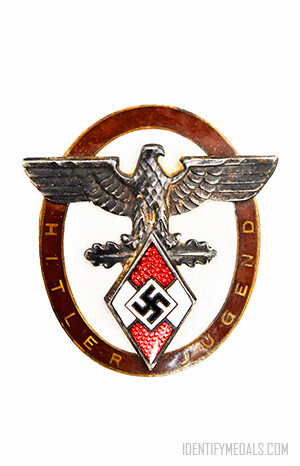
The badge is an oval-shaped decoration made from gilt and enamel, reflecting its prestigious nature. The design features a spread eagle perched above the emblem of the Hitler Youth, which is centrally placed. Surrounding the central design is a brown enamel band with the inscription “Hitler Jugend,” signifying its association with the Hitler Youth.

Other Hitler Youth Badges

The variety of Hitler Youth badges arose from the organization’s desire to recognize different levels of achievement, service, and merit among its members. These included:

Hitler Youth Information

Right Now on eBay 
Clicking a link to eBay may result in a referral commission being paid if a purchase is made.
Loading…

The Brunswick Rally Badge

The Brunswick Rally Badge was established in 1936 and was the third badge to be recognized as a national award by the Nazi Party (NSDAP).

The Brunswick Rally Badge, officially known as the Badge of the SA Rally at Brunswick 1931 (or Das Abzeichen vom SA – Treffen in Braunschweig 1931 in German), was the third badge to be recognized as a national award by the Nazi Party (NSDAP).

Established through regulations issued on November 6, 1936, this special Party Honor Badge commemorated the SA Assembly in Braunschweig, Lower Saxony, held on October 17-18, 1931.

The Rally Event

The Brunswick rally was a significant joint event involving members of the Sturmabteilung (SA) and Schutzstaffel (SS). It aimed to demonstrate the strength and solidarity of these paramilitary groups in a Germany weary from internal strife and political instability.

Held before Adolf Hitler became Chancellor in January 1933, the rally saw a massive participation of 104,000 SA and SS men who marched in a six-hour parade reviewed by Hitler. This event also marked the first inspection of the SA Motor and National Socialist Motor Corps (NSKK) units.

The rally was organized by SA-Gruppe Nord under the leadership of then SA-Gruppenführer Viktor Lutze. During the event, the SA pledged their loyalty to Hitler, who in turn expanded the SA by creating 24 new Standarten (regiment-sized formations). Hitler later rewarded Lutze’s loyalty by appointing him as the commander of the SA in 1934, following the purge of Ernst Röhm during the Night of the Long Knives.

The Brunswick Rally Badge Design

The Brunswick Rally Badge was created to commemorate this large-scale rally and honor its participants. To qualify for purchasing and wearing the badge, one had to have officially attended the rally. The badge was worn on the left breast of the uniform and was made in two patterns.

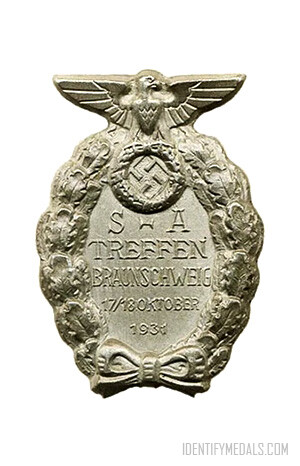
  • Pattern 1: Measuring 37mm wide by 50mm high, it featured the Party eagle at the top and an oak leaf wreath around the edge, with a bow at the bottom. Inside the wreath was inscribed “S—A Treffen Braunschweig 17./18. Oktober 1931.”
  • Pattern 2: Slightly larger at 37mm wide by 52mm high, it retained the same basic design as the first pattern. Early badges were stamped out of tin and silver in color, while later ones were stamped with a solid back and were grey.

Permission to wear the badge had to be confirmed by a senior SA Party leader or higher, and the authorization to wear it could be revoked by SA-Stabschef Viktor Lutze or his successors.