The 1894-95 Sino-Japanese War Medal

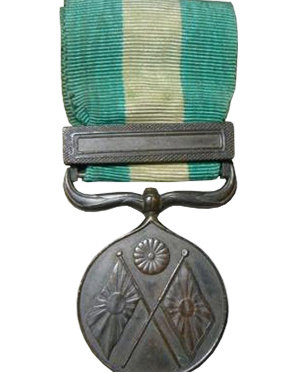
The 1894-95 Sino-Japanese War Medal was awarded in commemoration of the First Sino–Japanese War, which lasted from 1894 to 1895.

The 1894-95 Sino-Japanese War Medal was awarded in commemoration of the First Sino–Japanese War, which lasted from 1 August 1894 to 17 April 1895.

The war was fought between Qing Dynasty China and Meiji Japan, primarily over control of Korea. After more than six months of continuous successes by the Japanese army and naval forces, as well as the loss of the Chinese port of Weihai, the Qing leadership sued for peace in February 1895.

The Military Medal of Honor (or 従軍記章 jugun kisho in Japanese) was a military decoration for meritorious service to the Empire of Japan, formerly awarded to all military personnel who participated in battles in a war and effectively abolished during the Allied Occupation of Japan in the post-war years (1945–1951).

The plausible re-institution of a modern equivalent was made unlikely by the adoption of Japan’s post-war Constitution which disavows the right of the state to engage in aggressive war.

The 1874 Formosa Expedition War Medal

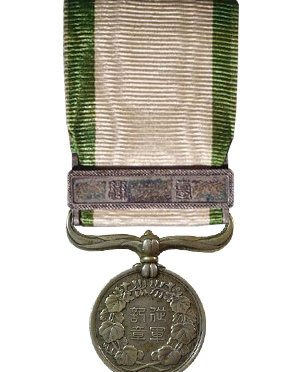
The 1874 Formosa Expedition War Medal was established in 1875 to commemorate the 3000 Japanese warriors who went to Formosa.

The 1874 Formosa Expedition War Medal was established by Daijou-kan Law #54 on April 10, Meiji 8 [1875]. Revised (Law #141) on November 15, 1876.

The Japanese expedition of 1874 to Taiwan Province, also referred to as the Taiwan Expedition of 1874, was in response to the Mudan Incident of 1871. Fifty-four shipwrecked Ryukyuan sailors were killed by Paiwan aborigines in December 1871 in southern Taiwan. In seeking restitution from Qing China, Japan reached an impasse when the Chinese claimed that they were not responsible for the actions of the aborigines in territory that was nominally under Chinese sovereignty.

The Japanese government sent an expedition of 3,600 soldiers led by Saigō Tsugumichi in May 1874. The Japanese won a decisive victory at the Battle of Stone Gate on 22 May 1874. Thirty aborigines were either killed or mortally wounded in the battle, and a great number wounded. Japanese casualties were six killed and thirty wounded.

In November 1874 the Japanese forces withdrew from Taiwan after the Qing government agreed to an indemnity of 500,000 Kuping taels.

The Military Medal of Honor (or 従軍記章 jugun kisho in Japanese) was a military decoration for meritorious service to the Empire of Japan, formerly awarded to all military personnel who participated in battles in a war and effectively abolished during the Allied Occupation of Japan in the post-war years (1945–1951).

The plausible re-institution of a modern equivalent was made unlikely by the adoption of Japan’s post-war Constitution which disavows the right of the state to engage in aggressive war.

The 1874 Formosa Expedition War Medal Design

The obverse of the medal bears branches of Imperial Paulonia Leaves. Inscribed ‘War Medal.’ The reverse is inscribed ‘Meiji 7 [1874] Year of the Dog.’ The latter refers to the Chinese Sexagenary Cycle.

The 1931-34 China Incident War Medal

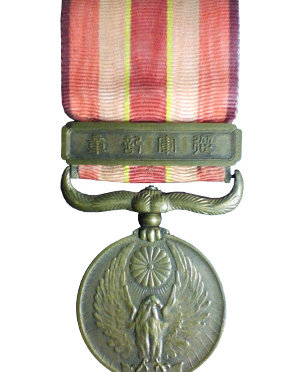
The China Incident Medal (Sina jihen jugun kisho) medal was created in 1939 and awarded for service in China during the Shōwa period.

The China Incident Medal (Sina jihen jugun kisho) medal was created by Imperial Edit No. 496 on July 27, 1939 and awarded for service in China at any time from the 12th through the 20th years of the Shōwa period — Shōwa 12-20 (1937–1945). The decoration was abolished in 1946 by government ordinance No. 177.

Although the Japanese government still uses “China Incident” in formal documents, media in Japan often paraphrase it with other expressions like Japan-China Incident (日華事変 Nikka jihen) or (日支事変 Nisshi jihen). The word Shina is now construed by China as a derogatory term.

The Military Medal of Honor (or 従軍記章 jugun kisho in Japanese) was a military decoration for meritorious service to the Empire of Japan, formerly awarded to all military personnel who participated in battles in a war and effectively abolished during the Allied Occupation of Japan in the post-war years (1945–1951).

The plausible re-institution of a modern equivalent was made unlikely by the adoption of Japan’s post-war Constitution which disavows the right of the state to engage in aggressive war.

The Argentine Nation to the Valour in Combat Medal

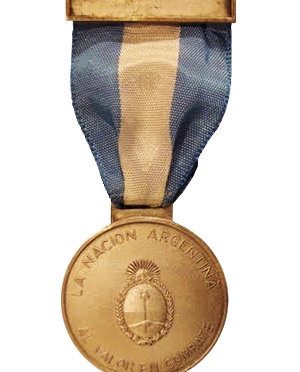
The Argentine Nation to the Valor in Combat Medal (or Medalla de la Nación Argentina al Valor en Combate in Spanish) is the second highest military decoration given by the President of Argentina (the highest one being the Cross to the Heroic Valour in Combat).

The conditions for its award are to “recognize acts during the Southern Atlantic war for merits, valor and heroism in the defense of the Motherland“. The medal can be given to Argentinian citizens as well as foreigners, from the military, police or civilian personnel. A total of 56 people have received this award: 24 Officials, 21 NCOs and 11 soldiers.

The Argentine Nation to the Valor in Combat Medal Design

The medal is a circular medal cast in bronze. The obverse depicts the Coat of arms of the Argentinian Republic and the words “The Argentinian Nation” (“La Nación Argentina“) and “Valor in Combat” (“Al Valor Heroico“).

The medal is suspended from a chest ribbon of equal light blue-white-light blue stripes.

The Distinguished Service Medal (Navy & Marines)

The Navy Distinguished Service Medal is a military decoration created in 1919 for the United States Navy and United States Marine Corps.

  • Time PeriodThe Great War
  • Institution: 4 February 1919
  • Country: United States

The Navy Distinguished Service Medal is a military decoration, first created in 1919, of the United States Navy and United States Marine Corps. It recognizes distinguished and exceptionally meritorious service to the country while serving in a duty or position of great responsibility.

At the start of World War I, the Navy had the Medal of Honor as the only decoration with which to recognize heroism. At a level below, the Navy Distinguished Service Medal and the Navy Cross were created by Public Law 253 on 4 February 1919. The Navy Distinguished Service Medal remained senior to the Navy Cross until August 1942, when the precedence of the two decorations was reversed. 

To justify this decoration, exceptional performance of duty must be clearly above that normally expected, and contributes to the success of a major command or project. The decoration is normally only bestowed to senior Navy flag officers and Marine Corps general officers, or extremely senior enlisted positions. In rare instances, it has also been awarded to Navy captains and Marine Corps colonels.

The Navy Distinguished Service Medal Design

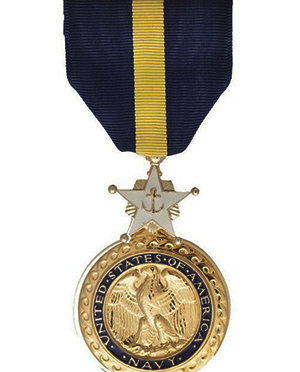
The Navy Distinguished Service Medal is a gilt bronze medallion measuring 1.25 inches (32 mm) in diameter.

The obverse features an American bald eagle in the center displaying its wings (the eagle holds an olive branch in its right talon and arrows in its left talons and is surrounded by a blue enameled ring with the words “UNITED  STATES OF AMERICA” at the top and “NAVY” at the bottom).

Surrounding the blue enamel ring is a gold border of scroll waves depicted moving in a clockwise direction. The medal is surmounted by a white five-pointed star, point up, the points of the star being tipped with gold balls. In the center of the star is a blue anchor, while gold rays radiate between the arms of the star.

The reverse depicts a trident surrounded by a laurel wreath, and surrounded itselft by a blue enamel ring containing the inscription “FOR DISTINGUISHED SERVICE”

The medal’s suspension and service ribbon is navy blue with a single central stripe of yellow. Additional awards of the Navy Distinguished Service Medal are denoted by gold and silver 5/16 inch stars worn on the medal’s suspension and service ribbon.

Find This Medal Online

Right Now on eBay 
Clicking a link to eBay may result in a referral commission being paid if a purchase is made.
Loading...

The Medal for Distinguished Labor (Russia)

The Medal For Distinguished Labor was an award of the Soviet Union established in 1938 and bestowed to especially deserving workers.

The Medal “For Distinguished Labor” (or Медаль «За трудовое отличие» in Russian) was a civilian labor award of the Soviet Union established on December 27, 1938 by decree of the Presidium of the Supreme Soviet of the USSR and bestowed to especially deserving workers to recognize and honor high performances in labor or contributions in the fields of science, culture or the manufacturing industry.

In just over fifty years of existence, the medal was bestowed to over two million deserving citizens. The first investiture took place on January 15, 1939 where the Medal “For Distinguished Labor” was presented to 19 employees of the Kalinin armaments plant number 8 for exceptional service to the country in the creation and development of new weapons for the Workers’ and Peasants’ Red Army.

Its statute was amended three times by further decrees and ceased to be awarded following the December 1991 dissolution of the Soviet Union.

The Medal for Distinguished Labor Medal Design

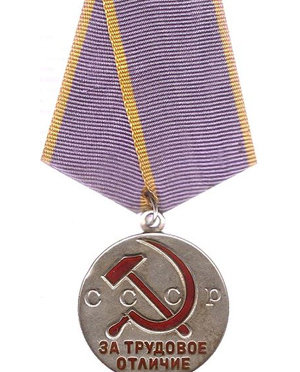
The Medal for Distinguished Labor measured 32 mm in diameter and is circular and struck from .925 silver with a raised rim on both sides.

In the upper 3/4 of the obverse, a 21 mm high by 20 mm wide ruby-red enameled image of the hammer and sickle over the relief inscription “USSR” («СССР») in 3.5 mm high letters. In the lower quarter of the obverse below the hammer and sickle, the sunken and red enameled inscription on two rows “FOR DISTINGUISHED LABOUR” («ЗА ТРУДОВОЕ ОТЛИЧИЕ») in 2 mm high letters. On the otherwise plain reverse, the relief inscription on two rows of 2.5 mm high letters “LABOUR IN THE USSR – A MATTER OF HONOUR” («ТРУД В СССР — ДЕЛО ЧЕСТИ»). The medal was numbered until 1945.

Early awards hung from a small triangular mount covered with a red ribbon with a threaded stub and screw for attachment to clothing. Following the 1943 decree, it was secured by a ring through the medal suspension loop to a standard Soviet pentagonal mount covered by a 24mm wide lilac colored silk moiré ribbon with 2 mm wide yellow edge stripes.

The Medal for Labor Valor (Russia)

The Medal for Labor Valor (Медаль «За трудовую доблесть») was a civilian labor award of the Soviet Union established on December 27, 1938.

The Medal for Labor Valor (or Медаль «За трудовую доблесть» in Russian) was a civilian labor award of the Soviet Union established on December 27, 1938 by decree of the Presidium of the Supreme Soviet of the USSR and bestowed to especially deserving workers to recognize and honor dedicated and valorous labor or significant contributions in the fields of science, culture or the manufacturing industry.

The medal’s statute was amended three times by further decrees. During its existence of just over fifty years, it was bestowed to almost two million deserving citizens, including workers, farmers, specialists of the national economy, workers of science, culture, education, health and other to citizens of the USSR, and in exceptional cases, to foreign nationals.

The first investiture took place on January 15, 1939 where the Medal “For Labor Valor” was presented to 22 employees of the Kalinin armaments plant number 8 for exceptional service to the country in the creation and development of new weapons for the Workers’ and Peasants’ Red Army. The medal ceased to be awarded following the December 1991 dissolution of the Soviet Union.

The Medal for Labor Valor Medal Design

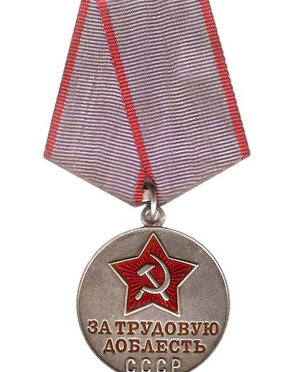
The medal measured 34 mm in diameter (some struck in 1945 measured 35 mm), was circular and struck from .925 silver with a raised rim on both sides.

In the upper obverse, a ruby-red enameled 19.2 mm wide five pointed star with a silver hammer and sickle at its center. Below the star, the inscription in two rows of sunken and red enameled 2.8 mm high letters “FOR VALOUR LABOUR” («ЗА ТРУДОВУЮ ДОБЛЕСТЬ»), at the very bottom, the relief inscription in 3.3 mm high letters “USSR” («СССР»). On the otherwise plain reverse, the relief inscription on two rows of 2.5 mm high letters “LABOUR IN THE USSR – A MATTER OF HONOUR” («ТРУД В СССР — ДЕЛО ЧЕСТИ»).

Early awards hung from a small triangular mount covered with a red ribbon with a threaded stub and screw for attachment to clothing. Following the 1943 decree, the medal was secured by a ring through the medal suspension loop to a standard Soviet pentagonal mount covered by a 24mm wide lilac coloured silk moiré ribbon with 2 mm wide red edge stripes.

The Medal For Battle Merit (Russia)

The Medal for Battle Merit was a Soviet military medal created in 1938 and awarded for combat action resulting in a military success.

The Medal for Battle Merit (or Медаль «За боевые заслуги» in Russian) was a Soviet military medal created on October 17, 1938 by the decision of the Presidium of the Supreme Soviet of the Soviet Union. It was awarded for “courageous defense of the state borders“, “combat action resulting in a military success” or “successful military and political training and preparation“.

The Medal for Battle Merit was Like the Medal for Courage, its status was revised to prevent the medal from being given for years of service (a practice that was rampant in the USSR) rather than actual bravery during a battle.

More than 5,210,000 medals were awarded between 1938 and 1991.

The Medal For Battle Merit Medal Design

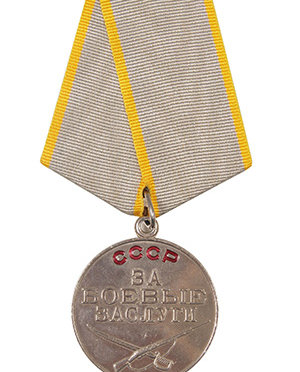
The Medal for Battle Merit  is a 32mm in diameter circular silver color medal with a raised rim on both the obverse and reverse.

The medal is secured to a standard Russian pentagonal mount by a ring through the medal suspension loop. The mount is covered in a 24mm wide grey ribbon with a yellow 2mm edge stripe on each side.

The Medal for Courage (Russia)

The Medal For Courage is a state decoration of the Russian Federation awarded to soldiers of the Soviet Army and other citizens.

The Medal “For Courage” or Medal “For Valour” (or Медаль «За отвагу» in Russian) is a state decoration of the Russian Federation that was awarded to soldiers of the Soviet Army, Navy, border and internal troops and other citizens (and in some cases non-citizens) of the USSR. The medal was retained from the Soviet awards system following the dissolution of the USSR.

It was created by the decision of the Presidium of the Supreme Soviet of the USSR on October 17, 1938. The first three Medals for Courage were awarded only three days later to three border guards for acts of bravery during the Battle of Lake Khasan. More than 4,2 million were awarded during the Great Patriotic War.

The award criteria was amended on three occasions by three separate Presidential Decrees, № 19 of January 6, 1999, № 444 of April 17, 2003 and № 1099 of September 7, 2010.

From its creation in 1938 to the fall of the Soviet Union in 1991, 4,569,893 medals were awarded, many posthumously.

The Medal for Courage Medal Design

The Medal for Courage measures 34mm in diameter and is a circular silver medal with a raised rim on both the obverse and reverse.

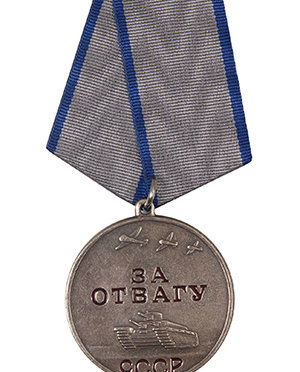
On the obverse are three aircraft flying from right to left. Below the aircraft is the impressed and red enameled inscription in two lines “FOR COURAGE” («ЗА ОТВАГУ») and below is a (T-35) tank with its forward left corner closest to the front.

The medal’s reverse is plain except for an embossed letter “N” followed by an horizontal line in the lower half reserved for the award serial number, and a maker’s mark below it. The medal is secured to a standard Russian pentagonal mount by a ring through the medal suspension loop. The mount is covered in a silk moiré 24mm wide grey ribbon with a blue 2mm edge stripe on each side.

The Medal “For Courage” was retained by the Russian Federation after the dissolution of the Soviet Union, with the same basic design save for the caption “USSR” (CCCP) on the lower obverse.

The Order of the Red Banner of Labor

The Order of the Red Banner of Labor was an order of the Soviet Union established to honor great deeds and services to the state and society

The Order of the Red Banner of Labor (or Орден Трудового Красного Знамени in Russian) was an order of the Soviet Union established to honor great deeds and services to the Soviet state and society in the fields of production, science, culture, literature, the arts, education, health, social and other spheres of labor activities.

It is the labor counterpart of the military Order of the Red Banner. A few institutions and factories, being the pride of Soviet Union, also received the order. The Order of the Red Banner of Labor could be awarded multiple times to the same recipient for successive deeds and long time merit

The Order of the Red Banner of Labor Design

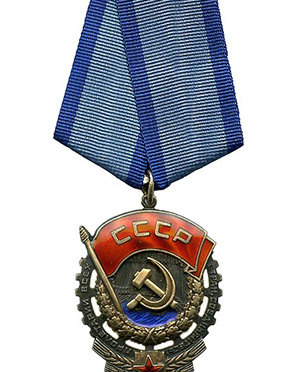
The “type 1” Order consisted of a 38 mm wide by 43 mm high silver badge in the shape of a cogwheel, at center, a disc bordered along its entire outer diameter by panicles of wheat. Protruding from under the lower half of the central disc, a red enameled triangle pointing downwards. On the central disc in the background, a hydro electric dam, at center, a gilded hammer and sickle, at the top, a waving red banner bearing the inscription “Пролетарии всех стран, соединяйтесь!”, “Proletarians of the World, unite!”. At the very bottom of the cogwheel, the relief inscription “USSR” (“СССР”) on a stylized horizontal shield bisected by a smaller cogwheel meshing into the larger one.

On the otherwise plain reverse, a recess at center bearing a threaded post, two rivets used to secure the hammer and sickle and the award serial number engraved on the lower portion opposite the “USSR” inscription. The Order was secured to clothing with a threaded screw and nut arrangement. The earlier nuts were 28 mm in diameter, later ones measured 32 mm.

The “type 2” Order also consisted of a silver badge in the shape of a cogwheel, it measured 38 mm wide by 44 mm high. At the center, a disc surrounded by a gilded wreath of oak leaves bearing the relief image of a hydro electric dam, below the dam, blue enameled water, at the center of the disc, the gilded hammer and sickle, from the inner left side of the disc, a gilded mast bearing a waving red enameled banner protruding from the central disc, covering the upper portion of the cogwheel and protruding past its outer upper edge on which “USSR” (“СССР”) is inscribed in gilded letters.