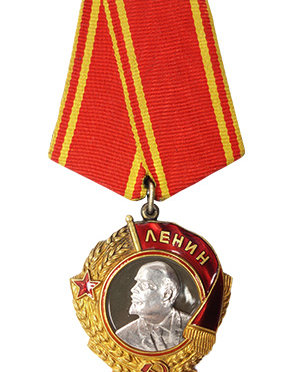
The Order of Lenin

The Order of Lenin (or Орден Ленина in Russian) was the highest civilian decoration bestowed by the Soviet Union. It was established in 1930.

The Order of Lenin (or Орден Ленина, Orden Lenina in Russian) was the highest civilian decoration bestowed by the Soviet Union. It was named after the leader of the Russian October Revolution and established by the Central Executive Committee on April 6, 1930. The Order of Lenin was awarded:

  • To civilians, for outstanding services provided to the State.
  • To members of the armed forces, for exemplary service.
  • To those who strengthened peace and promoted friendship and cooperation between peoples.
  • To those with meritorious services to the Soviet state and Soviet society.
  • From 1944 to 1957, the Order of Lenin was also used to reward 25 years of conspicuous military service.

The first Order of Lenin was awarded on 23 May 1930 to the newspaper Komsomolskaya Pravda. The Order could also be bestowed on cities, companies, factories, regions, military units, and ships – something that allowed them to apply the name of the Order into their official titles. The initial recipients also included three pilots, five industrial companies, and the Secretary to the Central Executive Committee Avel Enukidze. The first person to receive the Order was the test pilot Valery Chkalov in 1936. Among the first foreign recipients were a German and four US citizens, who received the Order of Lenin for helping in the reconstruction of Soviet agriculture and industry.

The Order of Lenin could be awarded multiple times. For example, Nikolay Patolichev, longtime Minister for Foreign Trade of the USSR, and Dmitriy Ustinov, Defence Minister in 1976–1984, received it 11 times.

Notable Recipients of the Order of Lenin

The Order of Lenin was awarded to the following notable individuals:

  • Fidel Castro (President of Cuba)
  • Yuri Gagarin (Cosmonaut, first human being in outer space)
  • Kim Il-sung (President of North Korea, awarded 2 times)
  • Nelson Mandela (Mandela, who led South Africa into democracy and out of apartheid, was awarded the Order of Lenin in 1990, the same year he was released from prison)
  • Ramón Mercader (Spanish NKVD agent who assassinated Leon Trotsky)
  • Joseph Stalin (1949)

The Order of Lenin Medal Design

The Order of Lenin badge was originally worn by screwback on the left chest and without a ribbon. From 943 on, it was worn as a medal suspended from a red ribbon with pairs of yellow stripes at the edges. There are four designs for the Order of Lenin medal:

Order of Lenin First Design (1930-1932)

The first design of the Order of Lenin (awarded between 1930–1932) is a round badge with a central disc featuring Vladimir Lenin‘s profile surrounded by smokestacks, a tractor, and a building, possibly a power plant. It was sculpted by Pyotr Tayozhny and Ivan Shadr based on sketches by Ivan Dubasov. It was made by Goznak of silver with some lightly gold-plated features. A thin red-enameled border and a circle of wheat panicles surround the disc. At the top is a gold-plated hammer and sickle emblem, and at the bottom are the Russian initials for “USSR” (СССР) in red enamel. There were only about 800 of this design minted.
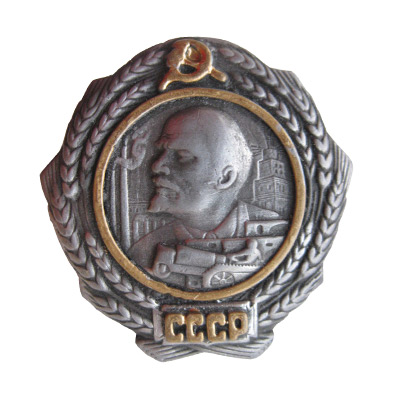
USSR Order of Lenin Type 1

Order of Lenin Second Design (1934-1936)

The second design of the Order of Lenin was awarded from 1934 until 1936. This design consists of a solid gold badge, featuring a silver-plated disc bearing Lenin’s portrait. The disc is surrounded by two golden panicles of wheat, and a red flag with the inscription “LENIN” in Cyrillic script (ЛЕНИН). On the left is a red star and at the bottom is the “hammer and sickle” emblem. Both are done in red enamel.
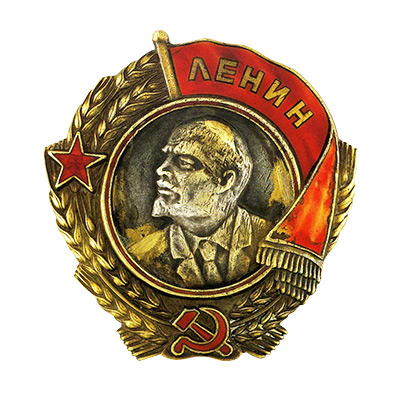
USSR Order of Lenin Type 2

Order of Lenin Third Design (1936-1943)

The third design of the Order of Lenin was awarded from 1936 until 1943. The design is the same as the second type, except that the central disc is enameled gray and Lenin’s portrait is made with a separate piece of platinum.
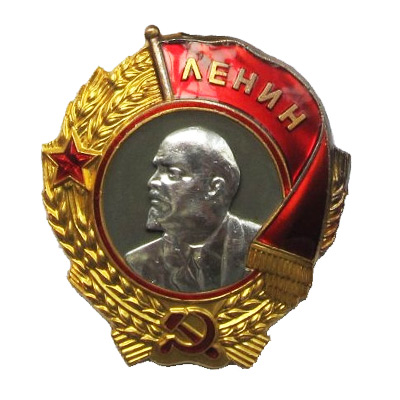
USSR Order of Lenin Type 3

Order of Lenin Fourth Design (1943-1991)

The fourth design of the Order of Lenin was awarded from 1943 until 1991. This version maintained the visual design elements of the third model, featuring the portrait of Vladimir Lenin. However, a significant change was the method of wearing the medal. While all previous versions were attached to clothing via a screwback mechanism, the fourth design was suspended from a ribbon, making it more adaptable and easier to wear on various types of clothing.

The ribbon used for the Order of Lenin was a red silk moiré ribbon, reflecting the symbolic color of the Soviet Union and its Communist Party. The medal itself retained its distinctive features: a gold badge with a platinum portrait of Lenin, surrounded by a wreath of wheat ears, a red banner, and a hammer and sickle at the bottom. This design was meant to symbolize the unity of the Soviet people and their dedication to the principles of communism.
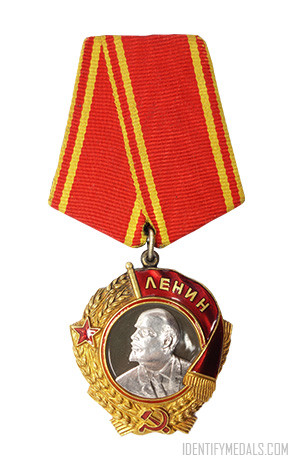
USSR & Russian Medals and Awards - The Order of Lenin

What's the Value and Price of The Order of Lenin?

The Order of Lenin is a very rare and well-respected award. As such, prices for this medal can range from U$ 1000 for types 4 and 5, to over U$ 50,000 for type 1. These prices can get higher too if the medals come with the accompanying documents.
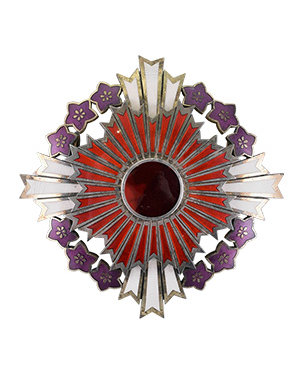
The Order of the Paulownia Flowers

The Order of the Paulownia Flowers is an order presented by the Japanese government and established in 1888 during the Meiji Restoration.

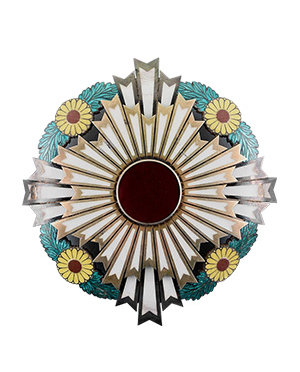
The Order of the Paulownia Flowers (桐花章 Tōka shō) is an order presented by the Japanese government and established in 1888 during the Meiji Restoration as the highest award in the Order of the Rising Sun.

The only grade of the order is Grand Cordon of the Order of the Paulownia Flowers (旭日桐花大綬章 Kyokujitsu tōka daijushō), which ranks higher than the Order of the Rising Sun but lower than the Order of the Chrysanthemum.

Traditionally, the order has been conferred upon eminent statesmen, former prime ministers and senior cabinet ministers, diplomats and judges. It may be conferred posthumously, and is the highest regularly conferred honor in the Japanese honors system.

The Order of the Paulownia Flowers Medal Design

The badge for the Order is a gilt cross with white enameled rays, bearing a central emblem of a red enameled sun disc surrounded by red rays, and with three paulownia blossoms between each arm of the cross. It is suspended from three enameled paulownia leaves on a sash in red with white border stripes, and is worn on the right shoulder.

The star for the Order is the same as the badge, but without the paulownia leaves suspension. It is worn on the left chest.

The Order of the Chrysanthemum

The Supreme Order of the Chrysanthemum is is the highest possible honor a Japanese citizen can be awarded during his or her lifetime.

The Supreme Order of the Chrysanthemum (大勲位菊花章 Dai-kun’i kikka-shō, literally Grand Order of the Capitulum of the Chrysanthemums) is Japan’s highest order.

The Grand Cordon of the Order was established in 1876 by Emperor Meiji of Japan; the collar of the Order was added on 4 January 1888. Unlike its European counterparts, the order may be conferred posthumously. Apart from the Imperial Family, only six Japanese citizens have ever been decorated with the collar in their lifetimes. Today, only the reigning Emperor holds this dignity as sovereign of the order; however, exceptions are made for foreign heads of state, who can be awarded the collar in friendship.

The grand cordon is the highest possible honor a Japanese citizen can be awarded during his or her lifetime.

The Order of the Chrysanthemum Medal Design

The star of the order is similar to the badge, but in silver, without the chrysanthemum suspension, and with an eight-pointed gilt medallion (with white-enameled rays and red-enameled sun disc) placed at the center. It is worn on the left chest.

The badge of the order is a four-pointed gilt badge with white-enameled rays; the center bears a red enameled sun disc. On each of the four corners of the badge is a yellow-enameled chrysanthemum blossom with green-enameled chrysanthemum leaves. The badge is suspended on a yellow-enameled chrysanthemum, either on the collar or on the grand cordon.

The collar of the order is made of gold, and features the kanji for “Meiji”, in classic form, indicating the era of the order’s establishment. It is decorated with gold chrysanthemum blossoms and green-enameled leaves. The sash of the grand cordon of the order is red with dark blue border stripes. It is worn on the right shoulder.

The Order of the Red Banner

The Order of the Red Banner was the first Soviet military decoration, established in 1918 by decree of the All-Russian Central Executive Committee.

The Order of the Red Banner (or Орден Крaсного Знамени in Russian) was the first Soviet military decoration. It was established on 16 September 1918, during the Russian Civil War by decree of the All-Russian Central Executive Committee.

The Order was awarded to individuals as well as to military units, cities, ships, political and social organizations, and state enterprises. Recipients were recognized for extraordinary heroism, dedication, and courage demonstrated on the battlefield. In later years, it was also awarded on the twentieth and again on the thirtieth anniversary of military, police, or state security service without requiring participation in combat (the “Long Service Award” variant).

The Order of the Red Banner Medal Design

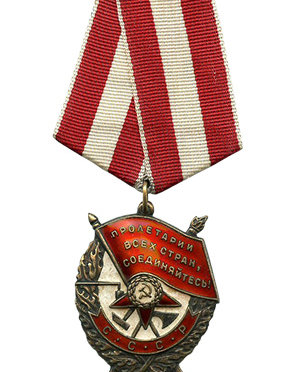
The Order consisted of a white-enameled badge, which had a golden hammer and sickle badge surrounded by two golden panicles of wheat on a Red Star, backed by crossed hammer, plough, torch, and a red flag bearing the motto Proletarians (Workers) of the World, Unite!.

The medal was surrounded by two golden panicles of wheat; at the bottom were the letters “SSSR” (СССР). Additional awards of the Order bore a white enameled shield with a silver sequence number at the bottom of the obverse. A recipient of multiple Orders of the Red Banner would wear a basic badge of the Order with a numeral corresponding to the sequence of the award on a cartouche over the wheat at the bottom of the badge.

The early variants of the Order were screw back badges to allow wear on clothing. Later variants (from 1943) hung from a standard Soviet pentagonal mount with a ring through the suspension loop. The mount was covered with an overlapping 24mm wide red silk moiré ribbon with 1.5mm wide white edge stripes and a 7mm wide white central stripe.

The Order of the Red Banner was worn on the left side of the chest and when in the presence of other Orders and medals of the USSR, was placed immediately after the Order of the October RevolutionIf worn in the presence of Orders or medals of the Russian Federation, the latter have precedence.

Find This Medal Online

Right Now on eBay 
Clicking a link to eBay may result in a referral commission being paid if a purchase is made.
Loading...

The Medal for the War of 1941–1945

  • Time Period: WW2
  • Year of Institution: 2 March 1946
  • Country: Greece

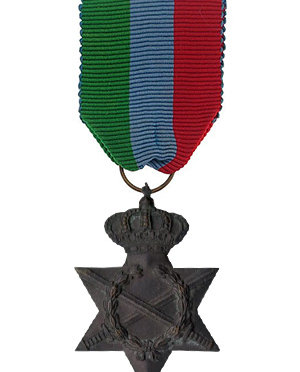
The Medal for the War of 1941–1945 was established on 2 March 1946 and awarded to members of the Royal Hellenic Armed Forces who had seen action. It was created as a star for land operations.

The medal was bestowed upon Royal Hellenic Armed Forces personnel for operational services to the Army in North Africa, the South Aegean Sea and Italy. Several thousands of Army personnel, the majority of the Fleet and the remaining airplanes escaped to Turkey or were evacuated to Egypt after the capitulation of the Continental Greece and the battle of Crete respectively. At the British controlled Middle East the Hellenic Armed Forces were reorganized and reequipped (with British assistance) while more personnel either from Greece or from the existing Greek population in Egypt joined their ranks.

Soon the Hellenic Armed Forces of the Middle East were able to form 2 Brigades, a Special Forces Unit (Sacred Band or Sacred Company in Greek) attached to 1st SAS. The Hellenic Royal Navy with 44 ships and over 8,500 men, became the second-largest Allied Navy in the Mediterranean after the RN, accounting for 80% of all non-RN operations.

The Hellenic Royal Air Force formed 3 Squadrons (the 335 and 336 Fighter Squadrons – equipped with Hurricanes and later with Spitfires – and the 13th Naval Cooperation Squadron which operated with Blenheims and later with Batimores).

The Hellenic Armed Forces participated to the Battle of El Alamein, to the Operations for Liberation of several Greek islands of the Aegean Sea after the capitulation of Italy, to the operation in Sicily and South Italy while several ships of the Hellenic Royal Navy supported the landing in Normany.

The Medal for the War of 1941–1945 Design

The ribbon shows what appears to be water / storage damage.

The Medal for the War of 1940–1941

  • Time Period: WW2
  • Year of Institution: 19 August 1947
  • Country: Greece

The Medal for the War of 1940–1941 was instituted by Royal Decree of August 19th 1947 to recognize the actions of the Royal Greek Armed Forces who took part in the war efforts from the outbreak of the war in Greece in 1940 until the fall of Crete in 1941 (it covers the campaigns in Epirus, Albania, Macedonia, Thrace and Crete.)

The medal was also awarded to foreign forces that fought on Greek soil.

The Medal for the War of 1940–1941 Design

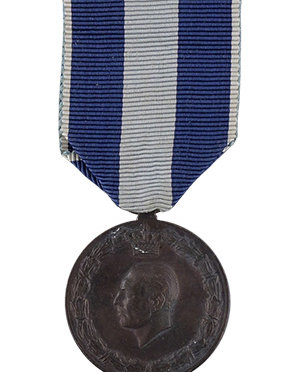
The medal can either be of bronze or of gilt. The riband is of a dark blue color with a pale blue center stripe and two narrow white edge stripes. Some variations have a more grey stripe in the center. Every recipient receives a certificate with the recipients name.

The obverse bears the head of King George II, surrounded with a laurel wreath. The wreath is at the top joined by a crown. In 1983 the obverse was changed because of the changing of Greece from a kingdom to a republic in 1974. From 1983 the obverse shows a headless winged female figure above the inscription “1940-41”. The figure is surrounded by a laurel wreath, at the top joined by the Greek word for “Greece”.

The reverse has original a Greek inscription meaning “1940-41 Eprius, Albania, Macedonia, Thrace, Crete” for Army medals and “1940-41 Aegean, Ionian, Myrtoum, Adriatic” for Navy medals. From 1983 the “1940-41” was removed but the rest remained.

The Medal for the National Resistance (Greece)

  • Time Period: WW2
  • Year of Institution: 22 December 1948
  • Country: Greece

The Medal for the National Resistance was instituted on 22 December 1948 to commemorate the Nation’s Resistance during the Second World War.

It was awarded in one class and bestowed upon those who had actively served in, or had been of assistance to Greek National Resistance Organizations in their struggle against occupying Italo-German forces between 1941 and 1945. 

Those who served with the British Special Operations Executive Military Mission to Greece are eligible for the award. As are escaped prisoners of war who joined Greek Resistance organizations.

The Medal for the National Resistance Design

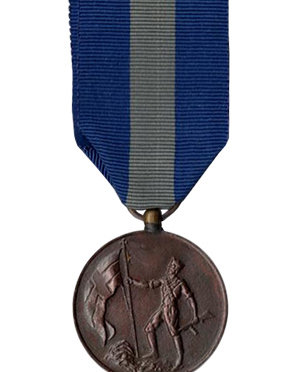
The Medal is a bronze medallion, the obverse of which depicts an armed Greek Resistance Fighter planting the National Flag on a rock. The reverse bears the inscription ‘National Resistance, 1941 – 1945’ in Greek.

The medal is pendent on a riband of dark blue with a wide grey center stripe. Some examples include a small bronze bar bearing the year of service on the riband.

The Medal for the Macedonian Struggle

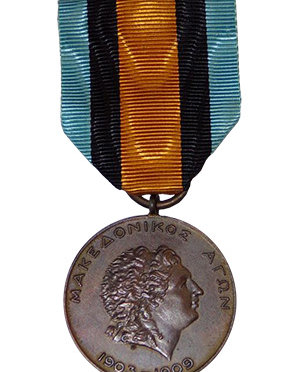
The Medal for the Macedonian Struggle was instituted in 1931 by the Second Hellenic Republic (1924-1935) first by law and then by Presidential Decree a year later.

It was awarded to living Makedonomachoi (Macedonian fighters) veterans of the Macedonian Struggle 1903-1909. The Macedonian Struggle was a the Greek guerrilla warfare against the forces of the supporters of the Bulgarian Exarchate such as the IMRO (International Macedonian Revolutionary Organization) that were aiming to annex Macedonia to Bulgaria. The Greek efforts for Macedonia were coordinated by the Hellenic Macedonian Committee, formed in 1903.

Its fighting forces were mainly former Officers of the Hellenic Army, volunteers brought to Crete and the Peloponnese,m as well as Macedonian Greeks.

The success of their efforts bolstered Greek presence in the still Ottoman-ruled Macedonia, and prepared the annexation of the Greek major part of Macedonia, following the Balcan Wars.

The Medal for the Macedonian Struggle Design

There were only approximately 2000 medals awarded. The text “Hellenic Republic” circumscribes it. The ribbon is colored light blue, black and yellow.

The Commemorative Medal for the Greco-Bulgarian War of 1913

  • Time Period: Pre-WW1
  • Year of Institution: 17 February 1914
  • Country: Greece

The Commemorative Medal for the Greco-Bulgarian War of 1913 was instituted by Royal Decree on 17 February 1914 and awarded for participation in the war against Bulgaria the previous year.

An alliance of Bulgaria, Greece, Montenegro and Serbia threw the Ottoman Turks out of almost all their remaining European territories in 1912 and the First Balkan War ended with the Treaty of London on 30 May 1913. However, the victors fell out over the division of the spoils, with Serbia and Greece forming an alliance against Bulgaria and the Second Balkan War broke out at the end of June. After initial setbacks, Bulgarian military successes stabilized the front in Macedonia. The situation was transformed by the invasion of Bulgaria by Romania on 10 July, leaving the former in a hopeless position. An armistice was agreed on 31 July with Greece gaining significant additional territory at the expense of Bulgaria.

The sense of grievance thus created led to Bulgarian participation in the two subsequent world wars on the side of Germany and against Greece but the territorial settlement has endured. The Byzantine Emperor Basil II earned the epithet ‘Bulgar-slayer’ during his wars against the Bulgarian empire of Tsar Samuel which led to the incorporation of most Bulgarian lands into the Byzantine Empire.

The Commemorative Medal for the Greco-Bulgarian War of 1913 Design

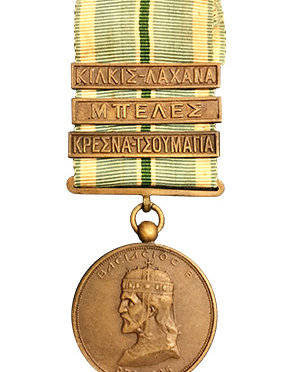
The medal is struck in bronze and measures 30 mm.

The ribbon is pale blue with white edge stripes and a white-edged green central stripe.

The Medal for the Greco-Turkish War of 1912-13

  • Time Period: Pre-WW1
  • Year of Institution: 1914
  • Country: Greece

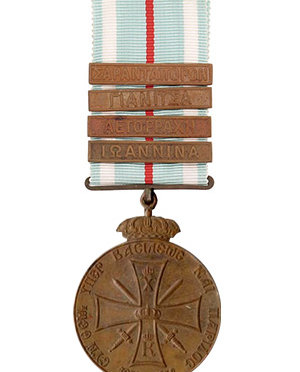
The Medal for the Greco-Turkish War of 1912-13 is a Greek medal instituted in 1914 and awarded to men of all armed forces who took part in battles or Naval battles or served in commandeering and auxiliary services on battle-sites, and also to civilians, either Greek or foreign subjects, who offered any kind of service to the Navy during the battles.

During the 1st Balkan War the alliance of Greece, Bulgaria, Montenegro and Serbia liberated the remaining Christian populations of the European territories from the Ottoman Empire. The War ended with the Treaty of London in 1913 but soon the 2nd Balkan War started, this time against Bulgaria.