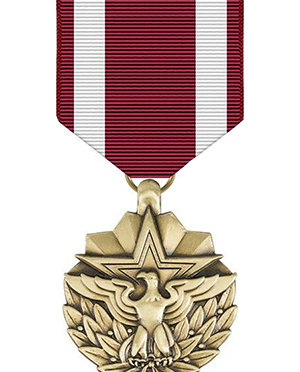
The Meritorious Service Medal (USA)

The Meritorious Service Medal (or MSM) is a military award presented to members of the U.S. Armed Forces who distinguished themselves.

The Meritorious Service Medal (also known as MSM) is a military award presented to members of the United States Armed Forces who distinguished themselves by outstanding meritorious achievement or service to the United States subsequent to January 16, 1969.

The MSM was previously awarded as a decoration for achievement during peacetime, but effective 11 September 2001, this decoration may also be bestowed in lieu of the Bronze Star Medal for meritorious achievement in a designated combat theater. Normally, the acts or services rendered must be comparable to that required for the Legion of Merit but in a duty of lesser, though considerable, responsibility. At the Tri-Department Awards Conference (February 5, 1968), there was a discussion on the need for a third meritorious award to provide appropriate recognition for non-combat achievement or service comparable to that of the Bronze Star Medal for combat achievement or service. It was felt that the Legion of Merit‘s prestige was slipping because it was being used with increasing frequency to reward service below the Legion of Merit’s intended standard, but higher than that required for the Commendation Medals of the various military services.

Foreign military personnel in the ranks of NATO OF-5 and below and individuals who have displayed a level of service that warrants an award of such magnitude may also be eligible to be awarded the MSM.

The Meritorious Service Medal Design

The Meritorious Service Medal is a bronze medal, 1.5 inches in diameter overall, consisting of six rays appearing from the upper three points of a five-pointed star with beveled edges and containing two smaller stars defined by incised outlines.

In the obverse, in front of the lower part of the star an eagle with wings upraised standing upon two upward curving branches of laurel tied with a ribbon between the feet of the eagle. The reverse has the encircled inscriptions “UNITED STATES OF AMERICA” and “MERITORIOUS SERVICE.” The suspension ribbon is 1 3/8 inches wide and consists of the following stripes: 1/8 inch Crimson 67112; 1/4 inch White 67101; center 5/8 inch Crimson; 1/4 inch White; and 1/8 inch Crimson.

Additional awards of the Meritorious Service Medal are denoted by bronze oak leaf clusters in the U.S. Army and U.S. Air Force and gold 5/16 inch stars in the U.S. Navy, U.S. Marine Corps and U.S. Coast Guard. These devices are also authorized for wear on the suspension and service ribbon of the medal.

Buy a Meritorious Service Medal

Note: As an eBay partner, I earn from qualifying purchases. This is all done automatically when you use a link and at no extra cost to you.

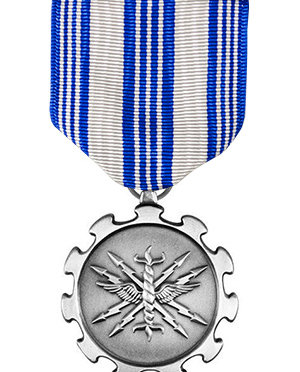
Right Now on eBay 
Clicking a link to eBay may result in a referral commission being paid if a purchase is made.
Loading...

The Achievement Medal – Air Force

The Achievement Medal is a military decoration of the Armed Forces for the contributions of junior officers and enlisted personnel

The Achievement Medal is a military decoration of the United States Armed Forces. It was first proposed as a means to recognize the contributions of junior officers and enlisted personnel who were not eligible to receive the higher Commendation Medal or the Meritorious Service Medal. Award authority rests with local commanders, granting a broad discretion of when and for what action the Achievement Medal may be awarded.

Each military service issues its own version of the Achievement Medal, with a fifth version authorized by the U.S. Department of Defense for joint military activity.

The U.S. Army and U.S. Air Force issued their own versions of the award with the Army Achievement Medal in 1981 and Air Force Achievement Medal in 1980. 

The Achievement Medal Design

The following devices may be authorized to be worn on the following achievement medals suspension ribbon and service ribbon:

  • All Achievement Medals, “C” device, which signifies meritorious performance “under combat conditions”, after January 2016
  • Army Achievement Medal, for additional awards – oak leaf clusters
  • Air Force Achievement Medal, for additional awards – oak leaf clusters
  • Navy and Marine Corps Achievement Medal, for additional awards – 5/16 inch stars
  • Coast Guard Achievement Medal, for additional awards – 5/16 inch stars
  • Joint Service Achievement Medal (all service branches), for additional awards – oak leaf clusters
  • Coast Guard Achievement Medal – Operational Distinguishing Device (“O” device)
  • Coast Guard Achievement Medal – Combat Distinguishing Device (Combat “V”)

Find This Medal Online

Right Now on eBay 
Clicking a link to eBay may result in a referral commission being paid if a purchase is made.
Loading...

The Achievement Medal – Coast Guard

The Achievement Medal is a military decoration of the  Armed Forces for the contributions of junior officers and enlisted personnel

The Achievement Medal is a military decoration of the United States Armed Forces. It was first proposed as a means to recognize the contributions of junior officers and enlisted personnel who were not eligible to receive the higher Commendation Medal or the Meritorious Service Medal. Award authority rests with local commanders, granting a broad discretion of when and for what action the Achievement Medal may be awarded.

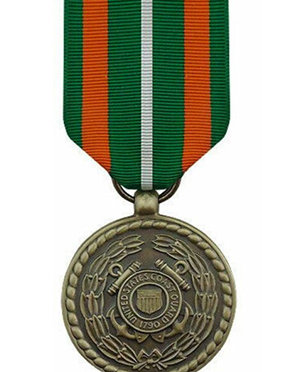
Each military service issues its own version of the Achievement Medal, with a fifth version authorized by the U.S. Department of Defense for joint military activity. The United States Coast Guard created its own Achievement Medal in 1967.

The Achievement Medal Design

The following devices may be authorized to be worn on the following achievement medals suspension ribbon and service ribbon:

  • All Achievement Medals, “C” device, which signifies meritorious performance “under combat conditions”, after January 2016
  • Army Achievement Medal, for additional awards – oak leaf clusters
  • Air Force Achievement Medal, for additional awards – oak leaf clusters
  • Navy and Marine Corps Achievement Medal, for additional awards – 5/16 inch stars
  • Coast Guard Achievement Medal, for additional awards – 5/16 inch stars
  • Joint Service Achievement Medal (all service branches), for additional awards – oak leaf clusters
  • Coast Guard Achievement Medal – Operational Distinguishing Device (“O” device)
  • Coast Guard Achievement Medal – Combat Distinguishing Device (Combat “V”)

Find This Medal Online

Right Now on eBay 
Clicking a link to eBay may result in a referral commission being paid if a purchase is made.
Loading...

The Medal of Military Merit (Greece)

The Medal of Military Merit (Μετάλλιο Στρατιωτικής Αξίας) is a military decoration of Greece created in 1916 for wartime meritorious service.

  • Time Period: WW1
  • Year of Institution: 28 February 1917
  • Country: Greece

The Medal of Military Merit (or Μετάλλιο Στρατιωτικής Αξίας in Greek) is a military decoration of Greece, originally created in 1916 for wartime meritorious service. After World War II the medal became a peace-time medal reserved for officers. After the abolition of the Greek monarchy in 1974, its design was slightly altered.

The medal was created as the Military Medal (Στρατιωτικόν Μετάλλιον) by the National Defence Government on 28 October 1916, during the National Schism, and was adopted as the Medal of Military Merit nationwide by Royal Decree on 30 June 1917.

The Medal of Military Merit Design

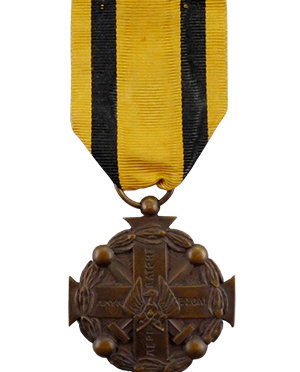
The medal was designed by the French sculptor André Rivaud (who also designed the 1916 War Cross) and is similar to its current version, a copper cross pattée concave with the arms filled, enclosed in a laurel wreath and with two crossed short swords superimposed.

The cross’s arms bear the legend ΑΜΥΝΕΣΘΑΙ ΠΕΡΙ ΠΑΤΡΗΣ (“Defending the fatherland”, a quote of Hector from the Iliad). The 1916 version had a phoenix rising from its ashes in the center, while the post-1974 version substitutes the national emblem of Greece. The 1916 version bore the legend ΕΛΛΑΣ 1916–1917 (“Greece 1916–1917”) on the reverse (although some medals omit the date or the inscription altogether), while the current version bears the legend ΓΙΑ ΣΤΡΑΤΙΩΤΙΚΗ ΑΞΙΑ (“For Military Merit”).

The 1916 version was suspended by a yellow ribbon with two black stripes, while the current version’s ribbon has three equal blue-white-blue stripes, edged with yellow. When worn as a ribbon bar, the circular wreaths were substituted by branches.

Originally the medal had four classes, with the third, second and first classes distinguished respectively by a bronze, silver and gilded laurel wreath on the ribbon, while the fourth class was plain.

The War Cross (Greece)

The War Cross (or Πολεμικός Σταυρός) is a military decoration of Greece, awarded for heroism in wartime to both Greeks and foreign allies.

  • Time Period: WW1
  • Year of Institution: 28 February 1917
  • Country: Greece

The War Cross (or Πολεμικός Σταυρός in Greek) is a military decoration of Greece, awarded for heroism in wartime to both Greeks and foreign allies.

There have been three versions of the cross, the 1917 version covering World War I (established by the Venizelist “National Defence” Government on 28 February 1917, and confirmed by Royal Decree on 31 October), the 1940 version covering the Second World War and the Greek Civil War, and the 1974 version covering peacekeeping missions in the subsequent years.

Its creation was inspired by the French Croix de guerre, and it was awarded to military personnel of all branches for acts of valor in the Macedonian Front (1916–1918), the Allied Expedition to the Ukraine (1919) and the Greco-Turkish War of 1919–1922 (rarely after 1920 due to its Venizelist connotations). In addition, from 1919, the first class could be awarded to the war flags of distinguished regiments.

When Greece found itself at war again in October 1940 after the Italian invasion, the staunchly royalist dictatorial government chose an entirely different design instead of simply re-establishing the old version. The new medal was instituted by Royal Decree on 11 November 1940 and continued to be awarded throughout the Second World War. It was re-authorised on 19 April 1947 for the Greek Civil War (1946–1949) and extended until 1953, covering the Greek participation in the Korean War.

In 1974, during the last months of the Greek military junta and following the abolition of the monarchy in June 1973, the junta issued Law 376/74 on military medals, which revised the until then current regulations. It specified that the War Cross would have three classes, with the 1st class was reserved for senior officers and war flags, the 2nd class for mid-level officers and the 3rd class for junior and warrant officers, NCOs and privates.

The War Cross Design

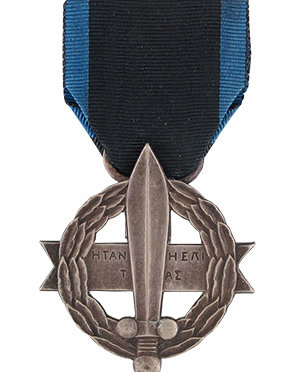
The War Cross medal was designed by the French sculptor André Rivaud and struck in silver.

1917 Version

The obverse features a vertical sword on a circular wreath, with a horizontal plaque, bearing the ancient Spartan motto “Η ΤΑΝ Η ΕΠΙ ΤΑΣ” (“[return home] either with your shield, or upon it”) underneath. The reverse bears the inscription “ΕΛΛΑΣ” (“Greece”) and underneath the dates “1916–1917”.

The ribbon was black, edged with blue, and 35–37 mm wide. The cross was awarded in three classes, distinguished by the devices born on the ribbon: the 3rd class being plain, the 2nd class bearing a bronze five-pointed star, and the 1st class a bronze palm leaf. Subsequent awards were designated by the addition of silver five-pointed stars on the ribbon.

1940 Version

The medal’s design is also a modification of the French Croix de guerre, featuring in the obverse a bronze cross pattée with the royal monogram (two crossed gammas and a crown) of King George II, atop two crossed swords, and topped by a royal crown. The reverse bears the date “1940”.

The ribbon features three equal alternating bands of red, blue and red. The cross was awarded in three classes, distinguished by the colour of the crown: bronze for the 3rd class, silver for the 2nd, and gold for the 1st class. Several variations exist because many manufacturers were used, some in Greece and others in the United Kingdom, with minor variations in the style of the crown and the cross, as well as design of the obverse side (in some versions, the date lies within a circle).

1974 Version

The medal was not officially redesigned at the time. In 1985, a provisional version was cut. It retained the same basic design as the 1940 version, but without the royal cypher, which was replaced by an oak wreath, and the crowns, which were replaced by bronze, silver and gold versions of the national emblem of Greece for the 3rd, 2nd and 1st classes respectively. The reverse bore the legend “ΕΛΛΗΝΙΚΗ ΔΗΜΟΚΡΑΤΙΑ” (“Hellenic Republic”). Four medals of the 1st class were issued to war flags of units participating in UN peacekeeping missions.

The design was finalized in Presidential Decree 159 of 17 March 2003. It retains the basic design of the 1940 and 1985 crosses, but the national emblem has been moved to the center of the cross, in bronze, silver and gold versions for the 3rd, 2nd and 1st classes respectively.

The Afghanistan Campaign Medal (USA)

The Afghanistan Campaign Medal is a military decoration awarded to any members who performed duty within the borders of Afghanistan.

The Afghanistan Campaign Medal (or ACM) is a military award of the United States military created by Executive Order 13363 of President George W. Bush on November 29, 2004, and became available for general distribution in June 2005. The medal is retroactive to October 24, 2001, and is active until a date to be determined. 

The medal is awarded to any member of the United States military who has performed duty within the borders of Afghanistan (or its airspace) for a period of thirty consecutive days or sixty non-consecutive days.

Personnel who have been engaged in combat with an enemy force, or personnel who have been wounded in combat within Afghanistan, may receive the ACM regardless of the number of days spent within the country. The medal is also awarded posthumously to any service member who dies in the line of duty within Afghanistan, including from non-combat injuries such as accidents and mishaps.

The Afghanistan Campaign Medal Design

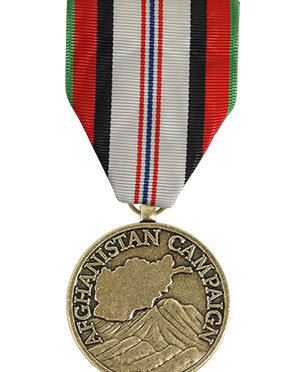
The medal was designed by the U.S. Army Institute of Heraldry. The medal is bronze in appearance and measures 1 14 inches in diameter. It depicts above a range of mountains a map of Afghanistan. Around the top is the inscription “AFGHANISTAN CAMPAIGN.”

On the reverse, a radiating demi-sun superimposed by an eagle’s head couped. Inscribed across the bottom half of the reserve side are the three lines “FOR SERVICE IN AFGHANISTAN“, enclosed by a laurel wreath.

Find This Medal Online

Right Now on eBay 
Clicking a link to eBay may result in a referral commission being paid if a purchase is made.
Loading...

The Iraq Campaign Medal (USA)

The Iraq Campaign Medal is a military award of the Armed Forces awarded during the Iraq War, from 29 November 2004 to 31 December 2011.

The Iraq Campaign Medal (or ICM) is a military award of the United States Armed Forces which was created by Executive Order 13363 of U.S. President George W. Bush on 29 November 2004, and became available for general distribution in June 2005.

The Iraq Campaign Medal was awarded to any member of the U.S. military who performed duty within the borders of Iraq (or its territorial waters) for a period of thirty consecutive days or sixty non-consecutive days. The medal was also awarded posthumously to any service member who died in the line of duty within Iraq, including from non-combat injuries such as accidents and mishaps.

The Iraq Campaign Medal replaced the Global War on Terrorism Expeditionary Medal (GWOT-EM) for service in Iraq from 19 March 2003, through 30 April 2005.

The Iraq Campaign Medal Design

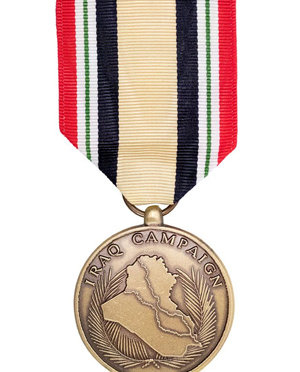
The medal was designed by the U.S. Army Institute of Heraldry. The medal is bronze in appearance, 1 14 inches (32mm) in diameter.

The obverse depicts a north-oriented relief of the map of Iraq, surmounted by two lines representing the Tigris and Euphrates rivers throughout, superimposed over a palm wreath. Above is the inscription “IRAQ CAMPAIGN.” On the reverse, the Statue of Freedom surmounts a sunburst, encircled by two scimitars pointing down with the blades crossing at the tips. Below is the inscription “FOR SERVICE IN IRAQ.”

The medal is suspended from a ribbon 1 38 inches (34.9 mm) wide. The stripes of the ribbon invoke the colors of the Iraqi flag and are: 532 inch scarlet at the edges, followed by 116 inch white, 132 inch green, and 116 inch white. The white is separated by a 532 inch black with a 716 inch stripe in chamois in the center.

Find This Medal Online

Right Now on eBay 
Clicking a link to eBay may result in a referral commission being paid if a purchase is made.
Loading...

The Vietnam Military Merit Medal

The Military Merit Medal is the highest military decoration for enlisted personnel by the Republic of Vietnam during the years of the War.

The Military Merit Medal (or Quân-Công Bội-Tinh in Vietnamese) was established on August 15, 1950. It’s the highest military decoration bestowed to enlisted personnel by the Republic of Vietnam during the years of the Vietnam War.

The Military Merit Medal is awarded or awarded posthumously to Non-Commissioned Officers (including Aspirants) and Enlisted Men in the Armed Forces, who have: Previously received citations at the Armed Forces level; Been wounded once or many times in combat; Distinguished themselves by their heroic actions or Served in an honorable manner for at least 13 years.

The Military Merit Medal was modeled after the French Médaille Militaire and was awarded mostly to Enlisted Men for valor in combat. The Vietnamese National Order of Vietnam was considered the equivalent decoration for military officers.

The United States military authorized the Military Merit Medal as a foreign decoration and permitted the medal to be worn on U.S. uniforms by enlisted personnel. A high number Military Merit Medals were issued posthumously as the medal was most often awarded to United States servicemen who were killed in action.

The Vietnam Military Merit Medal Design

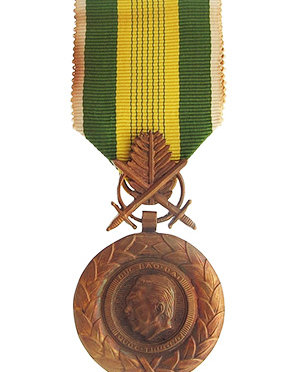
The Military Merit Medal is a circular gold-colored medal, the obverse bearing the words ‘TO-QUOC-TRI-AN‘ (‘The gratitude of the Fatherland’) in a central disc. A thin band around the disc contains the words ‘QUAN-CONG-BOI-TINH‘, and the whole is surrounded by a wreath. The reverse is similar, but the words ‘VIET-NAM CONG HOA‘ appear in the central disc.

The medal is suspended from a pair of rings supporting a trophy of arms (crossed swords). The ribbon is yellow, with a broad green and narrow white stripe at each edge. In the center are seven closely grouped green lines.

The Defeat American Aggression Badge

The Defeat American Aggression Badge is a military badge established in 1965 and given during the Vietnam War by North Vietnam.

The Defeat American Aggression Badge is a military badge established in 1965 and given during the Vietnam War by North Vietnam. The badge was awarded to units and individuals who performed outstanding services against American forces. This included any individual, who took part in combat after August 2, 1964, and received a commendation or the appellation good fighter.

The Defeat American Aggression Badge Design

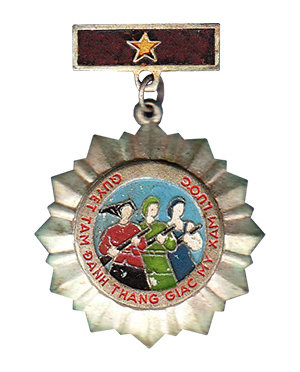
The Defeat American Aggression Badge is a tiny (measuring 30mm) and colorful badge.

The obverse of the 12-pointed star depicts three women clutching rifles. The red blouse represents farmers, the green blouse represents soldiers and the blue blouse represents the workers. The inscription reads, QUYET-TAM-DANH-THANG GIAC MY XAM-LUOC (“Resolved to defeat American Aggression”).

The badge is suspended from a red, hero-style bar, with a gold star. The bar measures 19mm by 5mm.

The Order of Ho Chi Minh

The Order of Ho Chi Minh is a decoration of the Socialist Republic of Vietnam that was first instituted in 1947 by president Hồ Chí Minh.

The Order of Ho Chi Minh (or Huân chương Hồ Chí Minh in Vietnamese) is a decoration of the Socialist Republic of Vietnam that was first instituted on 6 June 1947 by president Hồ Chí Minh. Currently, the Ho Chi Minh Order is the second highest national order of the Socialist Republic of Vietnam.

The Order is conferred (can be done posthumously) on individuals who have rendered great meritorious services, recorded numerous outstanding achievements in one of the political, economic, social, literature, art, scientific, technological, defense, security, diplomatic or other domains.

When first instituted, the Ho Chi Minh Order had 3 classes, but since 1981 the Order has become a single one. The Order is bestowed on citizens who have rendered outstanding services to the State, or members of the Vietnamese People’s Armed Forces for acts of bravery in action against an enemy force. The decoration may also be awarded to cities, regions, collectives, military units and ships for the same reasons.

The Order of Ho Chi Minh Design

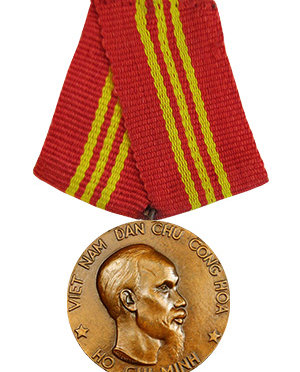
The medal is round and struck in bronze, and features the portrait of President Hồ Chí Minh in profile.