The National Defense Service Medal

The National Defense Service Medal (NDSM) is a service medal of the United States Armed Forces created by President Eisenhower in 1953. 

The National Defense Service Medal (or NDSM) is a service medal of the United States Armed Forces established by President Dwight D. Eisenhower in 1953. Currently, the National Defense Service Medal is the oldest service medal (as opposed to decorations for particular achievements) currently awarded by all branches of the United States Armed Forces.

It was first intended to be a “blanket campaign medal” awarded to service members who served honorably during a designated time period of which a “national emergency” had been declared during a time of war or conflict. It may also be issued to active military members for any other period that the Secretary of Defense designates. While no document is known which explains the rationale for the award, it was apparently established to recognize all service members who served during the Korean War to include those who did not serve in the war zone.

To date, the NDSM has been awarded for four specific time periods, which roughly correspond to the Korean, Vietnam and Gulf War eras as well as the Global War on Terrorism. As the NDSM has been awarded to all military personnel during four wartime periods, it has millions of recipients and is probably the most widely awarded medal in the history of the United States military, with the possible exception of World War II Victory Medal.

The National Defense Service Medal Design

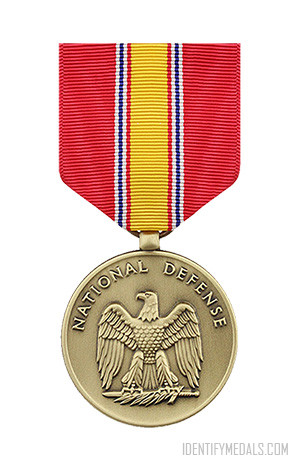
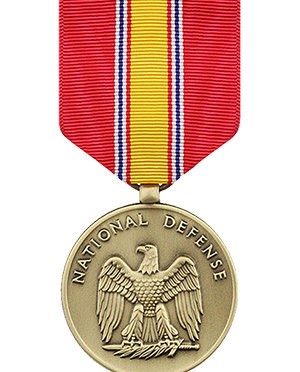
The obverse of the medal shows a North American bald eagle, perched on a sword and palm. Above this, in a semicircle, is the inscription “National Defense“. The reverse shows a shield, taken from the coat of arms of the United States; it is half encircled below with an open wreath, the right side of oak leaves and laurel leaves the left.

The ribbon has a wide yellow stripe in the center, flanked by narrow stripes of red, white, blue, white and wide red stripes.

How Do You Request a National Defense Service Medal?

If you are eligible for the National Defense Service Medal (NDSM) and need to request a replacement or a new one, you can typically do so through the appropriate military branch’s records office or the National Personnel Records Center (NPRC).

You can submit your request through various means, including mail, fax, email, or online, depending on the specific requirements of the records office you are dealing with.

Buy a National Defense Service Medal

Right Now on eBay 
Clicking a link to eBay may result in a referral commission being paid if a purchase is made.
Loading...

Other Service Medals

A service medal is a type of military decoration awarded to members of the armed forces, government employees, and, in some cases, civilians in recognition of their service, participation in specific military campaigns, or the fulfillment of certain criteria. Here are related to this one:
The Global War on Terrorism Expeditionary Medal

The Global War on Terrorism Expeditionary Medal (or GWOT-EM) is a United States Armed Forces award created by George W. Bush on 12 March 2003

The Global War on Terrorism Expeditionary Medal (or GWOT-EM) is a United States Armed Forces award created by George W. Bush on 12 March 2003, to recognize those military service members who have deployed overseas in direct service to the War on Terror from 11 September 2001 to a date to be determined.

To be awarded the Global War on Terrorism Expeditionary Medal a military service member must perform duty in a deployed status and must participate in designated anti-terrorism operation for a period of either 30 consecutive or 60 non-consecutive days of duty. For those who were engaged in combat, killed, or wounded in the line of duty (for example, those injured and requiring medical evacuation), the time requirement is waived.

Prior to 30 April 2005, the medal was awarded for service within Iraq and Afghanistan, but has been replaced with the Iraq Campaign Medal and Afghanistan Campaign Medal and now serves primarily as recognition for personnel who have deployed in support of the War on Terror to locations beyond Iraq and Afghanistan.

The Medal Service Stars

The Global War on Terrorism Expeditionary Medal may be awarded with service stars denoting subsequent awards of the medal. Each service star represents a subsequent deployment or campaign for which the medal was awarded.

These stars are typically worn on the suspension and service ribbon of the medal to indicate multiple awards of the GWOT-EM. Service members who have been deployed to multiple qualifying areas or campaigns in support of the Global War on Terrorism may receive additional service stars to recognize each deployment or campaign.

The Medal Operations

Some of the major approved operations and campaigns that qualify for the GWOT-EM include:

  1. Operation Enduring Freedom (OEF): This operation encompasses military operations in Afghanistan and other locations to combat terrorism and support the Afghan government.

  2. Operation Iraqi Freedom (OIF): This operation involved military operations in Iraq to remove Saddam Hussein’s regime and combat insurgency.

  3. Operation New Dawn: This operation succeeded Operation Iraqi Freedom and focused on supporting the Iraqi government and security forces after the withdrawal of U.S. combat troops.

  4. Operation Inherent Resolve (OIR): This ongoing operation involves military operations against the Islamic State of Iraq and Syria (ISIS) in Iraq and Syria.

  5. Operation Freedom’s Sentinel: This operation involves the continued U.S. military presence in Afghanistan to support Afghan security forces and counter terrorism.

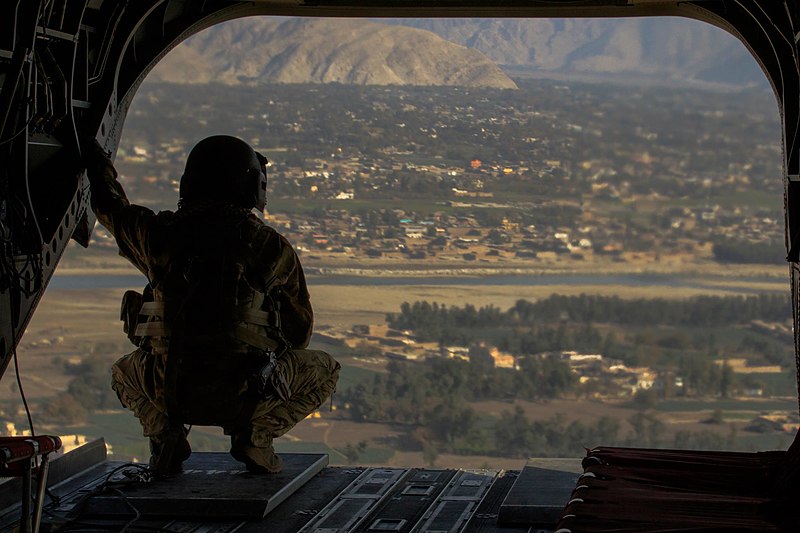
A U.S. Army crew chief with 17th Cavalry Regiment surveys the area over Jalalabad, Afghanistan.

The Global War on Terrorism Expeditionary Medal Design

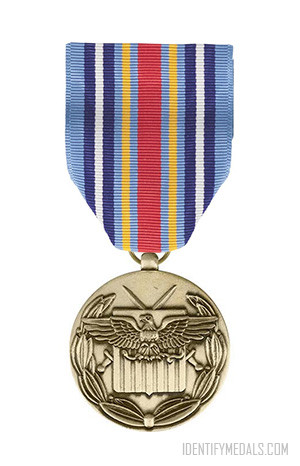
The medal was designed by John Sproston of the Army’s Institute of Heraldry. The Global War on Terrorism Expeditionary Medal may be awarded with the devices:

  • Arrowhead device – For qualified Army and Air Force service members.
  • Service stars – effective 9 February 2015, to recognize individual participation in each of the approved operations that a service member participates in, a 316 inch bronze service star is worn on the suspension and service ribbon of the medal, with a 316 inch silver star being worn in lieu of five bronze stars.
  • Fleet Marine Force Combat Operation Insignia – for qualified Navy service members such as hospital corpsmen assigned to Marine Corps units that participate in combat during the assignment.

Buy a Global War on Terrorism Expeditionary Medal

Right Now on eBay 
Clicking a link to eBay may result in a referral commission being paid if a purchase is made.
Loading...

Other Service Medals

A service medal is a type of military decoration awarded to members of the armed forces, government employees, and, in some cases, civilians in recognition of their service, participation in specific military campaigns, or the fulfillment of certain criteria. Here are related to this one:
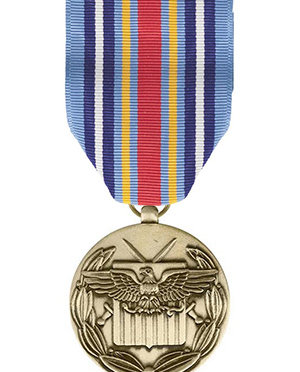
The Armed Forces Expeditionary Medal

The Armed Forces Expeditionary Medal is a military award of the U.S Armed Forces created in 1961 by Executive Order of President John Kennedy. 

The Armed Forces Expeditionary Medal (or AFEM) is a military award of the United States Armed Force created in 1961 by Executive Order of President John Kennedy. The medal is awarded to members of the U.S. Armed Forces who, after July 1, 1958, participated in U.S. military operations, U.S. operations in direct support of the United Nations (UN), or U.S. operations of assistance for friendly foreign nations.

Since its original conception in 1961, the Armed Forces Expeditionary Medal has been awarded for United States participation in over forty-five designated military campaigns. The first was the Cuban Missile Crisis (military service between October 1962 and June 1963.) The AFEM was made retroactive to 1958 and issued for actions in Lebanon, Taiwan, Republic of the Congo, Quemoy and Matsu, and for duty in Berlin between 1961 and 1963. 

During the early years of the Vietnam War, the Armed Forces Expeditionary Medal was issued for initial operations in South Vietnam, Laos, and Cambodia. In 1965, with the creation of the Vietnam Service Medal, the AFEM was discontinued for Vietnam War service. 

In 2003, with the creation of the Global War on Terrorism Expeditionary Medal, the AFEM was discontinued for Iraq, Saudi Arabia, and Kuwait.

The Armed Forces Expeditionary Medal Operations

The Armed Forces Expeditionary Medal (AFEM) is awarded for participation in U.S. military operations that are designated as “expeditionary” in nature. Some of the operations for which the Armed Forces Expeditionary Medal may be awarded include:

  1. Operation Urgent Fury (Grenada)
  2. Operation Just Cause (Panama)
  3. Operation Desert Shield and Operation Desert Storm (Gulf War)
  4. Operation Uphold Democracy (Haiti)
  5. Operation Joint Guardian (Kosovo)
  6. Operation Enduring Freedom (Afghanistan)
  7. Operation Iraqi Freedom (Iraq)
  8. Operation Odyssey Dawn (Libya)

It’s worth mentioning that, while Operation Southern Watch was not explicitly designated as an expeditionary operation, service members who participated in the operation may have been eligible for the Armed Forces Expeditionary Medal (AFEM) if they met the criteria outlined by the Department of Defense.

The Armed Forces Expeditionary Medal Design

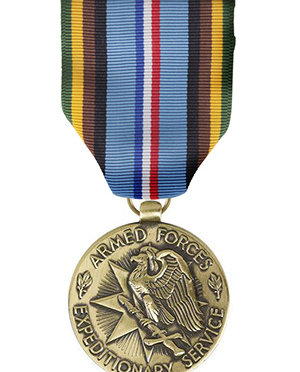
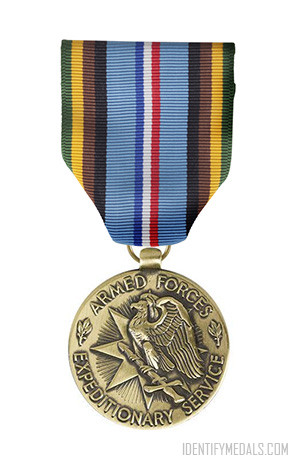
The medal is issued as a bronze medal, 1-1/4 inches in diameter. The obverse consists of an eagle, with wings addorsed and inverted (representing the strength of the United States Armed Forces), standing on a sword loosened in its scabbard, and superimposed on a radiant compass rose of eight points, (representing the readiness to serve wherever needed) all within the circumscription “ARMED FORCES” above and “EXPEDITIONARY SERVICE” below with a sprig of laurel on each side.

On the reverse side of the medal is the shield from the United States Coat of Arms above two laurel branches separated by a bullet, all within the circumscription “UNITED STATES OF AMERICA“.

The ribbon is 1 3/8 inches wide and consists of the following stripes: 3/32 inch Green; 3/32 inch Golden Yellow ; 3/32 inch Spicebrown ; 3/32 inch Black ; 7/32 inch Bluebird ; 1/16 inch Ultramarine Blue ; 1/16 inch White ; 1/16 inch Scarlet; 7/32 inch Bluebird; 3/32 inch Black; 3/32 inch Spicebrown; 3/32 inch Golden Yellow; and 3/32 inch Green.

Buy an Armed Forces Expeditionary Medal

Right Now on eBay 
Clicking a link to eBay may result in a referral commission being paid if a purchase is made.
Loading...

Other Service Medals

A service medal is a type of military decoration awarded to members of the armed forces, government employees, and, in some cases, civilians in recognition of their service, participation in specific military campaigns, or the fulfillment of certain criteria. Here are related to this one:
The Vietnam Service Medal

Authorized by executive order in 1965, the Vietnam Service Medal is a U.S. medal to honor service members who served in SE Asia.

Authorized by executive order in 1965, the Vietnam Service Medal is a U.S. medal to honor service members who served in Vietnam, Laos, Cambodia, and/or Thailand from 1965 to 1973 for 30 consecutive or 60 nonconsecutive days. It was established on 8 July 1965 by order of President Lyndon B. Johnson.

For those who participated in campaigns like the Tet counteroffensive in 1968 and the air offensive phases from 1966 to 1969, bronze stars on mounted on the ribbon for participation.

South Vietnam also issued its own service medal for the Vietnam War, known as the Republic of Vietnam Campaign Medal. This is a separate military award which was accepted by the U.S. Congress and the U.S. military in accordance with DoD 1348 C7. Six months of service in support of South Vietnamese military operations was the general U.S. requirement for the award.

The Vietnam Service Medal Design

The distinctive design has been attributed to both sculptor Thomas Hudson Jones, a former employee of the Army Institute of Heraldry and Mercedes Lee who created the design.

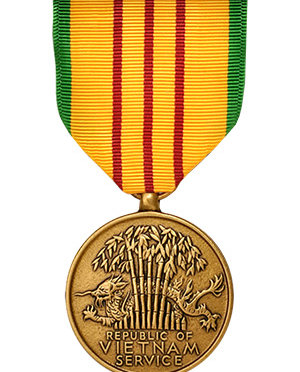
The medal is rounded and bronze shaped and measures 1 14 inches in diameter. The obverse consists of a figure of an oriental dragon (representing the subversive nature of the conflict) behind a grove of bamboo trees located above the inscription “REPUBLIC OF VIETNAM SERVICE“. On the reverse, a crossbow (representing the ancient weapon of Vietnam) facing upwards with a ready to be fired lighted torch of the Statue of Liberty, above an arched inscription “UNITED STATES OF AMERICA“.

The colors of the ribbon are green, yellow, and red, which represents the flag of the Republic of Vietnam at the time—yellow with red stripes running horizontally—and the green Vietnamese jungles. In addition, the three red stripes indicate the three ancient empires of Vietnam Tonkin, Annam, and Cochin China.

Find This Medal Online

Right Now on eBay 
Clicking a link to eBay may result in a referral commission being paid if a purchase is made.
Loading...

The Davis Guard Medal

The Davis Guard Medal is a military decoration bestowed by the State of Texas for the victory at the Second Battle of Sabine Pass.

The Davis Guard Medal is a military decoration bestowed by the State of Texas to the members of F Battery, 1st Texas Heavy Artillery Regiment, for the victory at the Second Battle of Sabine Pass. Some consider it to be the only medal issued by the Confederate States of America during the war.

The award was funded by a collection from Houston citizens. It was presented as a one-time award to exactly 50 men. In addition to the 49 members of the battery, the award was also presented to Jefferson Davis as the unit’s honorary commander. President Davis had his medal on him at the time of his capture in May 1865, but it was stolen by a Union soldier. A replacement was given him by three veterans in 1875.

The Davis Guard Medal Design

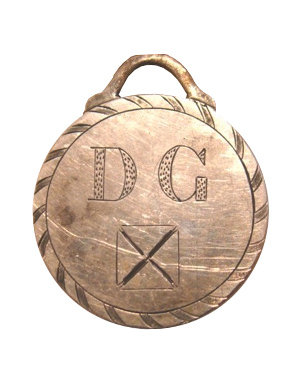
The medal consisted of a silver Mexican coin polished smooth with the letters “DG” on the front above a cross pattee. The reverse bore the inscription “Sabine Pass Sept. 23, 1864” in cursive script.

The medal hung from a green ribbon, in honor of the Irish origins of the unit’s members. The 50 recipients of the Davis Guard Medal were also listed on the Confederate Roll of Honor.

The Prisoner of War Medal (USA)

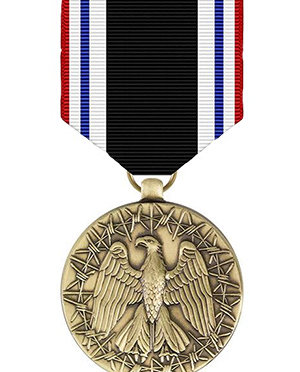
The Prisoner of War Medal is a military award authorized by Congress and signed into law by President Ronald Reagan on 8 November 1985.

The Prisoner of War Medal is a military award of the United States Armed Forces that was authorized by Congress and signed into law by President Ronald Reagan on 8 November 1985. It is awarded to any person who was taken prisoner or held captive while engaged in an action against an enemy of the United States; while engaged in military operations involving conflict with an opposing Armed Force; or while serving with friendly forces engaged in armed conflict against an opposing Armed Force in which the United States is not a belligerent party.

The Prisoner of War Medal may be awarded to any person who was a prisoner of war after April 5, 1917 (the date of the United States’ entry into World War I was April 6). The person’s conduct, while in captivity, must have been honorable. This medal may be awarded posthumously to the surviving next of kin of the recipient. 

Due to a provision in the FY1996 National Defense Authorization Act, service secretaries are required to award the Purple Heart to any POW Medal recipients wounded in captivity. The law specified that “[a] person shall be considered to be a former prisoner of war for purposes of this section if the person is eligible for the prisoner-of-war medal under section 1128 of title 10, United States Code.”

The Prisoner of War Medal Design

The medal was designed by Jay C. Morris of the United States Army Institute of Heraldry. The activities of the institute encompass research, design, development, standardization, quality control, and other services relating to official symbolic items—seals, decorations, medals, insignia, badges, flags, and other items awarded to or authorized for official wear or display by government personnel and agencies. Limited research and information services concerning official symbolic items are also provided to the general public. The Institute of Heraldry is located at Fort Belvoir, a military installation within the metropolitan area of Washington, D.C. The staff consists of thirty-two civilians.

No more than one Prisoner of War Medal may be awarded. For any subsequent award of the medal, service stars will be awarded and worn on the suspension and service ribbon of the medal.

The Pilot / Observer Badge of the Luftwaffe

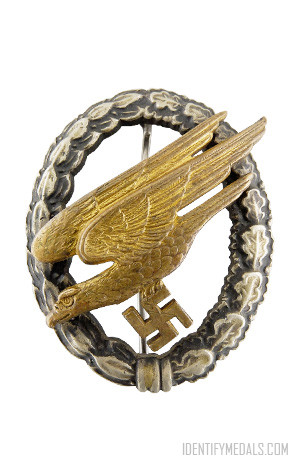
The Pilot/Observer Badge (or Flugzeugführer- und Beobachterabzeichen in German) was a WW2 German decoration instituted by Hermann Göring.

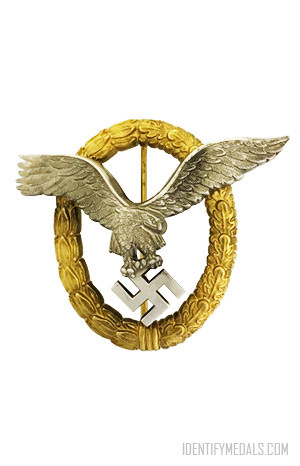
The Pilot/Observer Badge (or Flugzeugführer- und Beobachterabzeichen in German) was a World War II German military decoration instituted on 26 March 1936 by the Commander in Chief of the Luftwaffe Hermann Göring and awarded to Luftwaffe service personnel who had already been awarded the Pilot’s Badge and Observer Badge.

It was  It was worn on the lower part of the left breast pocket of the service tunic, underneath the Iron Cross 1st Class if awarded. It was to replace the older 1933 Aircrew Badge.

The Pilot/Observer Badge Design

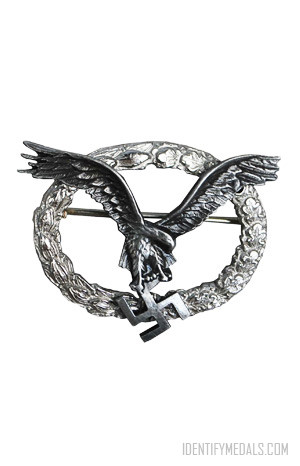
The badge was originally manufactured in bronze, and later zinc. The badge can be distinguished from the Pilot’s Badge by the gold wreath; the Pilot’s Badge had a silver wreath.

There was also a cloth version of the badge which used embroidered bullion for the officer’s version and cotton for the NCO’s version. The presentation case was dark blue, with a blue satin top liner and a blue velvet bottom liner on the inside.

There is an exclusive variant of the Pilot/Observer Badge in Gold with Diamonds (or Gemeinsame Flugzeugführer- und Beobachterabzeichen in Gold mit Brillanten in German). It was bestowed by Göring to honour exceptional achievement and on rare occasions as an honorary award. The first recipients were General Walther Wever, Chief of the Luftwaffe General Staff and General der Flieger Erhard Milch, State Secretary of the Reichsluftfahrtministerium on 11 November 1935.

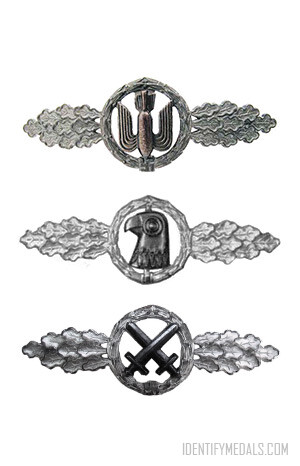
More Luftwaffe War Badges

Awarded to members of the German Luftwaffe for their achievements and contributions to air warfare, the Luftwaffe War Badges symbolized excellence, courage, and skill in aerial combat and support roles. Explore the complete collection below:

The Panzer Badge or Tank Battle Badge (Nazi Germany)

The Panzer Badge (or Panzerkampfabzeichen) was a World War II military decoration of Nazi Germany awarded to troops in armored divisions. 

The Panzer Badge (or Panzerkampfabzeichen in German) was a World War II military decoration of Nazi Germany awarded to troops in armored divisions.

If you know a thing or two about World War II, you might be aware that the German Panzers played one of the major roles, if not the most important one. Led by intrepid commanders such as Erich Von Manstein, Heinz Guderian, Erwin Rommel, and many more, the Panzers broke the front lines with speed, power and destruction following their paths. But the men who led the Panzers through the Russian Steppe or Northern France were the real “Heroes.”

To recognize the achievements of some of these Panzer crews, the OKW (OberKommando Wehrmacht, the German ground army HQ) decided to create a medal for these men. It was first awarded during World War I but was long forgotten since the Germans saw little action during the end of the war.

During the interwar period, a badge was issued for the veterans of the Condor Legion who participated in the Spanish Civil War. But as World War II was starting, the tank crews and their beloved tactics needed something, something to recognize their “Blitz” through the enemy lines.

Famous Recipients of The Panzer Badge

The most decorated generals of the Wehrmacht never got their grasp on this badge, even if their achievements were enormous. No, this badge was meant for the crewmen, those who gave their life for their country. Some of them never saw the end of the war, but some others did.

Otto Carius, per example, is one of the most decorated Panzer ace, having destroyed more than 150 enemy tanks, and most surprinsigly, a flying enemy plane. This particular enemy plane was “annoying” the gunner of the tank, Heinz Kramer, shooting its armor with its machine gun. As the sound of bullets hitting the armor was annoying more and more Mr Kramer, he asked permission to shoot down the plane, and after a first missed shot, shot down the plane. Probably the best tank shot ever. Carius lived until 2015 in Germany and was the last Panzer ace alive.

The most famous Panzer ace, Michael Wittmann, was also awarded with the highest class of the Badge. He was known to have destroyed at least 150+ tanks and more than 130 enemy canons (of any caliber). Unfortunately for him, he ultimately died in Normandy during Operation Overlord in his beloved Tiger. Nonetheless, his legend grew after the war when all of his achievements were discovered.

These folks are some of the most famous recipients of the Panzer Badge, but it would be wrong to forget about the 34,000 others that got the Badge in the different classes with around 22,000 getting the silver one.

There was definitely a lot of recipients during World War II but what is somehow “strange”, is that the Badge is still being given to members of Germany’s land Army, the Heer. If you are a badge “fanatic”, you can try to get one from the Internet but beware of forgeries, as some of them look very close to the original one.

The Panzer Badge Design

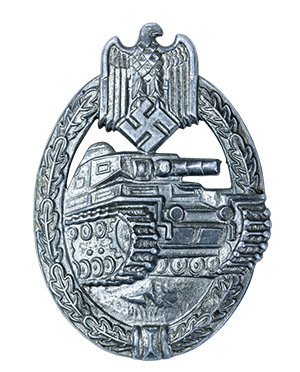
The obverse of the Panzer Badge shows a border of oak leaves with a tie at the base and a Panzerkampfwagen IV superimposed in the centre on grassy ground, with its left tank track extending over the edge of the badge. The reverse is plain with a vertical needle style pin, with an oval based hinge and catch.

The badge measures 42.05 mm (w) x 60.09 mm (h) and weights 27.6 grams.

The 50 and 100 engagement badges were struck in a lightweight zinc alloy; this was so that the larger pin did not pull inconveniently on the tunic. The 1957 de-Nazified version lost the eagle and the swastika, but was otherwise unchanged.

The Panzer Classes and Wear

Designed in 1939 by Ernst Peekhaus, the Panzer Badge was first issued in December 1939, when the chief of the OKW, Walter Von Brauchitsch, decided to create a medal dedicated to the sacrifice and the achievements of the Panzer’s crews. Two different classes of the badge were designed for those who received it during world war II. The first and “original” one was the silver Panzer Badge, designed to recognize solely the tank crews.

The “less original” one, the Bronze Panzer Badge, was designed to recognize the crews of armored vehicles (half tracks, trucks,…). As the war was still raging, it was decided that the Badge should evolve. In June 1943, four new classes were created, depending on the amount of engagement the recipent would have take part in: 25, 50, 75 and 100. Depending on which class and the amount of engagement you took part in, the metal used to design the medal and the color of it changed accordingly. 

After the war, it was frowned upon to wear this badge since there was a swastika on the top of it. Thus, West Germany decided in 1957 to authorize to wear the Panzer badge in public but only if the swastika was removed from it.

Note: As an eBay partner, I earn from qualifying purchases. This is all done automatically when you use a link and at no extra cost to you.

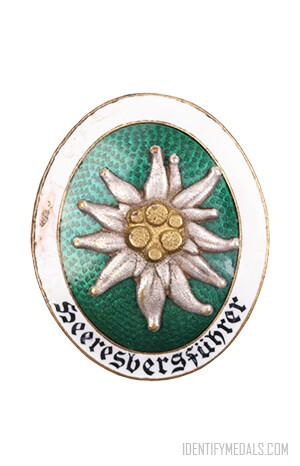
More Army/Waffen-SS War Badges

The Army/Waffen-SS war badges were military decorations awarded by Nazi Germany to members of the Army (Heer) and the Waffen-SS. Explore the complete collection below:

Buy a Panzer Badge

Right Now on eBay 
Clicking a link to eBay may result in a referral commission being paid if a purchase is made.
Loading...

The Medal of the Hellenic Red Cross

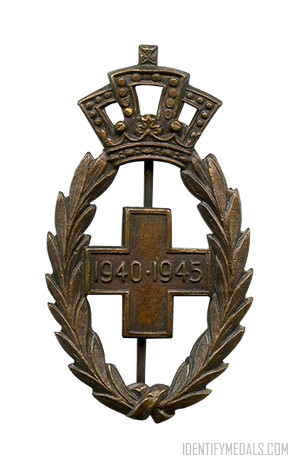
The Medal of the Hellenic Red Cross is medal for service in the ranks during the Italian invasion in 1940 until the Capitulation of Greece.

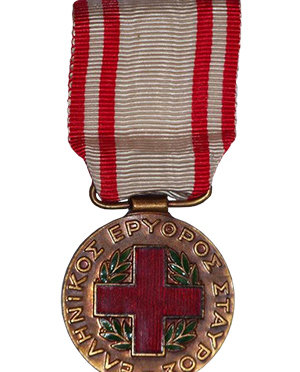
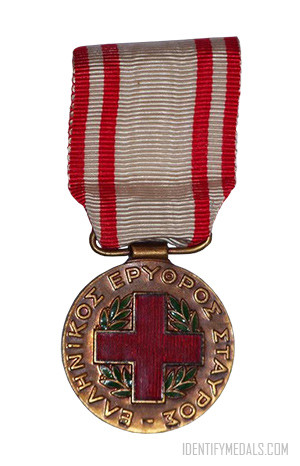
The Medal of the Hellenic Red Cross is a WW2 medal for service in the Hellenic Red Cross ranks during the Italian invasion in 1940 and until the Capitulation of Greece following the German invasion in April 1941 and the battle of Crete in May of the same year. The medal was awarded to both men and women.

The first initiative for the foundation of the Hellenic Red Cross took place in 1865 as the Kingdom of Greece participated in the 1st Geneva Convention. The Hellenic Red Cross was officially founded in 1877, with the active support of Queen Olga and it was recognized, the same year, by the International Red Cross Committee. Ever since it continues its humanitarian efforts both domestically and abroad whenever and wherever its aid is needed.

The Medal of the Hellenic Red Cross Design

The medal is made of bronze and enamels and measures 30.3 mm in diameter. The obverse depicts a large red cross in finely detailed red enamel, encircled by laurel branches in green enamel; on horizontal loop for suspension.

Find Red Cross Medals Online

More Red Cross Medals

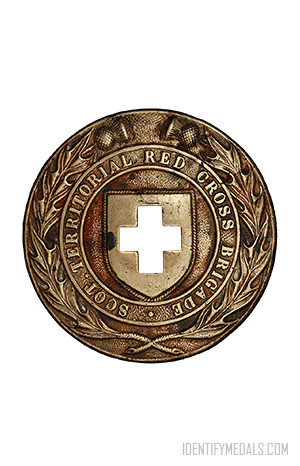
The Scottish Territorial Red Cross Brigade Badge

The Scottish Territorial Red Cross Brigade Badge is a WW1 cap badge made in brass-metal with a red felt backing to the central Geneva Cross.

The Scottish Territorial Red Cross Brigade Badge is a WW1 die-stamped cap badge to the Scottish Territorial Red Cross Brigade in brass metal with a red felt backing to the central Geneva Cross.

This organization was originally founded in 1908. The badge was approved by the War Office as the Scottish Branch of the British Red Cross Society and was intended as a formation of voluntary aid detachments for service in the event of war. It was only issued to registered members of detachments and had to be purchased by the member.

The Scottish Territorial Brigade was mobilized immediately after the proclamation of War in 1914. Sadly, there are no mentions of the Brigade after that – whether it changed name/structure – is not known. The Royal Scots (The Royal Regiment), once known as the Royal Regiment of Foot, was the oldest and most senior infantry regiment of the line of the British Army, having been raised in 1633 during the reign of Charles I of Scotland.

The Scottish Territorial Red Cross Brigade Badge Design

The Badge is made of brass with loops (lugs) and pin measuring 56mm in diameter. The back is red.

Find Red Cross Medals Online

More Red Cross Medals