The Medal for the Liberation of Kuwait (UAE)

The Medal for the Liberation of Kuwait was an award given to members of the UAE’s military for service during the First Gulf War, 1990–91.

The Medal for the Liberation of Kuwait (UAE version) was an award given to members of the UAE’s military for service during the First Gulf War, 1990–91. This medal was issued in very limited numbers.

The UAE’s armed forces have engaged in numerous wars since inception. During the Persian Gulf War, UAE troops, reportedly numbering several hundred, participated in the conflict as part of the GCC Peninsula Shield force that advanced into the city of Kuwait. United States aircraft bombed Iraqi positions from the UAE, and United States ships operated out of UAE ports. The UAE Air Force also carried out strikes against Iraqi forces. A total of six UAE combat deaths were reported as a result of the fighting.

The Medal for the Liberation of Kuwait (UAE) Design

The medal is gold-coloured gilt on metal with enamels. It measures 38.3 mm. The ribbon comes with a pinback.

The Medal for the Liberation of Kuwait (Kuwait)

The Medal for the Liberation of Kuwait was an award issued by the government of Kuwait for service during the Liberation of Kuwait campaign.

The Medal for the Liberation of Kuwait (or Wisam Al-Tahrir وسام التحرير‎ in arabic) was an award issued by the government of Kuwait for service during the Liberation of Kuwait campaign, 1990–91.

The medal was approved by the Kuwait Council of Ministers for award in five classes, generally according to the rank of the recipient. The medal was offered by the Chief of Staff of the Kuwait Armed Forces on July 16, 1994.

The Australian Government, as well as the governments of Canada and United Kingdom had decreed that personnel may accept their medals as a keepsake but permission to wear them in uniform has so far been refused. The only country that allowed them to be worn was France, who accepted all grades version for their personnel according to their rank at the time of Operation Desert Storm.

The Medal for the Liberation of Kuwait (Kuwait) Design

A nation of seafarers and ship builders, Kuwait chose as their coat of arms, the traditional dhow. Falconry is the sport of Kings in the Persian Gulf, and the falcon in the arms is seen as a symbol of Kuwaiti prowess. The official symbolism of the colors is that black symbolizes battlefields, white is for deeds, green is for the meadows, and red is for the blood of Kuwait’s enemies.

The medal is awarded in five classes.

5th Class (for non-commissioned personnel): A bronze medal with enamel, 1 9/16 inches (40 mm) in diameter suspended from a bar by a wreath. The obverse bears the Coat of Arms of the State of Kuwait (the shield of the flag design in color superimposed on a falcon with wings displayed). The falcon supports a disk containing a sailing ship with the full name of the State written at the top of the disk. At the top of the medal is the inscription “1991 LIBERATION MEDAL” in Arabic letters. The reverse side is the map of Kuwait on a rayed background. The ribbon consists of three equal stripes 29/64 inch (11.5 mm) each of Old Glory Red 67156; White 67101; and Irish Green 67189. A black trapezium is at the top of the ribbon drape and service ribbon.

4th Class (for warrant and junior commissioned officers): A dull grey metal medal, suspended from a bar engraved with laurel leaves. The obverse bears a fully sized, five pointed star over a pattern of engraved rays with the centre containing the same falcon and dhow emblem as the fifth class medal and the reverse the same map and rayed background.

3th Class (for field-grade and equivalent officers): A bright gilt medal of similar design to the fourth class medal. The points of the star are considerably rounded and, instead of the rayed background, the medal is pierced between the star and the outer circle.

2nd Class (for one and two star officers): A golden star overlaying a laurel wreath. The center emblem is significantly smaller than for the lower classes of medal. There is Arabic writing above and below the center emblem. The star is suspended directly from the ribbon, by a ring attached to the wreath.

1st Class (for three and four star officers): A neck decoration of large pattern. Similar to the second class medal but the star is enameled in with red points and a white circle surrounding the center emblem. The white circle contains a geometric outer pattern in gold and Arabic writing above the center. Pierced rays, of differing lengths, lie behind the wreath. The star is suspended from its high point.

The Medal for the Liberation of Kuwait (Egypt)

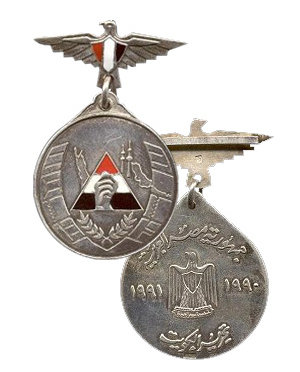
The Medal for the Liberation of Kuwait (Egypt) was instituted in 1991 and awarded to armed forces personnel who served in the Gulf War.

The Medal for the Liberation of Kuwait (Egyptian version) was instituted in 1991 and awarded to armed forces personnel who served in the Gulf War during the months of August 1990 – March 1991.

The Medal for the Liberation of Kuwait (Egypt Version) Design

The Egyptian version of the medal is silver and round. The ribbon has nine equal stripes: red, white, black, red, white, green, red, white and black.

The Medal for Defense Service Abroad (Norway)

The Medal for Defence Service Abroad is a Norwegian military medal originally awarded for service during military operations in the 1990s.

The Medal for Defence Service Abroad (or Forsvarets Innsatsmedalje in Norwegian) is a military medal established 1 January 1993 in Norway and originally awarded for service during military operations that took place in the 1990s. The later establishment of the Medal for Defence Operations Abroad rendered the first obsolete, however in 2009 it was reintroduced as an achievement medal.

It was awarded for distinguished bravery and courage, beyond what is normally required during combat operations. The medal’s color was changed from bronze to gold, and the ribbons of the medal would vary, depending on the area of operations.

The Medal for Defense Service Abroad Design

The medal is round, embossed in gold colored metal. On the obverse is a sword pointing up, with an oak branch on either side. On the reverse are the words FOR DIN INNSATS with oak branches above and below.

The award is suspended from a ribbon in the colors of the Flag of Norway and the Norwegian Armed Forces’ colors. The ribbon is blue with red edges, the red edges are bordered in the inside by a thin white stripe. In the center is a stripe of light blue.

During the first period of its existence, the medal was always awarded with a rosette. Finally, in 2012 the medal was further changed to a single ribbon design for all awards. The medal may be awarded with rosette for particularly meritorious distinction.

The Commemorative Cross for the Operations in the Persian Gulf

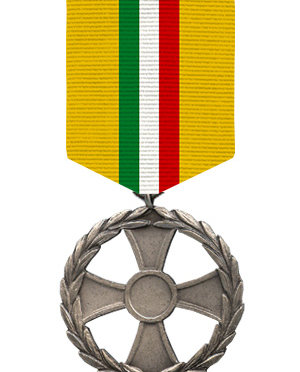
The Commemorative Cross for the Operations in the Persian Gulf is an Italian award for participation in Operazione Locusta.

The Commemorative Cross for the Operations in the Persian Gulf is an Italian award created to commemorate Italy’s participation in the Gulf War (1990-1991). Italy has been a part, in accordance to its long history of peacekeeping activities, of numerous UN missions and sub-regional peacekeeping efforts in Somalia, the Balkans, Afghanistan and Iraq. Some of these missions were accompanied by a series of crosses and distinct ribbon combinations.

The code name given to the contribution of the Italian Air Force in the Gulf War was Operazione Locusta. Following the invasion and annexation of Kuwait by Iraq (September 25, 1990) the Italian Government sent eight multi-role fighter bombers Tornado IDS to the Persian gulf. The bombers belonged to the 6º, 36º and 50º Stormo, which were deployed at the Al Dhafra Air Base, in United Arab Emirates. The deployment of Italian aircraft was part of the international security system implemented by UN Security Council Resolution 678.

The use of Italian aircraft as part of the Desert Storm operation represented the first operational employment in combat missions of Italian Air Force aircraft after the end of World War II. The RF104-G returned to Italy on March 11, 1991.

The Cross for the Operations in the Persian Gulf Design

The medal is a silver cross. The ribbon is yellow with a central green, white and red stripe.

In some cases the mission medals were issued with bronze (silver in the case of Afghanistan) bars to denote the specific mission. For earlier missions, the planchet was engraved with the name of the mission.

Find This Medal

Right Now on eBay 
Clicking a link to eBay may result in a referral commission being paid if a purchase is made.
Loading...

The Southwest Asia Service Medal

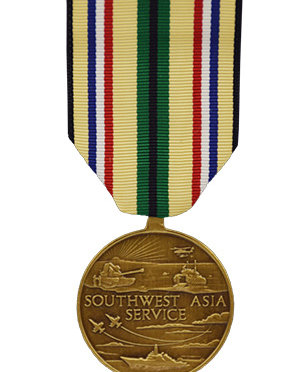
The Southwest Asia Service Medal (SASM or SWASM) is a military award of the US Armed Forces to recognize duty during the Persian Gulf War.

The Southwest Asia Service Medal (also known as SASM or SWASM) is a military award of the United States Armed Forces created by order of President George H.W. Bush to recognize those military service members who performed duty during the years of the Persian Gulf War between August 2, 1990, and November 30, 1995.

Individuals awarded the Southwest Asia Service Medal must have participated in or supported military operations in Southwest Asia, including participation in Operations Desert Shield or Desert Storm. To receive the award, a service member had to be attached to or regularly serving for one or more days with an organization participating in ground/shore military operations; aboard a naval vessel directly supporting military operations; participating as a crew member in one or more aerial flights or serving on temporary duty for 30 consecutive days or 60 nonconsecutive days.

The award is not authorized for those who performed support of the Persian Gulf War from European or Pacific bases, or for service members who performed “home service” during the Persian Gulf War.

The Southwest Asia Service Medal Design

The medal was designed by Nadine Russell of the Army’s Institute of Heraldry. The colors of the ribbon are tan, representing sand, with the black, white, red, blue, and green colors symbolizing the colors of coalition countries’ national flags. The maximum number of bronze service stars that are authorized to be worn for the Southwest Asia Service Medal’s ribbon or streamer is three.

Ribbon devices:
  • Bronze service star: for participation in each designated campaign. Each recipient of the medal should wear at least one campaign star.
  • Fleet Marine Force Combat Operation Insignia: for naval personnel on duty with and attached to a Marine Corps unit that participated in combat.

Designated campaigns:

  • Defense of Saudi Arabia. From August 2, 1990 to January 16, 1991.
  • Liberation and Defense of Kuwait. January 17, 1991 to April 11, 1991.
  • Southwest Asia Cease-Fire. April 12, 1991 to November 30, 1995.

In April 2016, the appearance of the suspension and service ribbon of the SASM was slightly modified. The DLA made the two vertical green bars and one vertical black bar in the middle wider than in the original 1991 version.

Find This Medal Online

Right Now on eBay 
Clicking a link to eBay may result in a referral commission being paid if a purchase is made.
Loading...

The Medal To a Partisan of the Patriotic War

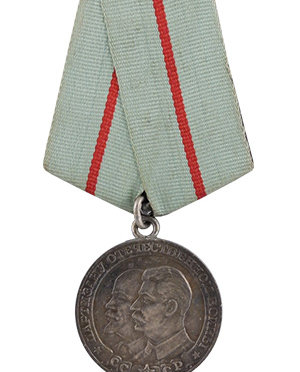
The Medal to a Partisan of the Patriotic War was a World War II Soviet paramilitary award established in 1943.

The Medal to a Partisan of the Patriotic War (or Медаль Партизану Отечественной войны in Russian) was a World War II Soviet paramilitary award established in two classes on February 2, 1943 to recognize the fortitude and courage of the partisans on the home front in their struggle to free the Soviet Motherland of the Nazi invaders far behind enemy lines.

The first class was awarded to partisans, to leaders and organizers of partisan units, for outstanding achievements in organizing the guerrilla movement, for bravery, heroism and outstanding achievements displayed in the partisan struggle in the occupied territories of our Soviet Motherland far behind the Nazi lines. The second class was awarded to partisans, to leaders and organizers of partisan units, for personal distinction in combat, in the execution of orders and command assignments, for active support of the guerrilla struggle against the Nazi invaders.

The medal’s statute was amended by a further decree of the Presidium of the Supreme Soviet of the USSR on February 26, 1947. Medals to a Partisan of the Patriotic War could be awarded posthumously, along with their relevant award certificates which are transferred to the families for safekeeping and as a memento.

The Medal To a Partisan of the Patriotic War Design

The medal measured 32mm in diameter. It’s a circular medal, the first class struck in silver, the second class struck in brass.

Their identical obverses bore the left bust profiles of Lenin and Stalin, the latter being the closer and slightly to the right. A 3mm wide relief ribbon ran along the entire circumference of the medal, at its very bottom, a relief five pointed star bearing a hammer and sickle and bisecting the inscription “USSR” («СССР»), on the remainder of the ribbon, the relief inscription “To a Partisan of the Patriotic War” («Партизану Отечественной войны»). On their also identical reverses, the relief inscription in three lines “For our Soviet Motherland” («За нашу Советскую Родину»), above the inscription, the relief image of the hammer and sickle.

The medal  was secured by a ring through the medal suspension loop to a standard Soviet pentagonal mount covered by an overlapping 24mm light green silk moiré ribbon with a 2mm wide red central stripe for the first class and a blue stripe for the second.

The Voluntary Medical Service Medal

The Voluntary Medical Service Medal is a medal instituted in 1932 by George V and awarded by the British Red Cross and St Andrew’s First Aid. 

The Voluntary Medical Service Medal is a medal instituted in 1932 at the direction of George V and awarded by the British Red Cross and St Andrew’s First Aid.

To qualify for the medal, a member has to accrue fifteen years’ continuous efficient service as a first aid volunteer in either the Red Cross or St Andrew’s. They also need to provide a minimum of ten hours field service per year.

The Voluntary Medical Service Medal Design

The medal measures 36 millimeters (1.4 inches) in diameter and was designed by Percy Metcalfe, an English artist sculptor and designer recognized mostly for his coin designs and his contribution to the Ashtead Pottery Collection.

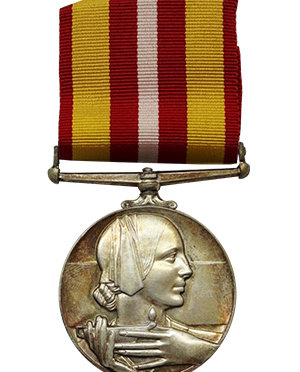
The obverse of the medal bears a symbolic representation of Florence Nightingale carrying a lamp. The reverse features a design of both the Geneva and St Andrew’s crosses to denote the two qualifying organizations. Between the upper arms of the St Andrew’s Cross is the text “LONG AND EFFICIENT SERVICE”.

The medal was originally made of silver, later of silver plated copper, and since the 1960’s of copper-nickel. It is suspended from a straight swivel bar and hangs from a ribbon of red with yellow stripes at the edges and a thin white stripe in the centre. On the suspension ribbon of the medal, clasps embellished with the Geneva cross (St Andrew’s cross in Scotland) are worn to denote five additional years of qualifying service. Up to four silver-gilt emblems can replace the silver type to denote 25, 30, and 35 years of service in the applicable voluntary organisation.

Find Red Cross Medals Online

More Red Cross Medals

The Inter Allied Victory Medal (Czechoslovakia)

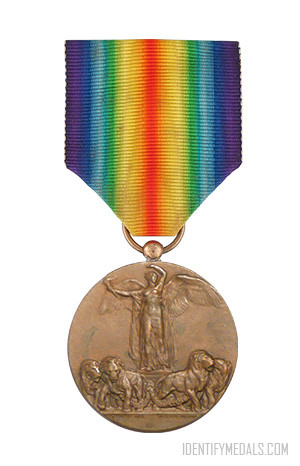
The Czechoslovakian Victory Medal was awarded to all military personnel or civilians who participated in WW1 and has an Art Deco style.

  • Time Period: World War I
  • Institution: 1919
  • Country: Czechoslovakia

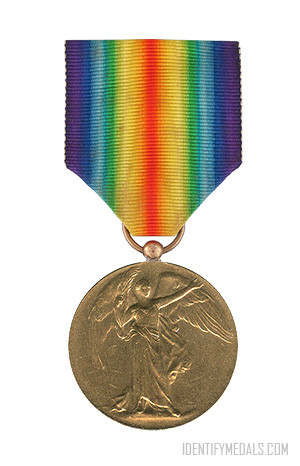
The Allied Victory Medal was recommended by an inter-allied committee in March 1919. Fourteen victorious countries finally awarded the medal after World War I, and each allied nation would design a ‘Victory Medal’ for award to their own nationals. Certain features were to be shared: a winged figure of Victory on the obverse and the same ribbon.

During the war, Czechs and Slovaks living in France were given the choice of military service or internment as enemy aliens. The Inter-Allied Victory medal was awarded to soldiers who served in the various Czech legions under the French, Italian and Russian Armies, to those who fought in the army of any allied nation, and to those who joined the French Foreign Legion.

The Czechoslovakia Inter-Allied Victory Medal Design

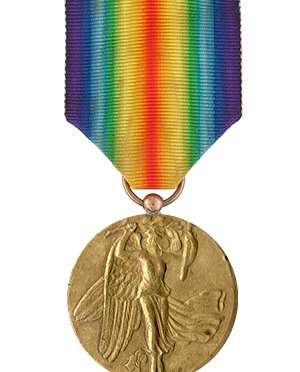
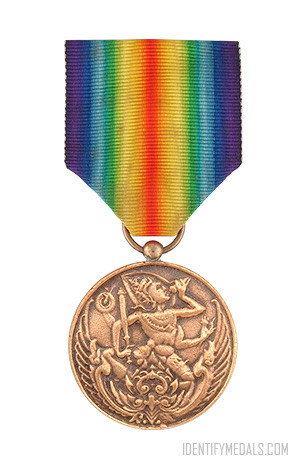
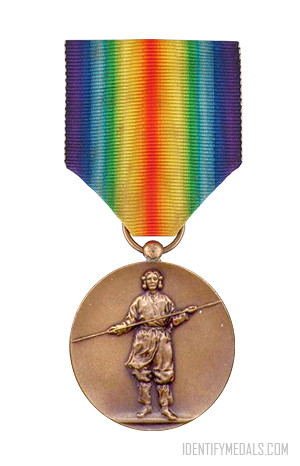
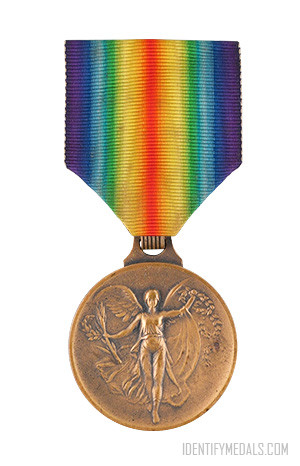
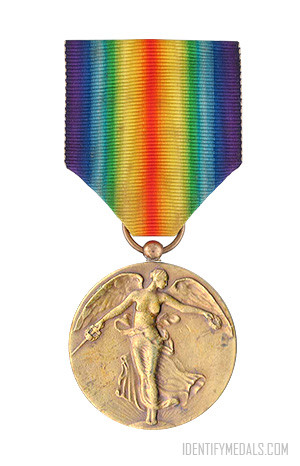
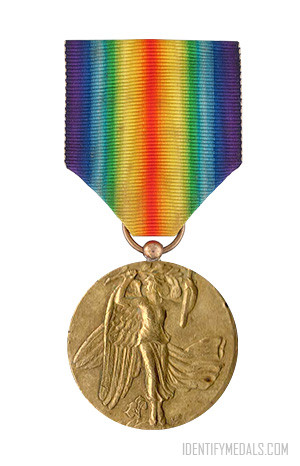
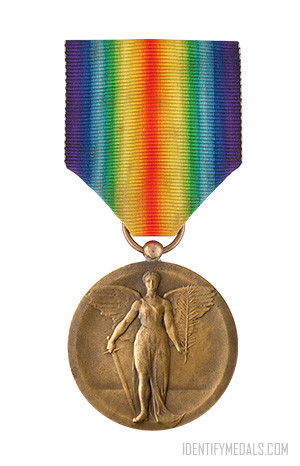
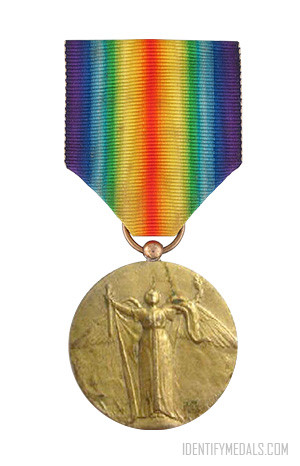
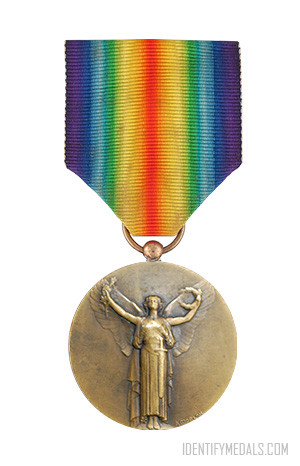
The Victory Medal measures 36 millimetres (1.4 in) in diameter and was designed by William McMillan. The design and ribbon was also adopted by Belgium, Brazil, Cuba, Czechoslovakia, France, Greece, Italy, Japan, Portugal, Romania, Siam, Union of South Africa and the USA. Each allied nation would design a ‘Victory Medal’ for award to their own nationals, all issues having certain common features, including a winged figure of victory on the obverse and the same ribbon.

The obverse of the Czechoslovakian Victory Medal featured an Art Deco style winged Victory. The linden tree, symbol of the Czech nation, sprouts near Victory’s feet. The back has a shield with the lion of Bohemia with the arms of Silesia on its chest, surrounded by linden leaves.

The reverse shows the words ‘THE GREAT / WAR FOR / CIVILISATION / 1914-1919’ surrounded by a laurel wreath.

The 39 millimeters (1.5 in) wide watered ribbon has an iridescent color scheme, with the violet moving through to a central red stripe where both schemes meet. It attaches to the medal through a ring suspender. The recipient’s name, rank, service number and unit were impressed on the edge of the medal. The name of the regiment or corps was omitted on medals awarded to Army officers.

All the Inter-Allied Victory Medal Variations

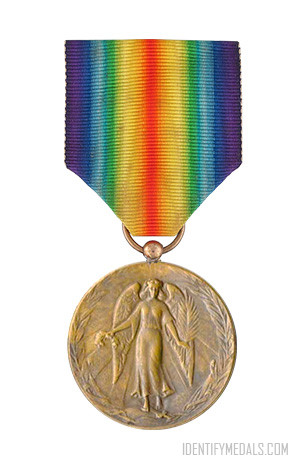
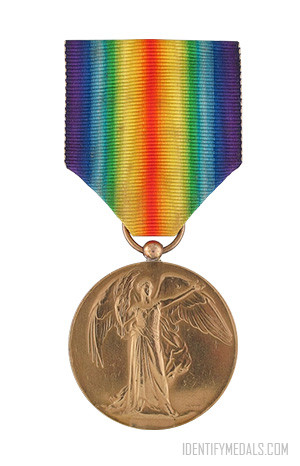
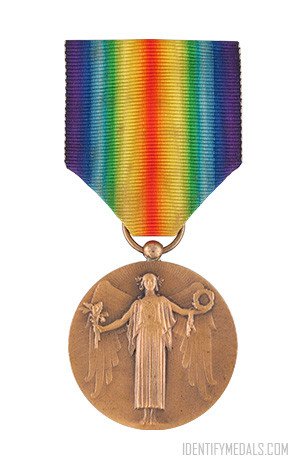
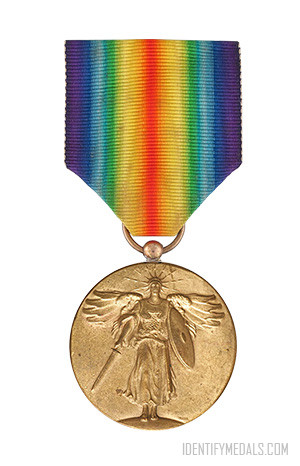
Although each country designed its own version of the Inter-Allied Victory Medal, all of them shared some common elements, such as a winged victory figure on the obverse and a similar ribbon with rainbow colors symbolizing unity among the Allies. Here are the versions for all countries:

Find an Inter-Allied Victory Medal Online

Right Now on eBay 
Clicking a link to eBay may result in a referral commission being paid if a purchase is made.
Loading...

The 1900 Boxer War Medal (Japan)

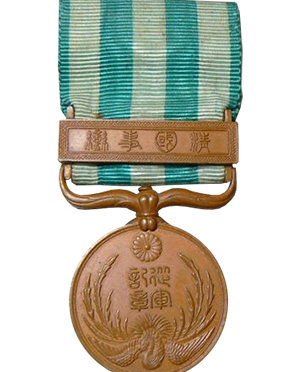
The 1900 Boxer War Medal was a Japanese medal created by Imperial Edict in 1901 to commemorate those that fought during the Boxer Rebellion.

The 1900 Boxer War Medal was a Japanese medal created by Imperial Edict No. 142 and issued on April 21, 1901. It’s a commemorative medal for those who had participated in the relief of the Beijing legations during the Boxer Rebellion.

The Military Medal of Honor (or 従軍記章 jugun kisho in Japanese) was a military decoration for meritorious service to the Empire of Japan, formerly awarded to all military personnel who participated in battles in a war and effectively abolished during the Allied Occupation of Japan in the post-war years (1945–1951).

The plausible re-institution of a modern equivalent was made unlikely by the adoption of Japan’s post-war Constitution which disavows the right of the state to engage in aggressive war.