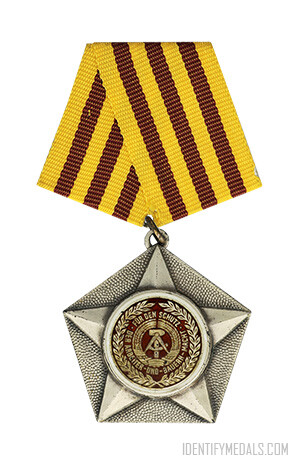
The Combat Order of Merit for the People and the Fatherland

The Combat Order of Merit for the People and the Fatherland was awarded to honor outstanding achievements in enhancing combat.

The Combat Order “For Merit to the People and Fatherland” was a state award in the German Democratic Republic, designed as a merit order to honor outstanding achievements in enhancing the combat strength and readiness of the National People’s Army and protecting the GDR’s borders.

Established on February 17, 1966, the Combat Order was awarded to members of the National People’s Army (NVA), the Border Troops, their respective units, subunits, facilities, and collectives. It was also awarded to individuals outside these organizations. The order could be awarded multiple times in each of its three classes: Gold (highest), Silver (middle), and Bronze (lowest).

The Order Classes and Awarding Process

The order was created in three classes, each signifying different levels of merit:

  • Gold 
  • Silver
  • Bronze 

The Minister of National Defense awarded the Combat Order on significant dates such as Republic Day (October 7), the anniversary of the NVA (March 1), and the anniversary of the Border Troops (December 1), or immediately following notable achievements. Recipients were given a certificate and a monetary reward, except for units and facilities.

Officially, the award recognized exceptional contributions in various areas, including:

  • Socialist military education of youth
  • Leadership and training within military units
  • Personal commitment and readiness
  • Maintenance and development of military equipment and technology
  • Contributions to military science
  • Actions benefiting the construction and protection of socialism in the GDR
  • Strengthening fraternal ties with socialist brother armies

The Banner of Labor Design

The medal was designed as a pentagonal hammered plate with a five-pointed star of the same size superimposed on it.

At the center was a medallion on a red enameled background, featuring the state emblem of the GDR, surrounded by the inscription “For the Protection of the Workers and Peasants Power” and flanked by laurel branches. The medallion was encircled by a white enameled ring with a diameter of 22 mm.

The order was made from either gilded silver, silver, or bronze, or from hard metals with similar finishes after 1973. It measured 40 mm at its widest point and had a smooth or textured back, depending on the year of manufacture.

The medal was worn on a large pentagonal clasp covered in a gold and reddish-brown striped ribbon, each stripe measuring 3.5 mm wide. The medal was worn on the upper left chest.
The Star of People’s Friendship

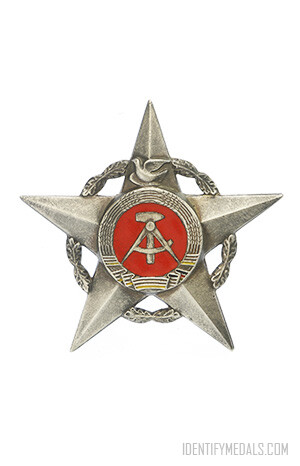
The Star of People’s Friendship was established 20 August 1959 and awarded for exceptional merit towards friendship between nations.

The Star of People’s Friendship (or Stern der Völkerfreundschaft in German), also known as the Star of Nations’ Friendship, was a prestigious order awarded by the German Democratic Republic. Established on August 20, 1959, this award was conferred upon individuals of exceptional merit who had significantly contributed to the promotion of understanding and friendship between nations, as well as the preservation of peace.

The award was presented on the recommendation of the presidency of the Council of Ministers (Präsidium des Ministerrates) and conferred by the chairman of the Council of State (Vorsitzender des Staatsrates) or in his name. Each recipient of the Star of People’s Friendship was also given a certificate, underscoring the formal recognition of their contributions.

The Star of People’s Friendship was part of the GDR’s broader strategy to promote its socialist ideals and foster international cooperation. By awarding this order to both domestic and international figures, the GDR sought to highlight and strengthen its diplomatic ties and promote the idea of global socialist solidarity. The award ceremonies were significant events, often held on important state occasions, further emphasizing the GDR’s commitment to peace and international friendship.

Star of People's Friendship Classes

The Star of People’s Friendship was categorized into three classes, each reflecting the level of contribution and distinction of the recipient:

  • 1st Class – Grand Star of People’s Friendship (Großer Stern der Völkerfreundschaft): This was the highest class, reserved for the most distinguished contributions.
  • 2nd Class – Star of People’s Friendship in Gold (Stern der Völkerfreundschaft in Gold): Awarded for significant but slightly lesser contributions than the 1st Class.
  • 3rd Class – Star of People’s Friendship in Silver (Stern der Völkerfreundschaft in Silber): Recognized notable contributions in fostering international friendship and peace.

Star of People's Friendship Design

The design of the Star of People’s Friendship features a five-pointed star, signifying excellence and distinction.

The center of the star displays a prominent emblem of the GDR, surrounded by elements that symbolized peace and international solidarity, such as olive branches or a globe.

The medal’s design varies slightly between the different classes, with the Grand Star often being larger and more elaborately decorated than the gold and silver versions.

The Order of Karl Marx

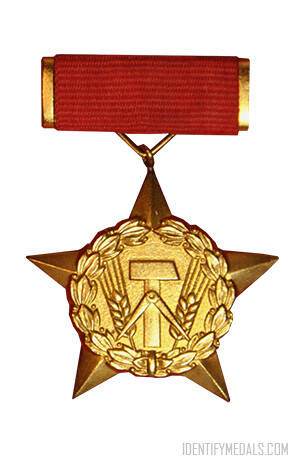
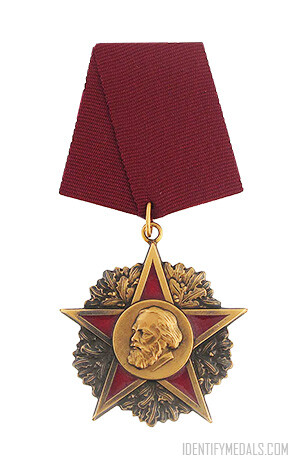
The Honored Activist Medal was a state award of the GDR conferred as an honorary title and granted to workers and employees.

The Order of Karl Marx (or Karl-Marx-Orden in German) held the distinction of being the most prestigious decoration in the German Democratic Republic (GDR).

Instituted on May 5, 1953, to commemorate the 135th anniversary of Karl Marx’s birth, this honor marked the “Karl Marx Year” in East Germany and was established based on the recommendation of the GDR Council of Ministers. Recipients of the Order of Karl Marx not only received the medal but were also awarded a monetary prize of 20,000 East German marks, emphasizing the significant recognition associated with this award.

In essence, the Order of Karl Marx served as a powerful emblem of recognition for outstanding service and contributions to the socialist cause, both within the GDR and internationally, embodying the values and aspirations of the East German state.

The Order of Karl Marx Criteria

The medal was bestowed upon individuals, enterprises, organizations, and military groups that demonstrated exceptional merit in various fields such as ideology, culture, economy, and beyond. Not limited to East German citizens, the order could also be conferred upon foreign nationals, reflecting its international prestige and the GDR’s effort to acknowledge global contributions to socialism and related fields.

The Order of Karl Marx Medal Design

The DDR Order of Karl Marx featured a red enameled five-pointed gold star with oak leaves between the points.

At the center of the star and in the obverse, a gold bust of Karl Marx was prominently displayed on a round gold plaque.

The reverse side of the medal bore either the gold content number or the award number, ensuring authenticity and traceability. This meticulous design symbolized the honor and esteem associated with the award, drawing parallels with the Soviet Order of the October Revolution, but replacing the cruiser “Aurora” with the iconic image of Karl Marx.

The medal was mounted on a plain red ribbon, adhering to the standard East Bloc pentagonal pattern, and the ribbon bar featured a central gold “oak leaf” motif.

The Hero of Labor (DDR)

The Hero of Labor was created by the German Democratic Republic and awarded for for supporting the socialist economy.

The title Hero of Labor (or Held der Arbeit in German) was a prestigious award in the German Democratic Republic (GDR) conferred to individuals who made significant contributions to the socialist economy.

Instituted on 19 April 1950, this honor was typically awarded for exceptional increases in factory output, agricultural yields, or other substantial contributions to economic development.

The Hero of Labor Award Criteria

Each year, the award was limited to a maximum of 50 recipients. This restriction emphasized the exclusivity and prestige of the honor. The recipients were often workers, engineers, and agriculturalists who demonstrated extraordinary dedication and innovation in their respective fields.

The goal was to incentivize and recognize efforts that aligned with the socialist principles of the GDR, fostering a culture of productivity and excellence.

The Hero of Labor Design

The Hero of Labor medal was a distinctive and symbolic piece of craftsmanship. The medal featured imagery representing labor and industry, such as hammer and sickle motifs, gears, and wheat sheaves. These elements symbolized the unity of workers and peasants in building the socialist state.

Central to the medal’s design was a gold star, a common symbol of excellence and achievement in socialist iconography. This star signified the recipient’s outstanding contributions to the nation’s economic progress.

The medal was suspended from a red ribbon, a color associated with socialism and the labor movement, and often included engravings of the recipient’s name and the date of the award.

Buy this Medal

Right Now on eBay 
Clicking a link to eBay may result in a referral commission being paid if a purchase is made.
Loading...

The Hero of the German Democratic Republic

The Hero of the German Democratic Republic (GDR) was an Honorary Title awarded by the East German state and its most prestigious award.

The Hero of the German Democratic Republic (or Held der Arbeit in German) was the highest honor awarded by East Germany, accompanied by a gold star medal, certificate, and financial reward.

Established by the politburo of the Socialist Unity Party on 29 October 1975, it was first awarded on 28 November 1975.

The first recipient was General Heinz Hoffmann on his 65th birthday. The first foreign recipient was Leonid Brezhnev, who was honored three times. Only two recipients, cosmonauts Vladimir Kovalyonok and Aleksander Ivanchenkov, are still alive today. The last citizen of the GDR to bear the title was Sigmund Jähn, who passed away in 2019.

A total of 17 awards were given to 11 recipients.

The Hero of the German Democratic Republic Award Criteria

The title was awarded to individuals who demonstrated extraordinary service or acts of heroism that contributed significantly to the development, international standing, military security, or authority of the GDR. Eligible recipients included combatants against fascism, servicemen of the National People’s Army, civilians cooperating with the armed services, foreign nationals in exceptional cases, and cosmonauts, who were also honored as Cosmonaut of the German Democratic Republic.

The Hero of the German Democratic Republic Privileges

The five-pointed gold star medal was similar to the Soviet Union’s Hero of the Soviet Union. Recipients also received a certificate and financial reward. After 1978, the Order of Karl Marx was a prerequisite for this honor. Both the medal and the certificate had to be returned to the state upon the recipient’s death.

Originally, up to 10 awards could be given annually, with recipients eligible for multiple awards, leading to titles such as “twice Hero” or, uniquely for Leonid Brezhnev, “three times Hero” of the GDR.

The Hero of the German Democratic Republic Design

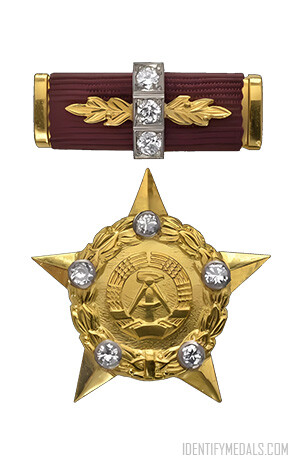
The design of the Hero of the German Democratic Republic (GDR) medal is inspired by the Soviet Hero of the Soviet Union award. The medal features a five-pointed gold star, symbolizing excellence and achievement. 

The main component of the award was a gold star with five points, which was worn on the left side of the chest. The star was polished and made to stand out, signifying the highest level of honor and valor recognized by the state.

The medal is suspended from a red ribbon, reflecting the socialist values and heritage of the GDR. The red color symbolized the socialist ideology and the connection to the broader communist movement. The ribbon was designed to be worn on the uniform, making the award highly visible.

Alongside the medal, recipients were presented with a certificate documenting their achievements and the reasons for their recognition and a financial reward.

Buy this Medal

Right Now on eBay 
Clicking a link to eBay may result in a referral commission being paid if a purchase is made.
Loading...

The Wounded on Operations Medal (Portugal)

The Wounded on Operations Medal was created in 1946 and is awarded to military personnel who were wounded in a campaign.

The Medal for Wounded in Campaign (or Medalha dos Mutilados em Campanhain Portuguese) was established on May 28, 1946 and is awarded to military personnel who suffer permanent impairment during a campaign or in directly related circumstances, resulting in damage or loss of an organ or function. This award is conferred by the Minister of National Defense.

Originally introduced as an insignia on October 5, 1918, by decree no. 4886, it was initially known as the Insignia of Mutilated and Crippled by War and consisted of a simple ribbon.

The Wounded on Operations Medal Design

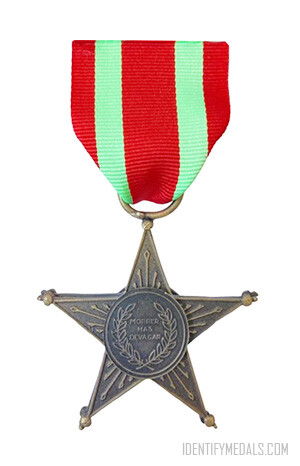
The medal is a five-pointed, chiseled star, with each point ending in a small armillary sphere. On the obverse and in the center is a disc bearing the National Emblem, encircled by a band with the inscription “FERIDOS EM CAMPANHA” (“WOUNDED IN CAMPAIGN“) in capital Elzevir type letters.

The reverse is identical to the obverse, but with a central disc inscribed with the phrase “MORRER MAS DEVAGAR” attributed to King Sebastião I of Portugal during the Battle of Alcácer Quibir. This inscription is arranged in three lines and surrounded by two laurel branches, with fruit and crossed at the base.

The ribbon is red with two vertical green lines.

The Order of the Immaculate Conception of Vila Viçosa

The Order of the Immaculate Conception of Vila Viçosa is a dynastic order of knighthood of the House of Braganza established in 1818.

The Order of the Immaculate Conception of Vila Viçosa (or Ordem de Nossa Senhora da Conceição de Vila Viçosa in Portuguese), also known as the Order of Our Lady of Conception of Vila Viçosa, is a dynastic order of knighthood of the House of Braganza, the former Portuguese Royal Family.

The Order was established by King John VI of Portugal in Rio de Janeiro on 6 February 1818, the day of his acclamation, to honor those who protected the spiritual sovereignty of the Kingdom. The Blessed Virgin Mother, under the title of the Immaculate Conception and venerated in the Ducal Chapel of the Palace of Vila Viçosa, had been proclaimed “Queen” and Patroness of Portugal by King John IV in 1646. Following a six-year referendum, the people confirmed their belief in her Immaculate Conception and her role as the reigning Queen of Portugal. This led to the Kings of Portugal no longer wearing a crown.

The Order honored individuals who demonstrated loyalty to the Portuguese Royal House during the war against Bonapartist forces. Initially, it was awarded in four classes: Grand Cross, Commander, Knight, and Servant, with limitations on the number of recipients. Grand Crosses were typically awarded to high-ranking nobles, while lower grades were given to lesser nobles who had provided personal service to the King.

The current Grand Master of the Order is Duarte Pio, Duke of Braganza, Head of the House of Braganza.

The Order 's Organization

Primarily bestowed upon Portuguese nobles, the Order is occasionally given to Heads of State and Royal Houses. It has also been awarded to individuals who have significantly contributed to the expansion of the Cult of the Blessed Virgin Mary, the Message of Our Lady of Fátima, or the Roman Catholic Church. However, these recipients are not listed as active members of the Portuguese order and do not participate in its functions.

The Order is unofficially acknowledged by the Portuguese government and may be worn by Portuguese citizens, though not on military uniforms.

It is divided into four grades:

  • Grand Cross (GCNSC)
  • Commander (ComNSC)
  • Knight/Dame (CvNSC/DmNSC)
  • Serving Brother or Sister (SNSC)

The Order 's Design

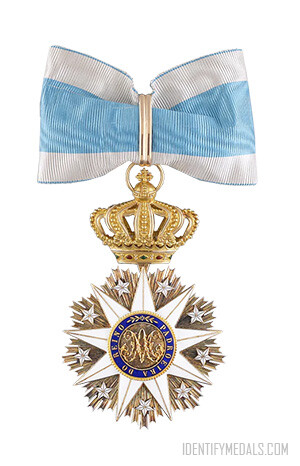
Designed by French painter Jean-Baptiste Debret, the insignia includes a star-shaped and crowned medallion with the monogram “AM” at its center. Surrounding the monogram is the inscription “Padroeira do Reino” (“Patroness of the Kingdom”).

The sash of the Order is light blue and white.

The Order of Entrepreneurial Merit

Order of Entrepreneurial Merit is intended to distinguish entrepreneur or workers for outstanding service in promoting the economic sector.

The Order of Entrepreneurial Merit (or Ordem do Mérito Empresarial in Portuguese) is the most junior of the Portuguese civil orders of merit, established to honor entrepreneurs and workers who have made outstanding contributions to the appreciation and services in various economic sectors.

The Order is divided into three categories: Agricultural, Commercial, and Industrial, each corresponding to specific economic sectors, which is reflected in their respective insignia.

The Order was originally established on 4 June 1893 by King Charles I as the “Civil Order of Agricultural and Industrial Merit” during his visit to Beja. It was abolished with the founding of the Portuguese republic and reformulated in 1926. In 1991, it was renamed the “Order of Agricultural, Industrial and Commercial Merit,” recognizing contributions to the trade and service sectors by adding a third class. Legislation in 2011 renamed it to the current “Order of Entrepreneurial Merit,” maintaining the three categories and extending the Commercial Class of Merit to include the tourism sector. The statutes also allow for the recognition of worker merit within their respective sectors.

The Order of Entrepreneurial Merit Grades

The Order is awarded in three categories, each with five classes:

Category of Agricultural Merit (Classe do Mérito Agrícola)

  • Grand Cross (Grã-Cruz – GCMA)
  • Grand Officer (Grande-Oficial – GOMA)
  • Commander (Comendador – ComMA)
  • Officer (Oficial – OMA)
  • Medal (Medalha – MedMA)
  • Honorary Member (Membro Honorário – MHMA)

Recognizes outstanding service in the promotion or enhancement of agriculture, livestock, fish, and forest resources.

Category of Commercial Merit (Classe do Mérito Comercial)

  • Grand Cross (Grã-Cruz – GCMC)
  • Grand Officer (Grande-Oficial – GOMC)
  • Commander (Comendador – ComMC)
  • Officer (Oficial – OMC)
  • Medal (Medalha – MedMC)
  • Honorary Member (Membro Honorário – MHMC)

Honors significant contributions to commerce, tourism, and related services.

Category of Industrial Merit (Classe do Mérito Industrial)

  • Grand Cross (Grã-Cruz – GCMI)
  • Grand Officer (Grande-Oficial – GOMI)
  • Commander (Comendador – ComMI)
  • Officer (Oficial – OMI)
  • Medal (Medalha – MedMI)
  • Honorary Member (Membro Honorário – MHMI)

Awards those who have rendered notable service in the promotion or enhancement of industry.

The Order of Entrepreneurial Merit Design

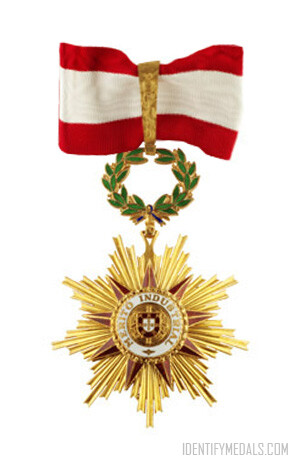
The star for all three categories is a nine-pointed enamel star, differentiated by color: green for Agricultural Merit, blue for Commercial Merit, and red for Industrial Merit. At the center of the star is the national coat of arms in gold, surrounded by a white enamel border inscribed with “Agricultural,” “Commercial,” or “Industrial” Merit in gold-enamel letters.

This star is centered on a nine-pointed plaque, in gold for Grand Cross and Grand Officer, and in silver for Commander. Between each arm of the star is a five-pointed enamel star matching the category color.

The badge is a miniature version of the star without the five-pointed stars between its arms, suspended from two crossed green enamel palms. It is worn on a sash for Grand Cross, a necklet for Grand Officer and Commander, and a ribbon on the left chest for Officer and Medal.

The ribbon for each category is made of moire silk: green and white for Agricultural Merit, blue and white for Commercial Merit, and red and white for Industrial Merit.

The Order of Public Instruction

The Order of Public Instruction was established in 1927 and awarded to deserving individuals for high services rendered to education.

The Order of Public Instruction is a Portuguese order of civil merit established in 1927. It honors individuals for significant contributions to education and teaching.

Initially founded in April 1927 as the “Order of Instruction and Benevolence” (Ordem da Instrução e da Benemerência), the order recognized services furthering education and public benevolence that contributed to the nation’s progress. In 1929, the order was restructured into two distinct orders: the “Order of Benevolence,” which evolved into the present-day Order of Merit, and the “Order of Public Instruction,” dedicated to rewarding contributions to education. The original insignia of the Order of Instruction and Benevolence was retained by the Order of Public Instruction.

The 1962 Statute of Honorific Orders refined the criteria for awarding the Order of Public Instruction, focusing on services rendered by educators, school administrators, and other contributors to education. Subsequent legislation solidified its current definition.

The Order of Public Instruction Grades

The Order of Public Instruction is awarded in the following grades:

  • Grand Cross (Grã-Cruz – GCIP)
  • Grand Officer (Grande-Oficial – GOIP)
  • Commander (Comendador – ComIP)
  • Officer (Oficial – OIP)
  • Medal (Medalha – MIP)
  • Honorary Member (Membro Honorário – MHIP)

The Order of Public Instruction Design

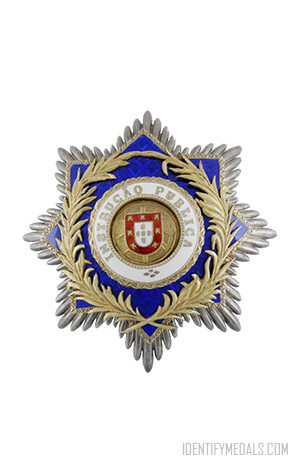
The insignia of the Order of Public Instruction features a distinctive plaque and badge.

The obverse is an eight-pointed star with gold enamel for the Grand Cross and Grand Officer, and silver for the Commander. It includes an inner blue enamel star superimposed with the coat of arms of Portugal, surrounded by golden palms and a white enamel scroll with the legend “Instrução Pública” in gold.

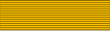
The badge consists of two crossed golden palms, and the ribbon is made of golden yellow silk, symbolizing the honor and prestige of the Order.

The Order of Camões

The Order of Camões was created in 1985 and integrated in 2021. It is awarded for relevant services to the language and its promotion.

The Order of Camões (or Ordem de Camões in Portuguese) is a distinguished Portuguese order of knighthood, originally established in 1985 and fully integrated into the Portuguese honors system on 30 June 2021.

Named in honor of Luís de Camões, Portugal’s national poet, this order celebrates significant contributions to the Portuguese language and its international promotion, as well as the strengthening of cultural relations among Portuguese-speaking communities.

Membership in the Order is conferred by the President of Portugal, either on their initiative, upon the recommendation of Ministers, or following a nomination by the Council of the Order.

The Order of Camões Grades

The Order of Camões is composed of several classes, listed in descending order of seniority:

  • Grand Collar (Grande-Colar – GColCa)
  • Grand Cross (Grã-Cruz – GCCa)
  • Grand Officer (Grande-Oficial – GOCa)
  • Commander (Comendador – ComCa)
  • Officer (Oficial – OCa)
  • Knight/Dame (Cavaleiro – CvCa / Dama – DmCa)

Additionally, the title of Honorary Member (Membro Honorário – MHCa) can be awarded to institutions and localities without specifying a grade. The Grand Collar is a special distinction reserved exclusively for heads of state.

The Order of Camões Design

The insignia of the Order of Camões reflects its dedication to the promotion of Portuguese culture and language.

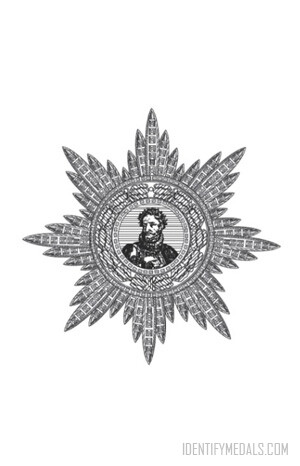
The badge features elements that symbolize literary excellence and cultural heritage, often incorporating imagery related to Luís de Camões and his contributions to Portuguese literature. The design includes a distinctive cross or emblem, which varies in complexity and decoration according to the class of the order.

For the higher classes, such as the Grand Collar and Grand Cross, the insignia is more elaborate, often featuring intricate designs and additional symbols that highlight the esteemed nature of these awards.

The ribbon associated with the Order is typically adorned in colors and patterns that reflect the cultural and historical significance of Luís de Camões and the values the Order stands for.