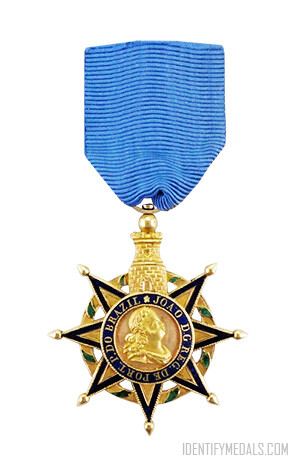
The Military Order of the Tower and Sword

The Military Order of the Tower and Sword is a Portuguese order of knighthood created by King Afonso V in 1459 as the Order of the Sword.

The Ancient and Most Noble Military Order of the Tower and Sword, of Valor, Loyalty, and Merit, originally established by King Afonso V in 1459 as the Order of the Sword, is the highest honor in the Portuguese honors system.

Initially created to reward those who participated in military conquests in Africa, the order fell into disuse after the conquest of Tangiers and Asilah. It was revived in 1808 by Prince Regent John, later John VI, to commemorate the royal family’s safe arrival in Brazil after Napoleon’s invasion of Portugal, and was renamed the Royal Order of the Tower and Sword. It was available to both Portuguese and foreigners for military, political, or civilian achievements.

The Order of the Tower and Sword's History

In 1832, Peter, Duke of Braganza, reformed the order, giving it its current name. The order saw further modifications, including the addition of the Grand Officer class in 1896 and the retention of the order after the 1910 abolition of other military orders following the establishment of the republic. The President of Portugal became the order’s Grand Master and a member of the Grand Cross. The Grand Collar, added in 1939, was initially for heads of state with notable military deeds but later restricted to former Portuguese presidents, with few exceptions.

The 1986 Organic Law of the Honorary Orders and the 2011 Law of Honorary Orders maintained the exclusivity of the Grand Collar for former Portuguese presidents while also allowing it to be awarded to foreign heads of state and individuals of exceptional achievements.

The Order of the Tower and Sword's Grades

The Order of the Tower and Sword, as currently awarded by the Portuguese government, is divided into six classes:

  • Grand Collar (GColTE): Wears the badge of the Order on a special collar (chain) and the gold star of the Order on the left chest.
  • Grand Cross (GCTE): Wears the badge of the Order on a collar (chain) or on a sash over the right shoulder, and the gold star of the Order on the left chest.
  • Grand Officer (GOTE): Wears the badge of the Order on a necklet and the gold star of the Order on the left chest.
  • Commander (ComTE): Wears the silver star of the Order on the left chest.
  • Officer (OTE): Wears the badge of the Order on a ribbon with a rosette on the left chest.
  • Knight or Dame (CavTE) / Dame (DamTE): Wears the badge of the Order on a plain ribbon on the left chest.
The Order of the Tower and Sword Design

The badge of the Order features a five-pointed gilt star with white enamel and one point directed downward. It includes a wreath of green enamel oak leaves between the star’s points and is topped by a gilt tower.

The obverse central disc displays a sword encircled by oak leaves on a white enamel background, surrounded by a blue enamel ring inscribed with the motto “Valor Lealdade e Mérito” (Valour, Loyalty, and Merit).

The reverse central disc shows the Portuguese coat of arms, encircled by a blue enamel ring with the inscription “República Portuguesa” (Portuguese Republic).

The star of the Order is a five-pointed faceted star, gilt for the Grand Collar, Grand Cross, and Grand Officer, and silver for Commander. It features the front design of the badge (without the oak leaf wreath) superimposed on it. The ribbon of the Order is blue, and the fourragère is solid blue.

The Order of the Norwegian Lion

The Order of the Norwegian Lion was established by King Oscar II in 1904 and was used to appoint knights in memory of important events.

  • Time Period: Pre-WW1
  • Institution: 10 September 1904
  • Country: Norway

The Order of the Norwegian Lion (or Den norske løve in Norwegian) was a prestigious Norwegian order of knighthood established by King Oscar II on January 21, 1904. It was created “in memory of the glorious events associated with Norway’s venerable Coat of Arms,” aiming to honor distinguished service and achievements.

The establishment of the Order of the Norwegian Lion was part of King Oscar II’s effort to elevate the Norwegian honors system to be on par with its Swedish counterpart. Specifically, it was intended to serve as an equivalent in rank to the Swedish Order of the Seraphim. This was because knights of the Norwegian Order of St. Olav were considered junior to the knights of the Seraphim within the shared Swedish-Norwegian royal court. The creation of this new order aimed to address this disparity and give Norwegian honors equal standing.

However, the expansion of the Norwegian honors system received mixed reactions from Norwegian politicians. Some saw it as an important step in recognizing Norwegian achievements, while others viewed it with skepticism, considering it unnecessary or politically motivated.

History

The Order of the Norwegian Lion was short-lived due to the political changes that followed its establishment. The Union between Sweden and Norway was dissolved in 1905, and no Norwegian knights were appointed before this dissolution. King Haakon VII, who ascended to the throne after the dissolution, chose not to appoint any new knights to this order. Eventually, he formally repealed the order in a Court resolution on March 11, 1952.

Last Living Knight

The last living knight of the Order of the Norwegian Lion was King Gustaf VI Adolf of Sweden, who passed away in 1973. His death marked the end of an era for this prestigious yet short-lived Norwegian order.

The Order of the Lion Design

The obverse of the medal prominently featured the Norwegian lion, a key element of Norway’s coat of arms. The lion was depicted in a heraldic stance, often holding a battle-axe, which is a traditional symbol of Norwegian royalty and strength.

The reverse of the medal bore the inscription detailing the order and its purpose, surrounded by ornate designs that emphasized its significance and grandeur.

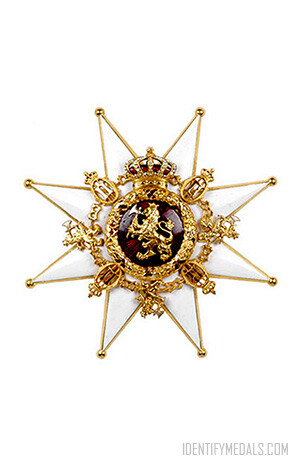
The star of the order was an elaborate and radiant design, often enameled in white and gold, further emphasizing the order’s prestige. It was worn on the left chest and signified the knight’s distinguished status.

The ribbon of the Order of the Norwegian Lion was typically a striking combination of red and white, reflecting the colors of the Norwegian flag. This ribbon was worn over the shoulder, crossing the chest, and supporting the medal.

The Order of Om Ram Patta

The Order of Om Ram Patta was established by King Tribhuvan in 1946 and bestowed upon both Nepalese and foreign nationals of Hindu faith.

The Order of Om Ram Patta was established by King Tribhuvan on October 31, 1946.

This honor is bestowed upon both Nepalese and foreign nationals who follow the Hindu faith and who set bright examples of national service.

The order includes three ranks:

  • The Sovereign (Parama-Pravitra-Om-Ram-Patta)
  • The Grand Master (Pravitra-Om-Ram-Patta)
  • Ordinary members (Om-Ram-Patta)

The Order of Om Ram Patta Design

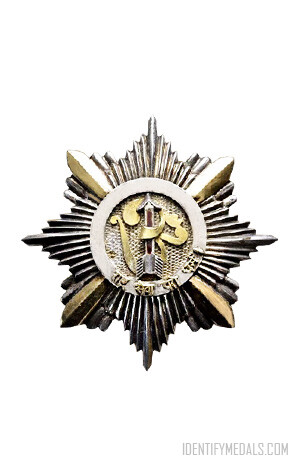
The front side bears an inscription in Nepalese, which translates to: “NATIONAL SERVICE IS THE HIGHEST VIRTUE.

The Order of the Dannebrog

The Order of the Dannebrog is a Danish order of chivalry (with a single class, the “White Knights”) established in 1671 by Christian V.

The Order of the Dannebrog (or Dannebrogordenen in Danish) is a Danish order of chivalry established by Christian V in 1671. Originally, membership was limited to fifty noble or royal individuals, who were known as White Knights, distinguishing them from the Blue Knights of the Order of the Elephant.

In 1808, the Order was reorganized into four classes. A Royal Ordinance in 1951 amended the Order’s statute to allow both men and women to become members. Today, the Order of the Dannebrog honors and rewards individuals for meritorious civil or military service, significant contributions to the arts, sciences, or business, and efforts in promoting Danish interests.

The Order is divided into six grades grouped into four classes:

  • Special class
    • Grand Commander (Storkommandør; S.Kmd.
  • First Order class
    • Grand Cross (Storkors; S.K.)
  • Second Order class
    • Commander 1st Class (Kommandør af 1. grad; K.1
    • Commander (Kommandør; K.)
  • Third Order class
    • Knight 1st Class (Ridder af 1. grad; R.1
    • Knight (Ridder; R.)

The Order of the Dannebrog Design

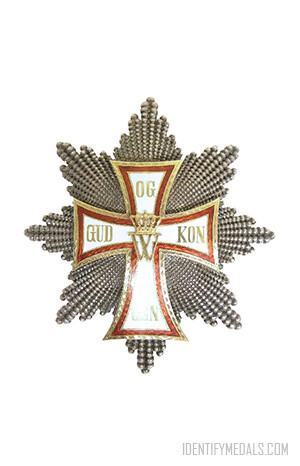
The badge of the Order of the Dannebrog is a white enameled Dannebrog cross, characterized by a longer lower arm and red enameled borders. For Knights, the badge is in silver, while for higher ranks it is in gold or silver gilt. At the top of the cross is the royal cypher of the reigning monarch, crowned with the distinctive Danish royal crown. The obverse of the cross features Christian V’s royal cypher at the center, along with the Order’s motto, “Gud og Kongen” (God and the King), on its arms. The reverse side displays the crowned royal cyphers of Valdemar II Sejr, Christian V, and Frederik VI, alongside the years 1219, 1671, and 1808, marking their respective ascensions to the Danish throne. Each of the four angles of the cross contains a small Danish royal crown.

The star of the Order is an eight-pointed silver star with straight rays, featuring an enamelled Dannebrog cross at the center, similar to the badge but without the royal cypher and crowns. The breast cross resembles the star’s cross but is larger, with faceted silver instead of white enamel, and lacks the silver rays.

The ribbon of the Order is made of white silk moiré with red borders, reflecting Denmark’s national colors.

The Order of Adolphe of Nassau

The Order of Civil and Military Merit of Adolph of Nassau was founded in 1858 as a chivalric order of the Duchy of Nassau.

The Order of Civil and Military Merit of Adolph of Nassau (or Ordre de Mérite civil et militaire d’Adolphe de Nassau in French) is a distinguished award of the Grand Duchy of Luxembourg. It recognizes outstanding service to the Grand Duke, the Grand-Ducal House, and Luxembourg.

Established in 1858 by Adolphe of Nassau as a chivalric order in the Duchy of Nassau, it honored his ancestor, Adolf, Count of Nassau, the sole member of the House of Nassau to become Roman King of Germany. Following the annexation of the Duchy by Prussia in 1866 and Adolphe’s accession as Grand Duke of Luxembourg in 1890, he reestablished the order as an order of merit.

The order consists of eight grades:

  1. Grand Cross 
  2. Grand Officer 
  3. Commander of the Crown
  4. Commander (male) / Cross of Honor for Ladies (female) 
  5. Officer of the Crown
  6. Officer
  7. Knight of the Crown
  8. Knight

Foreigners can also be inducted into the order, making it a common diplomatic honor. During World War II, it was awarded to a select number of Allied officers who played a role in liberating Luxembourg from Nazi Germany.

The Order of Adolphe of Nassau Design

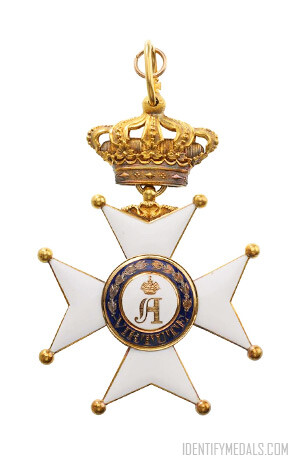
The badge of the order is a gold cross, enamelled in white, with eight points each ending in a gold pearl. The front central disc displays the gold letter “A” in Gothic script, crowned by an imperial crown. This is surrounded by a laurel wreath on a blue-enamelled background, inscribed with the motto “Virtute” in gold letters. The reverse side features the dates “1292” (the year Adolf of Nassau-Weilburg was crowned King of the Romans) and “1858” (the year the order was established by Adolphe, Duke of Nassau) in gold letters on a white-enamelled background. The military division includes two crossed swords under the central medallion. The badge for all classes of the order has a gold crown attached above it.

The plaque (breast star) for the civil division of the order is an eight-pointed faceted silver star for the Grand Cross, or a faceted silver Maltese Cross with silver rays between the arms for the Grand Officer. The central disc is identical to that of the badge. The military division’s plaque also features two crossed swords under the central medallion, with gold hilts and silver blades, and the corresponding badge shows two crossed swords in gold.

The cross mirrors the badge in shape but is not enamelled, and is made of plain gold or silver. The medal is round, available in gold, silver, or bronze, and features the portrait of Adolph, Duke of Nassau.

The ribbon of the order is blue moiré with a narrow orange stripe along each edge. The Grand Cross badge is suspended from a 100 mm wide ribbon. The Grand Officer and Commander wear the badge from a 43 mm wide ribbon, while the Officer and Knight wear it from a 38 mm wide ribbon, with the Officer’s ribbon featuring a rosette in the same colors.

The Family Order of Laila Utama

The Most Esteemed Family Order of Laila Utama is an order of Brunei established on 1 March 1954 by Sultan Omar Ali Saifuddien III.

  • Time Period: Post-WW2
  • Institution: 1 March 1954
  • Country: Others (Brunei)

The Most Esteemed Family Order of Laila Utama (or Darjah Kerabat Laila Utama Yang Amat Dihormati in Malay) is a prestigious order of Brunei, established on 1 March 1954 by Sultan Omar Ali Saifuddien III.

Recipients of this order are entitled to use the post-nominal letters “DK” or “DK I” and the honorary title “Dato Laila Utama.”

The Family Order of Laila Utama Design

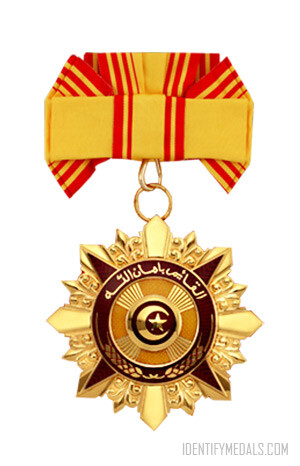
Initially, the order’s design featured a painted bust of Sultan Omar Ali Saifuddien III. However, since 1975, this has been replaced by a star and crescent moon motif.

The emblems of the order are crafted from gold or silver with enamel accents. The order confers the right to use the post-nominal letters “DK I” and the title “Dato Laila Utama.

The Distinguished Service Star (Philippines)

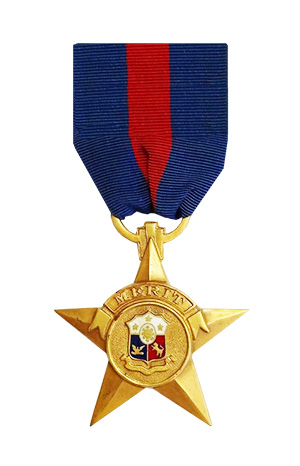
The Distinguished Service Star is the third highest military award of the Philippines and awarded for valuable service.

The Distinguished Service Star holds the position as the third highest military honor within the Armed Forces of the Philippines. It is bestowed in recognition of exceptionally meritorious and valuable contributions made while holding significant positions of responsibility.

The Distinguished Service Star Design

The award is worn suspended from the neck, secured by a ribbon featuring a dark blue hue with a prominent red vertical stripe at its center. Resembling a five-pointed star, the medal features a central disc showcasing the Coat of Arms of the Philippines. Above the seal, an arc-shaped golden scroll bears the inscription “Merit.”

A wreath composed of twenty-six dark green leaves and ten white buds attaches the star to its ribbon. Engraved on the reverse side of the medal are the words “For Distinguished Service.”

The Distinguished Conduct Star (Philippines)

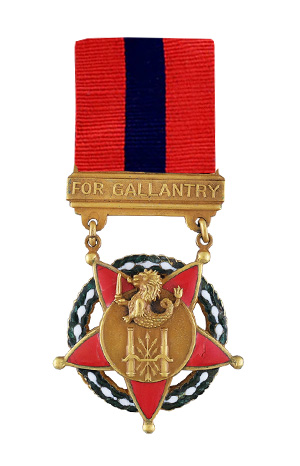
The Distinguished Conduct Star is the second highest military award of the Philippines and awarded for extraordinary acts of heroism.

The Distinguished Conduct Star stands as the Philippines’ second-highest military honor, ranking only below the Medal of Valor. President Manuel L. Quezon established this award in 1939, replacing the Philippine Constabulary Distinguished Conduct Star.

Criteria This decoration is bestowed upon individuals serving in any capacity within the Armed Forces of the Philippines who demonstrate extraordinary heroism not meeting the criteria for the Medal of Valor during military operations against an armed adversary. The act or acts of heroism must be exceptionally notable and involve a level of life-threatening risk that sets the individual apart from their peers. The Chief of Staff of the Armed Forces of the Philippines has the authority to confer this award.

The Distinguished Conduct Star Design

The medal features a red enameled, downward-pointing star with a central gold disc. Encased within the disc is a relief of a gold heraldic sea lion, grasping a dagger in its right hand, positioned atop the muzzles of two cannons flanking both sides. At the disc’s base lie two bows resting horizontally across arrows, placed between the breeches of the cannons. Vertically positioned spears point upward, overlaying the crossed arrows.

Affixed to a gold bar engraved with the phrase “For Gallantry,” the star is connected to the base of a wreath crafted from Sampaguita white flower buds and green leaves. The award is worn suspended from the neck by a red ribbon featuring a blue stripe at its center.

The Gawad Mabini Award

The National Living Treasures Award is conferred to artists for their contributions to the country’s intangible cultural heritage.

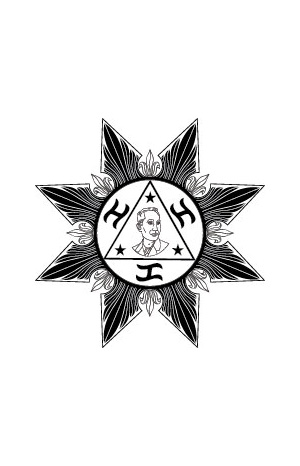
The Gawad Mabini Award (or Medalla de Premio Apolinario Mabini al servicios de Relaciones Exteriores in Spanish) is bestowed upon Filipinos who have demonstrated outstanding service in foreign affairs or have significantly advanced the interests and reputation of the Philippines on the global stage. Established through Presidential Decree No. 490, dated 1974, in homage to Apolinario Mabini, the inaugural Secretary of Foreign Affairs in the First Republic of the Philippines, its guidelines were formalized in 2003 under the Honors Code of the Philippines.

As outlined in the Implementing Rules and Regulations of the Honors Code, the Gawad Mabini is granted for various meritorious acts, including substantial contributions to the evacuation of Filipino nationals from perilous situations, exemplary provision of consular services, or safeguarding Philippine citizens abroad. It also recognizes outstanding performance in international negotiations or missions, along with other individual acts of merit that uphold the highest standards of the Foreign Service.

The Gawad Mabini Award Ranks

The Gawad Mabini comprises three distinct ranks:

  1. Grand Cross (GCrM) (Dakilang Kamanong) – Awarded to former or current Secretaries of Foreign Affairs, Chief of Mission, cabinet members, or other high-ranking officials who led Philippine delegations to significant international conferences at the ministerial level. Recipients of this rank are recognized for their substantial contributions to the public interest and welfare resulting from their participation in such conferences.

  2. Commander (CM) (Dakilang Kasugo) – Bestowed upon officers holding ranks ranging from career minister to foreign service officer class IV, or upon personnel from government agencies serving as Attaches in Foreign Service establishments. Recommendations for this rank are made by the Chief of Mission or the Principal Officer of the respective post served, or by the Secretary of Foreign Affairs for personnel based in the Home Office.

  3. Member (MM) (Kasugo) – Granted to staff officers or employees of the Department of Foreign Affairs (DFA). Recommendations for this rank are made by the Chief of Mission or the Principal Officer of the post served, or by the Secretary of Foreign Affairs for personnel in the Home Office.

The Gawad Mabini Award Design

The emblem of the Gawad Mabini features a stylized Romanian Cross with a central red triangle adorned with stars at each corner, showcasing the likeness of Apolinario Mabini.

Encircling this central design are three stylized letter Ks. The medal for recipients of the Grand Cross is crafted from silver gilt, while for those awarded Commander and Member ranks, it is fashioned from gilded bronze or copper. The ribbon consists of three equal stripes in red, yellow, and blue, reminiscent of the colors found in the Philippine flag.

The Outstanding Achievement Medal

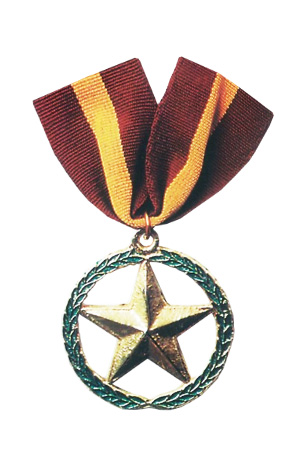
The Outstanding Achievement Medal is a single grade decoration of the Philippines awarded by the Secretary of National Defense.

The Outstanding Achievement Medal is a singular-grade honor in the Philippines bestowed by the Secretary of National Defense to members of the Armed Forces of the Philippines and civilians alike. It may also be conferred upon civilians and military personnel from allied foreign nations.

The award is designated “…for distinguished or exceptional accomplishments or service in the promotion of science, or in socio-economic, technical, or military sectors associated with national defense, or for exemplary public service.

The Outstanding Achievement Medal Design

The medal features a gold star encircled by a gold wreath, symbolizing exceptional accomplishment and honor, respectively. It is worn suspended from a ribbon around the neck.

The ribbon itself is purple with a prominent gold stripe running through its center.