The Medal of Sports (Egypt)

The Medal of Sports is an Egyptian decoration established in 1953 and awarded to the champions who win in international competitions.

The Medal of Sports (وسام الرياضة) is an Egyptian decoration established in 1953. 

It is bestowed upon individuals who render commendable services to the nation and to champions who excel in international competitions. Additionally, this accolade may be conferred upon sports teams, clubs, or similar institutions for their outstanding contributions to the field of sports.

The Sports Medal comprises three distinct classes, with each class tailored to the recipient based on the nature of their service and their social standing. These are:

  • Medal of Sports First Class
  • Medal of Sports Second Class
  • Medal of Sports Third Class

The Medal of Sports Design

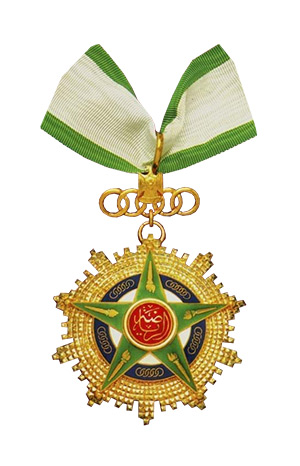
The Medal of Sports is crafted in the form of a five-pointed star adorned with vibrant green enamel, each point featuring the emblem of a blazing flame. These points are interconnected by a circular white enamel disc encircled by a blue enamel ring, upon which rests five interlocking circles symbolizing the Olympic games. Positioned at the heart of the star is a circular golden disc inscribed with the word “Sport” in Arabic above a crimson enamel backdrop.

The star is affixed atop a silver-gilded base, with radiant beams emanating from it. Suspended horizontally by a clip shaped like the overlapping Olympic rings, the Medal is awarded in multiple classes.

The First Class is worn suspended from a white silk ribbon with two green stripes around the neck, while both the First and Second Classes are worn on the left side of the chest using the same ribbon. Notably, the Second-Class medal is adorned with a Rosette for distinction.
The Order of The Sciences and Arts (Egypt)

The Order of The Sciences and Arts is an Egyptian presidential decoration created in 1972 for excellent services in science, art and knowledge.

The Order of The Sciences and Arts (وسام العلوم والفنون) is an Egyptian presidential decoration created in 1972 for excellent services in science, art and knowledge.

The Order is an esteemed honor from Egypt and celebrates individuals who have made significant contributions to the fields of science and the arts. It was, in fact, established to recognize excellence and innovation in these domains, and has been bestowed upon a select few whose accomplishments have left a lasting impact on Egyptian culture and society.

Examples of recipients of the Order of Sciences and Arts include renowned scholars, scientists, artists, and cultural figures whose groundbreaking work has enriched Egypt’s intellectual and artistic landscape. From pioneering researchers and inventors to visionary artists and writers, each recipient has contributed to advancing knowledge, creativity, and cultural heritage in their respective fields.

The medal has three degrees:

  • First class – Grand Cordon
  • Second class
  • Third class

The Order of The Sciences and Arts Design

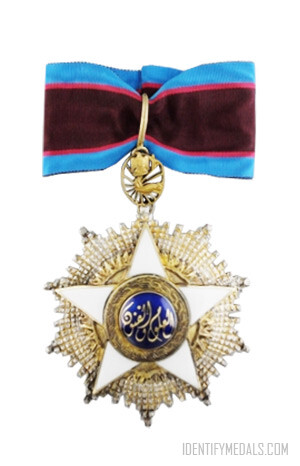
The Commander insignia bears an Arabic inscription on its obverse, which translates to the title of the Order, “Science and Arts.”

The medal is worn from a neck ribbon.

The Order of The Virtues

The Order of The Virtues is an Egyptian order of knighthood founded in 1915 and awarded to women for merit.

The Order of the Virtues (or Nishan al-Kamal, وسام الكمال) is an Egyptian order of knighthood awarded to women for merit. It was established in 1915 and brought back in 1953 under the Egyptian Republic.

Women who render valuable services to the nation or humanity may be eligible for the Order’s recognition. 

The order is composed of the following classes of merit:

  • Supreme Class
  • 1st Class
  • 2nd Class
  • 3rd Class

The highest distinction, the Supreme Class, is reserved for the world’s first ladies and may also be conferred upon the spouses of crown princes or vice-presidents. The First Class of the medal is designated for the spouses of prime ministers, ministers, and individuals in similar roles, while the Second Class is bestowed upon the spouses of ambassadors and other distinguished individuals.

The Order of The Virtues Design

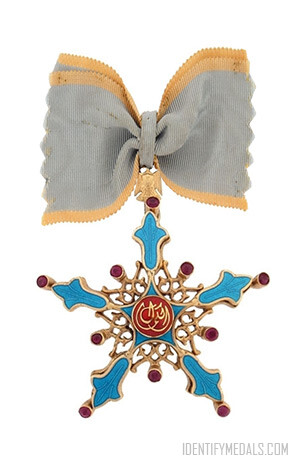
The Supreme Class of the medal is worn on the left side of the chest and features a medallion embellished with red sapphires, turquoise, and blue sapphires. This class is also draped with an 8-centimeter-wide sash crafted from gray silk and accented by two yellow golden welts. Completing this ensemble is a smaller medallion, also adorned with red sapphires, at the end of the sash.

The First Class of the medal mirrors the Supreme Class in design but omits the sapphires and turquoise. The Second and Third Classes of the medal are worn on the left side of the chest, too, but suspended by a knotted ribbon measuring 3.1 centimeters in width. These classes feature medallions akin to those of the First Class, albeit smaller in size.

The ribbon is light grey with yellow/gold edges.

The Order of Merit (Egypt)

The Order of Merit is an Egyptian order of merit established in 1953 on behalf of King Ahmad Fuad for meritorious service.

The Order of Merit (وسام الاستحقاق), established in 1953 by the Regent acting on behalf of King Ahmad Fuad, serves as a distinguished Egyptian honor recognizing meritorious service.

This prestigious order comprises multiple classes of merit, each representing varying degrees of distinction.

At its apex lies the First Class, known as the Grand Cordon, followed by the Second, Third, Fourth, and Fifth Classes. These classes encapsulate the diverse spectrum of contributions and achievements deserving of recognition within the Egyptian nation.

The Order of Merit Design

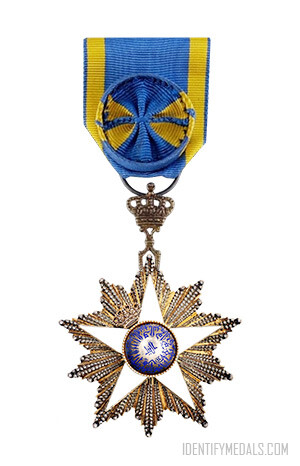
Crafted by Fahmy T. Bichay of Cairo, this medal is composed of silver, gilt, and enamels.

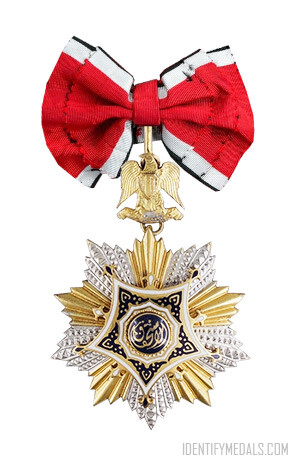
The neck badge, measuring 60mm in diameter, and the breast star, measuring 80mm, feature intricate details. At the heart of the medal lies a gold Arabic inscription, ensconced within a raised blue oval set amidst a backdrop of blue and white arabesque patterns forming a five-pointed star. Radiating outwards, the star is adorned with the Eagle of the Republic at its pinnacle, symbolizing strength and sovereignty.

On the reverse side is the maker’s name in Arabic and hallmarks.

The Order of Honor Star

The Order of Honor Star is a military decoration of Egypt, awarded to officers, non-commissioned officers and soldiers of the Armed Forces.

The Order of the Honor Star (وسام نجمة الشرف) stands as one of Egypt’s premier military honors, bestowed upon officers, non-commissioned officers, and soldiers of the Egyptian Armed Forces in recognition of their extraordinary bravery and valor exhibited in direct combat against the enemy.

Recipients of this esteemed order are granted special privileges, including:

  • A monthly stipend of twenty thousand Egyptian pounds, which remains in effect for the duration of the recipient’s service. This stipend continues even if the recipient transitions to a civilian occupation or upon retirement.

  • Exemption from educational fees for their children across various levels of schooling in state-owned educational institutions. These beneficiaries are also exempted from age and total score requirements for admission.

The Order of Honor Star Design

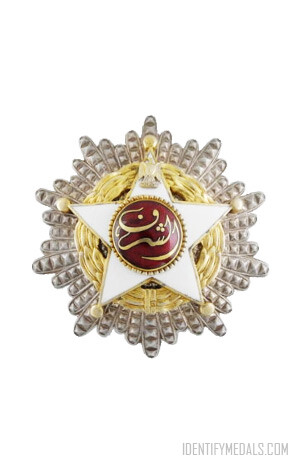
The medal is a silver star adorned with deep crimson enamel at its center. On the obverse, it showcases the Arabic inscription of the medal’s name, “Honor“.

The ribbon is blue with narrow red, white and black edge stripes. 

The Order of the Sinai Star

The Order of the Sinai Star is Egypt’s highest military honor, awarded for personal acts of extraordinary gallantry in direct combat.

The Order of the Sinai Star (وسام نجمة سيناء) is a prestigious military distinction in Egypt, comprising two levels of recognition. Serving as Egypt’s highest military accolade, it is conferred for individual acts of exceptional bravery and valor demonstrated in direct combat against the enemy.

Eligible recipients include officers, non-commissioned officers, and soldiers of the Egyptian Armed Forces. Since its establishment in 1972, a total of 68 officers and soldiers have been honored with this esteemed order. 

The Order of the Sinai Star has two classes: First Class and Second Class.

The Order of the Sinai Star Design

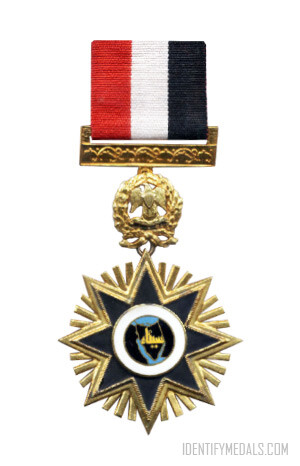
The insignia of the order consists of a ribbon and a medal. On the obverse, there is an inscription that reads سيناء‎‎ (Sinai Peninsula, or simply Sinai).

The ribbon design for both the first and second degrees features three horizontal stripes in red, white, and black. Additionally, first-degree recipients are distinguished by the inclusion of a golden eagle emblem affixed to the ribbon.

The Order of the Nile

The Order of the Nile was an Egyptian decoration established in 1915 and one of the principal orders of the Kingdom of Egypt.

Established in 1915, the Order of the Nile (Kiladat El Nil, قلادة النيل) stood as a prominent honor of the Kingdom of Egypt until the monarchy’s dissolution in 1953. Subsequently, it was reinstated as the highest state honor of the Republic of Egypt.

Established in 1915 by Sultan Hussein Kamel of Egypt, the Order was intended for individuals who had provided valuable service to the nation. Positioned below the Order of Ismail, it was frequently bestowed upon British officers and officials serving in Egypt, alongside esteemed Egyptian citizens.

The order consisted of five classes:

  • Grand Cordon: The badge was worn from a sash over the right shoulder, with a star displayed on the left chest.
  • Grand Officer: The badge was worn around the neck, accompanied by a smaller star on the left chest.
  • Commander: The badge was worn around the neck.
  • Officer: The badge was worn on the left chest, suspended from a ribbon adorned with a rosette.
  • Knight: The badge was worn on the left chest, suspended from a plain ribbon.
Following Egypt’s transition to a republic in 1953, the Order of the Nile underwent reconstitution to assume the role of Egypt’s premier state distinction. Presently, it comprises:

  • Collar: Reserved for the President of the Republic, and possibly conferred upon other Heads of State.
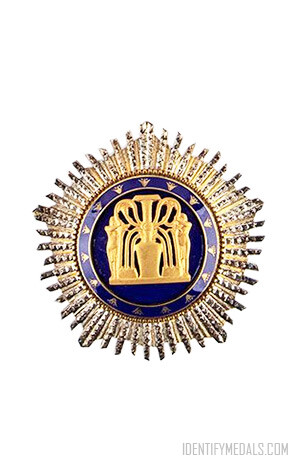
  • Grand Cordon: Conferred in recognition of exceptional contributions to the nation. In this category, the order’s insignia is worn from a sash, with the order’s star displayed on the left chest.

The Order of the Nile Design

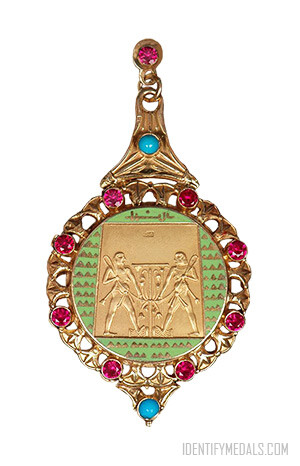
The Order of the Nile comprises a collar crafted from pure gold, adorned with three square gold units embellished with Pharaonic symbols.

Each unit symbolizes distinct concepts: the first unit embodies the idea of safeguarding the state from adversities, the second unit represents the prosperity and joy brought forth by the Nile, while the third unit signifies wealth and resilience. These units are intricately linked by a circular gold flower ornamented with turquoise and ruby gemstones.

Suspended from the collar is a hexagonal pendant adorned with Pharaonic-style floral motifs, accented with turquoise and ruby gems. At the center of the pendant, a prominent symbol depicting the Nile unites the representations of the North (portrayed by the Papyrus) and the South (embodied by the Lotus).

The Order of the Nile - Collar.
The Order of the Nile - Collar. Obverse.
The Order of the Nile - Grand Cross. Obverse.
The Order of the Nile - Grand Cross Insignia. Obverse.

The iPhrothiya yeGolide Golden Protea Medal

The iPhrothiya yeGolide Golden Protea Medal is a South African bestowed upon individuals who have demonstrated outstanding leadership.

The iPhrothiya yeGolide – Golden Protea, denoted by the post-nominal letters PG, was established by the President of the Republic of South Africa on April 16, 2003, becoming effective on April 27, 2003. It is bestowed upon individuals of all ranks who have demonstrated outstanding leadership, exceptional meritorious service, and unwavering dedication to duty. This prestigious decoration stands as South Africa’s highest military honor for meritorious conduct.

The decoration is granted to members of the South African National Defence Force, its Auxiliary Services, and affiliated Armed Forces who exhibit outstanding leadership, exceptional meritorious service, and unwavering dedication to duty. It holds precedence within a trio of military decorations for merit, accompanied by the iPhrothiya yeSiliva – Silver Protea and the iPhrothiya yeBhronzi – Bronze Protea.

About The Union Defence Forces (UDF)

Established in 1912 as the Union Defence Forces (UDF), the military entity underwent a renaming to become the South African Defence Force (SADF) in 1958. Subsequently, on April 27, 1994, it merged with six other distinct forces to form the South African National Defence Force (SANDF).

The iPhrothiya yeGolide Golden Protea Medal Design

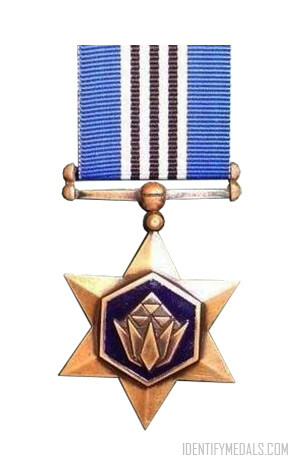
The iPhrothiya yeGolide – Golden Protea features a six-pointed star showcasing a stylized protea, the national flower of South Africa, positioned within a blue hexagon at its center.

On the reverse side, the decoration displays the coat of arms of South Africa in raised relief. It is attached to a plain silver-gilt suspender fixed to the upper point of the star, with the medal number stamped or engraved below the coat of arms.

The ribbon measures 32 millimeters in width and is colored national flag blue, with a 2 millimeter wide gold band flanked by 2 millimeter wide black bands positioned at its center.

The Order of Pope Pius IX

The Order of Pope Pius IX is a papal order of knighthood founded by Pope Pius IV and the highest honor conferred by the Holy See.

The Order of Pope Pius IX, also known as the Pian Order, is a papal order of knighthood originally established by Pope Pius IV in 1560. Currently, it holds the distinction of being the highest honor bestowed by the Holy See, as the Orders of Christ and the Golden Spur are presently dormant. After falling out of use, the order was reinstated by Pope Pius IX on 17 June 1847.

On June 17, 1847, Pope Pius IX revived the Order with the decree Romanis Pontificibus, tracing its lineage back to the ancient order established by Pope Pius IV in March 1559 through the bull Pii patris amplissimi.

These distinguished knights comprised the lay court of the Roman Pontiff, actively participating in his daily life by providing escort services, residing in the Apostolic Palace, sharing meals with the Pontiff, and accompanying him in his daily duties.

The Ranks of the Order of Pope Pius IX

The Order comprises five classes.

At the apex of the order stands the Collar, reserved for Catholic heads of state during official visits to the Holy See. The Grand Cross, the highest Papal accolade for lay individuals, is typically conferred upon resident Ambassadors accredited to the Holy See after two years in their post. It is also occasionally bestowed upon extraordinary Catholics worldwide for exceptional contributions, particularly in the realms of international affairs and service to the Church and society.

The Knight rank is exceedingly rare and reserved for Catholic faithful of esteemed stature who have provided notable service to the Holy See or the Pontiff personally, often hailing from ancient European noble lineages.

The remaining ranks of Commander and Commander with Star are sparingly granted to lay Catholics, particularly those in diplomatic roles, in recognition of outstanding merit or contributions to the Church and society. While primarily awarded to Catholics, the order may, on diplomatic grounds, be conferred upon non-Catholics and individuals of other faiths.

The Order of Pope Pius IX Design

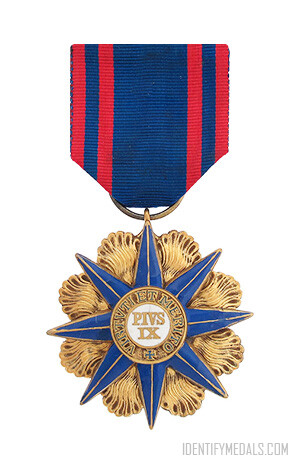
The insignia of the order is a standard octagram crafted from blue enamel, with gold flames filling the gaps between the rays.

Engraved on the white central medallion are the founder’s name surrounded by the words “Virtuti et Merito” (“Virtue and Merit”). The reverse side mirrors this design, replacing “Pius IX” with “Anno 1847.”

The official uniform, seldom worn, comprises a finely embroidered dark blue evening coat adorned with golden epaulettes, paired with white trousers, and topped with a white-plumed bicorne.

The Order of the Golden Spur

The Order of the Golden Spur is a papal order of knighthood awarded for distinguished service in propagating the Catholic faith.

The Order of the Golden Spur (or Ordine dello Speron d’Oro in Italian and Ordre de l’Éperon d’or in French), also officially known as the Order of the Golden Militia (or Ordo Militia Aurata in Latin and Milizia Aurata in Italian), is a papal knighthood bestowed upon individuals who have demonstrated exceptional service in promoting the Catholic faith or enhancing the prestige of the Church through acts of valor, scholarly writings, or other noteworthy achievements.

Following the passing of the last surviving knight, Grand Duke Jean of Luxembourg, in 2019, the order is now considered inactive.

The History of the Order of the Golden Spur

The Order of the Golden Spur has its roots in medieval times and is believed to have been established around the 8th century. Its origins are closely linked to the papacy and the Holy See’s role in recognizing individuals who made significant contributions to the Catholic Church and its mission.

Initially, the order was associated with the accolade of knighthood, often bestowed upon knights who demonstrated exceptional bravery in battle or service to the Church. Over time, its criteria expanded to include individuals who contributed to the glory of the Church through scholarly pursuits, artistic endeavors, or other illustrious acts.

During the Middle Ages, the order gained prominence as one of the highest honors conferred by the papacy. Recipients of the Golden Spur were esteemed members of the nobility and clergy, recognized for their unwavering dedication to the Catholic faith and their exemplary service to the Church.

Throughout its history, the order underwent various reforms and modifications, adapting to the changing political and religious landscape of Europe. Over time, the Golden Spur became associated not only with military valor but also with intellectual and cultural achievements that contributed to the advancement of Christianity.

The Order of the Golden Spur Design

The badge today features an eight-pointed, enamelled gold cross. At its center lies a small white medallion, bearing the word “Maria” encircled by a golden ring. On the reverse side of the medallion, the year MDCCCCV is inscribed, surrounded by the words “Pius X Restituit” in a surrounding circle. Hanging from the bottom of the cross is a small golden spur.

The decoration is suspended from a red ribbon with white borders.

The star, worn on the left breast, retains the same cross design. It is set against the backdrop of silver star rays, enhancing its visual appeal.