The New Zealand Bravery Star

The New Zealand Bravery Star was instituted by Royal Warrant on 20 September 1999 and is the second-level civil decoration of New Zealand.

The New Zealand Bravery Star (NZBS) holds the distinction of being the second-level civil decoration in New Zealand’s honors system.

It was established by Royal Warrant on September 20, 1999, as part of an initiative to transition from British bravery awards to a distinct New Zealand Bravery system. This noteworthy medal, which can also be conferred posthumously, is granted in acknowledgment of “acts of outstanding bravery in situations of danger.” While primarily a civilian honor, it is also extended to members of the armed forces who display acts of exceptional courage in non-operational contexts. This allowance is made because New Zealand’s gallantry awards are typically reserved for those involved in war, warlike operational service, including peacekeeping missions.

Additional recognition in the form of bars can be added to the NZBS to commemorate further acts of bravery deserving of this prestigious award. Those who receive the New Zealand Bravery Star are entitled to use the postnominal letters NZBS.

This medal took the place of the George Medal, recognizing acts of bravery within or worthy of recognition by New Zealand, and signifying the country’s shift towards its unique bravery recognition system.

The New Zealand Bravery Star Design

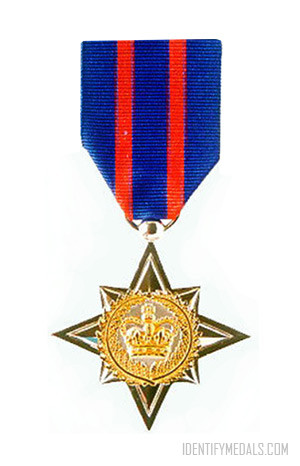
The New Zealand Bravery Star measures 45mm in diameter.

The obverse is a faceted silver eight-pointed star of equal points surmounted by the Royal Crown and fern frond wreath emblem (four of the arms are shorter than the Gallantry Star). The reverse has the inscription “FOR BRAVERY – MO TE MAIA“.

The suspension is a ring suspension.

Find This Medal

Right Now on eBay 
Clicking a link to eBay may result in a referral commission being paid if a purchase is made.
Loading...

The New Zealand Gallantry Star

The New Zealand Gallantry Star (or NZGS) was created in 1999 and is the second-level military decoration of the New Zealand armed forces.

The New Zealand Gallantry Star (NZGS) holds the position of the second-highest military decoration within the New Zealand armed forces.

Its establishment came through a Royal Warrant on September 20, 1999, marking a significant step toward replacing British gallantry awards with a distinctly New Zealand Gallantry system. This distinguished medal, which can also be awarded posthumously, is conferred in recognition of “acts of outstanding gallantry in situations of danger” that occur during war, warlike operational service, and even peacekeeping missions.

Bars, or additional recognitions, can be added to the NZGS to acknowledge further acts of gallantry deserving of this prestigious award. Those honored with the New Zealand Gallantry Star are entitled to use the postnominal letters “N.Z.G.S.”

This medal effectively replaced the Distinguished Service Order (when awarded for gallantry), the Distinguished Conduct Medal, and the Conspicuous Gallantry Medal, signifying a shift towards a more indigenous New Zealand system of recognizing gallantry.

The New Zealand Gallantry Star Design

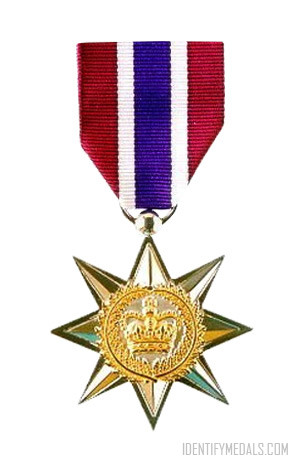
The New Zealand Gallantry Star measures 45mm in diameter.

The obverse is a faceted silver eight-pointed star of equal points surmounted by the Royal Crown and fern frond wreath emblem. The reverse has the inscription “FOR GALLANTRY – MO TE TOANGA“.

The suspension is a ring suspension.
Find This Medal

Right Now on eBay 
Clicking a link to eBay may result in a referral commission being paid if a purchase is made.
Loading...

Decoration for Meritorious Services (South Africa)

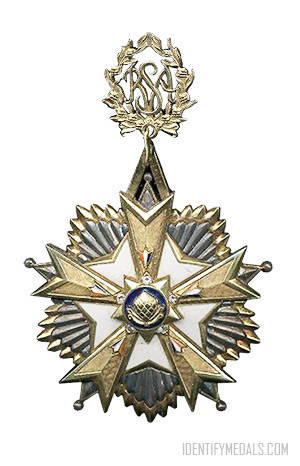
The Decoration for Meritorious Services was conferred until 1987 by the Government of the Republic of South Africa for political services.

The Decoration for Meritorious Services was an award granted until 1987 by the Government of the Republic of South Africa, typically in recognition of one’s political contributions to the nation. Appointments to this honor were made by the State President of South Africa.

Recipients of this distinction were entitled to use ‘DMS’ (or in Afrikaans, ‘DVD’) after their name. In 1986, it was succeeded by the Order for Meritorious Service.

Since June 1, 1994, this honor has been categorized as a Commonwealth distinction.

Decoration for Meritorious Services Design

The design featured a five-armed gold Maltese cross, with a golden protea flower at the center of a five-pointed diamond-studded star, all set against a multi-rayed silver and gold plaque on the obverse side. This decoration was worn suspended from a neck ribbon.

Find This Medal Online

Right Now on eBay 
Clicking a link to eBay may result in a referral commission being paid if a purchase is made.
Loading...

The Order of Good Hope

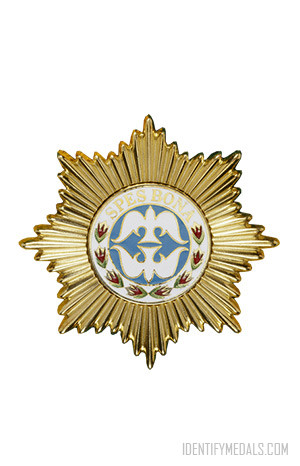
The Order of Good Hope is a dormant order of merit of the Republic of South Africa. It was founded in 1973 by the government.

The Order of Good Hope, also known as the Order of the Cape of Good Hope, is an inactive order of merit originating from the Republic of South Africa. Founded in 1973 by the South African government of that time, its purpose was to recognize individuals who had made significant contributions to fostering international relations and raising awareness about South Africa’s interests. However, the order was abolished in 2002.

The Order of Good Hope was bestowed upon foreign citizens, and between 1980 and 1988, it was briefly extended to South Africans as well, primarily for their efforts in promoting international relations during a time when South Africa was increasingly isolated due to its apartheid policies.

The Order of Hope Classes

Originally, the order was divided into five classes:

  1. Grand Collar – Exclusively for heads of state.
  2. Grand Cross – Reserved for heads of government, ministers of state, judges, presidents of legislatures, secretaries of state, ambassadors, commanders-in-chief, and others.
  3. Grand Officer – Intended for legislators, envoys, senior military officers, and similar roles.
  4. Commander – Designated for chargés d’affaires, consuls-general, colonels, and comparable positions.
  5. Officer – Awarded to consuls, lower-ranking military officers, and others.

The order underwent reorganization in 1988, resulting in the following structure:

  1. Grand Cross – Recognizing excellent meritorious service, primarily for heads of state, and on special occasions, heads of government.
  2. Grand Officer – Reserved for outstanding meritorious service, encompassing heads of government, ministers of state, judges, presidents of legislatures, secretaries of state, ambassadors, commanders-in-chief, and others.
  3. Commander – Acknowledging exceptionally meritorious service by legislators, envoys, senior military officers, and similar roles.
  4. Officer – Commending meritorious service performed by chargés d’affaires, consuls-general, colonels, and comparable positions.
  5. Member – Honoring exceptional service rendered by consuls, lower-ranking military officers, and others.

The Order of Hope Design

President Nelson Mandela had expressed his intent to reform the Order, as the newly established South African government viewed it as a relic of apartheid. One key concern was that the order’s insignia was deemed too European in design, featuring rays, colors, an anchor, and a Latin motto. Additionally, the cost of the insignia for each initiate amounted to approximately 11,000 rand. Consequently, the Order of the Companions of O. R. Tambo was established in its stead.

Find This Medal Online

Right Now on eBay 
Clicking a link to eBay may result in a referral commission being paid if a purchase is made.
Loading...

National Order of Merit (Brazil)

The National Order of Merit is a Brazilian decoration awarded to those who have rendered services relevant to the nation of Brazil.

The National Order of Merit (or Ordem Nacional do Mérito in Portuguese) is a Brazilian decoration awarded to those who have rendered services relevant to the nation of Brazil (both Brazilian citizens over 25 years old and foreigners considered worthy of the distinction).

The Order of Merit was established on 4 September 1946 during the government of President Eurico Gaspar Dutra. The Grand Master of the order is the President of Brazil, and the necklace is always transferred to their successor.

Classes of the National Order of Merit

The Order of Merit has five grades. The number of awards is limited for each of them.

  • National Order of Merit - Grand Cross (Brazil) - ribbon bar.png Grand Cross: 45 awards at a time.
  • National Order of Merit - Grand Officer (Brazil) - ribbon bar.png Grand Officer: 150 awards at a time.
  • National Order of Merit - Commander (Brazil) - ribbon bar.png Commander: 350 awards at a time.
  • National Order of Merit - Officer (Brazil) - ribbon bar.png Officer: 650 awards at a time.
  • National Order of Merit - Knight (Brazil) - ribbon bar.png Knight: Unlimited awards at a time.
The National Order of Merit Medal Design

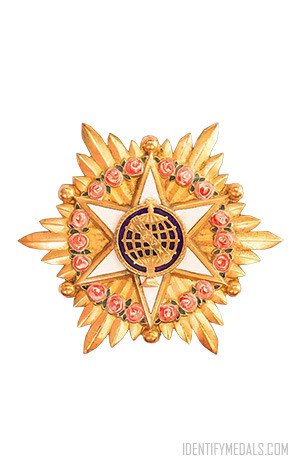
The Order of Merit’s insignia is a gold star with six beams, enameled in white with a wreath of roses. On the obverse, the center is an armillary sphere, also made of gold, in a blue field. The reverse reads the caption: “National Order of Merit“.

The design was inspired by the Imperial Order of the Rose, created by Jean-Baptiste Debret in 1829.

The necklace is made of two chains alternately ornamented with allegorical armillary and pink spheres. 

The Order of the Lion (France)

The Order of the Lion was an Order of Knighthood established by Enguerrand I of Coucy, to immortalize his killing of one such dangerous animal.

The Order of the Lion was an Order of Knighthood established by Enguerrand I of Coucy (some sources say it was actually his son Enguerrand II who created it) to immortalize his killing of one such dangerous animal.

Enguerrand I was the Lord of Coucy from 1086 until 1116 when he died. He was a man of ‘many scandals,’ including adultery and divorce. He’s also said to have kidnapped Sibyl of Château-Porcien, wife of Godfrey I, Count of Namur.

This Order of Knighthood was described by Gustav Adolph Ackermann, who mentions it as part of the historical orders of France.

The Order of the Rooster and the Dog

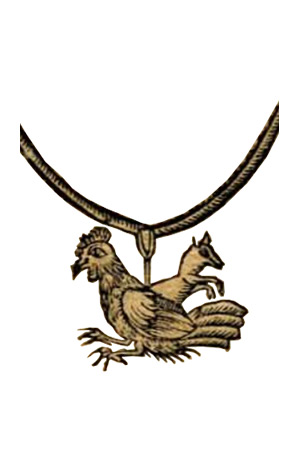
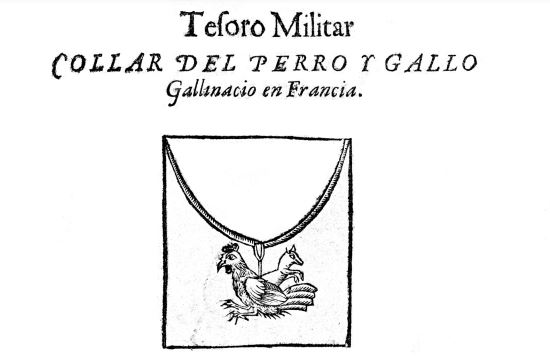
The Order of the Rooster and the Dog is an order of legendary origins in France. It’s not clear whether it actually existed or not.

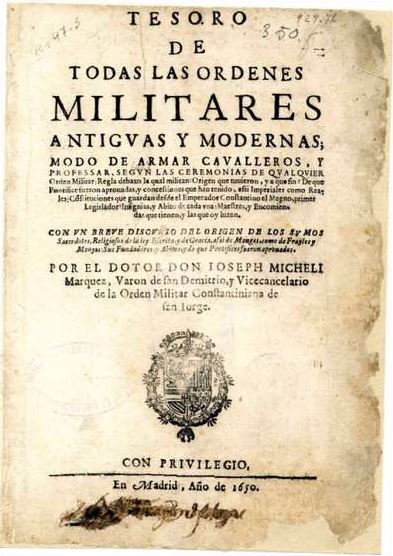
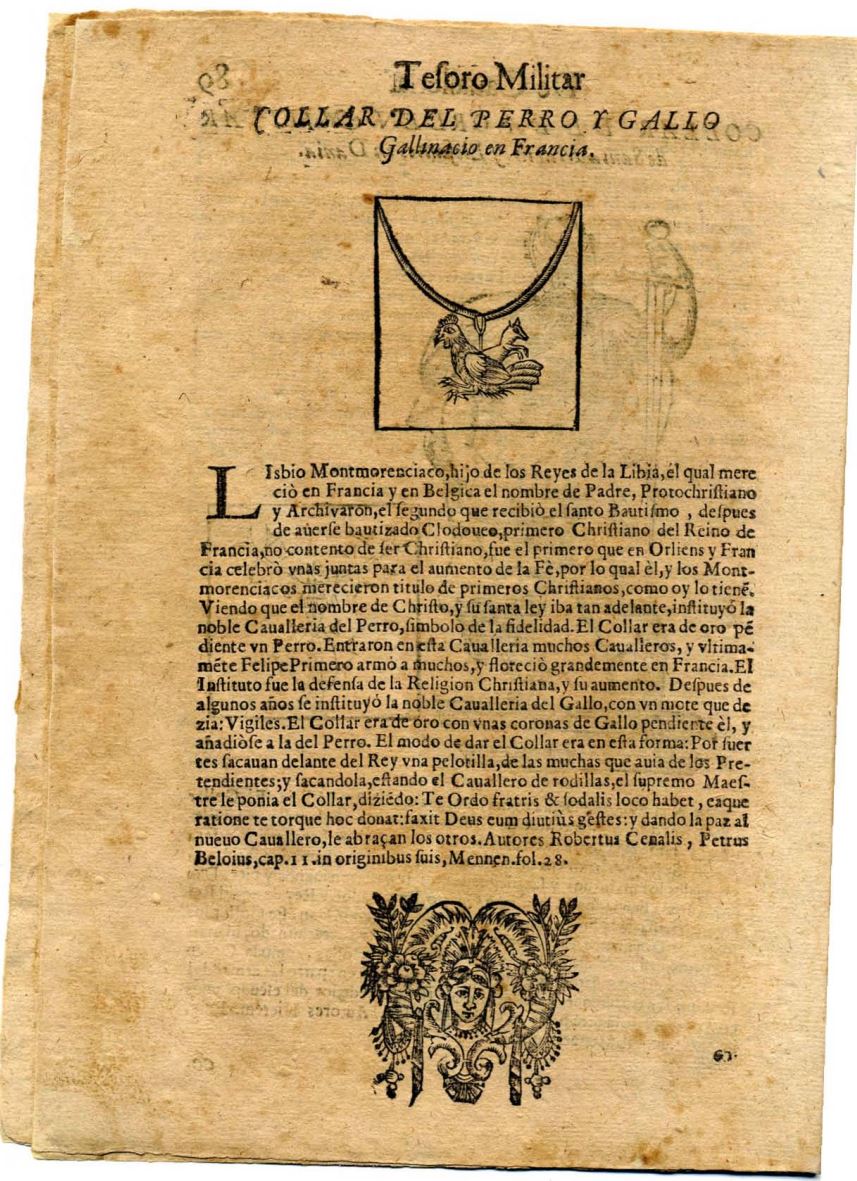
The Order is mentioned in the book “Tesoro de todas las ordenes militares antiguas y modernas” (Treasures of all Old and Modern Military Orders), published in 1650 and held by the Pitts Theology Library. You can see this book at Europeana and the Biblioteca Virtual de Defensa.

This is a description I translated from the original book:

“Lisbio Montmorenciaco, son of the Kings of Libya, who was called after his father in France and Belgium, baptized Clodoueo, first Christian in the Kingdom of Orliens and France (…) he was the first to celebrate in Orleans and France mass?. Seeing how the name of Christ and his holy faith were ahead, he instituted the noble “Cavalleria del Perro” (Knighthood of the Dog) as a symbol of fidelity. The collar was solid gold, and the pendant had a dog. Many knights were part of it, and ultimately Philip I armed many, and [the order] flowered in France. After some years, they instituted the Noble Knighthood of the Rooster, which had a gold necklace, and added the dog.”

Original source:

The Hero of Ukraine Medal

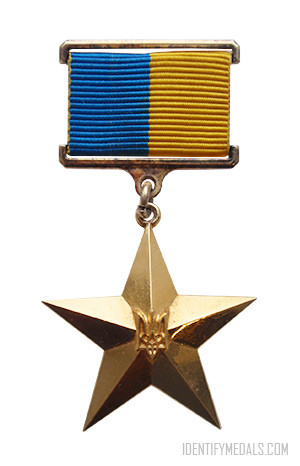
The Hero of Ukraine Medal (Герой України) is the highest national title conferred upon an individual citizen by the President of Ukraine.

  • Time Period: Post-WW2
  • Year of Institution: 26 November 1998
  • Country: Ukraine

The Hero of Ukraine Medal (Герой України) is the highest national title conferred upon an individual citizen by the President of Ukraine. The award was created in 1998 by President Leonid Kuchma.

The title is granted to two different order recipients: the civilian Order of the State, and the military Order of the Gold Star. These are the highest national award to citizens for accomplishing a remarkable work achievement and for accomplishing a remarkable heroic act.

The “Hero of Ukraine” medal can be traced to the Soviet medals Hero of the Soviet Union (established 16 April 1934) and the Hero of Socialist Labor (established 27 December 1938), which were the highest decorations in the Soviet Union. After the dissolution of the Soviet Union in 1991, similar awards were created in the resulting independent countries, including Ukraine

The Hero of Ukraine Medal Design

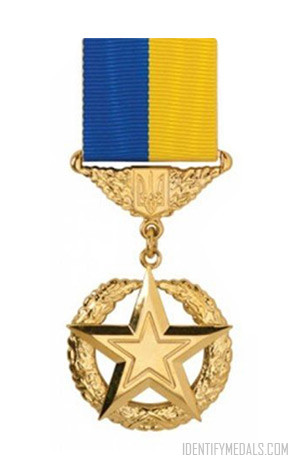
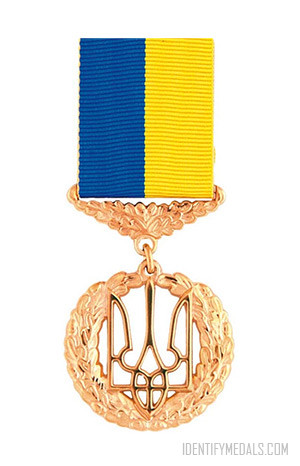
Two medals were created by Ukrainian law to differentiate between the titles. Both medals have a ribbon measuring 45 mm (1.8 in) long and 28 mm (1.1 in) wide, divided equally into two bands (a blue band on the left and a yellow band on the right, matching the colors of the Ukrainian flag). 

The Order of State and Order of Gold Star are as follows:

Order of Gold Star - Ukrainian Medals
Ukrainian Medals - Order of State

The New York City Police Department Medal of Valor

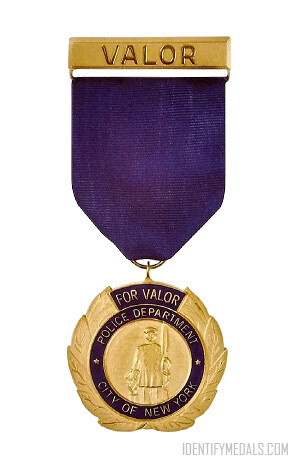
The New York City Police Department Medal of Valor is the department’s third highest medal, conferred for acts of outstanding bravery.

The New York City Police Department Medal of Valor is the department’s third highest medal, conferred for acts of outstanding personal bravery intelligently performed in the line of duty at imminent personal hazard to life under circumstances evincing a disregard of personal consequences.

Mayor Michael Bloomberg and NYPD Police Commissioner Raymond Kelly awarded the first 13 Medals for Valor at the 2006 Medal Day Ceremony in New York.

The NYPD Medal of Valor Design

The obverse of the medal bears the image of the Police Memorial Statue, representing the years of selfless service that New York City police officers have given to its citizens. Surrounding the center is a Mediterranean evergreen laurel leaves, representing honor and glory dating back to ancient Rome. The outer background and ribbon are police blue. The words “For Valor, Police Department City of New York” are written on the face of the medal in gold lettering. The two gold stars signify the level of importance associated with this recognition. The reverse bears the inscription of the recipient’s name.

The breast bar is a solid blue bar.

More New York City Police Department Medals

NYPD medals are awards presented by the New York City Police Department to recognize and honor the bravery, service, and exceptional achievements of its officers. These medals serve as symbols of honor and pride within the NYPD, highlighting the commitment and sacrifice of its members in safeguarding the communities they serve. 

The New York City Police Department Medal of Honor

The New York City Police Department Medal of Honor is the highest law enforcement medal of the NYPD and awarded for extraordinary bravery.

The New York City Police Department Medal of Honor is the highest law enforcement medal of the NYCPD and awarded for individual acts of extraordinary bravery performed in the line of duty at extreme risk and danger to life.

The NYPD Medal of Honor was created on October 23, 1973, although there are some earlier versions from as early as 1871. Back then, the decoration was known by a variety of names such as the “Police Silver Medal” and “Gold Medal of Valor“. These were first awarded on August 17, 1871 to Patrolman Bernard Tull of the 19th Precinct who arrested a burglar after being shot at. 

The New York City Police Department Medal of Honor was created in 1912 and was awarded until 1972, when it was redesigned.

The NYPD Medal of Honor Design

The initial medals were silver or gold and had the shape of the then shield of the department. On the obverse were the arms of the City of New York, the names of the police commissioners, and the words “Municipal Police”. On the reverse was an inscription describing the act for which the medal was awarded.

Later, the NYPD medal was changed to a silver medal in the shape of a police shield. On the obverse is the figure of a draped female placing a wreath upon the head of a police officer. On the reverse is an inscription of the act of bravery and the names of the city’s commissioners.

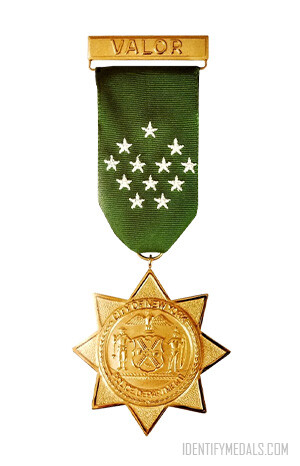
The medal hangs from a ring and suspender on which the letters “NY” are interlocked and attached to a top bar that is inscribed with the word “valor”.

The stars on the green ribbon commemorate the city’s original 12 police constables, who began to patrol in the 1700s.

More New York City Police Department Medals

NYPD medals are awards presented by the New York City Police Department to recognize and honor the bravery, service, and exceptional achievements of its officers. These medals serve as symbols of honor and pride within the NYPD, highlighting the commitment and sacrifice of its members in safeguarding the communities they serve.