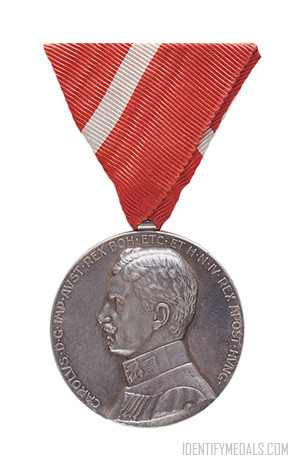
The Civil Merit Medal (Austria-Hungary)

The Civil Merit Medal (Austria-Hungary) is a medal established by Emperor Karl I in 1918 to recognize extraordinary service in war or peace.

The Civil Merit Medal is an Austro-Hungarian medal established by Emperor Karl I in 1918 to recognize extraordinary service in time of war or outstanding service in peace time by civil servants of all ranks or other civilians in support of the empire or the emperor. The medal could be awarded retroactively.

There are two classes of this award:

  • Gold Civil Merit Medal
  • Silver Civil Merit Medal

The Civil Merit Medal Design

The medal is round with an attached wedge shaped suspension eye. It measures 42 mm in diameter and is struck in silver gilt bronze and gold gilt bronze.

The obverse features the image of Emperor Karl in a Field Marshal’s uniform with decorations facing to the viewers left. Surrounding the image is the inscription: “CAROLVS D G IMP AVST RX BOH ETC ET H N IV APOST HVNG”. The reverse is a laurel on the left and an oak bough on the right within which is the inscription “SIGNVM LAVDIS” (“A token of esteem”) in two lines.

The ribbon is red with a white center stripe and measures 38-40 mm wide.
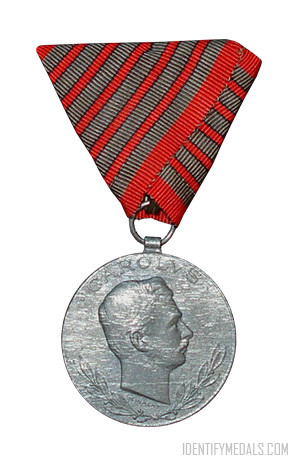
The Wound Medal (Austria-Hungary)

The Wound Medal (Austria-Hungary) a decoration of the Empire of Austria-Hungary established on August 12, 1917 by Emperor Karl I.

The Wound Medal is a decoration of the Empire of Austria-Hungary established on August 12, 1917 by Emperor Karl I.

The medal was awarded to service members of the Austro-Hungarian armed forces and to persons attached to the Austro-Hungarian armed forces who were wounded as a result of combat operations. It could also be awarded to persons who were disabled or suffered serious damage to their health in connection with military actions.

The Wound Medal Design

The Wound Medal is made of zinc and measures 38-mm in diameter. There are variations with both a dull gray and with a polished surface.

The obverse features a bust of Emperor Karl with his name in Latin “CAROLUS” above and a wreath of laurels below. Between the bust and the laurels in smaller letters was the name of the designer of the medal, R.(Richard) PLACHT, 1880 Kratzau – 1962 Vienna. The reverse featured the words LAESO MILITI (“to the wounded soldier”) and the date in Roman numerals “MCMXVIII” (1918).

The medal is suspended from an Austrian-style trifold ribbon, 39-mm in width, gray-green with 4-mm wide red edge stripes. The number of wounds was indicated by narrower 2-mm wide red stripes, edged in black, centered on the ribbon. No stripes indicated an award for someone invalided out of service. One stripe indicated a single wound, two stripes two wounds, etc.

The Karl Troop Cross

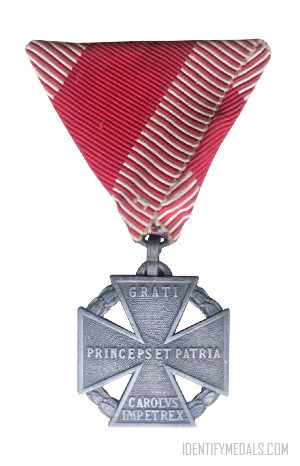
The Karl Troop Cross is a medal of Austria-Hungary created on 13 December 1916 and awarded for service up to the end of the First World War.

The Karl Troop Cross (or Karl-Truppenkreuz in German) is an Austro-Hungarian medal instituted on 13 December 1916 by Emperor Karl I.

The medal was awarded for service up to the end of the First World War to soldiers and sailors of all arms of the Austro-Hungarian armed forces, regardless of rank, who had been with a combatant unit for at least twelve weeks and who had participated in at least one battle. Members of the air service who made ten flights over enemy lines were also eligible.

The Karl Troop Cross Design

The medal is cross pattée resting on a laurel wreath made of zinc.

The obverse shows the Latin inscription “GRATI PRINCEPS ET PATRIA, CAROLVS IMP.ET REX“, (A grateful prince and country, Karl, Emperor and King). The reverse bears the Austrian Imperial and Hungarian Royal crowns above the letter “C” (for Carolus) with the inscription “VITAM ET SANGVINEM“, (“With life and blood“) and the date MDCCCCXVI, (1916).

The cross was worn on the left chest from a red ribbon with alternate red-white side strips towards each edge.

The Mobilization Cross 1912/13

The Mobilization Cross 1912/13 was awarded to military personnel who served with a mobilized unit in response to the Balkan crisis.

The Mobilization Cross 1912/13 was founded on 9 July 1913 by Emperor Franz Joseph I of Austria-Hungary and was awarded to all military personnel who served at least four weeks with a mobilized unit in response to the Balkan crisis in late September 1912.

Austro-Hungarian forces that had been mobilized as a precautionary measure during the Balkan Wars between an alliance of Bulgaria, Greece, Montenegro, and Serbia on the one hand and Ottoman Turkey on the other. Austria did not intervene in the wars but they led to Turkey being largely thrown out of Europe and a much-strengthened of Serbia, making Austria more nervous of her Slav neighbor and laying the ground for the outbreak of World War I.

The Mobilization Cross 1912/13 Design

The medal is a gilt Leopold cross, the ends of which are slightly curved inwards, with an eyelet and loop for ribbon suspension.

The obverse shows a circular central medallion bearing the dates ‘1912 1913’ in two lines. The reverse is plain.

The ribbon is yellow with two black stripes on the edges.

The Military Merit Medal (Austria-Hungary)

The Military Merit Medal is a military decoration of the Empire of Austria-Hungary only awarded to officers and officials of similar rank.

The Military Merit Medal (or Militär-Verdienstmedaille in German) is a military decoration of the Empire of Austria-Hungary founded by Emperor Franz Joseph I on March 12, 1890 and only awarded to officers and officials of similar rank.

The Military Merit Medal is often referred to as the “Signum Laudis” (Latin for “Sign of Praise”) after the inscription on the reverse of the medal. It was awarded in peacetime for meritorious service and in wartime for outstanding acts, including bravery or military merit.

The medal originally came in one class, a gilt bronze version, and repeat awards were not authorized. On March 26, 1911, a Silver Military Merit Medal was founded, intended to reward those who would have earned a second award of the Military Merit Medal. It too could be awarded on either of the two ribbons. On December 13, 1916, the addition of a pair of gilt-crossed swords on the ribbon was authorized to recognize a higher grade of wartime merit.

The Military Merit Medal became obsolete with the fall of the Austro-Hungarian monarchy in November 1918.

The Military Merit Medal Design

The medal is circular and struck in bronze, silver, or gold.

The obverse shows the bust of the reigning emperor. The reverse bears the words “SIGNUM LAUDIS” (Latin for “Sign of Praise“) surrounded by a wreath, half-laurels and half-oak leaves. The Medal is surmounted by a crown (dual crowns for the Karl I type) and worn from a tri-fold ribbon.

The peacetime awards were on the statute ribbon, a red ribbon, while wartime awards were on the ribbon of the Bravery Medal, a “laddered” pattern of red stripes edged in white and with white between the “rungs”.

The Civilian Wartime Merit Cross

The War Cross for Civil Merits is a civil award of Austria-Hungary awarded in recognition of civilian war service during World War I.

The War Cross for Civil Merits (or Kriegskreuz für Zivilverdienste in German) is a civil award of Austria-Hungary established on 16 August 1915 by Emperor Franz Joseph I of Austria to recognized civilian war service during World War I.

The cross could also be awarded to military officers for their contributions to the war when they were not directly involved in combat operations – for example when they had shown outstanding zeal and willingness to make sacrifices, and have given special support to the Austro-Hungarian government.

The Civilian Wartime Merit Cross Design

The medal has the shape of a Cross pattée and measures 55 mm high and 55 mm across. The first and second Class crosses are gilded, the third class is silver, and the fourth class is bronze. The first through third classes had white enamel on the arms of the cross.

The obverse shows a laurel wreath surrounding the center medallion, passing under the horizontal arms of the cross, and in front of the vertical arms. The center medallion, also enameled white, bears the Emperor’s monogram FJI (Franz Joseph Imperator), surrounding the letters is the inscription “Merito Civili tempore belli MCMXV” (or “Civil merit in time of war 1915“).

The cross was worn as a breast cross directly on the coat or uniform.

The Merit Cross for Military Chaplains

The Merit Cross for Military Chaplains was awarded to military chaplains for outstanding acts in wartime and meritorious service in peacetime.

The Merit Cross for Military Chaplains was instituted on 23 November 1801 and awarded to military chaplains for outstanding acts in wartime and for meritorious service in peacetime.

The cross was awarded in two classes:

  • Gold
  • Silver

The Merit Cross for Military Chaplains Design

The medal is a Latin cross struck in gold or silver and decorated with enamels. It measures 51.75 mm (w) x 63.22 mm (h) and weighs 22.1 grams.

The obverse and reverse have a central blue enameled medallion with the inscription “PIIS MERITIS”.

The ribbon is a red and white striped triangle for wartime merits and white for peacetime merits. The suspension is a loop. From 13 December 1916, the award for brave and successful conduct was awarded with swords on the ribbon.

The Austrian Decoration for Services to the Red Cross

The Decoration for Services to the Red Cross was an award instituted in 1914 to mark the 50th anniversary of the Geneva Convention.

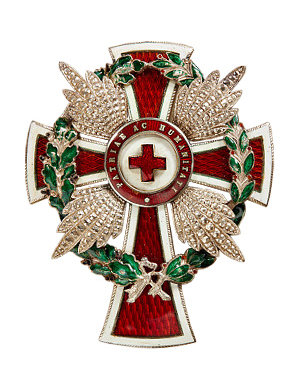
The Decoration for Services to the Red Cross (or Ehrenzeichen für Verdienste um das Rote Kreuz in German) was an Austro-Hungarian award instituted on 17 August 1914 by Emperor Franz Josef I to mark the 50th anniversary of the Geneva Convention.

The award was intended to honor individuals who had worked in the voluntary emergency services of the Red Cross, either in peacetime or in war. The Austrian Red Cross was founded in 1864 and the merit awards were created to mark the 50th anniversary.

The order consists of four classes, as well as an associated medal in two classes:

  • 1st: Star
  • 2nd: Merit Cross, 1st class
  • 3rd: Officer’s Cross
  • 4th: Merit Cross, 2nd class
  • Silver Medal
  • Bronze Medal

Awards for military services were augmented with a war decoration for the ceremony.

The Austrian Decoration for Services to the Red Cross Design

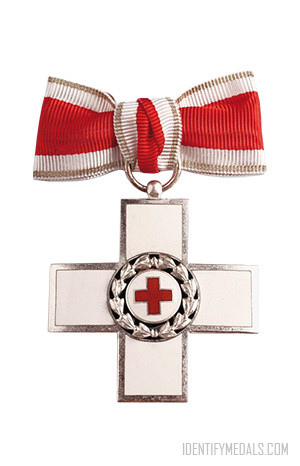
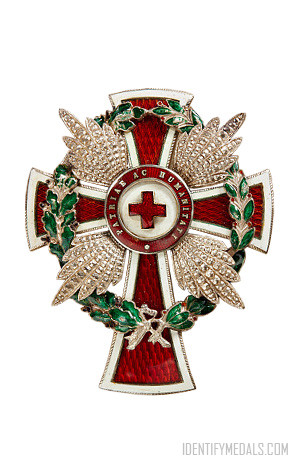
The medal is a silver-edged white enamel cross with silver-edged red enamel inset panels.

The obverse has a central circular white enamel medallion bearing a red enamel Greek (Geneva) encircled by a red enamel ring bearing the inscription in gilt letters ‘PATRIAE AC HUMANITATI’ (“Fatherland and Humanity“), and a green and red enamel wreath imposed indicating a wartime award.

The reverse bears a central circular white enamel medallion bearing the dates in silver ‘1864’ and ‘1914’.

The suspension ring is usually hallmarked and with the maker’s mark. The ribbon is white with red diagonal stripes.

Find Red Cross Medals Online

More Red Cross Medals

The Medal for Bravery (Austria)

The Medal for Bravery (or Tapferkeitsmedaille in German) was a military decoration of Austria-Hungary established in 1789.

Institution: 19 July 1789
 

The Medal for Bravery (or Tapferkeitsmedaille in German) was a military decoration of Austria-Hungary established in 1789 and awarded for bravery in battle until the dissolution of the Austro-Hungarian Empire in 1918.

The medal was created by Emperor Joseph II on 19 July 1789 in order to recognize courage in combat by personnel below commissioned rank. From 1789 to 1915, the Medal for Bravery existed in three classes:

  • Golden Medal for Bravery,
  • Silver Medal for Bravery 1st Class,
  • Silver Medal for Bravery 2nd Class.

A fourth class, the Bronze Medal for Bravery, was introduced on 14 February 1915 during World War I. It was the same size as the Silver Medal 2nd Class. Bars denoting subsequent awards within the same class were introduced on 29 November 1915.

On 26 September 1917, Emperor Charles I amended the statutes of the Medal for Bravery and decreed that the Golden Medal for Bravery and the Silver Medal for Bravery 1st Class could now also be awarded to commissioned officers, particularly in cases where their services were not sufficient for the Military Order of Maria Theresa.

After World War I and the dissolution of Austria-Hungary, the newly established Kingdom of Hungary instituted in 1922 the Medal of Bravery in silver only. By 14 April 1939, gold, large silver, small silver and bronze awards were issued to non-commissioned officers and men and, on 12 September 1942, the gold medal for bravery award for officers was added.

The Medal for Bravery Design

All versions of the Medal for Bravery bear, on the obverse, the portrait of the reigning monarch on the obverse and the inscription “Der Tapferkeit” (“To Bravery“) on the reverse.

Medals awarded during World War I were minted with the portrait of Emperor Franz Josef on the obverse until some months after his death. Starting in April 1917, the visage of his successor, Emperor Charles I, was substituted.

Commissioned officers after WW1 wore the same medals as the ranks, plus the letter “K” (in gold or silver, depending on the class of the award) superimposed on the triangular ribbon.

The Imperial Order of Elizabeth (Austria)

The Imperial Austrian Order of Elizabeth was an order created for women in 1898 by Francis Joseph, Emperor of Austria and King of Hungary.

The Imperial Austrian Order of Elizabeth (or Kaiserlich österreichischer Elizabeth-Orden in German) was an order created for women in 1898 by Francis Joseph, Emperor of Austria and King of Hungary.

The order was the namesake of Saint Elisabeth of Hungary, but it was created to honor and memorialize Franz Joseph’s late wife, Empress-Queen Elisabeth. She spent her life giving alms to the poor and sick. After her husband’s death, she gave away the vast majority of his estate to build hospitals and to aid in the relief of her starving subjects and was canonized by Pope Gregory IX in 1235. She is considered the patron saint of bakers, beggars, and charities.

The insignia of the order was to be returned to the state upon the death of the member, or upon the advancement from a lower degree to a higher degree.

The order was divided into three classes:

  • Grand Cross.
  • First Class.
  • Second class.

There were 81 awards of the Grand Cross, 332 awards of the I Degree, 500 awards of the II Degree, and 208 awards of the Elizabeth Medal for merit, between 1898 and 1918 when the Order was disbanded with the collapse of the monarchy.

An Elizabeth Medal for civil merit also existed.

The Order only existed until the end of the monarchy in 1918.

The Order of Elizabeth Design

The order’s badge is a silver Latin cross consisting of red and white enamels, with roses between the arms of the cross. The obverse bears a central white enameled medallion with a rightward facing bust of Elisabeth in gold. The reverse has a central white enameled medallion with a golden royal cipher of Elisabeth and fine hand-engraved detailing.

The ribbon is white and pink and measures 48.57 mm side by 52.40 mm high.