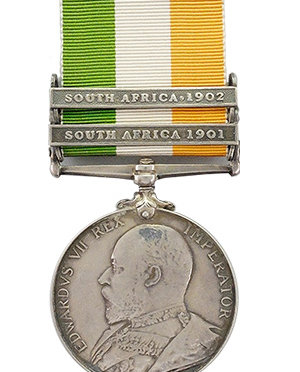
The King’s South Africa Medal

The King’s South Africa Medal is a British campaign medal awarded to all British and Colonial military personnel who served in the Second Boer War in South Africa, who were in the theatre on or after 1 January 1902 and who had completed 18 months service in the conflict prior to 1 June 1902.

Poor logistics, long logistics lines, disease and having to fight against a disciplined and capable enemy of excellent horsemen and marksmen made this a hard-won medal. Men often having had to go without basics such as food and water, enteric fever killed several thousand and was a constant drain on manpower. Published casualty rolls run to over 50,000 names, while contemporary studies put the actual figure for all casualties at 97,000. The King’s South Africa Medal was awarded only to those troops who fought in 1902, and who had served for 18 months.

Two date clasps were awarded for service in 1901 and 1902, but nurses did not qualify to receive either clasp.

The King’s South Africa Medal Design

The King’s South Africa Medal is struck in silver and measures 38 millimetres (1.5 inches) in diameter and 3 millimetres (0.12 inches) thick.

The obverse displays King Edward VII, in Field Marshal’s uniform and facing left, with the legend “EDWARDVS VII REX IMPERATOR” around the upper perimeter. The reverse shows Britannia holding the Union Flag in her left hand and a laurel wreath in her right hand. In the right background are troops marching inland from the coast. In the left background are two men-of-war, with Neptune’s Trident and Britannia’s shield on the ground in the foreground. Around the top perimeter are the words “SOUTH AFRICA”.

The clasps were attached to the suspender and to each other in roller chain fashion with rivets. The ribbon measures 32 millimetres wide, with an 11 millimetres wide green band, a 10 millimetres wide white band and an 11 millimetres wide orange band.
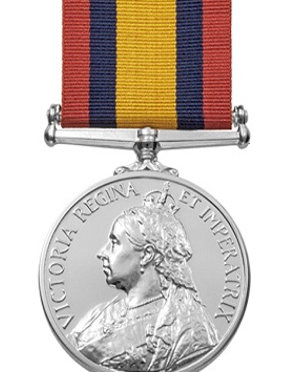
The Queen’s Mediterranean Medal

The Queen’s Mediterranean Medal was awarded to troops who had replaced their regular Army counterparts in garrisons across the Mediterranean.

The Queen’s Mediterranean Medal was awarded to Militia troops who had replaced their regular Army counterparts in the various military garrisons across the Mediterranean, in Gibraltar, Malta and Egypt. The medal was authorized by King Edward VII and This allowed regular troops to be available for the Second Boer War.

Troops on the island of St. Helena who were guarding Boer prisoners of war in the POW camp were awarded the Queen’s South Africa Medal without clasp.

The Queen’s Mediterranean Medal Design

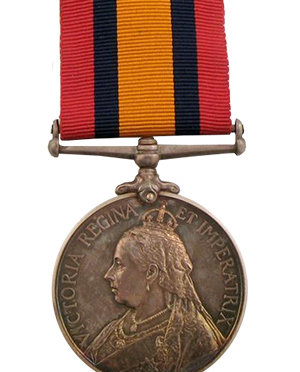
The Queen’s Mediterranean Medal and ribbon are identical to the Queen’s South Africa Medal 1899-1902, except the inscription ‘SOUTH AFRICA’ has been replaced by the word ‘MEDITERRANEAN’ on the reverse of the medal.

No clasps were awarded with this medal.

The Queen’s South Africa Medal

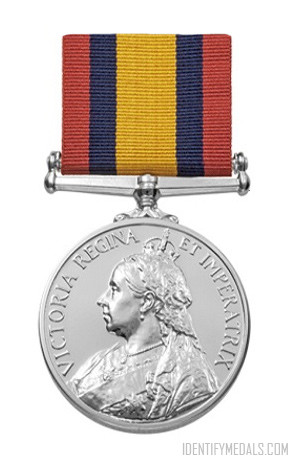
The Queen’s South Africa Medal is a military decoration established in 1900 and presented to military personnel in the Boer War.

The Queen’s South Africa Medal is a military decoration of South Africa that was established in 1900. It was first presented to military personnel who fought in the Boer War from the 11th of October 1899 to 31st May 1902 and awarded to the British forces, the Royal Navy, the colonial forces; mainly from Canada, Australia, India, New Zealand, South Africa and civilians employed in official positions by the military.

The medal (without bar) was also presented to soldiers who guarded the prisoners captured in the Boer War at POW camp in St Helena. Those in the Mediterranean islands received the Queen’s Mediterranean Medal, and some troops on the ships received the Transport Medal.

Establishment:

The QSA was instituted by Queen Victoria in 1900 to honor soldiers and civilians who served in South Africa’s Boer War.

There are three known versions of the medal. Since it was expected the war would only last a short duration and conclude by 1900, the original medals were struck years 1899 to 1900 on the back.

Fifty medals were presented before it became apparent the war was not going to end any time soon. And so the remaining medals had the impressed years scrapped off. The third version of the QSA medal didn’t have the labeling of the years.

The soldiers who received this medal deserved it because they faced difficulties during the war. For instance, they fought against an enemy who was well prepared in terms of marksmanship and movement. The enemy was good at navigation and used horses to move around.

These combatants survived devoid of the basic necessities like food and water, while thousands perished from enteric fever. Casualties reached 50,000 during the war, but recent studies put the number at approximately 97,000.

A majority of those who were awarded this medal took part in the scorched earth policy during the last stage of the war that lasted twenty months. They adopted this strategy when it became clear the conventional way of fighting the enemy wasn’t working.

The Queen’s South Africa Medal Design

The QSA medal is made of silver and is about 1.5 inches in diameter. But there were versions made of bronze, which were issued to Indian non-combatants and other non-combatant groups who were in the military payroll. The silver medal was mainly awarded to the native soldiers.

Forward-face:

The front part shows a crowned and disguised model of Queen Victoria, facing the left.

Back side:

The back side was designed by G.W. de Saulles. It shows Britannia clutching at the Union Flag in the left hand and a laurel wreath on the right. In the background, soldiers can be seen marching from the coat towards the inland.

Towards the background in the left, you’ll notice two men-of-war and Britannia’s shield and Neptune’s Trident on the ground. In the top perimeter the words ‘South Africa’ is engraved.

Three versions of the back side exist;

  1. The first version is dated 1899 and 1900, with the wreath close to touching the letter ‘R’ in Africa.
  2. The years were later scrapped off both the dies and the remaining medals were still somehow visible.
  3. Minting was subsequently done with new dies, without the years and the wreath almost touching letter ‘F’ of AFRICA. This is the reverse adopted for the King’s South Africa Medal.

The Ribbons:

The Queens South Africa Medal is worn from its specific ribbon, which was first made from silk but after the 19th-century advancements, changed to cotton.

Furthermore, their colors are symbolic; the equal stripes of 1939 -1945 star are dark blue, signifying the service of the Merchant and Royal Navies, whereas red is for the Armies, and light blue for the Air Force.

The ribbon’s width varies but in general, it’s about 32mm wide. It has five stripes, each around 5 mm wide; red, dark blue, orange at the center, blue and red.

Eligibility:

Recipients of this medal are those who served from 11th October 1899 to 31st May 1902, after the British declared war against the German Empire and the armistice of 11th November 1918. Furthermore, this award was issued to the recipients of the 1914 0r 1914-15 star or those who received the British War Medal.

Clasps:

Also known as bars, clasps are common but not restricted. They are single-faced bars carried on ribbons and attached to the medal. They signify the service during particular battles.

They also have side flanges which makes it easy to attach to the medal and is riveted together to allow a new one to be added as earned.

Typically, the first clasp earned should be attached near the medal, whereas the last one earned attached at the top, but people wear them in the wrong order.

Naming:

The recipient’s details were impressed on the medal’s rim, and some officer’s medals had their details engraved.

Since its institution the Queen’s South Africa model has been awarded to more than 178,000 individuals.

More Union of South Africa Medals

The Transport Medal

The Transport Medal was a campaign medal awarded by the Lord Commissioners of the Admiralty to masters and officers of merchant ships.

Time Period: Pre-WW1
Year of Institution: 8 November 1903
Country: Great Britain

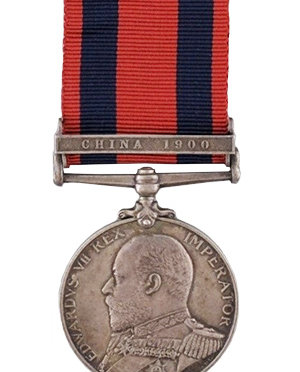
The Transport Medal was a British campaign medal awarded by the Lord Commissioners of the Admiralty to masters and officers of merchant ships employed by the Transport Service to move troops to either South Africa during the South African War or to China during the Boxer Rebellion.  The Transport Medal was created on 8 November 1903 and officers of hospital ships used in the campaigns also qualified.

It was intended that the medal would be awarded for future conflicts, but was not awarded again after the South Africa and China wars.

The Transport Medal Design

The obverse of the medal bears the head of King Edward VII in Royal Navy uniform, with the inscription EDWARDVS VII REX IMPERATOR. The reverse depicts HMS Ophir beneath a map of the world with, below, the words in Latin OB PATRIAM MILITIBUS PER MARE TRANSVECTIS ADJUTAM which translates as for services rendered in transporting troops by sea.

Two clasps were awarded: S.AFRICA 1899–1902 (for services related to the South African War) and CHINA 1900 (for services related to the Boxer Rebellion).

A total of 1,719 medals were awarded, 1,219 with the ‘S. Africa 1899-1902’ clasp, 322 with the ‘China 1900’ clasp and 178 with both clasps.

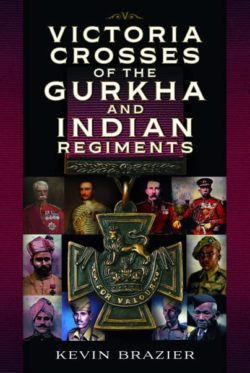
The Victoria Cross

The Victoria Cross (VC) is the highest United Kingdom honors system award. It is given for gallantry in the presence of the enemy.

The Victoria Cross (VC) is the highest award of the United Kingdom honors system. It is awarded for gallantry “in the presence of the enemy” to members of the British armed forces, and it can be awarded posthumously.

Since the first awards were presented by Queen Victoria in 1857, two-thirds of all awards have been personally presented by the British monarch, usually at Buckingham Palace. Before the Crimean War (when it was introduced), there was no official standardized system for recognition of gallantry within the British armed forces.

A single company of jewelers, Hancocks of London, has been responsible for the production of every VC awarded since its inception. 

Since its establishment, the Victoria Cross has been awarded approximately 1,360 times to individuals or groups of recipients. The medal has been awarded for actions in various conflicts and wars, including World War I, World War II, and more recent conflicts. Recipients come from a diverse range of military backgrounds and countries within the Commonwealth. A total of 1,358 Victoria Crosses have been awarded since 1856 to 1,355 men.

The History of the Victoria Cross

The Victoria Cross was established on January 29, 1856, during the reign of Queen Victoria.

It was introduced by a Royal Warrant to recognize acts of valor by members of the British military during the Crimean War (1854-1856). The VC was intended to honor acts of bravery and self-sacrifice in the face of the enemy.

Eligibility of the Victoria Cross

The Victoria Cross is awarded for most conspicuous bravery or acts of valor in the presence of the enemy. It can be awarded to members of the British armed forces, including the Army, Navy, and Air Force, as well as to civilians serving with military forces.

The VC is a rare and prestigious award, with recipients demonstrating exceptional courage and selflessness in combat.

The Victoria Cross Design

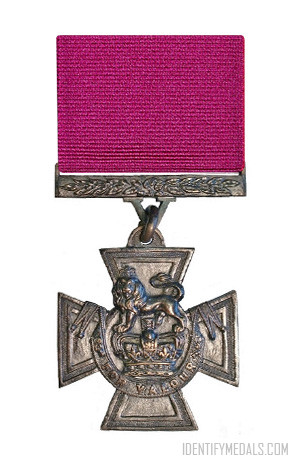
The Victoria Cross is a bronze straight-armed cross pattee measuring 38 mm across, with raised edges.

On the obverse, it bears a lion guardant standing upon the Royal Crown, and below the Crown, a scroll bearing the inscription “PRO VALORE”. On the reverse is the date of the act for which the decoration is bestowed is engraved in a raised circle.

The Cross is suspended by means of a plain link from a V below a straight bar ornamented with laurel leaves.

The ribbon is crimson and measures 38 millimeters in width. 

Further Reading About the Victoria Cross

Products Inspired by the Victoria Cross

Right Now on eBay 
Clicking a link to eBay may result in a referral commission being paid if a purchase is made.
Loading...