The Royal Order of Saint George (Immaculate Conception)

The Royal Military Order of Saint George for the Defense of the Faith and the Immaculate Conception was founded by Maximilian II Emanuel.

The Royal Military Order of Saint George for the Defense of the Faith and the Immaculate Conception (also known as the Royal Bavarian House Equestrian Order of Saint George, Königlich Bayerischer Haus-Ritter-Orden vom Heiligen Georg in German) was founded by Maximilian II Emanuel, Elector of Bavaria around 1726 to honor the nobility and recognize distinguished civil and military service.

Its status as a Catholic Order was confirmed in a Papal Bull of 15 March 1728 – specifically comparing the Order with the Teutonic Order, which had likewise been transformed from a Crusading Order to an exclusive chivalric religious institution for the Nobility.

Various Bavarian Princes who in the fifteenth century had made pilgrimages to the Holy Sepulcher and were there invested as knights had each made a promise to Saint George, the patron saint of chivalry. Maximilian’s son, the Elector Karl-Albrecht, gave the new Order its title of Order of the Holy Knight and Martyr Saint George and the Immaculate Conception of the Holy Virgin Mary and established its statutes on March 28, 1729 as a Military Order of Chivalry for Roman Catholic noblemen.

The Royal Order of Saint George Design

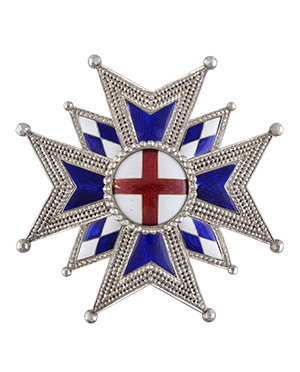
The badge of the Order is a blue enameled gold Maltese cross with white enameled borders and small gold balls on the points. There are blue diagonal lozenges (each bearing a gold letter, V. I. B. I., representing the words Virgini Immaculatae Bavaria Immaculata) between the arms also with white enameled borders.

The round gold medallion in the center obverse has the image of the Virgin Mary within a white enameled border. The reverse of the badge has the same design except that the arms of the cross are enameled red and the blue lozenges bear the letters I. V. P. F. (Justis Vt Palma Fiorebit or “Distinguished for Justice and Glory”). The center gold medallion is of Saint George slaying the Dragon within a green enameled laurel wreath.

The badge hangs from a light blue silk moire ribbon with white stripes near its border with narrow dark blue stripes on the inside of these white stripes. It’s suspended by a gold lion’s head holding in its mouth a blue reverse crescent shaped handle of the gold and enamel strapwork supporting the badge proper.

The officials of the order wore a special heraldic cross, a Maltese cross like the former, but with its round central medallion bearing the red cross of St. George.

On formal occasions the badge is worn by the members of the first class of the order (i.e., Grand Master, Grand Priors and Grand Commanders) from a gold collar formed of links in the form of a gold rectangle with gold Bavarian royal crowns on the either side of this rectangle, or in the form of two gold lions rampart combatant standing on a gold scroll.
The House Order of Hohenzollern

The House Order of Hohenzollern is a dynastic order of knighthood of the House of Hohenzollern awarded to officers and civilians.

The House Order of Hohenzollern (or Hausorden von Hohenzollern or Hohenzollernscher Hausorden in German) is a dynastic order of knighthood of the House of Hohenzollern awarded to military commissioned officers and civilians of comparable status.

The House Order of Hohenzollern was instituted on December 5, 1841, by joint decree of Prince Konstantin of Hohenzollern-Hechingen and Prince Karl Anton of Hohenzollern-Sigmaringen. These two principalities in southern Germany were Catholic collateral lines of the House of Hohenzollern, cousins to the Protestant ruling house of Prussia. On August 23, 1851, after the two principalities had been annexed by Prussia, the order was adopted by the Prussian branch of the house.

Associated with the various versions of the order were crosses and medals which could be awarded to lower-ranking soldiers and civilians.

The Royal House Order of Hohenzollern came in the following classes:

  • Grand Commander (Großkomtur)
  • Commander (Komtur)
  • Knight (Ritter)
  • Member (Inhaber) – For soldiers who were not officers, as well as civilians.

The House Order of Hohenzollern Design

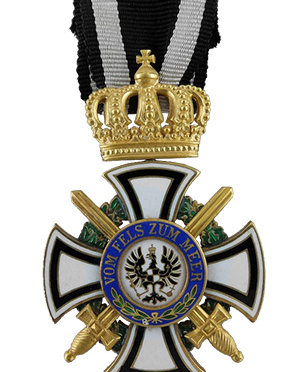
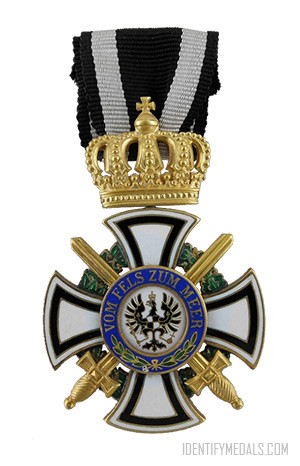
The badge is a cross pattée or “Alisee” cross with convex edges and curved arms. All versions of the badge feature white enamel on the higher classes and a black enameled stripe near the sides of the cross. Between the arms of the cross is a wreath of laurel leaves (left side) and oak leaves (right side).

The cross bears a center medallion with different coats of arms, mottos, dates and ciphers for each of the Royal, Princely and Romanian versions:

  • The white-enameled medallion bears a black Prussian royal eagle with the Hohenzollern house coat of arms on a shield on the eagle’s chest and a gold-rimmed band of blue enamel with the motto in gold letters: vom Fels zum Meer (“From the cliffs to the sea”) and a wreath of laurel below.
  • The white-enameled medallion of the Princely House Order of Hohenzollern bears the Hohenzollern coat of arms (a quartered shield of black and white) under a princely crown.
  • The white-enameled medallion of the Romanian House Order bore a black Romanian eagle with the Hohenzollern coat of arms on a shield on the eagle’s chest.

The ribbon of the order is white with three black stripes (with slight variations among the Royal, Princely and Romanian versions).

More Prussian Orders

Throughout Prussian history, these orders played a significant role in the social hierarchy and served as tangible expressions of royal favor and recognition. They continued to be awarded even after the dissolution of the Kingdom of Prussia, remaining as enduring symbols of valor, service, and honor in German society. Here are some more about Prussian Orders:

The Order of the Red Eagle

The Order of the Red Eagle (Roter Adlerorden) was an order of chivalry of the Kingdom of Prussia awarded to military personnel and civilians.

The Order of the Red Eagle (or Roter Adlerorden in German) is an order of chivalry of the Kingdom of Prussia awarded to both military personnel and civilians to recognize valor in combat, excellence in military leadership, long and faithful service to the kingdom, or other achievements.

The predecessor to the Order of the Red Eagle was founded on November 17, 1705, by the Margrave Georg Wilhelm of Brandenburg-Bayreuth as the Ordre de la Sincerité. It was revived in 1712 and again in 1734 in Brandenburg-Ansbach, where it first received the name of “Order of the Brandenburg Red Eagle”. The Kingdom of Prussia absorbed both Brandenburg-Bayreuth and Brandenburg-Ansbach in January 1792, and on June 12, 1792, King Frederick William II again revived the order as a Prussian royal order.

The Order of the Red Eagle could only be awarded to commissioned officers or civilians of approximately equivalent status. However, there was a medal of the order, which could be awarded to non-commissioned officers and enlisted men, lower ranking civil servants and other civilians.

The Order of the Red Eagle Design

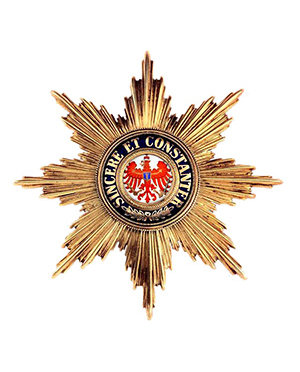
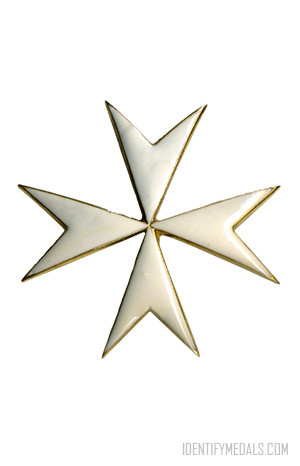
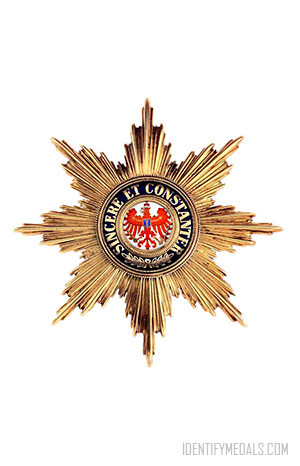
The badge is a gold (gilt after 1916) Maltese Cross enameled in white, with red enameled eagles between the arms of the cross. The central disc, in gold, bears the Royal monogram surrounded by a blue enameled ring bearing the motto of the Order, Sincere et Constanter.

The badge for the 1st to 3rd classes is a gold (gilt after 1916) cross pattée, enameled in white; that for the 4th class was similar but with smooth, plain silver arms. The enlisted man’s medal was of a relatively simple, round design, topped with the Prussian crown.

After September 16, 1848, awards of all classes (except the medal) bestowed for military merit had two golden swords crossed through the central medallion.

The traditional ribbon of the order was white with two orange stripes at the edges, but combat awards were frequently conferred with a black and white ribbon similar to that of the Iron Cross.

Find This Medal

Right Now on eBay 
Clicking a link to eBay may result in a referral commission being paid if a purchase is made.
Loading...

More Prussian Orders

Throughout Prussian history, these orders played a significant role in the social hierarchy and served as tangible expressions of royal favor and recognition. They continued to be awarded even after the dissolution of the Kingdom of Prussia, remaining as enduring symbols of valor, service, and honor in German society. Here are some more about Prussian Orders:

The Order of Saints Maurice and Lazarus

The Order of Saints Maurice and Lazarus is a Roman Catholic dynastic order of knighthood bestowed by the House of Savoy.

The Order of Saints Maurice and Lazarus (or Ordine dei Santi Maurizio e Lazzaro in Italian) is a Roman Catholic dynastic order of knighthood bestowed by the House of Savoy, founded in 1572 by Emmanuel Philibert, Duke of Savoy, through amalgamation approved by Pope Gregory XIII of the Order of Saint Maurice, founded in 1434, with the medieval Order of Saint Lazarus, founded circa 1119, considered its sole legitimate successor.

The order was formerly awarded by the Kingdom of Italy (1861–1946) with the heads of the House of Savoy as the Kings of Italy. Originally a chivalric order of noble nature, it was restricted to subjects of noble families with proofs of at least eight noble great-grandparents.

After the abolishment of the monarchy and the foundation of the Italian Republic in 1946, the legacy of the order is maintained by the pretenders of the House of Savoy and the Italian throne in exile.

The order is estimated to include about 2,000 members around the world.

The Order of Saints Maurice and Lazarus Medal Design

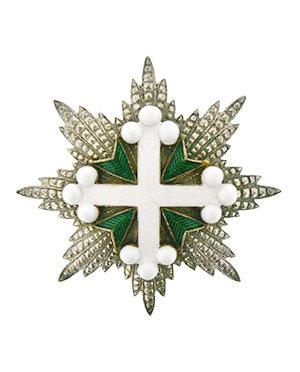
The badge of the order is in gilt, it displays a white-enameled cross bottony of the Order of Saint Maurice with a green-enameled Maltese Cross (the Cross of the Order of Saint Lazarus) placed between the arms of the cross botonny. The badge of each class except that of Knight and Dame is topped by a gilt crown.

The star of the Order is a silver faceted star, with eight points for Grand Cross and four points for Grand Officer, and with the badge (minus the crown) superimposed upon it.

The breast cross for the Commander “jus patronato” class is identical to the badge, minus the crown.

The ribbon of the Order is apple green, with slight variations for the several classes.

The Order of the Roman Eagle

The Fascist Order of the Roman Eagle was founded in 1942 with civil and military divisions, and abolished in Italy in 1944.

The Fascist Order of the Roman Eagle was founded in 1942 with civil and military divisions and abolished in Italy in 1944 – although it continued to be awarded by Benito Mussolini in the short-lived Italian Social Republic until 1945.

A self-styled order of the same name was founded by Romano Mussolini, fourth and youngest son of Benito Mussolini, in 1997. The separate Order of the Patron Saints of Italy (Ordine dei Santi Patroni d’Italia), St. Francis of Assisi and St. Catherine of Siena, was also conferred by the so-called Republic of Salò between February and April 1945. An organisation of this name was also founded by Romano Mussolini in 1997.

The Fascist Order of the Roman Eagle Design

The medal measures 32 mm diameter.

The Order Insignias consist of a golden Roman Eagle on purple background; the Eagle is fixed on various crosses from Knight to Grand Officer, while it is a plaque for Knights Grand Cross.

On the obverse there are three Fasces. Military medals have two crossed Roman swords behind the image on the foreground, while military crosses have two crossed Roman swords with blade pointing high and passing between the crosses arms.

For the Knight: the Cross is 35 mm and is hanging by a ribbon; it is worn on the chest, left side; Officer: the Cross is 35 mm and is hanging by a ribbon; it is worn on the chest, left side; the ribbon has a rosette; Commander: the Cross is 50 mm and is hanging by a ribbon worn around the neck; Grand Officer: the Cross is 50 mm and is suspended by the ribbon worn around the neck; the Grand Officer also has a 65 mm four-pointed plaque-star. Knight Grand Cross (Gold and Silver): the Cross is 50 mm and is hanging by a band worn over the shoulder, from right to left. Alongside the band, there is a 80 mm eight-pointed plaque-star.