The Royal Ark Mariner Jewel

The Royal Ark Mariner Jewel is a decoration of the Royal Ark Mariner degree, an appendant Masonic degree associated with the Mark Masonry.

The Royal Ark Mariner Jewel is a decoration of the Royal Ark Mariner degree, an appendant Masonic degree associated with the Mark Masonry.

The degree is conferred in some Masonic jurisdictions around the world and is sometimes administered by a separate Grand Lodge or Grand Mark Lodge.

The degree centers around the story of Noah’s Ark and the biblical flood. Members of the Royal Ark Mariner degree are often referred to as “Ark Mariners.” The degree emphasizes themes of preparation, preservation, and providence, drawing from the biblical narrative of Noah and his ark.

Membership in the Royal Ark Mariner degree is typically open to Master Masons who have already received the Mark Master Mason degree. It offers members an opportunity for further Masonic education and personal growth, while also fostering fellowship and camaraderie among its members.

The Royal Ark Mariner Jewel Design

The Royal Ark Mariner Jewel design is rich in symbolism and craftsmanship. 

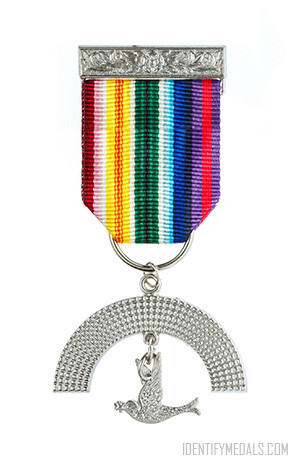
One distinctive element of the Royal Ark Mariner Jewel is the use of a rainbow-colored ribbon, symbolizing the story of Noah and the Ark, a tradition that has been maintained for centuries.

Additionally, the jewel tends to include symbols like a dove holding an olive branch, further emphasizing the Masonic symbolism associated with this degree.
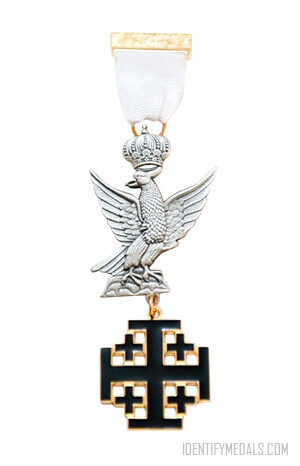
The Red Cross of Constantine Past Commanders Jewel

The Red Cross of Constantine Past Commanders Jewel is a decoration of the Christian fraternal order of Freemasonry.

The Red Cross of Constantine Jewel is a decoration of the Christian fraternal order of Freemasonry. Aspirants to the order are required to hold membership in Craft Freemasonry (lodge) and Royal Arch Freemasonry (chapter). Additionally, they must profess adherence to the Christian faith and affirm their belief in the Christian doctrine of the Holy Trinity.

The Masonic and Military Order of the Red Cross of Constantine comprises a three-degree Order of Masonry, and with its “Appendant Orders,” a total of five degrees are granted within this framework.

The Red Cross of Constantine bestows the title of Past Commander upon individuals who have previously served as Commanders within its ranks. This designation is a mark of honor and recognition for their dedication, leadership, and contributions to the order.

Past Commanders within the Red Cross of Constantine play a vital role in the organization’s activities and rituals. They bring a wealth of experience and knowledge to the table, guiding and mentoring newer members while upholding the traditions and values of the order. These esteemed individuals often continue to actively participate in the affairs of the Red Cross of Constantine, offering their expertise and support to ensure the continued success and prosperity of the order. 

The Red Cross of Constantine Past Commanders Jewel Design

For centuries, Freemasonry has integrated symbols and ceremonies from various Medieval military orders into its Masonic organizations. Among these is the notable Red Cross of Constantine, which is inspired by the Military Constantinian Order.

The insignia for the Red Cross of Constantine features a red cross pattée (a cross with arms that narrow towards the center) surrounded by a golden wreath or border. The Past Commander Jewel is instead black, with a bird suspension and a white ribbon.

The Mark Master Masons Jewel

The Mark Master Masons Jewel is a decoration used to attend the lodge meetings. A symbol of Masonic honor, it symbolizes dedication.

The Mark Master Masons Jewel is a decoration used to attend the lodge meetings. A symbol of Masonic honor, it symbolizes dedication.

The Grand Lodge of Mark Master Masons, commonly referred to as the Mark Degree, is a distinct Masonic body that focuses on the teachings and symbolism associated with the biblical character of Mark Master Masons. It is considered one of the appendant bodies within Freemasonry, meaning it operates alongside regular Masonic lodges but requires Masonic membership for admission.

The Mark Degree emphasizes the themes of craftsmanship, dedication, and personal improvement, drawing from the story of the construction of King Solomon’s Temple as described in the Bible. Mark Master Masonry is centered around the symbolic portrayal of the skilled stonemasons who marked their work with their unique mark or symbol.

The Mark Master Masons Jewel Design

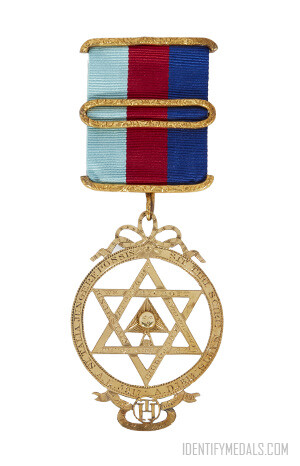
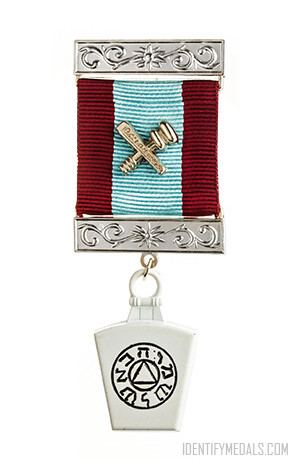
The pendant is marked “K.S.H.T.W.S.S.T.” for “Hiram The Widow’s Son Sent To King Solomon“.

In 1 Kings 7:13–14, Hiram is depicted as the offspring of a widow from the tribe of Naphtali, his father being a skilled bronze worker from Tyre. Solomon summoned him to fashion the bronze furnishings and intricate embellishments for the construction of the new temple. Freemasons frequently allude to Hiram (sometimes with the appended Abiff) as “the widow’s son,” drawing from this narrative. Hiram cast these bronze items in clay molds situated in the Jordan valley, between Succoth and Zarethan/Zeredathah (1 Kings 7:46–47). 

The ribbon is turquoise and red.

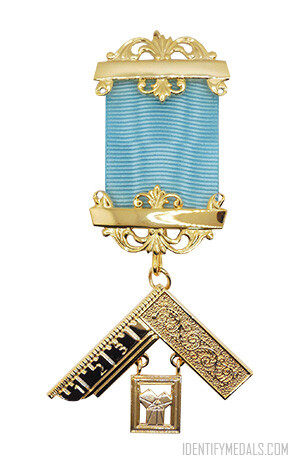
The Masonic Craft Past Masters Jewel

The Masonic Craft Past Masters Jewel is a decoration that signifies leadership and accomplishment among Freemasons.

The Masonic Craft Past Masters Jewel is a decoration that signifies leadership and accomplishment among Freemasons.

In Freemasonry, a Past Master refers to an individual who has previously served as the Worshipful Master of a Masonic Lodge. The title “Worshipful Master” is the formal designation for the presiding officer of a Masonic Lodge during their term of office. Once a Worshipful Master completes their tenure, they are referred to as a Past Master.

A Masonic Craft Past Master, therefore, is a Freemason who has held the position of Worshipful Master in a Masonic Craft Lodge. Past Masters often play important roles within their lodges and the broader Masonic community, providing guidance, wisdom, and leadership based on their experience in the chair. They may also participate in Masonic rituals and ceremonies, offering their knowledge and expertise to support the lodge and its members.

The Masonic Craft Past Masters Jewel Design

The jewel’s crest is made of metal gilt. It consists of the Square, the Compasses, and an Arc of a Circle in Scotland, the Square and Compasses with the capital ‘G’ in the center in Ireland, and in England, it has been the Square with the 47th Proposition of Euclid pendent within it. The shape of this jewel varies slightly depending on the region, but it commonly includes these symbolic elements.

The light blue or turquoise ribbon that accompanies the jewel is significant as well, as the color is one of the primary colors associated with Freemasonry. It represents the virtues of friendship, fidelity, and truth, which are central to the Masonic ethos.

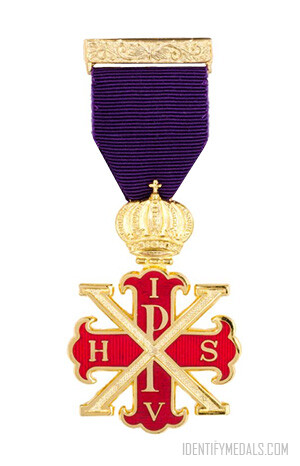
The Red Cross of Constantine Jewel

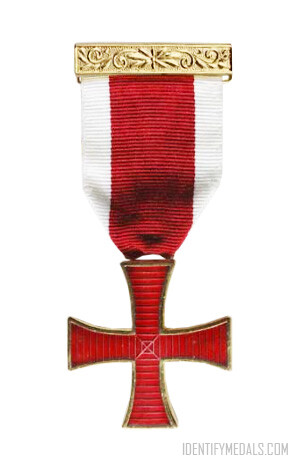
The Red Cross of Constantine Jewel is a decoration of the Christian fraternal order of Freemasonry. Members must be of Christian religion.

The Red Cross of Constantine Jewel is a decoration of the Christian fraternal order of Freemasonry. Aspirants to the order are required to hold membership in Craft Freemasonry (lodge) and Royal Arch Freemasonry (chapter). Additionally, they must profess adherence to the Christian faith and affirm their belief in the Christian doctrine of the Holy Trinity.

The Masonic and Military Order of the Red Cross of Constantine comprises a three-degree Order of Masonry, and with its “Appendant Orders,” a total of five degrees are granted within this framework.

Attainment of the title “Knight of the Red Cross of Constantine” marks entry into the Order’s initial degree. Subsequently, two additional degrees are conferred, along with two other separate Masonic Orders, both characterized by their Christian nature, overseen by each national or regional Grand Imperial Conclave of the Order.

The Knight-Mason ceremony is short and simple, but focuses on teaching valuable moral lessons to the candidate. These lessons are based upon the story of the Roman Emperor Constantine the Great and the Battle of the Milvian Bridge.

The Red Cross of Constantine Jewel Design

For centuries, Freemasonry has integrated symbols and ceremonies from various Medieval military orders into its Masonic organizations. Among these is the notable Red Cross of Constantine, which is inspired by the Military Constantinian Order.

The insignia for the Red Cross of Constantine features a red cross pattée (a cross with arms that narrow towards the center) surrounded by a golden wreath or border. This symbolizes the connection to the historical figure Constantine the Great, who is said to have had a vision of a red cross before a decisive battle.

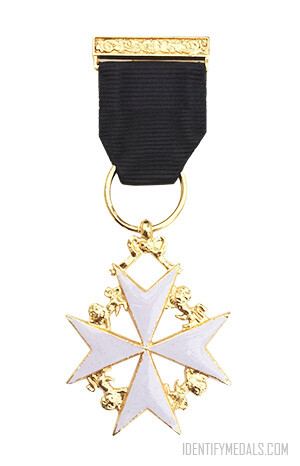
The Masonic Knights of Malta Jewel

The Knights of Malta Jewel is a decoration of one of the highest and most illustrious orders in Freemasonry, the Knights of Malta.

The Knights of Malta Jewel is a decoration of one of the highest and most illustrious orders in Freemasonry, the Knights of Malta

During the 11th century, the inception of the original Knights of Malta order aimed to ensure the safe journey and administer medical aid to Christian pilgrims.

In Masonic context, the Malta Degree is bestowed upon Candidates who have previously been Installed as Knights Templar. Although the regalia and ceremonial proceedings differ significantly from those of Knights Templar Freemasonry, it does not constitute a distinct governing body; rather, it serves as a progressive Degree within the Knights Templar Order. 

The Masonic ritual for the Installation of a Knight of Malta is richly ceremonial and punctuated with moments of drama and historical narrative. For instance, the ceremony commemorates the journey of the Knights Hospitaller from their origins in Jerusalem to their eventual settlement on the Island of Malta in 1522, following their passage through Palestine and Rhodes. 

The Masonic Knights of Malta Jewel Design

The Order’s jewel is a Maltese Cross similar to that of the Sovereign Military Order of Malta. On the obverse, the cross is adorned with white enamel and gold details. The ribbon is black.

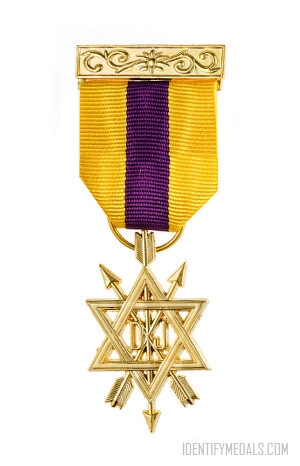
The Order of Secret Monitor Jewel

The Order of Secret Monitor Jewel is a decoration of the Brotherhood of David and Jonathan, a fraternal organization within Freemasonry.

The Order of Secret Monitor Jewel is a decoration of the Brotherhood of David and Jonathan, a fraternal organization within Freemasonry.

The Order of the Secret Monitor is based on the biblical story of the friendship between David, the future king of Israel, and Jonathan, the son of King Saul. In Freemasonry, this story is interpreted as a symbol of fidelity, loyalty, and brotherly love.

This is a Society framed upon the principles of self sacrifice; of mutual trust, watchful Brotherly care; of warning in time of danger; solace in time of sorrow; and skillful and effective friendly advice in every circumstance of life: A Society that meets a great and crying need in human affairs and is calculated to benefit those who act up to its tenets.

The primary aim of the Order of the Secret Monitor is to promote these values among its members and within the broader community. It does so through ritual ceremonies, lectures, and discussions that explore the themes of friendship, loyalty, and mutual support.

Membership in the Order of the Secret Monitor is open to Master Masons who are in good standing with their respective lodges. The organization is structured into individual units called Conclaves, each led by a Supreme Ruler. 

The Order consists of three Degrees:

  • Induction ceremony
  • Princes or admission Degree
  • Third Degree, during which a Brother is Installed as the Supreme Ruler of his Conclave.

The Order of Secret Monitor Jewel Design

The Order’s jewel is suspended from a collar of yellow and violet hues and a sash of matching colors.

The Supreme Ruler’s rank, along with the name and number of the Conclave, is embroidered in silver wire.

The Masonic Knights Templar Past Preceptor Jewel

The Masonic Knights Templar Past Preceptor Jewel is a distinctive emblem worn by members of the Knights Templar, within Freemasonry.

The Masonic Knight Templar Past Preceptor Jewel holds a distinguished significance within the Knights Templar, a chivalric order within Freemasonry. As a mark of honor and recognition, this emblem is bestowed upon those who have served with dedication and distinction as Preceptors within the Knights Templar.

The Knights Templar, formally known as The United Religious, Military, and Masonic Orders of the Temple and of St John of Jerusalem, Palestine, Rhodes, and Malta, is a fraternal organization associated with Freemasonry. Membership in the Knights Templar and several other Masonic Orders is restricted to Freemasons who profess faith in Christianity. As part of their obligations upon entry into the order, individuals are required to pledge to safeguard and uphold the Christian faith. 

For those who have served as Preceptors within the Knights Templar, the Past Preceptor jewel serves as a tangible reminder of their commitment to the principles of the order and their contributions to its mission. 

The Masonic Knights Templar Past Preceptor Jewel Design

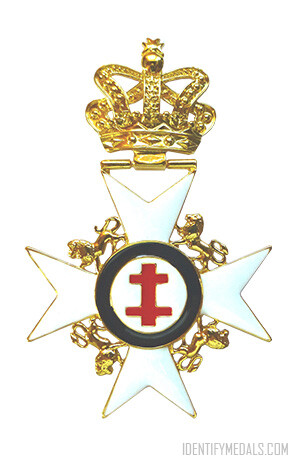
The jewel is shaped like a Maltese Cross, the symbol of the Order of Malta.

The emblem incorporates white, black, and red hard enamel to highlight a crimson preceptor’s cross encircled by a black ring and white enamel. This enamel arrangement is enhanced by gold plating.

The Masonic Knights Templar Breast Jewel

The Knights Templar Breast Jewel is a distinctive emblem worn by members of the Knights Templar, a chivalric order within Freemasonry.

The Masonic Knights Templar Breast Jewel is a distinctive emblem worn by members of the Knights Templar, a chivalric order within Freemasonry. The jewel typically consists of a cross pattée (a type of cross with arms that narrow towards the center), often adorned with various symbols and designs that hold specific significance within the Knights Templar tradition.

The Knights Templar Breast Jewel is worn as a mark of membership and distinction within the Knights Templar order. It is typically worn suspended from a ribbon or chain around the neck, or pinned to the wearer’s clothing during Masonic ceremonies and events.

In addition to serving as a symbol of membership, the Knights Templar Breast Jewel carries with it the rich symbolism and tradition of the Knights Templar, including concepts of honor, duty, and service that are central to the ideals of chivalry and Freemasonry.

The Masonic Knights Templar Breast Jewel Design

At the center of the cross, there is a symbol representing the Knights Templar: Typically, a red cross potent or a crown.

Surrounding this central emblem, the cross may feature additional symbols such as swords, crowns, helmets, or other medieval motifs associated with chivalry and knighthood. For example, the Knights Templar Preceptory Centenary Breast Jewels also induce the Preceptory Name, number, and years of consecration on the obverse, as well as the word centenary on the enamelled bar.

The Masonic Royal Arch Jewel

The Royal Arch Jewel is the most important of all Masonic jewels and depicts the Royal Arch, a key component of Royal Arch Masonry.

The Royal Arch Masonic medal, often referred to simply as the Royal Arch Jewel, is a significant emblem within Freemasonry, particularly in Royal Arch Masonry. It typically consists of a jewel suspended from a ribbon and worn around the neck or pinned to the wearer’s clothing.

The Royal Arch Jewel holds deep symbolic meaning within Freemasonry, representing the journey of spiritual enlightenment and the search for hidden truths. It serves as a reminder of the lessons learned in the Royal Arch degree, emphasizing the importance of fidelity, virtue, and reverence to the Supreme Being.

In addition to its symbolic significance, the Royal Arch Jewel is also a mark of distinction and recognition within the Masonic fraternity. It is often awarded to members who have attained a certain degree of proficiency or leadership within Royal Arch Masonry, serving as a symbol of their dedication and commitment to the principles of Freemasonry.

About Royal Arch Masonry or Capitular Masonry

Royal Arch Masonry, also recognized as “Capitular Masonry,” constitutes the initial segment of the American York Rite sequence of Masonic degrees. Members of Royal Arch Masonry convene in Chapters, where four degrees are conferred:

  • The Mark Master Mason degree, to some extent, extends the teachings of the Fellowcraft or Second degree. In certain jurisdictions, this degree is granted within a lodge of Fellowcraft Masons, which corresponds to the Second degree of the Blue Lodge.

  • The Past Master (Virtual) degree is conferred due to the traditional prerequisite that only Past Masters of a Blue Lodge could gain admission to Royal Arch Masonry. Due to the high number of applicants for this degree, the Virtual Past Master degree is necessary to qualify them for it. The rituals involved largely mirror those performed to install the Worshipful Master of a Blue Lodge. This requirement and procedure are not observed outside the United States.

  • In the Most Excellent Master degree, the construction of King Solomon’s Temple, which plays a significant role in Blue Lodge rituals, has been completed. In England and Wales, this degree is granted by Cryptic Councils, along with three other degrees (referenced below).

  • Regarded by many as the most aesthetically appealing degree in Freemasonry, the Royal Arch Mason degree is esteemed. Freemasons who attain this degree may progress to Cryptic Masonry or proceed directly to Knights Templar, depending on jurisdictional requirements.

The Masonic Royal Arch Jewel Design

The design of the Royal Arch Jewel can vary, but it commonly features a symbolic depiction of the Royal Arch, which is a key component of Royal Arch Masonry.

The insignia comprises two concentric circles, with the outer circle representing Eternity and the inner circle symbolizing the Deity. Enclosed within these circles are two intertwined equilateral triangles, with a central triangle surrounded by rays, signifying the Creator, and a pair of Compasses positioned over the Globe, representing the Great Architect of the Universe.

The interlaced triangles serve as a reminder of our dual nature—spiritual and material. At the base of the Jewel lies a scroll featuring another circle containing a Triple Tau symbol. Positioned at the top of the Jewel is an ornamental scroll.