The Scottish Territorial Red Cross Brigade Badge

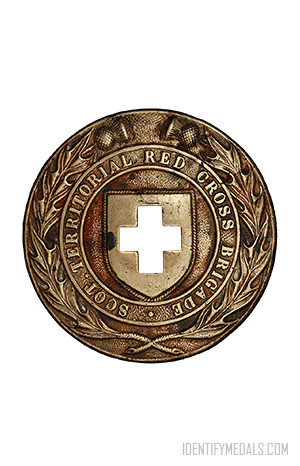
The Scottish Territorial Red Cross Brigade Badge is a WW1 cap badge made in brass-metal with a red felt backing to the central Geneva Cross.

The Scottish Territorial Red Cross Brigade Badge is a WW1 die-stamped cap badge to the Scottish Territorial Red Cross Brigade in brass metal with a red felt backing to the central Geneva Cross.

This organization was originally founded in 1908. The badge was approved by the War Office as the Scottish Branch of the British Red Cross Society and was intended as a formation of voluntary aid detachments for service in the event of war. It was only issued to registered members of detachments and had to be purchased by the member.

The Scottish Territorial Brigade was mobilized immediately after the proclamation of War in 1914. Sadly, there are no mentions of the Brigade after that – whether it changed name/structure – is not known. The Royal Scots (The Royal Regiment), once known as the Royal Regiment of Foot, was the oldest and most senior infantry regiment of the line of the British Army, having been raised in 1633 during the reign of Charles I of Scotland.

The Scottish Territorial Red Cross Brigade Badge Design

The Badge is made of brass with loops (lugs) and pin measuring 56mm in diameter. The back is red.

Find Red Cross Medals Online

More Red Cross Medals

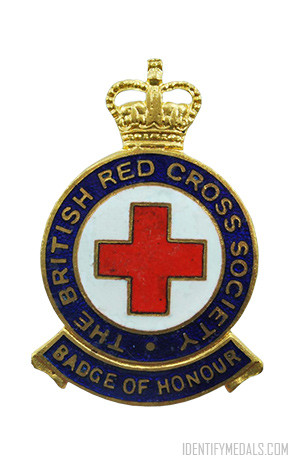
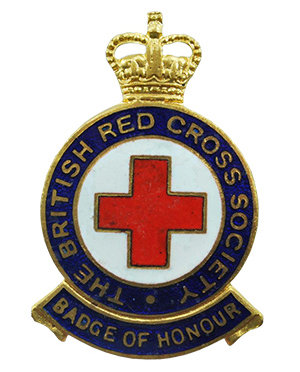
The British Red Cross Badge of Honor

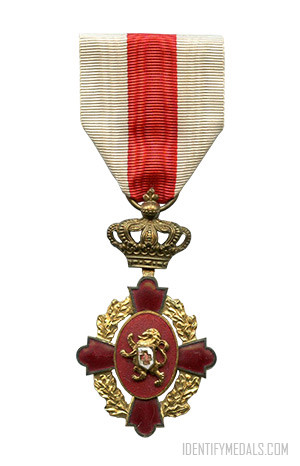
The British Red Cross Badge of Honor was instituted in 1958 and given to people who show exceptional service to the British Red Cross.

The British Red Cross Badge of Honour was instituted in 1958. It’s an award badge given to people who show exceptional service to the British Red Cross.

The Badge has 3 classes:

  • Class 1 “Badge of Honour for Devoted Service”
  • Class 2 “Badge of Honour for Distinguished Service”
  • Class 3 “Queens Badge of Honour”

Badge of Honour for Devoted Service

The award is given to volunteers and staff who have given devoted service to the Society. The Badge is accompanied by a Certificate, which is signed by the Chairman of the Board. The criteria for this award will include the demonstration of service above and beyond the call of duty and actions showing the nominee’s personal involvement and commitment over a longer period of time, furthermore, the recipient’s actions should include devoted and consistent service, showing loyalty and dependability, as well as a certain amount of self-sacrifice and determination.

As a general rule, a minimum period of five years of service should have been completed before receiving this award. Exceptional circumstances may arise when it would be acceptable to make the award sooner.

Badge of Honour for Distinguished Service

The award is given to volunteers and staff for distinguished or exceptional service to the Society. The Badge is accompanied by a Certificate, which is signed by the Chairman of the Board. The recipient should have shown an element of self-sacrifice in time and effort, and should also have demonstrated the ability to initiate innovative ideas, maintain enthusiasm and expand training and service to the community.

Queen’s Badge of Honour

This award may be awarded to any person by the Trustees, with the approval of The President of the Society, His Royal Highness The Prince of Wales, for exceptional service of the highest order to the Society or to the International Red Cross and Red Crescent Movement. The award is accompanied by a certificate, which is signed by The President. The award is limited to thirty holders at any one time.

Find Red Cross Medals Online

More Red Cross Medals

The Henry Dunant Medal

The Henry Dunant Medal is the highest award of the Red Cross. It was created in 1963 and named after the founder of the Red Cross Movement.

The Henry Dunant Medal is the highest award of the Red Cross Movement. It was created in 1963 and named after Henry Dunant, the founder of the Red Cross Movement. In 1963, the idea of creating a medal named in honor of the founder of the International Red Cross was submitted to and approved by the Council of Delegates. This coincided with the 100th anniversary of the Red Cross. In 1965, through the generosity of the Australian Red Cross, the Henry Dunant Medal was established by the International Red Cross Conference in Vienna. The first medals were presented in 1969.

The medal is awarded to “recognize and reward outstanding services and acts of great devotion, mainly of international significance, to the cause of the Red Cross/Red Crescent by any of its members“. 

The medal is presented every two years by the Standing Commission of the Red Cross and Red Crescent, the body that represents the International Committee of the Red Cross, the International Federation of Red Cross and Red Crescent Societies and the various National Red Cross and Red Crescent Societies. This body, representing all of the groups making up the Red Cross Movement, makes five awards of the medal every two years. These limits are placed to ensure the value and prestige of the medal as the highest honour the Red Cross Movement can bestow upon one of its members.

Regulations still allow for the posthumous award of the medal. However, the various groups of the movement have been encouraged to create recognition for those killed in service to the Red Cross. All posthumous nominations for the Henry Dunant Medal should be for, “truly exceptional cases.”

The Henry Dunant Medal Design

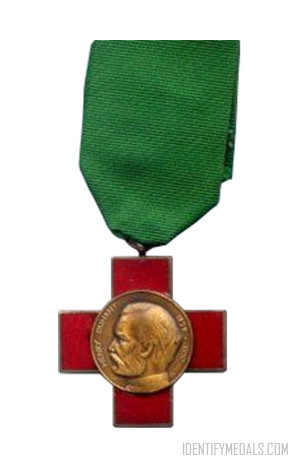
The Henry Dunant Medal is in the shape of a Geneva or Greek cross. The arms of the cross are colored with red enamel. In the center of the cross is a circular bronze medallion bearing effigy of Henry Dunant, facing left. Circumscribed around the effigy are the words HENRY DUNANT 1828-1910. The reverse of the medal is plain. To the top arm of the cross is attached a loop for ribbon suspension.

The ribbon is depicted as either solid green, or green with red edges.

Find Red Cross Medals Online

More Red Cross Medals

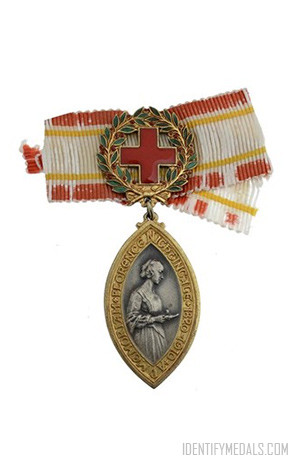
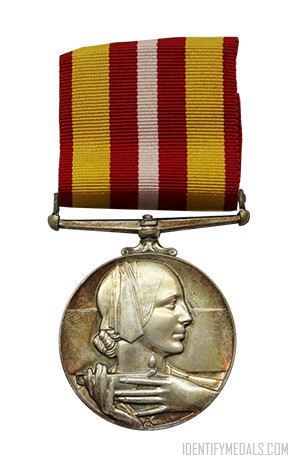
The Florence Nightingale Medal

The Florence Nightingale Medal was instituted in 1912 by the Red Cross as the highest distinction a nurse can achieve.

The Florence Nightingale Medal was instituted in 1912 by the International Committee of the Red Cross. It is the highest international distinction a nurse can achieve and is awarded to nurses or nursing aides for “exceptional courage and devotion to the wounded, sick or disabled or to civilian victims of a conflict or disaster” or “exemplary services or a creative and pioneering spirit in the areas of public health or nursing education“.

The assembled delegates of the Eighth International Conference of Red Cross Societies in London in 1907 decided to create a commemorative International Nightingale Medal to be awarded to those distinguished in the nursing field. It was initially set up to be awarded to six nurses annually, although the first 42 awards were only made in 1920 due to the disruption of the First World War. Among the first recipients were six American nurses: Florence Merriam JohnsonHelen Scott HayLinda K. MeirsMartha M. RussellMary E. Gladwin, and Alma E. Foerster.

The medal was restricted to female nurses until regulation changes in 1991. Under the new regulations, it is open to both women and men and is awarded every two years to a maximum number of fifty recipients worldwide. 

In 2007, the 41st set of medals were awarded to 35 recipients from 18 countries. In 2009, the 42nd set of medals were awarded to 28 recipients from 15 countries, including one for the first time to a nurse in Afghanistan. In 2011, the 43rd set of medals were awarded to 39 recipients from 19 countries, (including for the first time to two Kenyan nurses). In 2013, the 44th set of medals were awarded to 32 recipients from 16 countries, including one posthumously to a delegate from the British Red Cross. In 2015, the 45th set of medals were awarded to 36 recipients from 18 countries, including one posthumously to a Sierra Leonian nurse who had worked in an Ebola treatment center.

In 2017, the 46th set of medals were awarded to 39 recipients from 22 countries, including one to Rear Admiral Sylvia Trent-Adams, the Acting Surgeon General of the United States.

The medal and a diploma are usually presented by the Head of State at a ceremony in their own country, which is required to have “a formal character, in keeping with the founders’ wishes“.

The Florence Nightingale Medal Design

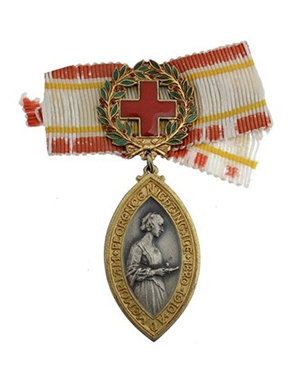
The vesica piscis-shaped medal is composed of gold and silver-gilt and bears, on the obverse, a portrait of Florence Nightingale surrounded by the words ‘Ad memoriam Florence Nightingale 1820-1910‘.

On the reverse, the name of the recipient and the date of the award are engraved, surrounded by the inscription ‘Pro vera misericordia et cara humanitate perennis décor universalis‘ (‘true and loving humanitarianism – a lasting general propriety‘).

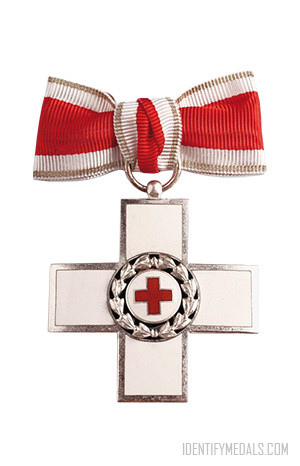
The medal is attached to a white and red ribbon by a clasp featuring a red enamel cross encircled by a green laurel crown.

Recipients are also presented with a parchment diploma of the award and, from 1927, a miniature version of the medal that could be more easily worn. 

Find Red Cross Medals Online

More Red Cross Medals

The Royal Red Cross

The Royal Red Cross is a military decoration established by Queen Victoria and awarded for exceptional services in military nursing.

The Royal Red Cross is a military decoration awarded in the United Kingdom and Commonwealth for exceptional services in military nursing. It was established on 27 April 1883 by Queen Victoria.

The Royal Red Cross has a single class of Member and it was first awarded to the founder of modern nursing, Florence Nightingale. A second and lower class, Associate, was added during World War I in 1917.

The award is awarded to a fully trained nurse of an officially recognized nursing service, military or civilian, who has shown exceptional devotion and competence in the performance of nursing duties, over a continuous and long period, or who has performed an exceptional act of bravery and devotion at her or his post of duty.

The decoration was conferred exclusively to women until 1976.  Recipients of the Royal Red Cross are entitled to use the post-nominal letters “RRC” or “ARRC” for Members and Associates respectively.

The Royal Red Cross Medal Design

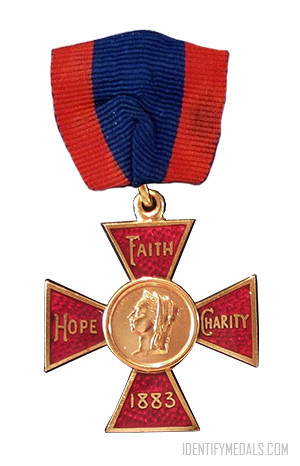
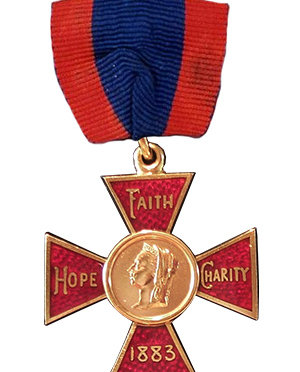
The badge for RRC is shaped like a golden cross. It measures 1.375 inches (or 3.49 cm) wide.

The obverse is enameled red, with a circular medallion (now bearing an effigy of the reigning monarch) at its centre. The words “Faith“, “Hope” and “Charity” are inscribed on the upper limbs of the cross, and the year “1883” in the lower limb.

The reverse is plain except a circular medallion bearing the Royal Cypher of the reigning monarch.

The ribbon for both grades is dark blue with crimson edge stripes. To recognise further exceptional devotion and competency in the performance of nursing duties or exceptional act of bravery and devotion at her or his post of duty, a bar may be awarded to a recipient of the RRC. The bar is linked to the cross and is made of red enamel. A rosette is worn on the ribbon in undress to denote a bar to the RRC.

Find Red Cross Medals Online

More Red Cross Medals