
The U.S.S. Brooklyn Medal

The U.S.S. Brooklyn Medal was a privately issued commemorative medal presented by the citizens of Brooklyn, New York, to sailors and Marines.

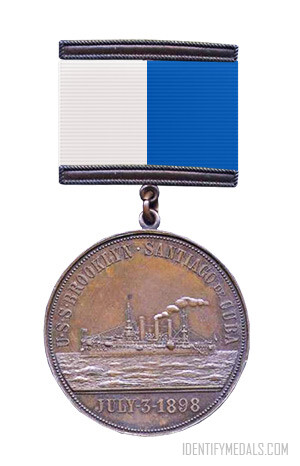
The U.S.S. Brooklyn Medal was a privately issued commemorative medal, presented by the citizens of Brooklyn, New York, to the sailors and Marines who served aboard the armored cruiser USS Brooklyn during the Battle of Santiago de Cuba on 3 July 1898.

As Commodore Winfield Scott Schley‘s flagship, Brooklyn played a leading role in the destruction of the Spanish fleet, and the city chose to honor her crew for their bravery. Unlike the Sampson Medal, this was not an official U.S. military award, but a civic tribute.

Design

The bronze medal features an image of the USS Brooklyn under steam, encircled by the inscription “U.S.S. BROOKLYN – SANTIAGO DE CUBA – JULY 3, 1898.” The reverse bears the Dutch motto “Eendracht Maakt Macht” (“Unity Makes Strength“), together with the inscription:

In Commemoration of Their Heroism at the Destruction of the Spanish Fleet, From the Citizens of Brooklyn to the Men Behind the Guns.

Each medal was individually named by engraving the recipient’s name on the suspension bar.

More Medals from the Spanish-American War

Find This Medal Online

Right Now on eBay 
Clicking a link to eBay may result in a referral commission being paid if a purchase is made.
Loading...

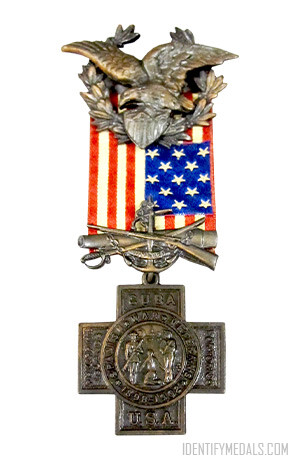
The United Spanish War Veterans Medal

The USWV Membership Medal was not an official U.S. military decoration, but rather the membership badge of the United Spanish War Veterans,

The United Spanish War Veterans (USWV) Membership Medal was not an official U.S. military decoration, but rather the membership badge of the United Spanish War Veterans, one of America’s largest veterans’ organizations in the early twentieth century.

Formed in 1904 through the merger of several Spanish–American War veterans’ associations, the organisation brought together former soldiers, sailors, and Marines who had served during the Spanish–American War, the Philippine–American War, and related campaigns. Membership was open to anyone who had served honorably during these conflicts, regardless of branch of service.

The medal served as a visible symbol of membership rather than an award for military service. Members wore it during reunions, parades, memorial ceremonies, and official functions of the organisation. 

Design

The membership badge is an elaborate multi-piece bronze medal measuring approximately 4 inches (10 cm) in length. At the top is an American eagle set within a laurel wreath, backed by a shield symbolizing the United States. Suspended below is a ribbon designed as a miniature American flag, displaying thirteen red and white stripes with a blue canton containing thirteen white stars, representing the original states of the Union.

Beneath the ribbon is a suspension bar formed by three crossed military emblems: a cavalry sabre, an infantry rifle, and a naval anchor. These represent the principal branches of the armed forces whose members served during the conflict, reflecting the organisation’s inclusive nature.

The pendant is a bronze Maltese cross. Around its four arms appear the names “CUBA,” “PORTO RICO,” “PHILIPPINES,” and “USA,” acknowledging the principal theatres of American service. At the center are the words “SPANISH WAR VETERANS” surrounding a small military scene, while the dates 1898–1902 recognize both the Spanish–American War and the Philippine–American War, which the organization regarded as part of the same period of service. The use of the historic spelling “Porto Rico” reflects official American usage at the time the badge was designed.

The reverse of the cross continues the theme of national unity. The four arms bear the words “NORTH,” “SOUTH,” “EAST,” and “WEST,” symbolizing veterans from every region of the United States united in a single organization.

More Medals from the Spanish-American War

Find This Medal Online

Right Now on eBay 
Clicking a link to eBay may result in a referral commission being paid if a purchase is made.
Loading...

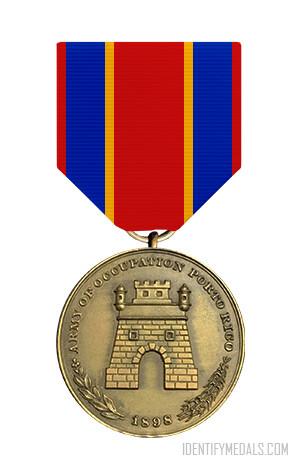
The Army of Occupation Medal for Puerto Rico

This medal was established in 1919 for soldiers who performed occupation duty in Puerto Rico after the Spanish–American War.

The Army of Puerto Rican Occupation Medal was established by the U.S. War Department on 4 February 1919 to recognize soldiers who performed occupation duty in Puerto Rico following the end of the Spanish–American War. Created more than twenty years after the events it commemorated, the medal acknowledged that many Army personnel had served in Puerto Rico after the fighting ceased but had not been eligible for the Spanish Campaign Medal, whose qualifying period ended with the formal cessation of hostilities.

The medal was awarded to officers and enlisted men of the United States Army who served in Puerto Rico between 14 August and 10 December 1898. These dates cover the period immediately after the signing of the armistice with Spain, when American forces occupied and administered the island before military operations officially concluded. Originally, only officers and enlisted men who were still serving in the Army after the creation of the award could receive the medal directly from the government. Veterans who had already left the service were required to obtain proof of eligibility and purchase the medal themselves. 

Design

The bronze medal measures approximately 1¼ inches (32 mm) in diameter. The obverse bears the inscription “ARMY OF OCCUPATION OF PORTO RICO“—using the spelling officially adopted by the United States at the time—with the date “1898” below. At the center is a castle with two round corner towers, a stylized representation derived from Spanish heraldry and thought to reference the island’s historic coastal fortifications. The design is framed by a branch of tobacco on the left and a stalk of sugar cane on the right, symbolizing two of Puerto Rico’s principal agricultural products during the period.

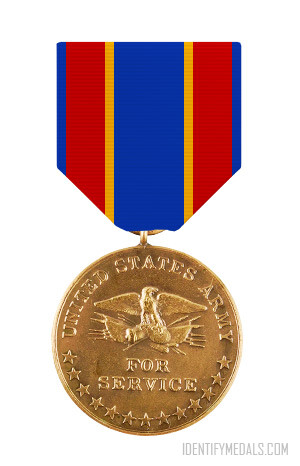
The reverse follows the standard design used on several contemporary U.S. Army campaign medals. Around the edge appears the inscription “UNITED STATES ARMY“, while the words “FOR SERVICE” are placed beneath the central device.

The ribbon is distinctive and closely related to that of the Army of Cuban Occupation Medal. It consists of ultramarine blue and Old Glory red stripes separated by narrow golden-yellow stripes, with thin red edge stripes framing the design. The arrangement produces a balanced pattern of red, blue, yellow, red, yellow, blue, and red.

More Medals from the Spanish-American War

Find This Medal Online

Right Now on eBay 
Clicking a link to eBay may result in a referral commission being paid if a purchase is made.
Loading...

The Army of Cuban Occupation Medal

This medal was established in 1915 for soldiers who served with the American occupation forces in Cuba after the Spanish–American War.

The Army of Cuban Occupation Medal was established by the U.S. War Department on 28 June 1915 to recognize soldiers who served with the American occupation forces in Cuba after the conclusion of the Spanish–American War.

Although hostilities with Spain had ended in August 1898, the United States maintained a military government in Cuba until the island achieved formal independence on 20 May 1902. The medal was created to honour those who took part in this important occupation and reconstruction period rather than the combat operations of the war itself.

The medal was awarded to members of the United States Army who served in Cuba between 18 July 1898 and 20 May 1902. Eligible service included occupation and garrison duty under the Military Government of Cuba. Unlike the Army Spanish Campaign Medal, which recognized wartime operations, the Army of Cuban Occupation Medal commemorated the peacekeeping and administrative duties that followed the conflict. 

Design

The medal is struck in bronze and measures approximately 35 mm (1⅜ inches) in diameter. Its obverse prominently displays the Coat of Arms of Cuba, surrounded by the inscription “ARMY OF OCCUPATION – MILITARY GOVERNMENT OF CUBA.” The dates 1898 and 1902 appear on either side of the Phrygian cap at the top of the Cuban coat of arms, marking the period of American military administration. 

The reverse follows the standard style used on several early twentieth-century Army campaign medals. Around the upper edge appears the inscription “UNITED STATES ARMY,” while “FOR SERVICE” is placed beneath the central design. The center depicts a spread-winged American eagle perched upon a trophy of military arms, including cannon, rifles, flags, spears, a shield, and edged weapons, symbolizing the strength and traditions of the U.S. Army. Thirteen stars beneath the trophy represent the original thirteen states of the Union.

The ribbon is distinctive and colourful, consisting of alternating ultramarine blue and Old Glory red stripes separated by narrow golden-yellow stripes. The arrangement produces a balanced pattern of blue-red-yellow-blue-yellow-red-blue. 

More Medals from the Spanish-American War

Find This Medal Online

Right Now on eBay 
Clicking a link to eBay may result in a referral commission being paid if a purchase is made.
Loading...

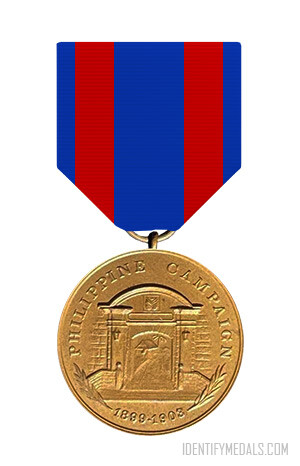
The U.S. Navy Philippine Campaign Medal

This campaign medal commemorates service during the Philippine–American War (1899–1902) and the subsequent pacification campaigns.

Although often grouped with Spanish–American War decorations, the U.S. Navy Philippine Campaign Medal actually commemorates service during the Philippine–American War (1899–1902) and the subsequent pacification campaigns. It was created on 27 June 1908 to recognize the service of Navy sailors and U.S. Marines who participated in operations in and around the Philippine Islands after Spain had ceded the archipelago to the United States.

The medal was awarded to officers and enlisted personnel of the U.S. Navy and Marine Corps who served in the Philippine Islands between 4 February 1899 and 31 December 1904. Eligibility included personnel who served ashore in support of Army operations as well as those assigned to designated naval vessels operating in Philippine waters. Unlike some later campaign medals, it was awarded only once regardless of the length or number of qualifying operations.

Although the Philippine–American War officially ended in 1902, American naval operations continued for several years while resistance in parts of the islands was suppressed. For this reason, eligibility extended through the end of 1904 for most recipients.

Design

The obverse bears the inscription “PHILIPPINE CAMPAIGN” around the upper edge, with the dates “1899–1903” below. At the center is a depiction of a fortified city gate opening onto the Philippine countryside beyond. The gateway represents the transition from Spanish colonial rule to American administration and symbolises the Navy’s role in securing the islands during the campaign.

The reverse is identical to that of the Navy Spanish Campaign Medal. Around the upper rim appears the inscription “UNITED STATES NAVY“, while the words “FOR SERVICE” are placed beneath the central device. The design features an American eagle perched on a fouled anchor, representing naval service.

More Medals from the Spanish-American War

Find This Medal Online

Right Now on eBay 
Clicking a link to eBay may result in a referral commission being paid if a purchase is made.
Loading...

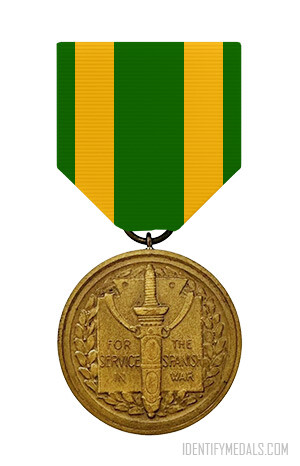
The Spanish War Service Military Medal

This medal was established in 1918 to recognize members of the U.S. Army who served but did not qualify for the Spanish Campaign Medal.

The Spanish War Service Medal was established by an Act of Congress on 9 July 1918 to recognize members of the United States Army who served on active duty during the Spanish–American War but did not qualify for the Spanish Campaign Medal. Whereas the Spanish Campaign Medal was reserved for soldiers who served in the overseas theatres of Cuba, Puerto Rico, or the Philippines, the Spanish War Service Medal honored those whose service was confined to the continental United States. Its principal purpose was to acknowledge the important role played by troops engaged in homeland defence, training, mobilisation, and administrative duties during the war. It was also awarded extensively to members of the National Guard who had been called into federal service but were never deployed overseas.

Eligibility

To qualify, a soldier had to have served on active duty in the U.S. Army between 20 April 1898 and 11 April 1899. Any individual who had already received the Spanish Campaign Medal was ineligible, ensuring that service members did not receive both awards for the same period of service. The medal was issued only to Army personnel, as Navy and Marine Corps personnel who served during the conflict qualified instead for the Navy’s Spanish Campaign Medal regardless of whether they served overseas. The first recipient was Major General Charles M. Clement, commander of U.S. forces responsible for homeland defense during the war.

Design

The bronze medal measures approximately 1⅜ inches (35 mm) in diameter. The obverse features a sheathed Roman sword suspended from a tablet inscribed “FOR SERVICE IN THE SPANISH WAR“, surrounded by a laurel wreath. The sheathed sword is symbolic, representing military readiness and faithful service without participation in overseas combat.

The reverse displays the Great Seal of the United States above a scroll inscribed “FOR SERVICE“. Surrounding the central design is a wreath incorporating the crossed branch insignia of the Infantry, Artillery, and Cavalry, representing the principal combat arms of the U.S. Army during the Spanish–American War.

The medal is suspended from a distinctive emerald green ribbon with a golden-yellow stripe near each edge. Unlike the blue-and-yellow ribbon of the Spanish Campaign Medal, the green ribbon clearly distinguished the award as one recognizing stateside rather than overseas service.

No clasps or additional devices were ever authorized.

More Medals from the Spanish-American War

Find This Medal Online

Right Now on eBay 
Clicking a link to eBay may result in a referral commission being paid if a purchase is made.
Loading...

The U.S. Marine Corps Spanish Campaign Medal

This U.S. medal was awarded to sailors and Marines who served aboard vessels operating during the Spanish–American War.
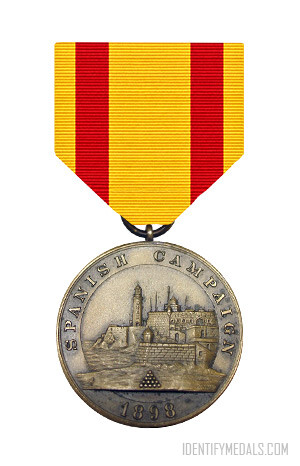
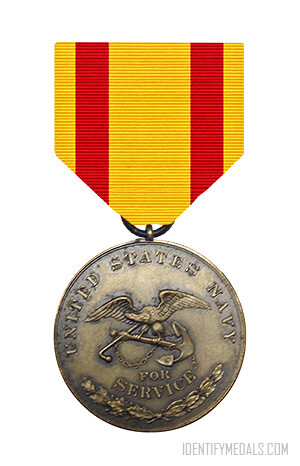
The U.S. Marine Corps Spanish Campaign Medal was awarded to sailors and Marines who served aboard vessels operating during the Spanish–American War. Established in 1908, it recognized service in the Caribbean and Pacific campaigns. 
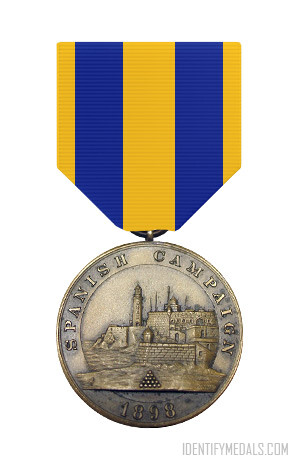
The Spanish Campaign Medal was established on 27 June 1908 to recognize the service of United States Navy sailors and Marine Corps personnel who took part in the Spanish–American War. Eligibility was limited to those who served in the waters of Cuba, Puerto Rico, or the Philippines between 21 April and 16 August 1898 aboard designated naval vessels. In total, the crews of 47 ships qualified for the award.

Initially, naval personnel who served in the Caribbean could also receive the West Indies Campaign Medal, while those who participated in the Battle of Santiago de Cuba were eligible for the Sampson Medal, authorized by Congress in 1901. In 1913, the Navy discontinued the West Indies Campaign Medal and expanded the eligibility requirements of the Spanish Campaign Medal to include all Marine Corps personnel who served on active duty during the Spanish–American War. At the same time, the ribbon design was revised to distinguish it from the national colors of Spain.

Design

The obverse of the bronze medal features the inscribed words “SPANISH CAMPAIGN” and 1898″ and depicts the Havana Harbour, with Castillo de los Tres Reyes del Morro (Morro Castle) prominently shown guarding its entrance. The scene is not a detailed architectural portrait but a symbolic representation of one of Spain’s most important naval strongholds in the Caribbean. The lighthouse tower of Morro Castle is clearly visible on the left, while the fortified walls and buildings of the castle occupy the center and right of the design. Beneath the fortress appears a stack of cannonballs, reinforcing the military theme.

The U.S. Navy Spanish Campaign Medal - First ribbon
The Spanish Campaign Medal - Navy, first ribbon, obverse.
The U.S. Navy Spanish Campaign Medal - First ribbon.
The Spanish Campaign Medal - Medal - Navy, first ribbon, reverse.
The U.S. Navy Spanish Campaign Medal - Second ribbon.
The Spanish Campaign Medal - Medal - Navy, second ribbon, obverse.
The U.S. Army Spanish Campaign Medal
The Spanish Campaign Medal - Medal - Army, obverse.

The original ribbon consisted of gold-yellow with two broad red vertical stripes, closely resembling the colors of the Spanish flag. When the award criteria were broadened in 1913, the Navy replaced this ribbon with a blue and yellow design. The official reason for the change was to avoid using Spain’s national colours on an American campaign medal. As a result, medals issued after 1913 feature the distinctive blue-and-yellow ribbon, while examples retaining the original red-and-yellow ribbon are associated with the medal’s earliest period of issue and are of particular interest to collectors.

Havana was the principal base of the Spanish Caribbean fleet, and its harbor was the focal point of the U.S. Navy’s blockade during the Spanish–American War. By depicting Morro Castle, the medal commemorated the naval campaign against Spain rather than any single battle.

More Medals from the Spanish-American War

Find This Medal Online

Right Now on eBay 
Clicking a link to eBay may result in a referral commission being paid if a purchase is made.
Loading...

The U.S. Army Spanish Campaign Medal

The Spanish War Service Medal was authorized in 1918 for Army personnel who served during the Spanish-American War.

The Army Spanish Campaign Medal was established on 12 January 1905 to recognise soldiers of the United States Army who served in active campaign operations during the Spanish–American War. Eligibility was limited to personnel who served between 11 May and 16 August 1898 in one or more of the principal theatres of the conflict: Cuba, Puerto Rico, or the Philippine Islands. Unlike the Navy’s campaign medal, which recognised service aboard designated vessels, the Army medal was awarded to those who took part in military operations ashore within these campaign areas.

The decoration was awarded to officers and enlisted men who met the prescribed service requirements, and by 1 July 1923, a total of 7,667 medals had been issued. Although the medal was established several years after the war ended, it became the Army’s principal campaign award for veterans who had served overseas during the conflict.

Not all Army personnel who served during the Spanish–American War qualified for the Spanish Campaign Medal. Many soldiers remained on active duty within the continental United States, performing essential training, garrison, and support duties without deploying to the war zones. To recognise this important service, the Spanish War Service Medal was established in 1918. This separate decoration acknowledged Army personnel who served honourably during the war but did not meet the overseas campaign requirements for the Spanish Campaign Medal, ensuring that both combat-zone and home-service contributions were formally recognised.

Design

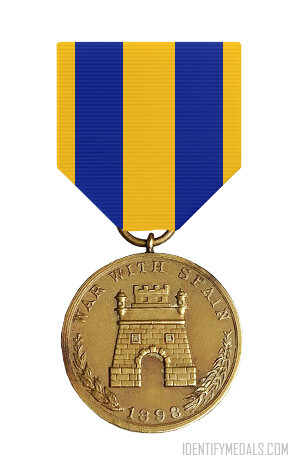
The obverse of the Army Spanish Campaign Medal bears the inscription “WAR WITH SPAIN” around the upper edge, with the date “1898” at the bottom. At its center is the depiction of a Spanish military fortification. Flanking the central image are two important agricultural symbols of Spain’s Caribbean colonies: a stalk of tobacco on the left and a stalk of sugar cane on the right. These elements evoke the principal theatres of the conflict, particularly Cuba and Puerto Rico.

The medal is suspended from a ribbon consisting of yellow with two blue vertical stripes, a design shared with the Navy and Marine Corps versions of the Spanish Campaign Medal.

More Medals from the Spanish-American War

Find This Medal Online

Right Now on eBay 
Clicking a link to eBay may result in a referral commission being paid if a purchase is made.
Loading...

The U.S. Navy Spanish Campaign Medal

This U.S. medal was awarded to sailors and Marines who served aboard vessels operating during the Spanish–American War.
The U.S. Navy Spanish Campaign Medal was awarded to sailors and Marines who served aboard vessels operating during the Spanish–American War. Established in 1908, it recognized service in the Caribbean and Pacific campaigns. 
The Navy Spanish Campaign Medal was established on 27 June 1908 to recognise the service of United States Navy sailors and Marine Corps personnel who took part in the Spanish–American War. Eligibility was limited to those who served in the waters of Cuba, Puerto Rico, or the Philippines between 21 April and 16 August 1898 aboard designated naval vessels. In total, the crews of 47 ships qualified for the award.

Initially, naval personnel who served in the Caribbean could also receive the West Indies Campaign Medal, while those who participated in the Battle of Santiago de Cuba were eligible for the Sampson Medal, authorized by Congress in 1901. In 1913, the Navy discontinued the West Indies Campaign Medal and expanded the eligibility requirements of the Spanish Campaign Medal to include all Navy and Marine Corps personnel who served on active duty during the Spanish–American War. At the same time, the ribbon design was revised to distinguish it from the national colors of Spain.
Design

The obverse of the bronze medal features the inscribed words “SPANISH CAMPAIGN” and 1898″ and depicts the Havana Harbour, with Castillo de los Tres Reyes del Morro (Morro Castle) prominently shown guarding its entrance. The scene is not a detailed architectural portrait but a symbolic representation of one of Spain’s most important naval strongholds in the Caribbean. The lighthouse tower of Morro Castle is clearly visible on the left, while the fortified walls and buildings of the castle occupy the center and right of the design. Beneath the fortress appears a stack of cannonballs, reinforcing the military theme.

The U.S. Navy Spanish Campaign Medal - First ribbon
The Spanish Campaign Medal - Navy, first ribbon, obverse.
The U.S. Navy Spanish Campaign Medal - First ribbon.
The Spanish Campaign Medal - Medal - Navy, first ribbon, reverse.
The U.S. Navy Spanish Campaign Medal - Second ribbon.
The Spanish Campaign Medal - Medal - Navy, second ribbon, obverse.
The U.S. Army Spanish Campaign Medal
The Spanish Campaign Medal - Medal - Army, obverse.

While the medal itself remained unchanged after its introduction, its ribbon underwent a significant redesign. The original ribbon consisted of gold-yellow with two broad red vertical stripes, closely resembling the colors of the Spanish flag. When the award criteria were broadened in 1913, the Navy replaced this ribbon with a blue and yellow design. The official reason for the change was to avoid using Spain’s national colours on an American campaign medal. As a result, medals issued after 1913 feature the distinctive blue-and-yellow ribbon, while examples retaining the original red-and-yellow ribbon are associated with the medal’s earliest period of issue and are of particular interest to collectors.

Havana was the principal base of the Spanish Caribbean fleet, and its harbor was the focal point of the U.S. Navy’s blockade during the Spanish–American War. By depicting Morro Castle, the medal commemorated the naval campaign against Spain rather than any single battle.

More Medals from the Spanish-American War

Find This Medal Online

Right Now on eBay 
Clicking a link to eBay may result in a referral commission being paid if a purchase is made.
Loading...

The War Commemorative Medal of 1813-15

The War Commemorative Medal for 1813–1815 was established in 1813 by King Friedrich Wilhelm III of Prussia for the Wars of Liberation.

The War Commemorative Medal of 1813/15 (or Kriegsdenkmünze für 1813/15 in German) was a Prussian war commemorative medal  established on 24 December 1813 by King Friedrich Wilhelm III of Prussia to honour members of the Prussian Army who fought in the Wars of Liberation against Napoleonic France during 1813–1815.

It recognised those who served throughout the conflict, which included campaigns that eventually led to the defeat of Napoleon and the decisive Battle of Waterloo.

A later related piece, the Erinnerungs‑Kriegs‑Denkmünze, was instituted on 17 March 1863 by King Wilhelm I on the 50th anniversary of the original campaigns. This anniversary issue featured portraits of Friedrich Wilhelm III and inscriptions marking the years 1813–1815, and was intended as a keepsake for legitimate holders of the original medal and their families.

The War Commemorative Medal Design

The medal is about 29 mm in diameter and features a cross on the obverse with rays between its arms and a wreath of laurel and oak leaves encircling the year or years of service (such as 1813, 1814, or 1815). The reverse bears the crowned monogram “F. W.” for Friedrich Wilhelm and the inscription Preußens tapferen Kriegern, Gott war mit uns, Ihm sey die Ehre (“To Prussia’s brave warriors, God was with us, to Him be the glory”).

There were two versions of the medal: a combatant version struck in bronze made from captured artillery, often with the edge inscription Aus erobertem Geschütz (“From captured cannon”), and a non‑combatant version cast in iron and oval in shape, which was awarded to those who did not see active combat or who supported the war effort. The iron variant became informally known as the “Eiserne Pflaume” (“Iron Plum”) due to its shape.

Both versions were worn on the left breast suspended from distinctive ribbons: combatants on an orange ribbon edged in black and white, and non‑combatants on a white ribbon edged in black, orange, and white.

The Different Waterloo Medals

The Waterloo medal was issued by the British Government to all soldiers present during action. Seven nations of the Seventh Coalition struck differently designed medals for soldiers who took part in the campaign. These are:

The Waterloo Medal - British Medals Pre-WW1

The Waterloo Medal

The Waterloo Medal is a British military medal established in 1816-17 and struck for all those who participated in the Waterloo campaign.

British Campaign Medals: The Brunswick Waterloo Medal

The Brunswick Waterloo Medal

The Brunswick Waterloo Medal was a campaign medal awarded to those who participated in the Battles of Quatre Bras and Waterloo.

British Campaign Medals: The Hanoverian Waterloo Medal

The Hanoverian Waterloo Medal

The Hanoverian Waterloo Medal was issued to all members of the Hanoverian army who fought in the battles of Quatre Bras and Waterloo.

British Campaign Medals: The Nassau Medal for Waterloo

The Nassau Waterloo Medal

The Waterloo Medal is a campaign of the Duchy of Nassau established by Frederick Augustus, Duke of Nassau on 23 December 1815.

Where to Find Waterloo Medals

Right Now on eBay 
Clicking a link to eBay may result in a referral commission being paid if a purchase is made.
Loading...