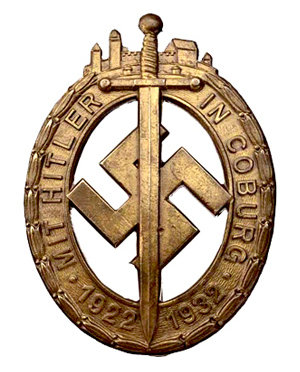
The Coburg Badge

The Coburg Badge (Das Coburger Abzeichen in German) was the first badge recognized as a national award of the Nazi Party or NSDAP.

The Coburg Badge (or Das Coburger Abzeichen in German) was the first badge recognized as a national award of the Nazi Party or NSDAP.

Adolf Hitler ordered the Coburg Badge to be struck on 14 October 1932 to memorialize the event which took place ten years earlier, on Saturday, 14 October 1922. On that day, Hitler led 800 members of the SA from Munich and other Bavarian cities by train to Coburg for a weekend rally. Once there, numerous pitched street battles with leftists and communists occurred. In the end, the final victory belonged to the Nazis. Later, the day was known as the Deutscher Tag in Coburg (German Day in Coburg). Hitler had one his first decisive victory, as it was to become Nazi folklore and led to the expression, in ardent Nazi circles, ‘But were you at Coburg?

The badge was declared an official party and national decoration in a decree signed by Hitler, on 6th November 1936, who had taken a personal interest in the design. Only 436 names were entered on the official party roll of recipients who were entitled to the badge.

On 1 August 1939, Reichsfuhrer-SS Heinrich Himmler decreed that any SS member (whether enlisted or officer) who wore the Coburg Badge was eligible to wear the Totenkopf ring.

The Coburg Badge Medal Design

The award consists of an oval, slightly convex badge that was originally produced in massive bronze. It is 40mm wide and 54mm high, with a narrow wreath of laurel leaves around its edge measuring 2 mm across.

The badge features, in the obverse, a sword placed tip downward across the face of a swastika within an oval wreath of three leaves in each bunch and two berries at their tips. There are ten bunches on either side and the top two bunches on either side do not have the laurel berries. At the top of the wreath is Coburg Castle and village. The Castle has two spires on the viewer’s left with a large roofed building and a small adjacent pinnacle on the right. The wreath contains the words, “MIT HITLER IN COBURG 1922-1932″ (with Hitler in Coburg 1922-1932). Inside the wreath is a flat field that measures 4 mm, with a raised 0.5 mm line.  The central oval void has a large swastika measuring 16 mm across and the width of the individual arms is 4 mm. From the top of the badge, superimposed over the castle and swastika is a double-edged sword with straight quillons, twisted grip handle and a pronounced ball pommel.

The reverse is plain with a thin hinge and a pin that has a circular retainer and a ‘C’ type hook at the bottom. There is a second version of the badge which is thinner and has the RZM mark on the reverse.
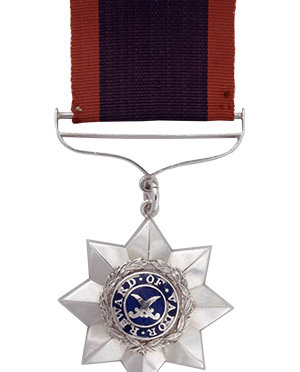
The Indian Order of Merit

The Indian Order of Merit (IOM) is a military and civilian decoration of British India established in 1837on 1 May 1837.

Time Period: Pre-WW1
Year of Institution: 1 May 1837
Country: Great Britain

The Indian Order of Merit (also known as IOM) is a military and civilian decoration of British India established in 1837 by General Order of the Governor-General of India, No. 94 of 1 May 1837.

Following the Partition of India in 1947 it was decided to discontinue the award, and a separate Indian honours system was developed in 1954 to act retrospectively.

For a long period of time the IOM was the highest decoration that a native member of the British Indian Army could receive and initially it had three divisions. This was changed in 1911 when Indian servicemen became eligible for the Victoria Cross.

A civilian division of the IOM also existed between 1902 and 1939, however, it was only conferred very rarely. The name of the medal was changed in 1902 to avoid confusion with a British Order of the same name.

The Indian Order of Merit Medal Design

The medal was originally introduced with three classes: First, second and third classes.

The Third Class is an eight pointed dull silver star with blue circle surrounded by silver laurels. In the middle, with crossed swords and the words, the words Awarded for Valour were written (this was changed to Awarded for Gallantry in 1944.)

The Second Class is an eight pointed shiny silver star with blue circle, surrounded by gold laurels in the middle, with crossed swords and the words Awarded for Valour, this was changed to Awarded for Gallantry in 1944.

The First Class is an eight pointed gold star with blue circle, surrounded by gold laurels in the middle, with crossed swords and the words Awarded for Valour, this was changed to Awarded for Gallantry in 1944.

The ribbon is dark blue and flanked by two red stripes of about a sixth of the width.

The Royal Red Cross

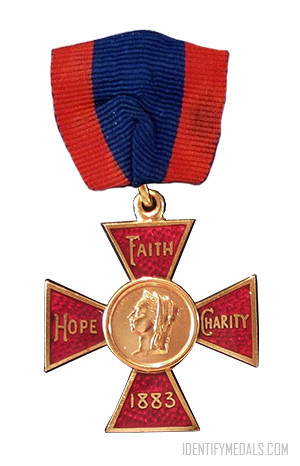
The Royal Red Cross is a military decoration established by Queen Victoria and awarded for exceptional services in military nursing.

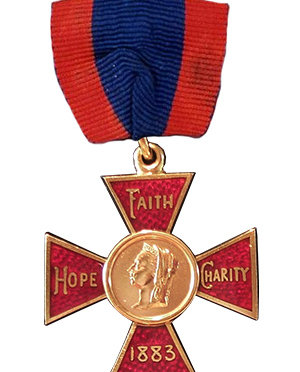
The Royal Red Cross is a military decoration awarded in the United Kingdom and Commonwealth for exceptional services in military nursing. It was established on 27 April 1883 by Queen Victoria.

The Royal Red Cross has a single class of Member and it was first awarded to the founder of modern nursing, Florence Nightingale. A second and lower class, Associate, was added during World War I in 1917.

The award is awarded to a fully trained nurse of an officially recognized nursing service, military or civilian, who has shown exceptional devotion and competence in the performance of nursing duties, over a continuous and long period, or who has performed an exceptional act of bravery and devotion at her or his post of duty.

The decoration was conferred exclusively to women until 1976.  Recipients of the Royal Red Cross are entitled to use the post-nominal letters “RRC” or “ARRC” for Members and Associates respectively.

The Royal Red Cross Medal Design

The badge for RRC is shaped like a golden cross. It measures 1.375 inches (or 3.49 cm) wide.

The obverse is enameled red, with a circular medallion (now bearing an effigy of the reigning monarch) at its centre. The words “Faith“, “Hope” and “Charity” are inscribed on the upper limbs of the cross, and the year “1883” in the lower limb.

The reverse is plain except a circular medallion bearing the Royal Cypher of the reigning monarch.

The ribbon for both grades is dark blue with crimson edge stripes. To recognise further exceptional devotion and competency in the performance of nursing duties or exceptional act of bravery and devotion at her or his post of duty, a bar may be awarded to a recipient of the RRC. The bar is linked to the cross and is made of red enamel. A rosette is worn on the ribbon in undress to denote a bar to the RRC.

Find Red Cross Medals Online

More Red Cross Medals

The Conspicuous Gallantry Cross and Medal

The Conspicuous Gallantry Cross (CGC) is a second level military decoration of the British Armed Forces created in 1993.

The Conspicuous Gallantry Cross (also known as CGC) is a second level military decoration of the British Armed Forces created in 1993 after a review of the British honors system as part of the drive to remove distinctions of rank in awards for bravery.

The CGC now serves as the second level award for gallantry for all ranks across the whole armed forces. The CGC may be awarded posthumously, “in recognition of an act or acts of conspicuous gallantry during active operations against the enemy“.

All ranks of the Royal Navy, Royal Marines, British Army, and Royal Air Force may be awarded the CGC in recognition of qualifying acts of gallantry. Recipients are entitled to the postnominal letters CGC

The Conspicuous Gallantry Cross and Medal Design

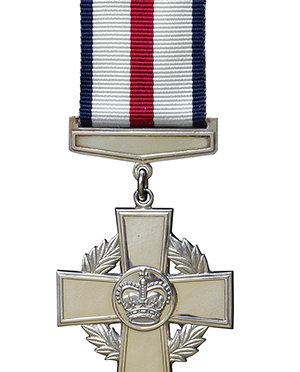
The medal is in the shape of a cross pattée and truck in silver. Arranged behind the cross, visible between the arms is a laurel wreath.

On the obverse, the circular medallion in the center depicts St. Edward’s crown. The reverse is plain which allows room for the engraving of the rank, name, and unit of its recipient.

The award date is also engraved on the reverse of the medal. The medal is suspended by a white ribbon with two narrow dark blue stripes at the edge and one center stripe in crimson.

The Order of the British Empire

The Most Excellent Order of the British Empire is a British order of chivalry that rewards charitable works and public service.

The Most Excellent Order of the British Empire is a British order of chivalry that rewards work with charitable and welfare organizations, contributions to the arts and sciences and public service outside the Civil service.

The Most Excellent Order of the British Empire was established on 4 June 1917 by King George V, and comprises five classes across both civil and military divisions. The most senior two of them make the recipient either a knight (male) or Dame (female).

The five classes of appointment to the Order are, in descending order of precedence:

  1. Knight Grand Cross or Dame Grand Cross of the Most Excellent Order of the British Empire (GBE)
  2. Knight Commander or Dame Commander of the Most Excellent Order of the British Empire (KBE or DBE)
  3. Commander of the Most Excellent Order of the British Empire (CBE)
  4. Officer of the Most Excellent Order of the British Empire (OBE)
  5. Member of the Most Excellent Order of the British Empire (MBE)

The senior two ranks of Knight or Dame Grand Cross, and Knight or Dame Commander, entitle their members to use the title of Sir for men and Dame for women before their forename.

The Order of the British Empire Medal Design

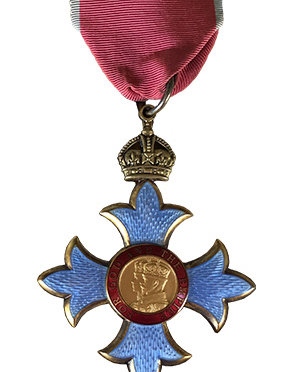
Members of the Order wear elaborate vestments on important occasions, which vary by rank: The mantle was originally made of yellow satin lined with blue silk but is now rose pink satin lined with pearl-grey silk. It’s worn only by Knights and Dames Grand Cross. The collar is made of gold and consists of six medallions depicting the Royal Arms, alternating with six medallions depicting the Royal and Imperial Cypher of George V (GRI, which stands for “Georgius Rex Imperator“) and is also worn by only Knights and Dames Grand Cross.

The star is an eight-pointed silver star worn pinned to the left breast and bearing a crimson ring with the motto of the Order inscribed. Within the ring, before 1937 a figure of Britannia was originally shown. Since then, the effigies of George V and Mary of Teck are shown instead.

The badge was, until 1937, suspended on a purple ribbon with a red central stripe for the military division. After 1937 the ribbon became rose-pink with pearl-grey edges, with the addition of a pearl-grey central stripe for the military division. The badge is in the form of a cross patonce, the obverse of which bears the same field as the star; the reverse bears George V’s Royal and Imperial Cypher. Both are within a ring bearing the motto of the Order. The size of the badges varies according to rank.

Find This Medal

Right Now on eBay 
Clicking a link to eBay may result in a referral commission being paid if a purchase is made.
Loading...

The Order of Merit

The Order of Merit is an award established in 1902 that recognizes distinguished service in the armed forces, science, art, or culture.

The Order of Merit (or Ordre du Mérite in French) is an order of merit that recognizes distinguished service in the armed forces, science, art, literature, or for the promotion of culture.

The Order was established in 1902 by King Edward VII and is restricted to a maximum of 24 living recipients from the Commonwealth realms, plus a limited number of honorary members.

The first mention of a possible Order of Merit was made following the Battle of Trafalgar, in correspondence between First Lord of the Admiralty Lord Barham and William Pitt, though nothing else came of the idea. Queen Victoria, her courtiers, and politicians also considered it, as well as her husband Albert, Prince Consort.

Victoria’s son, King Edward VII, eventually founded the Order of Merit on 26 June 1902 as a means to acknowledge “exceptionally meritorious service in Our Navy and Our Army, or who may have rendered exceptionally meritorious service towards the advancement of Art, Literature and Science.

The Order of Merit’s precedence among other honors differs between countries. From its inception, the order has been open to women, Florence Nightingale being the first woman to receive the honor in 1907. Since 1991, it has been required that the insignia be returned upon the recipient’s death.

The Order of Merit Medal Design

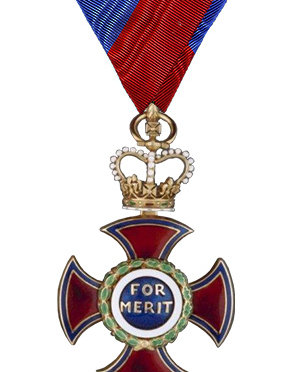
The Order of Merit badge consists of a golden crown suspended from a red enameled cross, which is centered by a disk of blue enamel surrounded by a laurel wreath and bearing in gold lettering the words FOR MERIT.

The insignia for the military grouping is distinguished by a pair of crossed swords behind the central disk. The ribbon is divided into two stripes of red and blue.

Men wear their badges on a neck ribbon, while women carry theirs on a ribbon bow pinned to the left shoulder, and aides-de-camp may wear the insignia on their aiguillettes.

The Order of the Bath Medal

The Most Honorable Order of the Bath is a British order of chivalry founded by King George I in 1725 and turned into a Military Order.

The Most Honorable Order of the Bath (also knows previously as “The Most Honorable Military Order of the Bath“) is a British order of chivalry founded by King George I on 18 May 1725 and erected into a regular Military Order.

The name Order of the Bath is derived from the ancient practice of ritual purification by bathing, symbolizing spiritual cleansing and renewal. In medieval times, knights were often ceremonially bathed before being dubbed into chivalric orders, signifying their commitment to noble ideals and virtues. The knights product of this ceremony were known as “Knights of the Bath“.

The Order was re-organized in 1815 in two divisions: Military and Civil. Members can belong to either the Civil or the Military Division. Before 1815, the order had only a single class (Knight Companion), but it no longer exists.

The Order of the Bath Classes

The Order of the Bath consists of three classes, each with its own distinctive medal. These three classes of the Order of the Bath recognize different levels of achievement and service to the British Crown. 

  • Knight Grand Cross (GCB): The highest class of the Order is awarded for the most exceptional acts of service and gallantry. Recipients of this honor are entitled to wear a star and a badge. 

  • Knight Commander (KCB): The second class is awarded for distinguished service and gallantry. Recipients of this honor are entitled to wear a star and a badge suspended from a crimson ribbon worn around the neck.

  • Companion (CB): The third and lowest class is awarded for meritorious service and gallantry. Recipients are entitled to wear a badge only.

A Brief History of the Order of the Bath

The origins of the Order can be traced back to the medieval period, with its establishment formally documented in the early 18th century. The modern incarnation of the Order of the Bath was founded by King George I of Great Britain in 1725. The king established the order as a means of recognizing and rewarding military and civil merit within his realm. 

During the Napoleonic Wars of the late 18th and early 19th centuries, the Order of the Bath experienced a period of revival and expansion. It became one of the most prestigious honors bestowed by the British Crown, awarded to military officers and civil servants for distinguished service, bravery, and leadership in times of conflict.

Over the centuries, the Order of the Bath has continued to evolve, adapting to changes in British society and the nature of warfare. It remains an important institution, honoring individuals who have made significant contributions to the nation, both in times of war and peace.

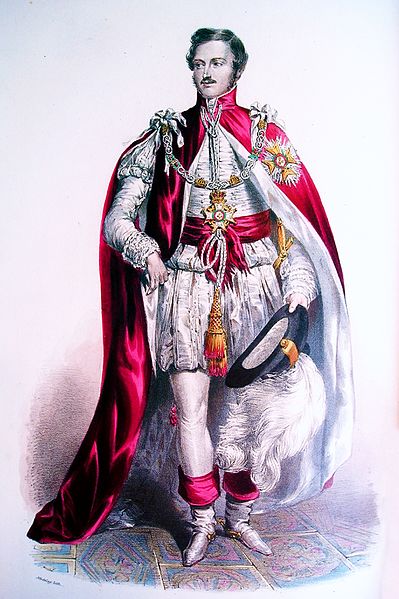
Prince Albert, the Prince Consort, Great Master 1843–1861.

The Most Honorable Order of the Bath Medal Design

Members of the Order wear elaborate costumes on important occasions (such as its quadrennial installation ceremonies and coronations), which vary by rank.

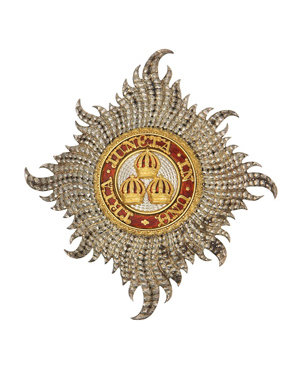
The star is a silver flaming star surmounted by a circular gold band enameled red bearing the motto around the top and laurel around the foot. It encloses three gold crowns enameled in red. The collar chain is made of gold and composed of nine crowns and eight devices (a rose, a thistle, and a shamrock), connected by gold, white-enameled knots. The collar badge is a skeletal gold badge with an oval collar and the inscription “TRIA JUNCTA IN UNO” (or “Three joined in one” in Latin) in white enameled letters. The inscription encloses a thistle, rose, and shamrock. The sash badge is similar to the collar one, but smaller and without white enamel. The ribbon is 38 millimeters and deep red.

The military badge is a gold Maltese Cross of eight points, enameled in white. Each point of the cross is decorated by a small gold ball, and each angle has a small figure of a lion. The center of the cross shows three crowns on the obverse side, and a rose, a thistle and a shamrock emanating from a scepter on the reverse. Both are surrounded by a red circular ring bearing the motto of the Order and flanked by two laurel branches, above a scroll bearing the words Ich Dien in gold letters.
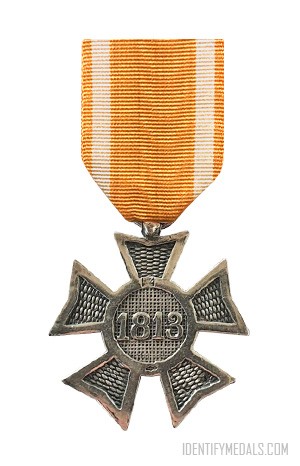
The civil badge is a plain gold oval bearing three crowns on the obverse side, and a rose, a thistle, and a shamrock, emanating from a scepter on the reverse side; both emblems are surrounded by a ring bearing the motto of the Order.

The Waterloo Medal

The Waterloo Medal is a British military medal established in 1816-17 and struck for all those who participated in the Waterloo campaign.

The Waterloo Medal is a British military medal established in 1816-17 by the House of Commons. The military medal was to be struck for all those who participated in the Waterloo campaign.

On 23 April 1816, it was announced in the London Gazette that the Prince Regent had been graciously pleased to confer the Waterloo Medal upon every officer, non-commissioned officer and soldier of the British Army who took part in the battles of Ligny (16 June 1815), Quatre Bras (16 June 1815) and/or Waterloo (18 June 1815). This included also members of the King’s German Legion.

The measure was supported by the Duke of Wellington, who on 28 June 1815 wrote to the Duke of York: “…the expediency of giving to the non commissioned officers and soldiers engaged in the Battle of Waterloo a medal. I am convinced it would have the best effect in the army, and if the battle should settle our concerns, they will well deserve it.

On 17 September 1815, the Duke of Wellington wrote to the Secretary of State for War recommending “that we should all have the same medal, hung to the same ribbon as that now used with the [Army Gold] Medal.

The Waterloo Medal was finally issued in 1816–1817 and given to every soldier that had been present at one or more of the battles of Ligny, Quatre Bras and Waterloo. Each and every soldier was also credited with two years extra service and pay, and were to be known as “Waterloo Men“.

Different Waterloo Medals

The Waterloo medal was the first medal issued by the British Government to all soldiers present during an action, and it was also the first campaign medal awarded to the next-of-kin of men killed in action.

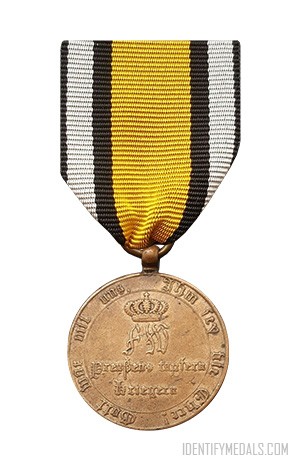
Seven nations of the Seventh Coalition struck medals for soldiers who took part in the campaign: 

British Campaign Medals: The Brunswick Waterloo Medal

The Brunswick Waterloo Medal

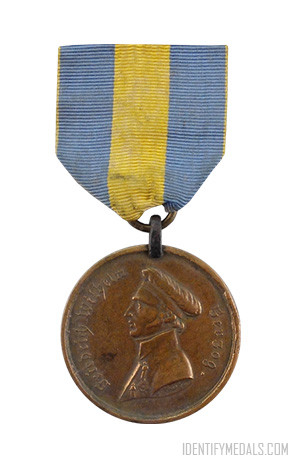
The Brunswick Waterloo Medal was a campaign medal awarded to those who participated in the Battles of Quatre Bras and Waterloo.

British Campaign Medals: The Hanoverian Waterloo Medal

The Hanoverian Waterloo Medal

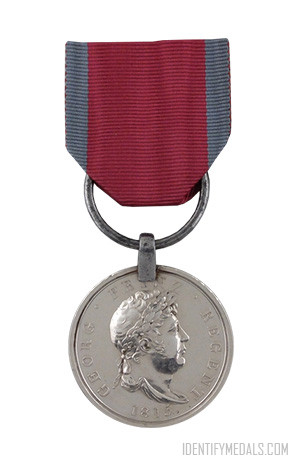
The Hanoverian Waterloo Medal was issued to all members of the Hanoverian army who fought in the battles of Quatre Bras and Waterloo.

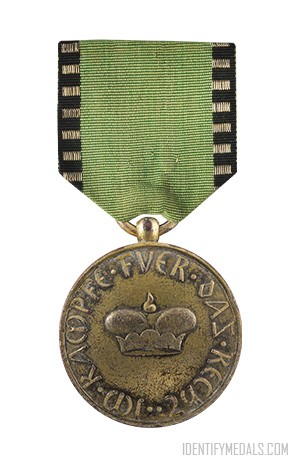
British Campaign Medals: The Nassau Medal for Waterloo

The Nassau Waterloo Medal

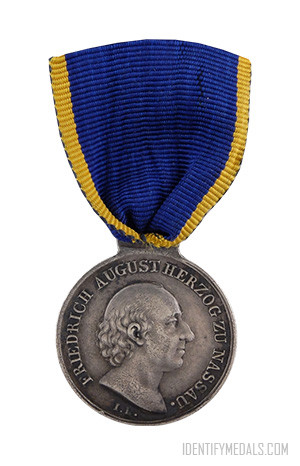
The Waterloo Medal is a campaign of the Duchy of Nassau established by Frederick Augustus, Duke of Nassau on 23 December 1815.

The Waterloo Medal Design

The Waterloo medal is made of silver and is 37 mm (1.5 in) in diameter. It was designed by Thomas Wyon, a recently appointed Chief Engraver to the Royal Mint. The medals were to be awarded originally in bronze, but it was decided at a late stage that they should be produced in fine silver.

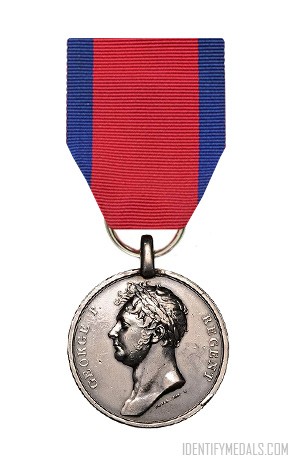
The obverse of the Waterloo medal shows a left facing effigy of the Prince Regent with the inscription GEORGE P. REGENT. The reverse displays a figure of Victory seated on a plinth with the words WELLINGTON above, and WATERLOO and the date JUNE 18 1815 below.

The design of the Waterloo medal was modeled on an ancient Greek coin from Elis, that belongs today to the British Museum collection.

Find This Medal

Right Now on eBay 
Clicking a link to eBay may result in a referral commission being paid if a purchase is made.
Loading...

The Seringapatam Medal

The Seringapatam medal (Sri Ranga Pattana) is a British military medal commissioned by the East India Company in 1801 and given to soldiers.

The Seringapatam medal (or Sri Ranga Pattana) is a British military medal commissioned by the East India Company in 1801 and distributed to soldiers who had contributed to the British victory in the 1799 Battle of Seringapatam, fought against the armies of Tipu Sultan, who was the ruler of the Kingdom of Mysore

These medals were issued to all participants, but their materials were of various values; Those given to the highest-ranking commanders were made of gold, the ones given to intermediate ranks were silver, silver-gilt, or bronze, and those for lesser ranks were made of tin or pewter.

The Seringapatam Medal Design

The medal was designed by Conrad Heinrich Küchler, a German engraver who  worked as a designer of coinage and medals for the manufacturer and mint owner Matthew Boulton from 1793 until his death. Küchler was Boulton’s sole artist for designing and die-cutting, and produced the designs for various coins, medals and tokens, including the copper “cartwheel” pennies and twopences.

Many of the Seringapatam medals were manufactured at the Soho Mint in Birmingham, although a smaller version of the medal was manufactured in the Calcutta Mint.

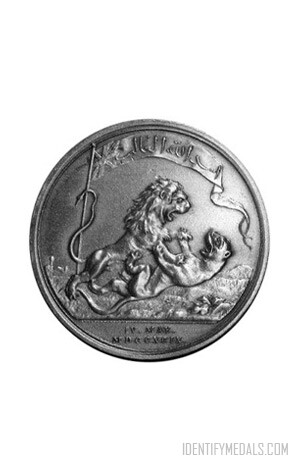
The reverse of the medal displays the storming of the fort, with the sun at its meridian. The obverse shows the British lion trampling Tipu’s emblem, the tiger, with the caption “Asad Allah al-Ghalib” (that means “Lion of God the Conqueror” in Arabic).

The Wehrmacht Long Service Award

The Wehrmacht Long Service Award is a military service decoration of Nazi Germany issued for satisfactory completion of years in service.

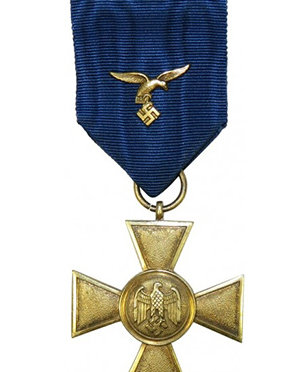
The Wehrmacht Long Service Award (or Wehrmacht-Dienstauszeichnung in German) is a military service decoration of Nazi Germany, which was issued for satisfactory completion of a number of years (12, 18, 25 or 40) in military service.

On 16 March, 1936, Adolf Hitler ordered the institution of service awards for the first four classes. Afterwards, on 10 March, 1939, the 40 years service award was also introduced.

Each branch of the Wehrmacht (air force, army and navy) maintained their own version of the Long Service Award. The decoration was issued for four years (fourth class), 12 years (third class), 18 years (second class), 25 years (first class), and 40 years (1939 special class).

The Wehrmacht Long Service Award Design

The award was designed by Dr Richard Klein, a German artist known for his patriotic work as a medallist from the start of World War I and for his work as a favoured artist of the Nazi regime. Klein was director of the Munich School of Applied Arts and also one of Hitler’s favorite painters. His work was exhibited at the “Great German Art Exhibition” held at the Haus der Kunst in Munich in 1937, including plaques contributed from Adolf Hitler’s private collection.

Recipients of lower Wehrmacht Long Service year awards would wear the decoration simultaneously with higher level decorations in the following manner:

  • 3rd Class with 4th Class
  • 2nd Class with 4th Class
  • 1st Class with 3rd Class

The Long Service Award was retroactive throughout a service member’s career, including Reichswehr service and service during and before World War I. In consequence, there were a handful of 40 year awards presented even when the Nazi era only lasted 12 years, from 1933 to 1945.