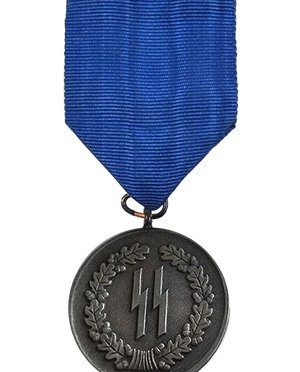
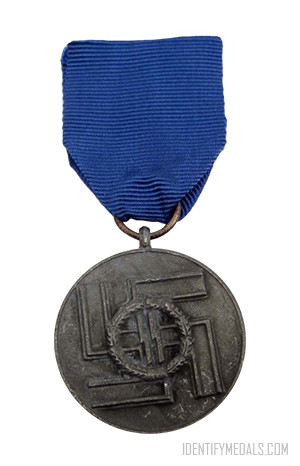
The SS Long Service Award (4 Years of Service)

The SS Long Service Awards were given in grades of four years, eight years, twelve years, and twenty-five years of true services in the SS.

The SS Long Service Awards (or SS-Dienstauszeichnungen in German) were given in grades of four years, eight years, twelve years, and twenty-five years as an acknowledgment for faithful and true services of SS members in the SS-Verfügungstruppen (SS Dispositional Troops), SS-Totenkopfverbänden (Death’s Head Units) und SS-Junkerschulen (Junker Schools). It was first introduced by Adolf Hitler on 30 January 1938.

The SS Long Service Award for 4 years of service was the first and lowest class in the hierarchy of the SS long service awards. The 4-year award was specifically given to non-commissioned officers (NCOs) and enlisted men, recognizing their service within the SS.

The SS Long Service Awards Grades or Classes

The grades are awarded to the respective ranks as follows:

  • 1st Class (Gold) for 25 years true service awards to eligible Officers, NCO’s and Men
  • 2nd Class (Silver) for 12 years true service awards to eligible Officers, NCO’s and Men
  • 3th Class (Bronze) for 8 years true service awards to eligible Officers, NCO’s and Men
  • 4th Class (Black) for 4 yrs true service for eligible NCO’s and Men.

The four-year and eight-year awards were the most common awards, and despite the fact that the Nazi movement lasted for little over 25 years, awards of the 25-year version were made well before 25 years of actual service were completed. This was because Kampfzeit (or “Time of Struggle”) counted double. Nevertheless, this was one of the rarer awards given out by Nazi Germany.

The SS Long Service Awards Design

The SS service awards were designed in Munich by Professor Karl Diebitsch, an artist and the Schutzstaffel (SS) officer responsible for designing much of the SS regalia in the Third Reich, including the chained SS officer’s dagger scabbard.

On its reverse side, each award had emblazoned the inscription, in German: FÜR TREUE DIENSTE IN DER SS (“For Loyal Service in the SS”). 

The awards varied in design depending on the length of service of the recipient, and the branches of the Wehrmacht (LuftwaffeHeer and Kriegsmarine) had different insignia. The Nazi Party and German Police also had a similar service award.

The four and eight-year service awards were in the form of circular medals while the 12 and 25-year service awards were in the form of swastikas.  According to historian Chris Ailsby the awards ceased to be given at the end of 1941.

The four-year service award featured a black finish and was exclusively given to non-commissioned officers (NCOs) and enlisted men. The use of black enamel and the SS runes emphasized the connection to the SS organization. 

The SS Long Service Award (8 Years of Service)

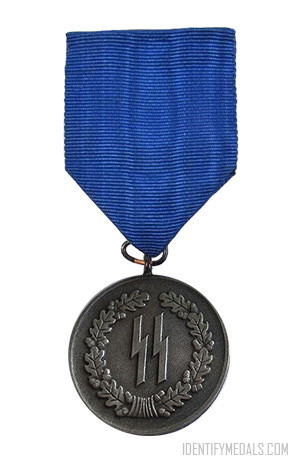
The SS Long Service Award (8 Years) was given as an acknowledgment for faithful and true services of German SS members.
The SS Long Service Awards (or SS-Dienstauszeichnungen in German) were given in grades of four years, eight years, twelve years, and twenty-five years as an acknowledgment for faithful and true services of SS members in the SS-Verfügungstruppen (SS Dispositional Troops), SS-Totenkopfverbänden (Death’s Head Units) und SS-Junkerschulen (Junker Schools). It was first introduced by Adolf Hitler on 30 January 1938.

The four and eight-year service awards were in the form of circular medals while the 12 and 25-year service awards were in the form of swastikas.  According to historian Chris Ailsby the awards ceased to be given at the end of 1941.

The SS Long Service Awards Grades or Classes

The grades are awarded to the respective ranks as follows:

  • 1st Class (Gold) for 25 years true service awards to eligible Officers, NCO’s and Men
  • 2nd Class (Silver) for 12 years true service awards to eligible Officers, NCO’s and Men
  • 3th Class (Bronze) for 8 years true service awards to eligible Officers, NCO’s and Men
  • 4th Class (Black) for 4 yrs true service for eligible NCO’s and Men.

The four-year and eight-year awards were the most common awards, and despite the fact that the Nazi movement lasted for little over 25 years, awards of the 25-year version were made well before 25 years of actual service were completed. This was because Kampfzeit (or “Time of Struggle”) counted double. Nevertheless, this was one of the rarer awards given out by Nazi Germany.

The SS Long Service Awards Design

The SS service awards were designed in Munich by Professor Karl Diebitsch, an artist and the Schutzstaffel (SS) officer responsible for designing much of the SS regalia in the Third Reich, including the chained SS officer’s dagger scabbard.

On its reverse side, each award had emblazoned the inscription, in German: FÜR TREUE DIENSTE IN DER SS (“For Loyal Service in the SS”). 

The awards varied in design depending on the length of service of the recipient, and the branches of the Wehrmacht (LuftwaffeHeer and Kriegsmarine) had different insignia. The Nazi Party and German Police also had a similar service award.

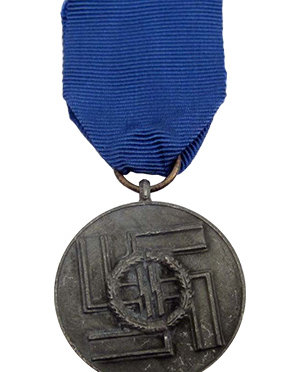
The eight-year service award was finished in bronze and was awarded to all Officers, NCOs and enlisted men. The eight-year service medal was manufactured by the firm Deschler.

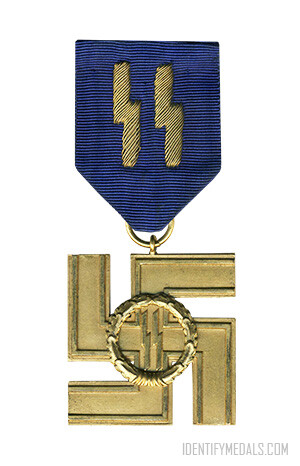
The SS Long Service Award (12 Years of Service)

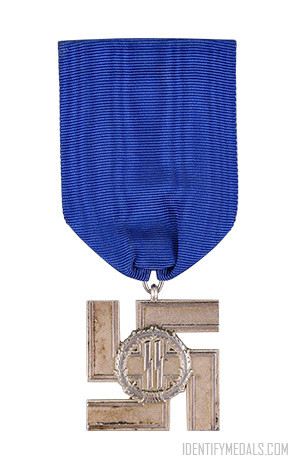
The SS Long Service Awards were given to SS members in grades of four, eight, twelve, and twenty-five years of service.
The SS Long Service Awards (or SS-Dienstauszeichnungen in German) were given in grades of four years, eight years, twelve years, and twenty-five years as an acknowledgment for faithful and true services of SS members in the SS-Verfügungstruppen (SS Dispositional Troops), SS-Totenkopfverbänden (Death’s Head Units) und SS-Junkerschulen (Junker Schools). It was first introduced by Adolf Hitler on 30 January 1938.

The four and eight-year service awards were in the form of circular medals while the 12 and 25-year service awards were in the form of swastikas.  According to historian Chris Ailsby the awards ceased to be given at the end of 1941.

The SS Long Service Awards Grades or Classes

The grades are awarded to the respective ranks as follows:

  • 1st Class (Gold) for 25 years true service awards to eligible Officers, NCO’s and Men
  • 2nd Class (Silver) for 12 years true service awards to eligible Officers, NCO’s and Men
  • 3th Class (Bronze) for 8 years true service awards to eligible Officers, NCO’s and Men
  • 4th Class (Black) for 4 yrs true service for eligible NCO’s and Men.

The four-year and eight-year awards were the most common awards, and despite the fact that the Nazi movement lasted for little over 25 years, awards of the 25-year version were made well before 25 years of actual service were completed. This was because Kampfzeit (or “Time of Struggle”) counted double. Nevertheless, this was one of the rarer awards given out by Nazi Germany.

The SS Long Service Awards Design

The SS service awards were designed in Munich by Professor Karl Diebitsch, an artist and the Schutzstaffel (SS) officer responsible for designing much of the SS regalia in the Third Reich, including the chained SS officer’s dagger scabbard.

On its reverse side, each award had emblazoned the inscription, in German: FÜR TREUE DIENSTE IN DER SS (“For Loyal Service in the SS”). 

The awards varied in design depending on the length of service of the recipient, and the branches of the Wehrmacht (LuftwaffeHeer and Kriegsmarine) had different insignia. The Nazi Party and German Police also had a similar service award.

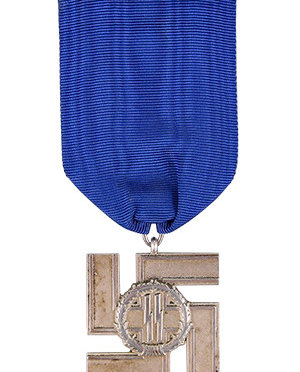
The twelve-year service award was in the shape of the swastika, had a silver finish and was awarded to all Officers, NCOs and enlisted men.

The Sudetenland Medal

The commonly known Sudetenland Medal was a decoration of Nazi Germany established in 1938 and awarded for the occupationsof Sudetenland.

The commonly known Sudetenland Medal (or “1 October 1938 Commemorative Medal”, Die Medaille zur Erinnerung an den 1. Oktober 1938 in German) was a decoration of Nazi Germany awarded during the interwar period.

The Sudetenland medal was instituted on 18 October 1938 and was awarded to all German (and as well Sudeten) military personnel and State officials who had participated in the occupation of Sudetenland and the occupation of Czechoslovakia in March 1939, as well as members of the German Wehrmacht and SS who marched into Sudetenland. Later, the medal was awarded to military personnel participating in the occupation of the remnants of Czechoslovakia on 15 March 1939.

The Sudetenland medal was awarded until 31 December 1940. In total, 1,162,617 medals and 134,563 bars were awarded.

The Sudetenland Medal Design

The medal was designed by Professor Richard Klein, a German artist known for his patriotic work as a medallist from the start of World War I and for his work as a favoured artist of the Nazi regime.

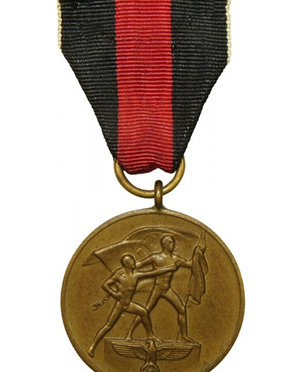
The medal looked similar to the Anschluss Medal, but the reverse differed in the date. It is round and on the obverse there is a man standing on a podium with the Third Reich coat of arms and holding the Nazi flag. The man is holding his hand and helping him get on the podium. Another man has a broken shackle on his right hand, symbolizing the joining to the Reich of Austria.

On the reverse side there is the inscription “1. Oktober 1938“, and the date is surrounded with the words “Ein Volk, Ein Reich, Ein Führer” (One People, One Empire, One Leader).

The medal was dye-struck and high in detail, with a bronze finish. It was suspended from a black ribbon with a red stripe in the middle, these being the colors of the Sudetenland.

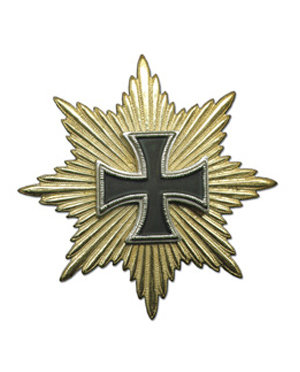
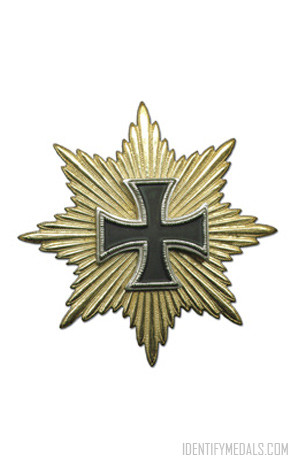
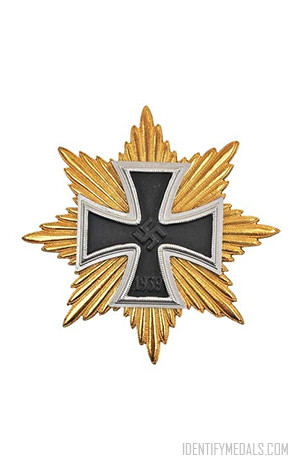
The Star of the Grand Cross of the Iron Cross

The Star of the Grand Cross of the Iron Cross was the highest military decoration of the Kingdom of Prussia and the German Empire. 

The Star of the Grand Cross of the Iron Cross (or Stern zum Großkreuz des Eisernen Kreuzes in German) was a senior decoration to the Grand Cross of the Iron Cross and the highest military decoration of the Kingdom of Prussia and the German Empire. The award is commonly known as “Blücher’s Star” (Blücherstern) after its first recipient.

This award was given to the most outstanding of generals who had performed feats of leadership that had extremely benefited the German state.

The Star of the Grand Cross of the Iron Cross was awarded only twice, a century apart. The first time it was to Field Marshal Gebhard von Blücher in 1815, to recognize his victory over Napoleon at the Battle of Waterloo. The second was awarded to Field Marshal Paul von Hindenburg in 1918 for his victory at the Battle of Tannenberg. Paul von Hindenburg received the Grand Cross of the Iron Cross (9 December 1916) to which the Golden Star added on 25 March 1918 (Star of the Grand Cross of the Iron Cross).

The Star of the Grand Cross of the Iron Cross Design

During the reign of Nazi Germany, Reichsmarschall Hermann Göring commissioned a new version of the Star of the Grand Cross of the Iron Cross medal, with the intention of awarding it to Adolf Hitler once Germany had won the Second World War. Because Germany was defeated in 1945, the award was never bestowed on him.

After the Allied victory in May 1945, the US Army seized the only known prototype of this medal, which had been securely stored in a bunker. It is now a part of the collection of the Museum of the United States Military Academy in West Point, New York.

More Variations of the Iron Cross

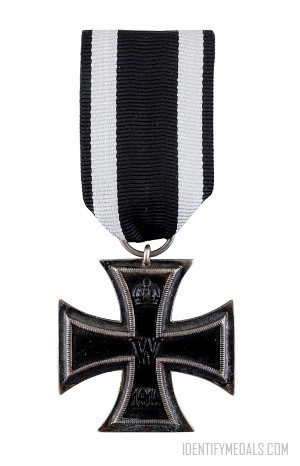
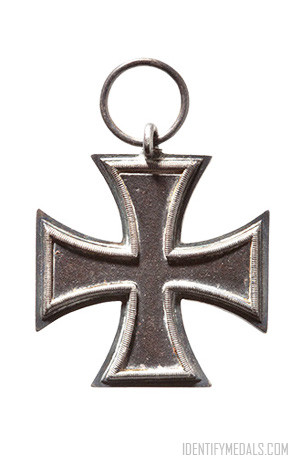
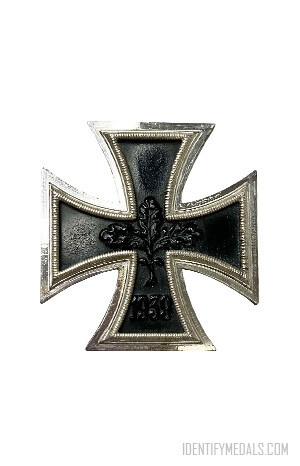
The Iron Cross, a prestigious German military decoration, has undergone several variations since its inception. For example, the Iron Cross 1813 was instituted during the Napoleonic Wars by King Frederick William III of Prussia, the Iron Cross 1914 was awarded during World War I, it was reinstated by Kaiser Wilhelm II, and the Iron Cross 1939 was revived by Adolf Hitler for World War II, with modifications including a swastika.

Find the Iron Cross Medal Online

Right Now on eBay 
Clicking a link to eBay may result in a referral commission being paid if a purchase is made.
Loading...

Further Reading About the Iron Cross

Discover the stories behind the Iron Cross with these compelling books and delve into the rich history and significance of this prestigious military decoration.

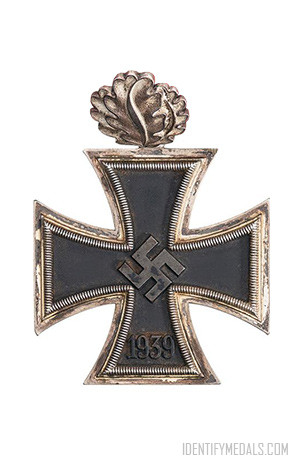
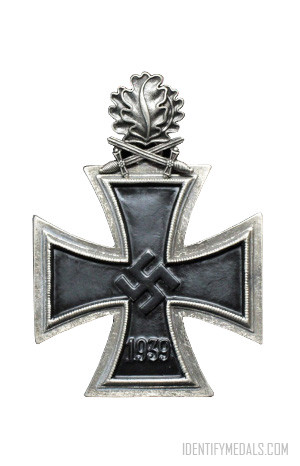
The Knight’s Cross of the Iron Cross (EK 1939)

The Knight’s Cross of the Iron Cross was the highest military and paramilitary award for the forces of Nazi Germany during World War II. 

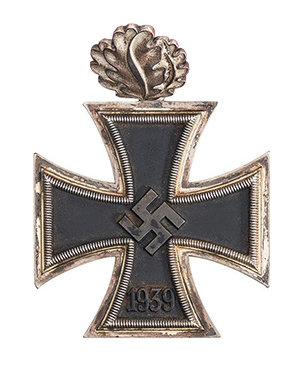
The Knight’s Cross of the Iron Cross (or Ritterkreuz des Eisernen Kreuzes in German, also known as the Knight’s Cross or Ritterkreuz), was the highest military and paramilitary award for the forces of Nazi Germany during World War II. The award was instituted on 1 September 1939, at the onset of the German invasion of Poland, although it had been initially created by King Friedrich Wilhelm III of Prussia on 17 March 1813 (EK 1813).

The Knight’s Cross was awarded across all ranks for a wide range of reasons like skilled leadership of troops in battle or single acts of military valor. It was awarded to members of the three military branches of the Wehrmacht (the Heer or army, the Kriegsmarine or navy, and the Luftwaffe, Waffen-SS, Reichsarbeitsdienst and Volkssturm), along with personnel from other Axis powers.

Several higher graded, like the Oak Leaves to the Knight’s Cross, the Knight’s Cross with Oak Leaves, Oak Leaves and Swords and with Oak Leaves, Swords and Diamonds between 1941 and 1944, when the final grade, the Knight’s Cross with Golden Oak Leaves, Swords and Diamonds, was created.

The Knight's Cross of the Iron Cross Design

The Iron Cross was established by the Prussian king Friedrich Wilhelm III at the beginning of the German campaign during the Napoleonic Wars. The design was a silver-framed cast iron cross on 13 March 1813.

The material utilized was iron, because it symbolised defiance and reflected the spirit of the age. To finance the Prussian state army repulse the French occupation, the king implored wealthy Prussians to turn in their jewels in exchange for a men’s cast-iron ring or a ladies’ brooch, each bearing the legend “Gold I gave for iron” (Gold gab ich für Eisen).

The Iron Cross was renewed in 1939 with the outbreak of World War II and with Adolf Hitler in his role as commander in chief of the German armed forces. A new grade of the series was introduced, the Knight’s Cross of the Iron Cross

Over 7,000 awards were made during the course of the war. Analysis of the German Federal Archives revealed evidence for 7,161 officially bestowed recipients: 863 awards of the Oak Leaves to the Knight’s Cross, 147 Swords and 27 Diamonds awards. The Golden Oak Leaves to the Knight’s Cross was awarded only once, to Hans-Ulrich Rudela German ground-attack pilot, on 29 December 1944.

More Variations of the Iron Cross

The Iron Cross, a prestigious German military decoration, has undergone several variations since its inception. For example, the Iron Cross 1813 was instituted during the Napoleonic Wars by King Frederick William III of Prussia, the Iron Cross 1914 was awarded during World War I, it was reinstated by Kaiser Wilhelm II, and the Iron Cross 1939 was revived by Adolf Hitler for World War II, with modifications including a swastika.

Find the Iron Cross Medal Online

Right Now on eBay 
Clicking a link to eBay may result in a referral commission being paid if a purchase is made.
Loading...

Further Reading About the Iron Cross

Discover the stories behind the Iron Cross with these compelling books and delve into the rich history and significance of this prestigious military decoration.

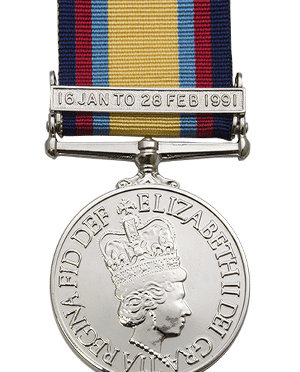
The Gulf Medal

The Gulf War Medal is a British campaign medal issued to officers and men of British forces who served in Kuwait and Saudi Arabia during Operation Granby.

The Gulf War Medal is a British campaign medal issued to officers and men of British forces who served in Kuwait and Saudi Arabia during Operation Granby (the Liberation of Kuwait) in 1990–91 and approved in 1992.

It was instituted to recognize and honor the service of British and Commonwealth military personnel who participated in the Gulf War (also known as Operation Desert Storm) and subsequent operations in the Persian Gulf region in the early 1990s.

The Gulf Medal was established in 1992 and was awarded for various periods of operational service in the Gulf region, depending on the specific campaign or operation. The medal comes in several variations, each with its own distinctive ribbon and clasp, denoting the specific period and theater of service.

In addition to the Gulf Medal, there is also a separate medal called the Iraq Medal, which was awarded for service in later operations in Iraq, particularly during the post-9/11 period.

The Gulf War Medal Clasps

Two clasps were authorized for those who served in Kuwait during the Iraqi invasion, and for those who took part in operations to liberate Kuwait:

  • 2 Aug 1990: Awarded to the members of the Kuwait Liaison Team who were in Kuwait on the said date, and who were taken hostage by the invading Iraqi Army.
  • 16 Jan-28 Feb 1991: Awarded for seven days continuous service between these dates in the designated Theatre of Operations. This clasp signifies service during the actual war.

In undress uniform, a rosette is worn on the medal ribbon to denote the award of either clasp.

The Gulf War Medal Design

The Gulf Medal is made of cupro-nickel and measures 36 millimeters (1.4 in) in diameter.

The obverse shows the crowned effigy of Queen Elizabeth II facing right with the inscription ELIZABETH II DEI GRATIA REGINA FID. DEF. The reverse display an eagle in flight above an automatic rifle superimposed on an anchor, representing the three services, with THE GULF MEDAL above and 1990-91 below. The recipients details were impressed in capitals on the edge of the medal.

The Gulf War Medal ribbon measures 32 millimeters (1.3 in) wide, and shows a sand-colored broad central stripe flanked by narrow stripes of dark blue, red and light blue which represent the three services. A dark blue line appears on both outer edges.

Find This Medal

Right Now on eBay 
Clicking a link to eBay may result in a referral commission being paid if a purchase is made.
Loading...

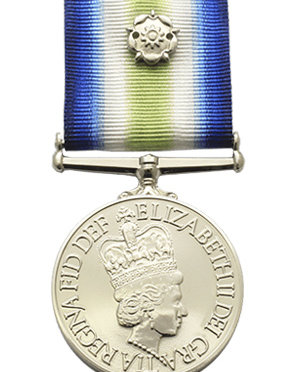
The South Atlantic Medal

The South Atlantic Medal is a British campaign medal awarded to civilians and military personnel for service in the Falklands War of 1982.

The South Atlantic Medal is a British campaign medal awarded to British civilians as well as military personnel for service in the Falklands War of 1982. Over 33,000 medals have been awarded. The South Atlantic Medal Association was formed in 1997 for recipients of the South Atlantic Medal.

Initially, about 29,700 people were awarded the South Atlantic medal, including Prince Andrew. Civil servants serving in Accession Island, NAAFI staff, war artist Linda Kitson and journalists attached to the armed forces, including Michael Nicholson, have also received this medal.

Since 2014 an additional 3,626 South Atlantic medals have been awarded without rosette, in response to the extension of the qualifying period to 21 October 1982.

The South Atlantic Medal Design

The South Atlantic Medal is made of cupronickel, and measures 36 mm in diameter. It was struck by the Royal Mint and issued by the Army Medal Office, Droitwich. The design, attributed to HM the Queen, was based on the ribbon for the 1939-45 Atlantic Star.

The obverse shows a crowned effigy of The Queen facing right, with the inscription ELIZABETH II DEI GRATIA REGINA FID:DEF (“Elizabeth II, by the grace of God, Queen and Defender of the Faith”). The reverse displays the Falkland Islands’ coat of arms, bearing the words “DESIRE THE RIGHT” (an allusion to English explorer John Davis’ ship, “Desire”). The border is made up of a laurel wreath below and the words “SOUTH ATLANTIC MEDAL” above.

The initials and surname, rank or rating, service number and unit of the recipient are diamond engraved on the edge of the medal, but the Royal Navy officers (as was the tradition) don’t include the service number.

The 32 mm ribbon has a central stripe of “sea green” flanked on each side by stripes of white and “empire blue” symbolizing the Atlantic Ocean.

Find This Medal

Right Now on eBay 
Clicking a link to eBay may result in a referral commission being paid if a purchase is made.
Loading...

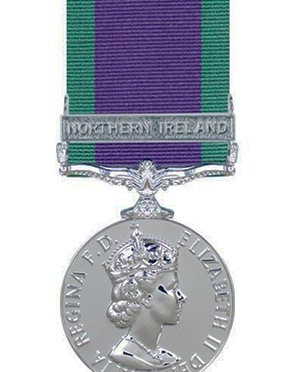
The General Service Medal (1962)

The General Service Medal 1962 (or 1962 GSM) is a campaign medal of the United Kingdom awarded for what were often arduous campaigns.

The General Service Medal 1962 (or 1962 GSM) is a campaign medal of the United Kingdom awarded for what were often arduous campaigns and well fought operations and introduced in 1962 to combine the General Service Medal (1918), which was awarded to the Army and RAF, and the Naval General Service Medal (1915). The 1962 General Service Medal was awarded until 2007.

The General Service Medal 1962 Design

The 1962 GSM is a circular silver medal measuring 36 mm in diameter. The obverse bears the crowned effigy of Queen Elizabeth II with the inscription ELIZABETH II DEI GRATIA REGINA F.D. The reverse shows the words ‘FOR CAMPAIGN SERVICE‘ under a crown, all surrounded by a wreath of oak leaves. The name, rank, service number and regiment or corps of the awardee are annotated on the rim of the medal.

The ribbon is 32 mm wide, purple with two outer stripes of dark green. In different proportions, these are the same colours as the GSM 1918–62.

Those mentioned in despatches during a campaign qualifying for the 1962 GSM wear a bronze oak leaf on the medal ribbon.

Fourteen clasps were awarded, and the medal always had one of them. The maximum appears to have been six, which were worn in the order that the recipient qualified for them and not the date of the relevant Army Order. There was no minimum qualifying period for each clasp for those killed, wounded or disabled during operations.

The clasps were: Cyprus 1963-64, Borneo, Radfan, South Arabia, Malay Peninsula, South Vietnam, Northern Ireland, Dhofar, Lebanon, Gulf of Suez, Gulf, Kuwait, North Irak and Turkey and Air Operations Irak.

Find This Medal

Right Now on eBay 
Clicking a link to eBay may result in a referral commission being paid if a purchase is made.
Loading...

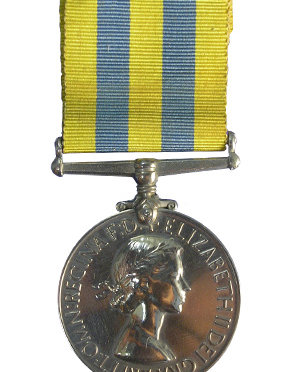
The Korea Medal

The Korea Medal (or Médaille de Corée in French), also known as the Queen’s Korea Medal, was a campaign medal created in 1951 to recognize troops from Australia, Canada, New Zealand, and the United Kingdom who had given 28 days service offshore during the Korean War, or at least one day’s service in an air sortie over Korea.

The Korean War was the first event in which United Nations (UN) armed forces took on a combat role in a multinational effort to stop the North Korean takeover of the Republic of Korea. It involved the participation of 20 UN member states, the Republic of Korea and Italy.

Except for Canada, the medal was identical in all countries where it was awarded, and holds a different place in each country’s order of precedence for honors.

The Korean War Medal Design

Designed by Edward Carter Preston, a Liverpool artist, sculptor and medallist, the Korea Medal measures 36 millimetres (1.4 in) and is a disc. All medals were made of cupro-nickel, except for the Canadian version that was made of silver.

On the Korean War medal obverse is an effigy of Queen Elizabeth II, surrounded by an inscription that symbolizes her roles as both fount of honour and Commander-in-Chief of her various forces. At the time of the medal’s creation, King George VI was monarch. However, he died on 6 February 1952 and so the image of his daughter was placed on the obverse of the medal, uncrowned.

There are three versions of the inscription surrounding the Queen’s head:

  • ELIZABETH II DEI GRA. BRITT. OMN. REGINA F.D. (Elizabeth II, by the Grace of God Queen of all the Britons, Defender of the Faith).
  • ELIZABETH II DEI GRATIA REGINA F.D. (Elizabeth II, by the Grace of God Queen, Defender of the Faith), later awards omitting BRITT. OMN..
  • ELIZABETH II DEI GRATIA REGINA CANADA (Elizabeth II, by the Grace of God Queen of Canada), awarded to Canadian participants.

On the reverse is a depiction of Hercules wrestling the Hydra—a symbolic representation of communism—with the word KOREA below.

The recipient’s name, rank and regimental number is impressed on the medal’s rim.