The German Social Welfare Decoration

The Social Welfare Decoration was created by Adolf Hitler as a civil award for services in the social sector.

The Social Welfare Decoration (or “Ehrenzeichen für deutsche Volkspflege” in German) was created by Adolf Hitler as a civil award for services in the social sector on 1 May 1939.

The decoration was issued in three classes and was awarded for a wide variety of service to the German statsuch as WinterhilfswerkNational Socialist People’s Welfare, medical and rescue work, or care of foreign and ethnic Germans.

The medal was a replacement for the German Red Cross Decoration. The main requirement for the award was that the service rendered should be to the benefit of the civil population. Reinhard Heydrich was awarded the decoration for his running of the Gestapo in the 1930s and for providing “security” to the German people. The infamous Doctor Josef Mengele was also awarded the decoration in 1941, for providing medical services to wounded soldiers and civilians alike on the battlefields of the Eastern Front.

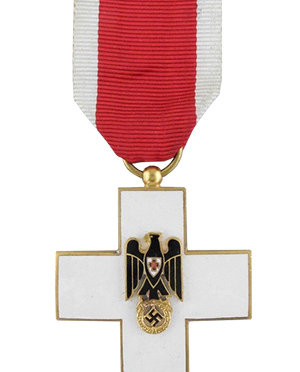
It was conferred in four classes consisting of a white-enameled gold Balkenkreuz with Reich eagle and swastika. A “Medal of Social Welfare” was also issued for lesser degrees of service, not warranting the higher presentation of a class award.
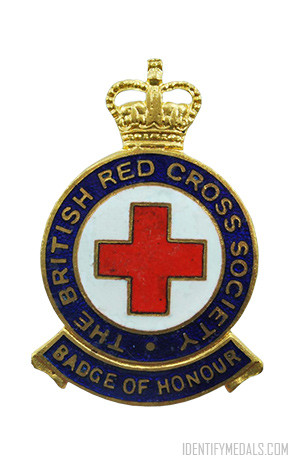
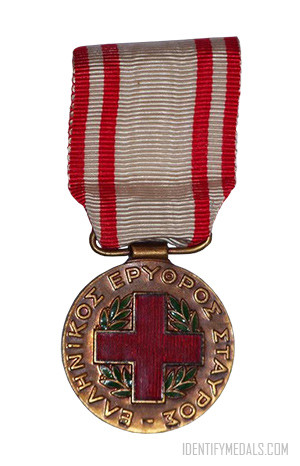
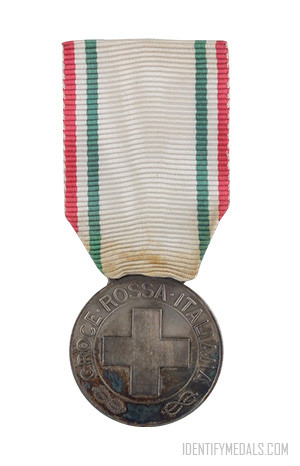
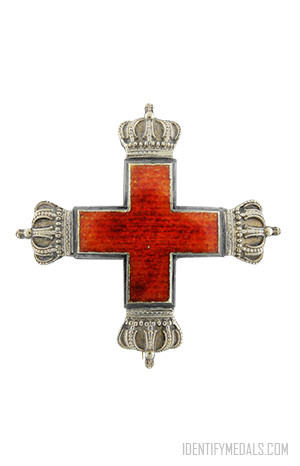
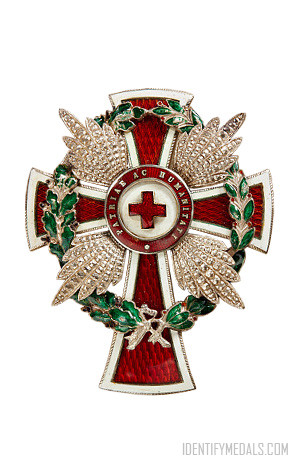
The German Red Cross Decoration

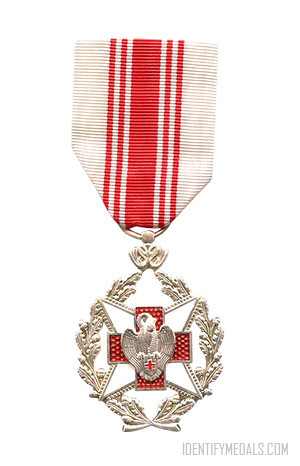
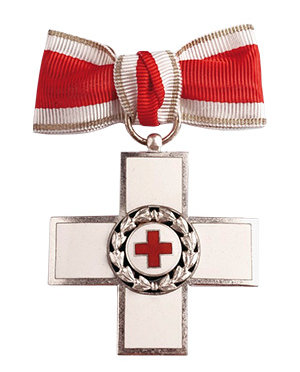
The German Red Cross Decoration (or “Ehrenzeichen des Deutschen Roten Kreuzes” in German) is a decoration founded in 1922.

The German Red Cross Decoration (or “Ehrenzeichen des Deutschen Roten Kreuzes” in German) is a decoration founded in 1922.

It was replaced (by Adolf Hitler) by the Social Welfare Decoration in 1939 and re-founded in its present form on 8 May 1953. It is awarded by the German Red Cross.

The West German Red Cross was recognized by the International Red Cross as the DRK BRD in 1951. The East German Red Cross was recognized by the International Red Cross as the DRK DDR in 1952.

Find Red Cross Medals Online

More Red Cross Medals

The Königgrätz Commemorative Cross

The Königgrätz Commemorative Cross is a Prussian medal instituted in 1866 by Wilhelm I and awarded to officers, NCOs and officials.

The Königgrätz Commemorative Cross is a Prussian medal instituted on September 20, 1866 by the King of Prussia Wilhelm I. The medal was awarded to Prussian officers, NCOs and other ranks as well as to military officials following the Prussian victory in the Austro-Prussian War (June 17 – July 26, 1866).

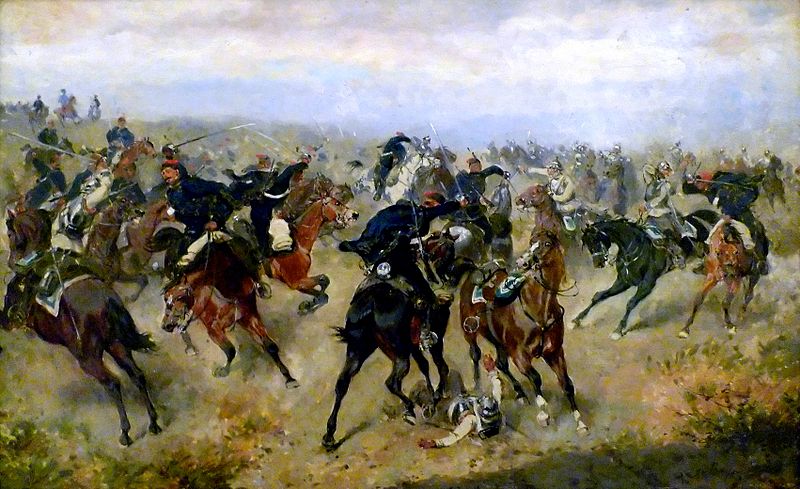
This award was named after the Battle of Königgrätz (Schalcht bei Königgrätz, also referred to as the Battle of Sadowa) that took place on July 03, 1866 and  involved the largest number of troops in Europe until that time. The battle ended with one of the highest casualties for a major battle: Austrians and their Saxon allies lost 44,000 men killed in action, wounded and missing in action including 22,000 being held prisoners while Prussians had 360 officers and 8,812 men killed.

A total of 144,000 “combat” crosses and 1,200 non-combatant versions were issued.

The Königgrätz Commemorative Cross Design

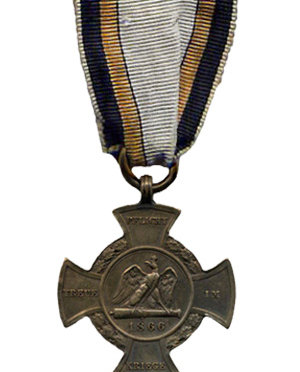
The medal has the shape of a cross pattée with a round medallion superimposed on its center and a round wreath between its arms and is made of bronze from captured Austrian cannons. It was designed by the Prussian court medalist Friedrich Wilhelm Kullrich (1821-1887) and the Prussian royal mint engraver Emil Weigand (1837-1906) and measured 34,5 x 34,5 mm.

A central medallion on its obverse has an image of a crowned Prussian eagle leaning against a captured Austrian cannon (with some variations). There were four different crosses instituted to commemorate “1866 victorious campaign”. All the four crosses share the same reverse design, a crowned cipher of the Prussian king Wilhelm I.

  • Königgrätz Cross: For the military personnel who participated directly in the Battle of Königgrätz. Inscription: “König-Grätz” – “Den 3.” – “Juli” – “1866”.
  • “Main Army” Cross: For the military personnel of a Main army who fought under command of General Eduard Vogel von Falckenstein against troops from Hannover, Hessen, Bavaria, Baden and Wurttemberg. Inscription “Der” – “Main” – “Armee” -“1866”.
  • “Loyal Fighters” Cross: For military personnel who hadn’t participated in the Battle of Königgrätz and were not attached to the Main army. Inscription “Treuen” – “Krie-” – “Gern” – “1866”.
  • “Loyal to its duty in times of war” Cross: For non-combatants. Round wreath is made of oak leaves. Inscription “Pflicht” – “Treue” – “Im” – “Kriege”.

Like other Imperial awards, the Cross was worn either obverse or reverse outwards. The silk ribbon of the first three versions of a Königgrätz Commemorative Cross was black with two yellow-orange and white vertical stripes closer to its edges.

Related Article:

The Pilot / Observer Badge of the Luftwaffe

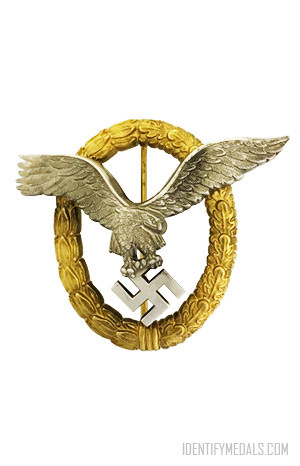
The Pilot/Observer Badge (or Flugzeugführer- und Beobachterabzeichen in German) was a WW2 German decoration instituted by Hermann Göring.

The Pilot/Observer Badge (or Flugzeugführer- und Beobachterabzeichen in German) was a World War II German military decoration instituted on 26 March 1936 by the Commander in Chief of the Luftwaffe Hermann Göring and awarded to Luftwaffe service personnel who had already been awarded the Pilot’s Badge and Observer Badge.

It was  It was worn on the lower part of the left breast pocket of the service tunic, underneath the Iron Cross 1st Class if awarded. It was to replace the older 1933 Aircrew Badge.

The Pilot/Observer Badge Design

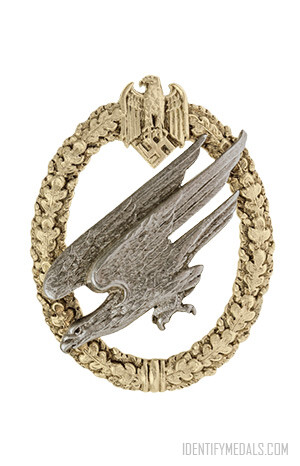
The badge was originally manufactured in bronze, and later zinc. The badge can be distinguished from the Pilot’s Badge by the gold wreath; the Pilot’s Badge had a silver wreath.

There was also a cloth version of the badge which used embroidered bullion for the officer’s version and cotton for the NCO’s version. The presentation case was dark blue, with a blue satin top liner and a blue velvet bottom liner on the inside.

There is an exclusive variant of the Pilot/Observer Badge in Gold with Diamonds (or Gemeinsame Flugzeugführer- und Beobachterabzeichen in Gold mit Brillanten in German). It was bestowed by Göring to honour exceptional achievement and on rare occasions as an honorary award. The first recipients were General Walther Wever, Chief of the Luftwaffe General Staff and General der Flieger Erhard Milch, State Secretary of the Reichsluftfahrtministerium on 11 November 1935.
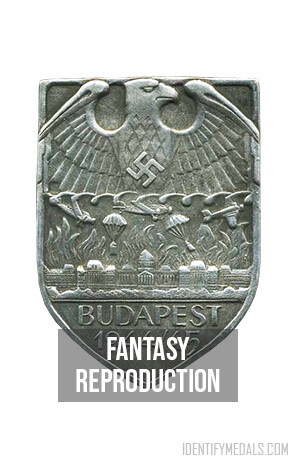
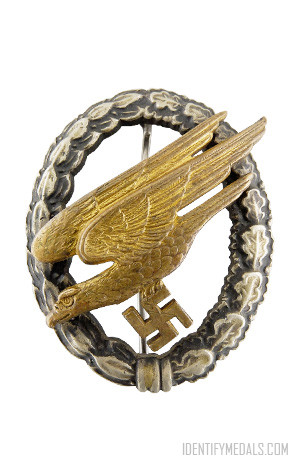
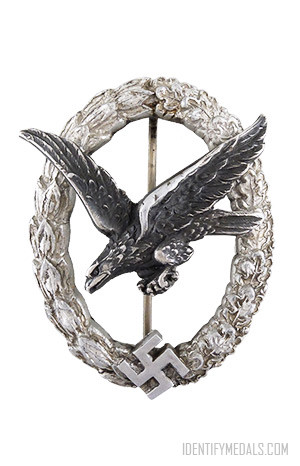
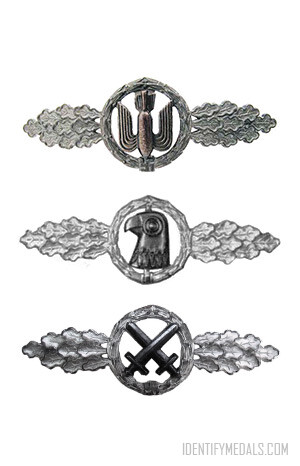
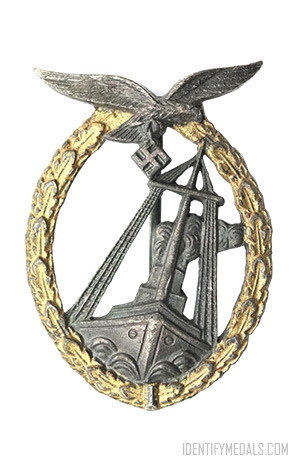
More Luftwaffe War Badges

Awarded to members of the German Luftwaffe for their achievements and contributions to air warfare, the Luftwaffe War Badges symbolized excellence, courage, and skill in aerial combat and support roles. Explore the complete collection below:

The Order of the Zähringer Lion

The Order of the Zähringer Lion was instituted on 26 December 1812 by the Grand Duke of Baden in memory of the Dukes of Zähringen.

The Order of the Zähringer Lion was instituted on 26 December 1812 by Karl, Grand Duke of Baden, in memory of the Dukes of Zähringen from whom he was descended.

It remains a very high-level award, sitting just above the Commander’s Cross (a neck order) and the Knight’s Crosses (1st and 2nd Class).

The Grand Duchy of Baden was formed in 1806 during the Napoleonic Wars. Its location on France’s southeastern border led to its devastation when it opposed the French Empire. Its two final Grand Dukes were Friedrich I (1826-1907), who reigned from 1856-1907 and his son, Friedrich II (1856-1928), who reigned from 1907 to the Empire’s end in 1918.

The Order of the Zähringer Lion was awarded in five classes:

  • Grand Cross;
  • Commander, First Class;
  • Commander, Second Class;
  • Knight, First Class; and
  • Knight, Second Class.

A total of 763 of this Order of the Zähringer Lion Grand Cross were awarded between 1815 and 1918.

The Order of the Zähringer Lion Design

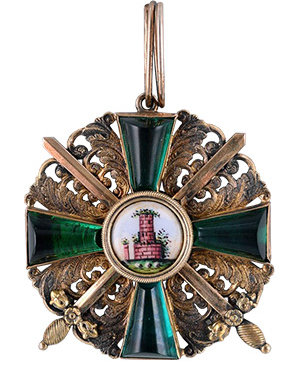
The order’s insignia measures 39.7 mm and consists of a green enameled cross with four arms of equal length, whose angles are filled out with golden clasps. The gold-edged medallion shows the tribal symbol of the Zähringers in coloured enamel. Around the circle is the order’s motto, FÜR EHRE UND WAHRHEIT (German for “FOR HONOUR AND TRUTH”). On the back, the Zähringer lion is portrayed on a red background. The order’s ribbon is green with orange-yellow stripes along the edges.

For special awards, the order was granted with oak leaves and from 1866, it could also be awarded with crossed swords for military services. The oak leaves originally carried an “L” cipher, which went out of use in 1866. Moreover, in exceptional cases, the grand cross award could also be covered in diamonds

The Württemberg Military Merit Order

The Military Merit Order (Militärverdienstorden) was a military order of the Kingdom of Württemberg, which joined the German Empire in 1871.

The Military Merit Order (or Militärverdienstorden in German) was a military order of the Kingdom of Württemberg, which joined the German Empire in 1871.

The order was one of the older military orders of the states of the German Empire. It was founded on February 11, 1759 by Karl Eugen, Duke of Württemberg as the Militär-Carls-Orden, and was renamed the Militärverdienstorden on November 11, 1806 by King Friedrich I. The order underwent several more revisions over the course of the 19th and early 20th centuries. It became obsolete with the fall of the Württemberg monarchy in the wake of Germany’s defeat in World War I.

The order came in three classes. Generally, the rank of the recipient determined which grade he would receive:

  • Grand Cross (Großkreuz)
  • Commander’s Cross (Kommandeurkreuz) and
  • Knight’s Cross (Ritterkreuz).

Between 1799 and 1919, there were an estimated 95 awards of the Grand Cross, 214 of the Commander’s Cross, and 3,128 of the Knight’s Cross, with the bulk of these awards made in World War I; the numbers may only cover native Württembergers.

The Württemberg Military Merit Order Design

The badge of the order was a white-enameled gold cross pattée with curved arms and slightly concave edges. Around the white-enameled center medallion was a blue-enameled gold ring bearing on both sides the motto “Furchtlos und trew” (“Fearless and loyal”).

On the obverse, the medallion bore a green-enameled gold laurel wreath. On the reverse, the medallion bore the monogram of the king of Württemberg at the time of award. The cross was the same size for the Grand Cross and the Commander’s Cross, and slightly smaller for the Knight’s Cross. The Grand Cross and Commander’s Cross, and from 1870 the Knight’s Cross, were topped with a crown. On September 25, 1914, the crown was removed from all grades.
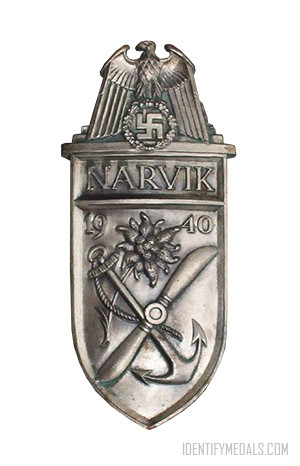
The star of the order, awarded with the Grand Cross only, was a gold-rimmed silver eight-pointed star featuring the ringed medallion of the obverse of the cross.

The ribbon of the order was, until 1818 and after 1914, yellow with broad black stripes near each edge. After November 1917, when the ribbon was worn without the medal, the ribbon bore a green-enameled wreath to distinguish it from other Württemberg decorations on the same ribbon. The ribbon from 1818 to 1914 was blue.

Buy This Medal Online

Right Now on eBay 
Clicking a link to eBay may result in a referral commission being paid if a purchase is made.
Loading...

The Panzer Badge or Tank Battle Badge (Nazi Germany)

The Panzer Badge (or Panzerkampfabzeichen) was a World War II military decoration of Nazi Germany awarded to troops in armored divisions. 

The Panzer Badge (or Panzerkampfabzeichen in German) was a World War II military decoration of Nazi Germany awarded to troops in armored divisions.

If you know a thing or two about World War II, you might be aware that the German Panzers played one of the major roles, if not the most important one. Led by intrepid commanders such as Erich Von Manstein, Heinz Guderian, Erwin Rommel, and many more, the Panzers broke the front lines with speed, power and destruction following their paths. But the men who led the Panzers through the Russian Steppe or Northern France were the real “Heroes.”

To recognize the achievements of some of these Panzer crews, the OKW (OberKommando Wehrmacht, the German ground army HQ) decided to create a medal for these men. It was first awarded during World War I but was long forgotten since the Germans saw little action during the end of the war.

During the interwar period, a badge was issued for the veterans of the Condor Legion who participated in the Spanish Civil War. But as World War II was starting, the tank crews and their beloved tactics needed something, something to recognize their “Blitz” through the enemy lines.

Famous Recipients of The Panzer Badge

The most decorated generals of the Wehrmacht never got their grasp on this badge, even if their achievements were enormous. No, this badge was meant for the crewmen, those who gave their life for their country. Some of them never saw the end of the war, but some others did.

Otto Carius, per example, is one of the most decorated Panzer ace, having destroyed more than 150 enemy tanks, and most surprinsigly, a flying enemy plane. This particular enemy plane was “annoying” the gunner of the tank, Heinz Kramer, shooting its armor with its machine gun. As the sound of bullets hitting the armor was annoying more and more Mr Kramer, he asked permission to shoot down the plane, and after a first missed shot, shot down the plane. Probably the best tank shot ever. Carius lived until 2015 in Germany and was the last Panzer ace alive.

The most famous Panzer ace, Michael Wittmann, was also awarded with the highest class of the Badge. He was known to have destroyed at least 150+ tanks and more than 130 enemy canons (of any caliber). Unfortunately for him, he ultimately died in Normandy during Operation Overlord in his beloved Tiger. Nonetheless, his legend grew after the war when all of his achievements were discovered.

These folks are some of the most famous recipients of the Panzer Badge, but it would be wrong to forget about the 34,000 others that got the Badge in the different classes with around 22,000 getting the silver one.

There was definitely a lot of recipients during World War II but what is somehow “strange”, is that the Badge is still being given to members of Germany’s land Army, the Heer. If you are a badge “fanatic”, you can try to get one from the Internet but beware of forgeries, as some of them look very close to the original one.

The Panzer Badge Design

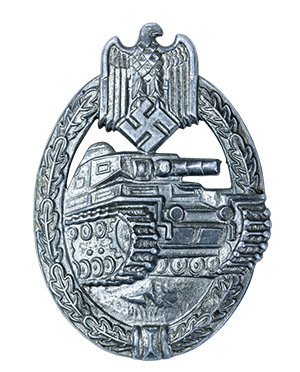
The obverse of the Panzer Badge shows a border of oak leaves with a tie at the base and a Panzerkampfwagen IV superimposed in the centre on grassy ground, with its left tank track extending over the edge of the badge. The reverse is plain with a vertical needle style pin, with an oval based hinge and catch.

The badge measures 42.05 mm (w) x 60.09 mm (h) and weights 27.6 grams.

The 50 and 100 engagement badges were struck in a lightweight zinc alloy; this was so that the larger pin did not pull inconveniently on the tunic. The 1957 de-Nazified version lost the eagle and the swastika, but was otherwise unchanged.

The Panzer Classes and Wear

Designed in 1939 by Ernst Peekhaus, the Panzer Badge was first issued in December 1939, when the chief of the OKW, Walter Von Brauchitsch, decided to create a medal dedicated to the sacrifice and the achievements of the Panzer’s crews. Two different classes of the badge were designed for those who received it during world war II. The first and “original” one was the silver Panzer Badge, designed to recognize solely the tank crews.

The “less original” one, the Bronze Panzer Badge, was designed to recognize the crews of armored vehicles (half tracks, trucks,…). As the war was still raging, it was decided that the Badge should evolve. In June 1943, four new classes were created, depending on the amount of engagement the recipent would have take part in: 25, 50, 75 and 100. Depending on which class and the amount of engagement you took part in, the metal used to design the medal and the color of it changed accordingly. 

After the war, it was frowned upon to wear this badge since there was a swastika on the top of it. Thus, West Germany decided in 1957 to authorize to wear the Panzer badge in public but only if the swastika was removed from it.

Note: As an eBay partner, I earn from qualifying purchases. This is all done automatically when you use a link and at no extra cost to you.

More Army/Waffen-SS War Badges

The Army/Waffen-SS war badges were military decorations awarded by Nazi Germany to members of the Army (Heer) and the Waffen-SS. Explore the complete collection below:

Buy a Panzer Badge

Right Now on eBay 
Clicking a link to eBay may result in a referral commission being paid if a purchase is made.
Loading...

The Kuban Shield

The Kuban Shield is a World War II military decoration awarded to those who fought at the Kuban bridgehead in the Soviet Union.

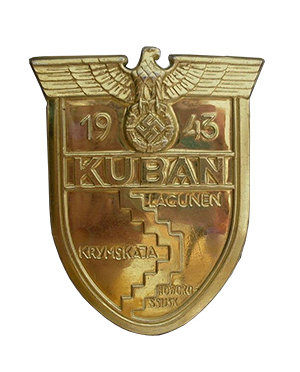
The Kuban Shield (or Ärmelschild Kuban in German) is a World War II military decoration of Nazi Germany, awarded to those who fought at the Kuban bridgehead in the Soviet Union from February 1943 until it was abandoned in October 1943.

The criteria for award of the shield to military personnel:

  • Served in the bridgehead for 60 days; or
  • Been wounded while defending the bridgehead; or
  • Had been engaged in a single major operation at the bridgehead.

The Kuban Shield Design

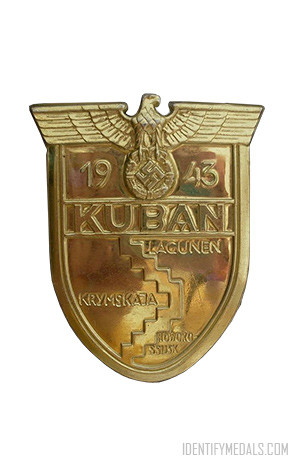
The shield is designed in a similar fashion to the Crimea Shield and was struck in sheet metal or zinc and treated with a bronzed wash.

It features a German eagle with outstretched wings clutching a laurel wreath with a swastika. On each side the wreath are the numbers 19 and 43. Directly below the eagle is written KUBAN in block capital letters. Below this name is a stylized map of the Kuban region, with a line representing the defensive line that the men fought to preserve with the location of the bridgeheads – KRYMSKAJALAGUNEN, and NOWOROSSIJSK.

The shield was worn on the upper left sleeve of the tunic. A back plate, which held in place a piece of cloth matching the recipients’ branch of service, was applied to the shield:

  • Green for Heer (army)
  • Blue for Luftwaffe (air force)
  • Black for Panzer units (armoured units)

More Nazi Germany Shields (Ärmelschilde)

These campaign shields were awarded to members of the Wehrmacht (the unified armed forces of Nazi Germany from 1935 to 1945). They were given for participation in specific battles or campaigns and worn on the left upper arm of the uniform jacket.

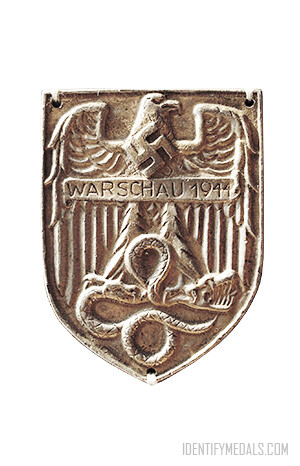
German WW2 Nazi Awards: The Warsaw Shield

The Warsaw Shield

The Warsaw Shield (Ärmelschild Warschau) is a German military decoration for those who took part in the suppression of the Warsaw uprising.

Read More »

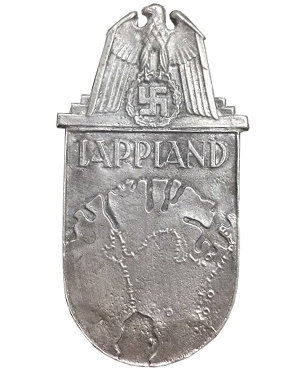
The Lappland Shield

The Lappland Shield (Lapplandschild) is a World War II German military decoration awarded to military personnel who fought in Lapland.

The Lappland Shield (or Lapplandschild in German) is a World War II German military decoration awarded to military personnel which had been fighting a two-front campaign against the advancing Finnish and Soviet Red Army forces in Lapland between November 1944 and the war’s end in May 1945.

The badge was awarded to men of General Franz Böhme’s 20th Mountain Army who had “honorably served” for six months in the region or had been wounded during operations therein. It was authorized in February 1945 and was the last officially instituted German campaign shield of the war.

The Lappland shield continued to be awarded after the end of the war in May, 1945 by the unit commander.

The Lappland Shield Design

The badge consists of a basic shield with flat top and rounded bottom. It incorporates an eagle at the top but without a swastika. Directly below this, in capital letters, is written “LAPPLAND” and beneath it appears a map of the region.

Four small holes were punched in the shield to allow it to be sewn on the upper left sleeve of the uniform, however, it had no back-plate or uniform cloth section attached.

More Nazi Germany Shields (Ärmelschilde)

These campaign shields were awarded to members of the Wehrmacht (the unified armed forces of Nazi Germany from 1935 to 1945). They were given for participation in specific battles or campaigns and worn on the left upper arm of the uniform jacket.

The Narvik Shield - German WW2 Medals, Badges and Awards

The Narvik Shield

The Narvik Shield (Narvikschild) is a WW2 German military decoration awarded to German forces that took part in the battles of Narvik.

Read More »
German WW2 Nazi Awards: The Warsaw Shield

The Warsaw Shield

The Warsaw Shield (Ärmelschild Warschau) is a German military decoration for those who took part in the suppression of the Warsaw uprising.

Read More »

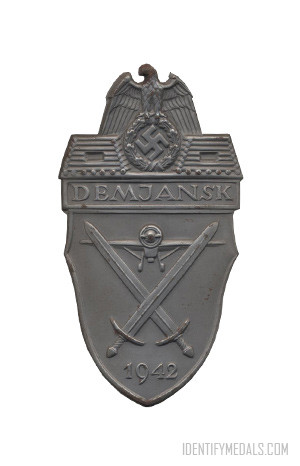
The Demyansk Shield

Demyansk Shield is a World War II German military decoration awarded to military personnel who fought in the Demyansk pocket.

Demyansk Shield (or Ärmelschild Demjansk in German) is a World War II German military decoration instituted on 25 April 1943 by Adolf Hitler and awarded to military personnel who fought in the Demyansk pocket, achieved through the use of an airbridge.

The pocket of German troops had been encircled and cut off by the Red Army around Demyansk, south of Leningrad, during World War II on the Eastern Front. It was not bestowed after 1 July 1944.

Requirements for army, Waffen-SS and auxiliary units included honorable service in the besieged area for 60 days or wounded in the besieged area. For Luftwaffe personnel — 50 combat or re-supply missions over the besieged area.

The Demyansk Shield Design

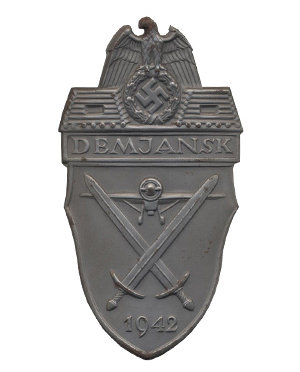
The Demyansk shield features at its apex an eagle with swooped down wings clutching a laurel wreath that surrounds a swastika in the obverse. This is flanked by two pillboxes with gun ports. Below this is capital letters is written DEMJANSK.

The central portion of shield features a head-on single engine aircraft, two crossed swords and at the base, the year 1942. Two minor variations of the aircraft’s propeller exist with either a curved or straight propeller.

The shield was die struck and produced in silver-washed zinc and later in plain zinc. It was affixed to the upper left sleeve of the uniform via a cloth that matched the color of the uniform of the recipient:

  • Light green-grey (field-grey) for Heer (army)
  • Blue for Luftwaffe (air force)
  • Black for Panzer units (armoured units)
  • Field-grey for Waffen-SS

More Nazi Germany Shields (Ärmelschilde)

These campaign shields were awarded to members of the Wehrmacht (the unified armed forces of Nazi Germany from 1935 to 1945). They were given for participation in specific battles or campaigns and worn on the left upper arm of the uniform jacket.

The Narvik Shield - German WW2 Medals, Badges and Awards

The Narvik Shield

The Narvik Shield (Narvikschild) is a WW2 German military decoration awarded to German forces that took part in the battles of Narvik.

Read More »