The Bavarian Air Gunner’s Badge

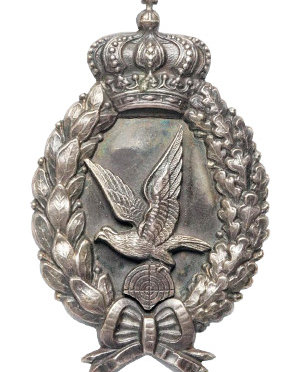
The Bavarian Air Gunner’s Badge is a badge from the Kingdom of Bavaria was introduced in 27 January 1918 by King Ludwig III.

The Bavarian Air Gunner’s Badge is a badge from the Kingdom of Bavaria was introduced in 27 January 1918 by King Ludwig III immediately after Wilhelm II, King of Prussia and Emperor of Germany, instituted similar badges.

The Bavarian Air Gunner’s Badge Design

The badge measures 46.2mm by 70.93mm and is struck in Silver. Of hollow construction, it has four went holes and weighs 26.3 grams.

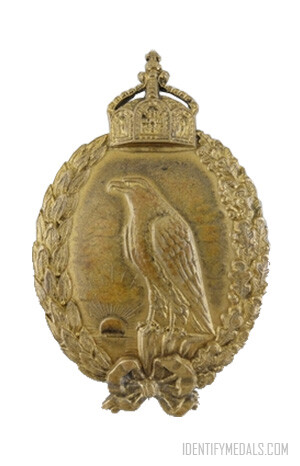
In the obverse, the eagle has its wings raised, atop target sight, radiant within wreath, and crown above. The maker’s name is stamped in the reverse, which has a vertical pinback and breather hole below the catch.
The Naval Observer’s Badge (Prussia)

The Naval Observer’s Badge is a badge from the Kingdom of Prussia introduced in 1915  by the King and Emperor of the German Empire Wilhelm II.

The Naval Observer’s Badge (Beobachter der Fliegertruppe der Marine) is a badge from the Kingdom of Prussia introduced in 1915  by the King of Prussia and the Emperor of the German Empire Wilhelm II.

The badge was awarded to naval observers who successfully passed series of theoretical and practical examinations upon completion of the special training. Operational requirements for naval observers were by far more strict than those for army personnel.

The Naval Observer’s Badge Design

The badge measures approximately 48mm wide and 74mm high and is made of guilded medal. It weighs 58.2 grams.

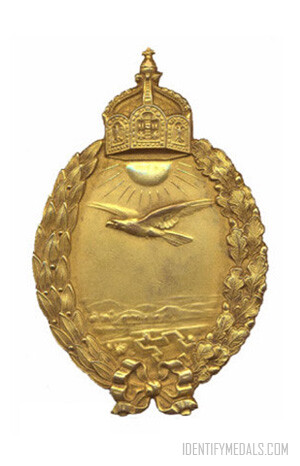
It has a shape of a vertical oval with an outside perimeter surrounded by a wide wreath. Its left side has laurel leaves symbolizing victory and its right side had oak leaves standing for strength and hardiness. Both were joined together with a ribbon bow at the bottom thus signifying a combination of those two qualities. Imperial crown topped the badge.

The obverse of the badge carries an image of an eagle with lowered wings sitting on a rock and facing left. The background shows a sea with rising or descending sun and clouds above. The reverse is either plain or carries an image of multiple straight rays radiating from the center.

Depending on the manufacturer, the badge differs in certain details (for example, some had crown inserts and lower ribbon fragments cut out). The manufacturers’ hallmarks and silver standards were often found on the reverse or the pin.

The Naval Sea Service Pilot’s Badge (Prussia)

The Naval Sea Service Pilot’s Badge is a badge from the Kingdom of Prussia awarded to qualified NCO pilots during WWI.

The Naval Sea Service Pilot’s Badge is a badge from the Kingdom of Prussia awarded to qualified NCO pilots during WWI.

The Imperial Air Service Korps eventually consisted of 88 Jastas (squadrons). Prussia formed 67 Jastas, Bavaria formed 10 Jastas, Saxony formed 7 Jastas, and Wurttemberg formed 4 Jastas. All used the Imperial badge with the Prussian crown except for Bavaria.

Naval Sea Service Pilot’s Badge Design

The badge is struck in guilded solid bronze.

Its obverse shows a sea eagle flying over the sea and Helgoland rock.

The Commemorative Flyer’s Badge (Prussia)

The Commemorative Flyer’s Badge is a badge from the Kingdom of Prussia awarded to retired German Army Air Service flight crew during WWI. 

The Commemorative Flyer’s Badge (or Flieger-Erinnerungsabzeichen in German) is a badge from the Kingdom of Prussia awarded to retired German Army Air Service flight crew during WWI.

The Commemorative Flyer’s Badge Design

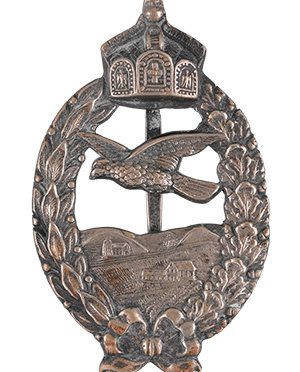
The badge is made from a heavy piece of solid silver and features a dove flying over a landscape. It measures 71 mm high and 44 mm wide and weighs 24.1 grams.

The obverse bears an eagle in flight over a rural landscape, bordered by a wreath made of laurel leaves on the left and oak leaves on the right, surmounted by an imperial crown, tied with a ribbon below. The reverse presents a barrel hinge and tapering banjo-style pinback meeting a round wire catch.

The Observer’s Badge (Prussia)

The Observer’s Badge is a badge from the Kingdom of Prussia awarded to qualified Imperial German Observers during WWI.

The Observer’s Badge (or Beobachterabzeichen in German) is a badge from the Kingdom of Prussia awarded to qualified Imperial German Observers during WWI.

Silver qualification badges were approved by the German Air Service shortly before the start of the First World War. Most wartime crews wore the Prussian designs, with minor changes to the badges worn by Bavarians. There were also variations in quality, particularly between issued versions and those purchased privately.

The Observer’s Badge Design

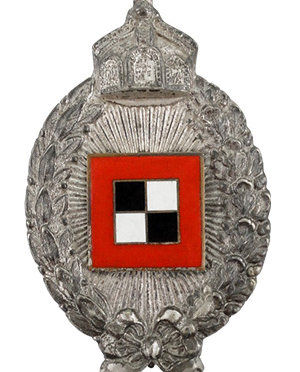
The badge measures 72.36 mm x 45.47 mm and is struck in silvered brass. In all of the Imperial German Army flight qualification badges, the outside perimeter is surrounded by a wreath. The left side has laurel leaves symbolizing victory, while the right side has oak leaves signifying strength and hardiness. The bow joining them together at the bottom signifies the joining of these two qualities.

The Observer’s badge carries an enameled flag of the German tactical symbol for an Army Corps. Issued badges were thinly stamped and silvered or silver-washed metal. Privately purchased examples can be found in hollow two-piece construction or single massive silver stampings.

The enameled square insignia consists of white, black, and red enamels mounted to the center of the badge via two hooks on the reverse. The insignia is placed within a bed of sun rays and a wreath consisting of oak and laurel leaves, and with a bow on the bottom, and a Prussian crown on the top of the wreath.

The Pilot’s Badge (Prussia)

The Pilot’s Badge is a badge from the Kingdom of Prussia instituted in 1913 by the King of Prussia and Emperor Wilhelm II.

The Pilot’s Badge (or Flugzeugführerabzeichen in German) is a badge from the Kingdom of Prussia instituted on 27 January 1913 by the King of Prussia and the Emperor of the German Empire Wilhelm II in conjunction with his birthday.

At some point during the war, and because stamped metal badges become scarce, it’s believed only certificates were issued and aircrew were required to purchase their own badges. While issued badges are thinly stamped and silvered (or silver-washed, an economical alternative) metal, privately purchased examples can be found in hollow two-piece construction or single massive silver stampings.

The Pilot's Badge Award Criteria

The badge was awarded to officers, NCOs and enlisted men upon successful graduation from the flying schools and passing two practical flight examinations. 

One of the examinations consisted of unassisted takeoff and landing. The other was a long-distance or a cross-country flight. The badges were presented by local air station commanders.

What Was Training Like for a Prussian Pilot?

Training to become a Prussian pilot during World War I was both rigorous and dangerous, reflecting the early, experimental days of military aviation. The training process involved multiple stages, beginning with ground school where recruits learned the basics of flight, navigation, and military conduct. This was followed by preliminary flight school, which included about 40-50 flight hours. Cadets had to perform a variety of maneuvers such as sideslips, loops, and simulated uncontrolled falls before graduating​ (Hartzell Propeller)​​ (MyLearning)​.

Some popular aircraft used during the time included:

  1. Fokker Eindecker (E-Series): The Fokker E.I, E.II, E.III, and E.IV were some of the first aircraft used for aerial combat. These were monoplane designs equipped with synchronized machine guns that could fire through the propeller arc, giving the Germans an initial air superiority.

  2. Albatros B Series: An early reconnaissance biplane, the Albatros B.I was unarmed and used primarily for observation and artillery spotting.

  3. Albatros D-Series (D.I to D.Va): The Albatros D.I and its subsequent models (D.II, D.III, D.V, D.Va) became the backbone of the German fighter force. Known for their speed and firepower, these aircraft were used extensively from 1916 onward.

  4. Halberstadt D.II: Another early fighter aircraft, the Halberstadt D.II was used to complement the Fokker Eindecker until more advanced aircraft became available.

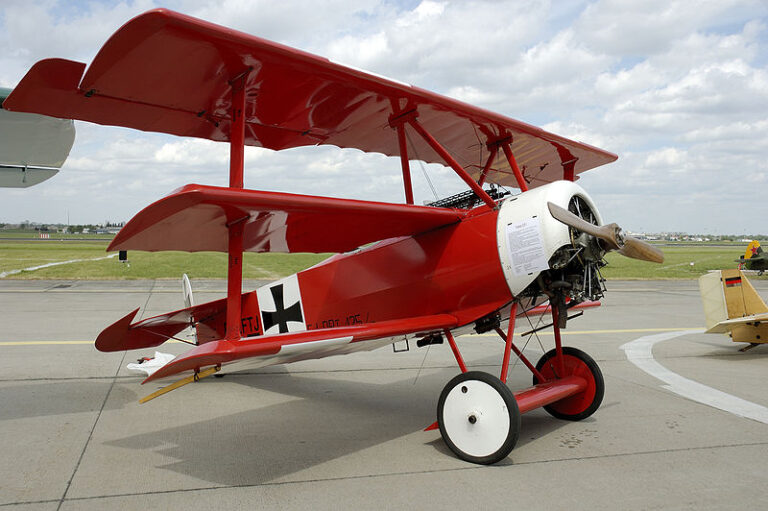
  5. Fokker Dr.I: The Fokker Dr.I triplane, made famous by Manfred von Richthofen (the Red Baron), was renowned for its maneuverability. However, it was also prone to structural failures.

  6. Fokker D.VII: Considered one of the best fighter aircraft of the war, the Fokker D.VII was introduced in early 1918. It had excellent handling, firepower, and structural integrity, making it highly effective in combat.

  7. Pfalz D.III: The Pfalz D.III and its improved version, the D.IIIa, were used by many Jastas (fighter squadrons). They were known for their durability and decent performance but were generally considered inferior to the Albatros and Fokker designs.

  8. Aviatik C.I: A versatile two-seater used for reconnaissance and light bombing missions, the Aviatik C.I was one of the many C-type aircraft that served various roles.

The Red Baron, or Manfred von Richthofen, was a legendary German fighter pilot and fighter ace during World War I.
Replica of Richthofen's Fokker Dr.I triplane, at the Berlin Air Show in 2006". Aircraft & Warplanes

The Pilot's Badge Design

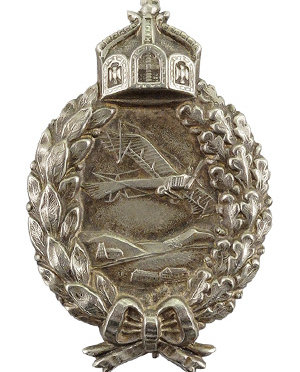
The badge measures 46.00 mm (width) by 70.60 mm (height), weighs 13.5 grams and is struck in silvered brass. In all of the Imperial German Army flight qualification badges, the outside perimeter is surrounded by a wreath. The left side has laurel leaves symbolizing victory, while the right side has oak leaves signifying strength and hardiness. The bow joining them together at the bottom signifies the joining of these two qualities.

The top of the badge mounts either a Preußen (Prussian) crown or a Bayern (Bavaria) crown. These badges were manufactured by C.E. Juncker (Berlin), Meybauer or Pollath and worn on or below the left breast pocket lower than the Prussian Iron Cross 1st Class.

The obverse bears a standard pilot’s badge motive within a wreath, with laurel leaves towards the left side of the wreath, and oak leaves towards the right side of the wreath, separated by a bow on the bottom of the wreath, ordained by the Prussian crown at the top.

The reverse is hallowed and has a vertical needle pinback with a barrel hinge and a round wire catch.

The Cross of the Mount of Olives

The Cross of the Mount of Olives is a Prussian award founded in 1909 to commemorate the foundation of a hospital on the Mount of Olives.

The Cross of the Mount of Olives (or Ölberg-Kreuz in German) is a Prussian award founded on 24 December 1909 as a decoration to commemorate the foundation of a hospital, the Kaiserin Auguste Victoria-Stiftung on the Biblical Mount of Olives in Jerusalem.

The award was created by Prince Eitel Friedrich of Prussia. His very devout mother, Augusta Victoria of Schleswig-Holstein, was fond of charitable works and built several churches and he and Emperor Wilhelm II of Germany had visited Jerusalem in 1898. They then pledged to build a hospital for Christian pilgrims suffering from malaria.

The Cross of the Mount of Olives was awarded to those who contributed to the Foundation, and the Augusta Victoria Hospital opened its doors in 1910.

The Cross of the Mount of Olives Design

The badge of the decoration is a red-and-black enameled Jerusalem cross, upon which is imposed the white cross of the Johanniterorden, the evangelical noblemen’s society which Prince Eitel Friedrich then headed as Grandmaster.

The badge is suspended from a monogram of the Empress’s initials, “AV”. The ribbon is plain white and the deserving were awarded golden or silver-gilt Crosses.

The Jerusalem Cross

The Jerusalem Memorial Cross is a Prussian decoration established in 1898 and awarded to those who visited Palestine with the King.

The Jerusalem Cross, also known as the Jerusalem Memorial Cross or “Jerusalem-Kreuz; Jerusalem-Erinnerungskreuz” in German, holds historical significance as a Prussian decoration established on October 31, 1898. Its establishment coincided with Emperor Wilhelm II‘s notable visit to Palestine in the same year. This distinguished award was bestowed upon individuals who had the unique privilege of accompanying Emperor Wilhelm II on his pilgrimage to Palestine and participated in the solemn inauguration ceremony of the Lutheran Church of the Redeemer in Jerusalem.

Emperor Wilhelm II’s journey to Palestine and the dedication of the Lutheran Church of the Redeemer marked a significant event in Prussian history, symbolizing the nation’s cultural and religious ties to the Holy Land. The Jerusalem Cross served as a commemorative token of this historic occasion, honoring those who were part of this remarkable pilgrimage. As a testament to their participation in this momentous event, recipients of the Jerusalem Cross were recognized for their role in fostering diplomatic relations, religious unity, and cultural exchange between Prussia and the Holy Land

The Jerusalem Cross Design

The cross is made in the shape of the Jerusalem cross, which consists of a large cross portent with four plain crosslets between the arms. The crosses are red enameled with silver-gilt borders. In the center of the cross is a round gold colored medallion.

The obverse depicts the Imperial Crown of the Prussian German Emperor surmounting the letters IR (Imperator Rex) over the royal cypher of a stylized W II. The reverse of the medallion bears the date 31 October 1898, which is depicted using a large Roman numeral X in the center for October, and a small Roman numeral XXXI at the top. To the left is MDCCC and to the right side IIC for the year 1898.

The Lifesaving Medal

The Lifesaving Medal was a civil decoration of the Kingdom of Prussia awarded to those who had saved a person’s life at risk to their own.

The Lifesaving Medal (on Rettungsmedaille am Band” in German) was a civil decoration of the Kingdom of Prussia.

Established 1 February 1833, it was awarded to individuals who had saved another person’s life, at risk to their own.

This medal is referred to as the Lifesaving Medal on Band to differentiate it from a previous non-portable award established in 1802. Otto von Bismarck received it for rescuing a drowning man.

The Lifesaving Medal Design

The medal is circular and struck in silver. The obverse presents the head of King Friedrich Wilhelm III in relief, facing left, in the center.

Around it is circumscribed FRIEDRICH WILHELM III KÖNIG VON PREUSSEN. The reverse has inscribed FÜR RETTUNG AUS GEFAR (FOR RESCUE FROM DANGER) within an oak leaf wreath, measuring 24.79 mm in diameter, on loop for suspension from the period original ribbon, and in fine condition.

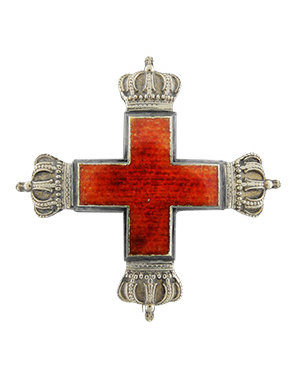
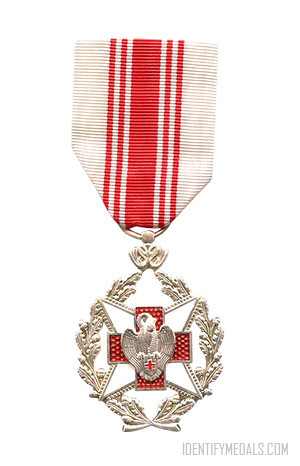
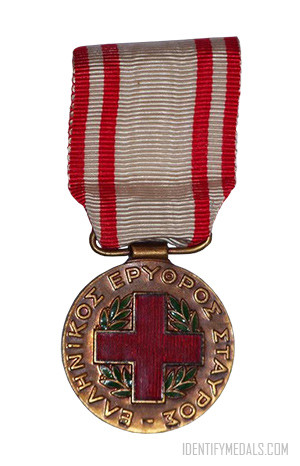
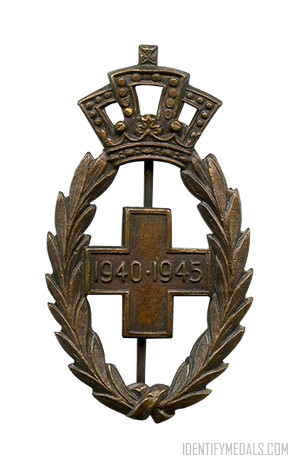
The Prussian Red Cross Medal

The Red Cross Medal was set up in 1898 by Emperor Wilhelm II and awarded to those who did great service to the sick in peace or wartime.

The Red Cross Medal was set up on 1 October 1898 by Emperor Wilhelm II and awarded to all those who carried out great service to the sick in peace or wartime, or for special achievement in the service of the German Red Cross. This was a peacetime award, as opposed to the Order of the Crown and general honor decorations with the Red Geneva Cross.

The Red Cross Medal was awarded in three classes, the Second and Third classes being worn as circular medals suspended from a red ribbon with white and black stripes.

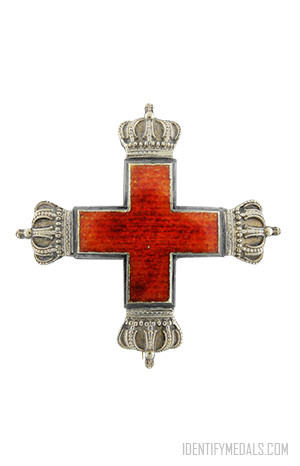
The First Class was a red enameled Geneva Cross with gilded Prussian Royal Crowns at the ends of the arms. This award was worn as a steckreuz on the breast like the Iron Cross. Recipients could be promoted to the next class of the medal with five years time in service, with the first level anyone could be initially appointed to being the Second Class.

Find Red Cross Medals Online

Right Now on eBay 
Clicking a link to eBay may result in a referral commission being paid if a purchase is made.
Loading...

More Red Cross Medals