The Anti-Partisan Guerrilla Warfare Badge

The Anti-Partisan Guerrilla Warfare Badge is a Military Service Badge (Army/Waffen-SS) from the Third Reich, Germany, Second World War.

The Anti-Partisan Guerrilla Warfare Badge (Bandenkampfabzeichen in German) is a war badge awarded to Heer, Luftwaffe, and Waffen-SS personnel during World War II. It was instituted on 30 January 1944 and referred to as “Bandenkampf-Abzeichen”, because Heinrich Himmler decided the term Banden was better than the term “partisans” – as to not give credence to the guerrillas that were active in almost Germany-occupied countries during WW2.

While many of these resistance movements were initially small and disorganized, a lot coalesced into larger, more powerful bands of fighters. For example, in Greece, Russia and the Yugoslavian states, the partisans had become large enough to require increasing German manpower and resources.

The Anti-Partisan Guerrilla Warfare Badge was created to recognize the soldiers of the Axis that were involved in these behind-the-lines battles. There were three grades for this badge:

  • Bronze: For 20 days in combat.
  • Silver: For 50 days in combat. And
  • Gold: For 100 days in combat. 

For the Luftwaffe, the criteria was based on sorties instead of days in action. 

The Anti-Partisan Guerrilla Warfare Badge Design

The design of the badge is a wreath with a sword placed vertically in the center. The handle has a sun wheel swastika, representing the Nordic and auxiliary forces. The sword plunges into a Hydra, or multi-headed sea serpent representing the Partisans.

The Hydra was a mythical Greek creature, considered almost impossible to destroy because its heads would grow again after being cut off – alluding to the ever-growing presence of Partisan activities.

More Army/Waffen-SS War Badges

The Army/Waffen-SS war badges were military decorations awarded by Nazi Germany to members of the Army (Heer) and the Waffen-SS. Explore the complete collection below:

The General Assault Badge

The General Assault Badge is a Military Service Badge (Army/Waffen-SS) from the Third Reich, Germany, Second World War.

The General Assault Badge (or Allgemeines Sturmabzeichen in German) is a war badge instituted on 1 June 1940 and awarded to personnel of the German Army, Waffen-SS and Ordnungspolizei that were neither in unmotorized rifle, Gebirgsjäger or tank units. The badge was given to engineers, motorized infantry and troops who had supported infantry and armor units in combat. Artillery, anti-tank (PaK) and anti-aircraft (Flak) units and some medics were also included. 

The General Assault Badge only existed in a silver class and was awarded to persons participating in:

  • Three infantry assaults;
  • In the first line;
  • Breaking through with weapon at hands;
  • On three different days after 1 January 1940; 
  • Not being eligible for the Infantry Assault Badge or Panzer Badge

The General Assault Badge Design

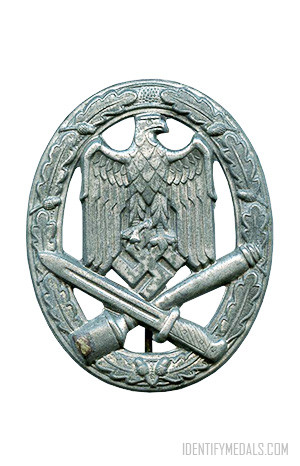
The badge features an eagle clutching a swastika. The design is set over a simple crossed bayonet and grenade and surrounded by an oval of oak leaves. 

More Army/Waffen-SS War Badges

The Army/Waffen-SS war badges were military decorations awarded by Nazi Germany to members of the Army (Heer) and the Waffen-SS. Explore the complete collection below:

The Infantry Assault Badge

The Infantry Assault Badge is a Military Service Badge (Army/Waffen-SS) from the Third Reich, Germany, Second World War.

The Infantry Assault Badge (Infanterie Sturmabzeichen in German) is a war badge awarded to Waffen SS and Wehrmacht Heer soldiers during World War II. It was instituted on December 20, 1939 and could be awarded to members of non-motorized Infantry units and units of the Gebirgsjäger that had participated in Infantry assaults (as long as they had spent least three days of battle in the front line January 1, 1940).

The Infantry Assault Badge was awarded in two classes:

  • Silver: Instituted on December 20, 1939, it was awarded to infantry soldiers who had taken part in three or more infantry assaults, counter-attacks, armed reconnaissance operations, hand-to-hand combat in an assault position, or in the restitution of combat positions.
  • Bronze: Instituted on June 1, 1940, it was awarded to motorized Panzer troops who had taken part in three or more motorized infantry assaults, motorized infantry counter-attacks, motorized armed reconnaissance operations, hand-to-hand combat in motorized assault positions, or in the restitution of a motorized combat position.

The Infantry Assault Badge Design

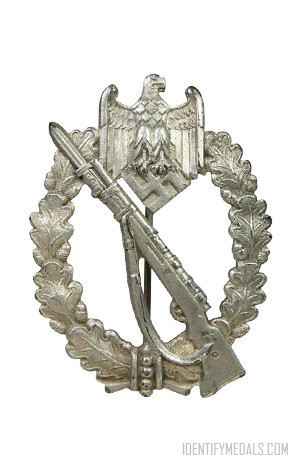
Designed by C. E. Junker of Berlin, the badge is oval in shape and has four oak leaves on each side. On the top there is an eagle standing on a swastika. The front shows a rifle placed across the badge.

The reverse is plain and has a pin attachment.

A de-nazified version of this decorations exists. It’s also available in Silver and Bronze but without the eagle and the Swastika.

More Army/Waffen-SS War Badges

The Army/Waffen-SS war badges were military decorations awarded by Nazi Germany to members of the Army (Heer) and the Waffen-SS. Explore the complete collection below:

The Grand Cross of the Iron Cross

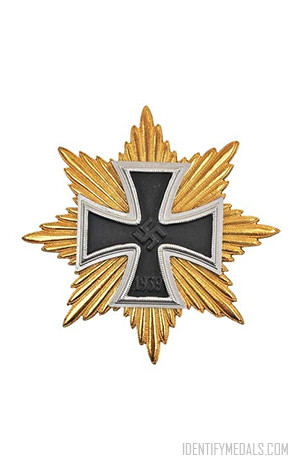
The Grand Cross of the Iron Cross was the highest grade Nazi decoration above the various classes of the Knight’s Cross.
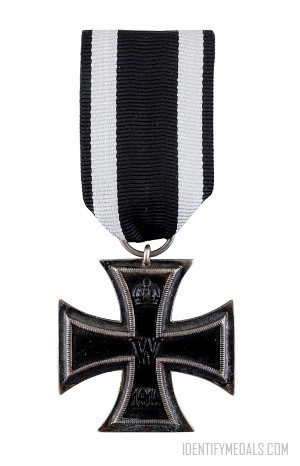
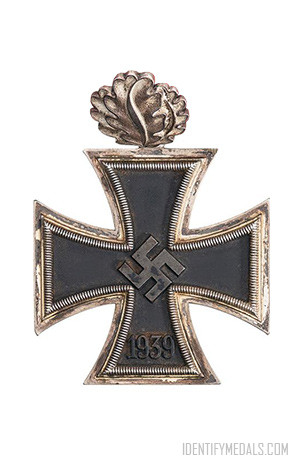
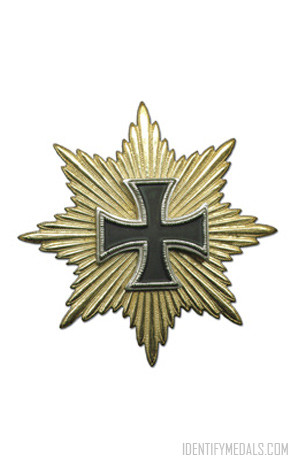
The Grand Cross of the Iron Cross (or Großkreuz des Eisernen Kreuzes in German) was reinstituted as a German decoration in September 1939. The Grand Cross of the Iron Cross is above the different classes of Knight’s Cross of the Iron Cross

During World War II, only one person received the Grand Cross of the Iron Cross: Hermann Göring. 

The original award was destroyed during an air raid in 1943 – after Hitler had deprived Göring of his after feeling betrayed. 

The Grand Cross of the Iron Cross Design

The Grand Cross was designed as having an outline in gold. However, this was changed before Göring’s award. He actually had several copies made of his medal, one with platinum edges which he wore. Göring was wearing this version at the time of his surrender in 1945.

The medal was awarded in a red leather case with an embossed gold Reich Eagle. The interior was made in black velvet. 

More Variations of the Iron Cross

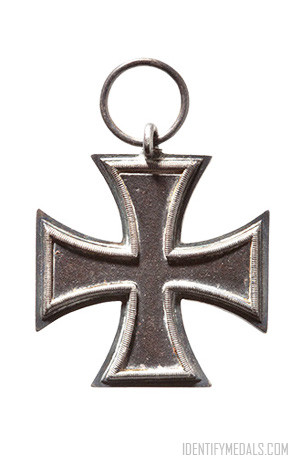
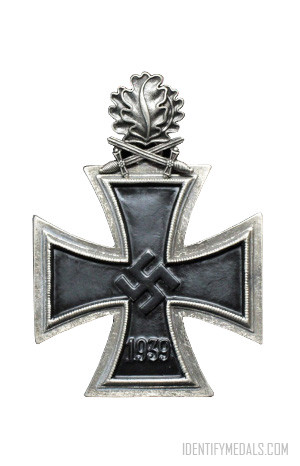
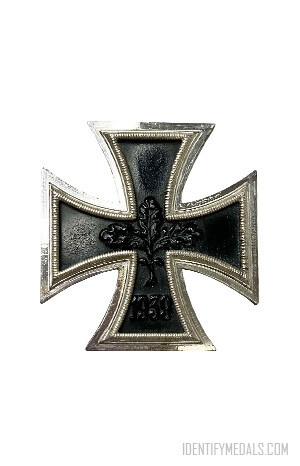
The Iron Cross, a prestigious German military decoration, has undergone several variations since its inception. For example, the Iron Cross 1813 was instituted during the Napoleonic Wars by King Frederick William III of Prussia, the Iron Cross 1914 was awarded during World War I, it was reinstated by Kaiser Wilhelm II, and the Iron Cross 1939 was revived by Adolf Hitler for World War II, with modifications including a swastika.

Find the Iron Cross Medal Online

Right Now on eBay 
Clicking a link to eBay may result in a referral commission being paid if a purchase is made.
Loading...

Further Reading About the Iron Cross

Discover the stories behind the Iron Cross with these compelling books and delve into the rich history and significance of this prestigious military decoration.

The Knights Cross of the War Merit Cross

The Knights Cross of the War Merit Cross was a decoration of Nazi Germany awarded during World War II created by Adolf Hitler.

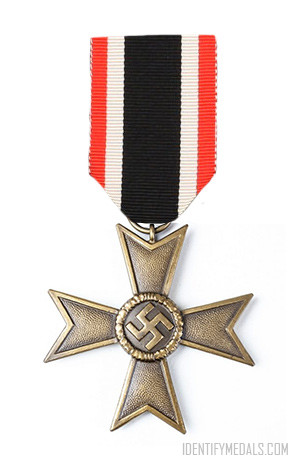
The Knights Cross of the War Merit Cross (or Kriegsverdienstkreuz in German) was a decoration of Nazi Germany awarded to military personnel and civilians during the Second World War. It was created by Adolf Hitler in October 1939 as a successor to the non-combatant Iron Cross which was used in earlier wars.

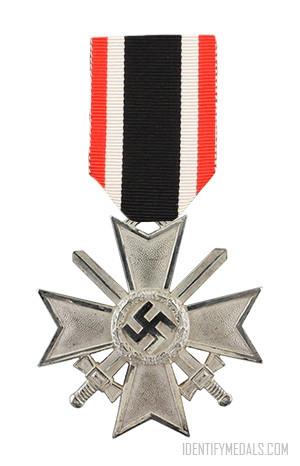
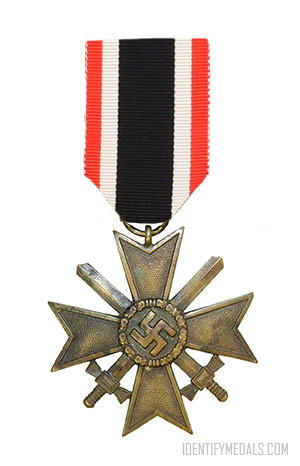
The award had four variantswith swords given to soldiers for exceptional service “not in direct connection with combat”, without swords given to civilians for meritorious service in “furtherance of the war effort”, the Knights Cross of the War Merit Cross, and the rare Knight’s Cross of the War Merit Cross in Gold

The Knights Cross of the War Merit Cross Design

The medal consists of a silver Maltese Cross. The obverse has pebbled arms, with a central wreathed mobile swastika and crossed swords piercing the centrepiece. The reverse has a block hinge and a banjo-style pinback. The War Merit Cross measures 48.51 mm (w) x 48.48 mm (h) and weighs 17.6 grams.

Ribbon

The ribbon of the Knights Cross of the War Merit Cross was in red-white-black-white-red (the colors being reversed from the ribbon of the World War II version of the Iron Cross). 

Order of Wear

The Knights Cross of the War Merit Cross was a neck decoration and worn the same way as the Knights Cross of the Iron Cross.

Medal Variations

Find this Medal Online

The Knight’s Cross Of The War Merit Cross In Gold

The Knight’s Cross Of The War Merit Cross In Gold is a rare Third Reich variation of the War Merit Cross suggested by Albert Speer in 1944.

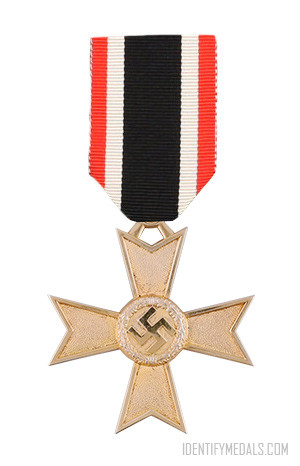
The Knight’s Cross of the War Merit Cross in Gold (or Ritterkreuz des Kriegsverdienstkreuzes in Gold in German) was a decoration of Nazi Germany and a variation of the War Merit Cross (Kriegsverdienstkreuz). The medal can be dated back to 7 July 1944 when Albert Speer suggested the need for a superior grade of the award. The goal was to recognize exceptional non-combatant contributions to the war effort in Germany. 

The medal was officially instituted on 13 October 1944. Only 21 Knight’s Cross of the War Merit Cross in Gold are known to have been awarded (with several dozen having been produced but not given).

The award had four variantswith swords given to soldiers for exceptional service “not in direct connection with combat”, without swords given to civilians for meritorious service in “furtherance of the war effort”, the Knights Cross of the War Merit Cross, and the rare Knight’s Cross of the War Merit Cross in Gold

Knight’s Cross of the War Merit Cross in Gold Design

The medal consists of a gilded silver Maltese Cross. The obverse has pebbled arms, with a central wreathed mobile swastika and crossed swords piercing the centerpiece. The reverse has a block hinge and a banjo-style pinback. The cross measures 48.51 mm (w) x 48.48 mm (h) and weighs 17.6 grams.

Ribbon

The ribbon of the Knight’s Cross of the War Merit Cross in Gold was red-white-black-white-red (the colors being reversed from the ribbon of the World War II version of the Iron Cross). 

Order of Wear

Knight’s Cross of the War Merit Cross in Gold was a neck decoration and worn the same way as the Knights Cross of the Iron Cross.

Medal Variations

Find this Medal Online

The Commemorative Medal for Rescue from Danger 1925-1933

The Commemorative Medal for Rescue from Danger 1925-1933 was instituted on 9 June 1925 for rescue from danger at the peril of rescuer’s life.

The Commemorative Medal for Rescue from Danger 1925-1933 was instituted on 9 June 1925 for rescue from danger at the peril of rescuer’s life. The medal was awarded very sparingly.

The Commemorative Medal for Rescue from Danger 1925-1933 Design

The medal is large and circular, and measures 48.72mm (1.92 inches) in diameter. Records show that it was originally manufactured in silver, however there are several examples struck in zinc alloy – perhaps manufactured at a time of material shortages and economic crisis or for collectors at the time.

The obverse has the Prussian eagle, head facing right, wings outstretched, and the inscription ‘REPUBLIK’ above and ‘PREUSSEN’ below. The reverse is inscribed ‘FÜR RETTUNG AUS GEFAHR’ (“For Rescue from Danger”) within an oak leaf border in relief.

The Zeppelin Commemorative Badge

The Zeppelin Commemorative Badge is a badge established in 1920 by the Weimar Republic as a “Badge for Airshipmen.”

Institution: 1 August 1920
Country: Germany

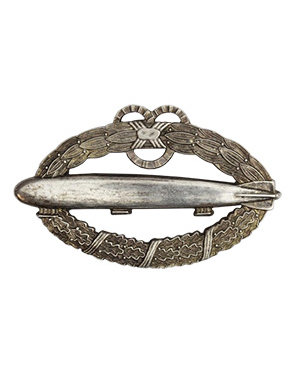
The Zeppelin Commemorative Badge is a badge established on 1 August 1920 by Reichswehrminister Otto Karl Geßler of the Weimar Republic as a “Commemorative Badge for Airshipmen”. The badge was awarded to navy personnel regardless of rank who served on naval airships for at least one year. This condition was waived in case of outstanding merits during the Great War as well as for ex-POWs and crews of naval airships destroyed by enemy fire.

The total true aircrew personnel of the Army Airships numbered around 500 during the War, however during it no badges were issued to them (although the plan existed early on, it was canceled). Instead, the badges were manufactured and issued in the Summer of 1920, as ” Commemorative Badge for Airshipmen”.

The Zepplin badge was a post-war badge, its production was begun in 1920.

The Zeppelin Commemorative Badge Design

The badge measures 67.88mm by 38.77mm and was designed by P. Meybauer in Berlin. It’s struck in silver-plated brass.

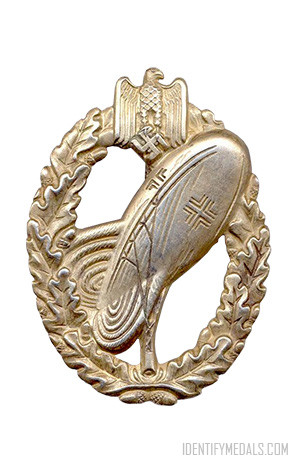
The badge has a horizontal oval shape with an airship facing left superimposed on a green enameled wreath. The wreath is made of laurel leaves on its upper part and oak leaves on the lower one. The laurel part of the wreath is tied crosswise on its top by a ribbon that forms three semicircular arcs, two facing above and one beneath. The oak portion in its turn is tied with three ribbons.

The Tank Battle Badge

The Tank Battle Badge (or Kampfwagenab-zeichen in German) is a badge established on 13 July 1921 by Dr. Otto Geller in Germany.

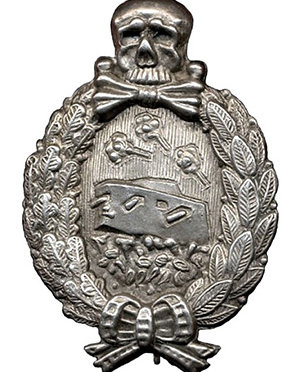
The Tank Battle Badge (or Kampfwagenab-zeichen in German) is a badge established on 13 July 1921 by Dr. Otto Geller in Germany. It wasn’t a wartime insignia, but rather an immediate post-war offering.

The medal was created “In order to keep awake among the German people the memory of the battle vehicle units“. The German tanks made their initial combat appearance at San Quenten, on March 21, 1918, at the start of the Michael Offensive known as “the Great Battle in France”. The First Detachment fielded five German-built A7V tanks and the Second Detachment operated five captured British tanks.

To qualify for the badge, a tanker had to have participated in three assaults against the enemy, but this requirement could be waived if the tanker was wounded. Only about 100 of these badges were awarded.

The Tank Battle Badge Design

The badge is a 2 piece silver hollow-core badge made of metal with a dull silver finish. It measures approximately 75mm by 45mm and is oval shaped, with a skull and crossed bones atop an oval wreath of oak leaves on one side and laurel leaves on the other, enclosing a scene of an A7V tank crossing a battlefield with shells bursting above it. The enclosing wreath is tied at the bottom with a bow.

A total of 99 badges were issued. The Berlin firm of C.E. Junker was the first company authorized to produce it. These badges continued to be produced in the 1930s.

The Naval Wound Badge

The Naval Wound Badge is a badge from Imperial Germany established on 24 June 1918 by Emperor Wilhelm II for three or four wounds.
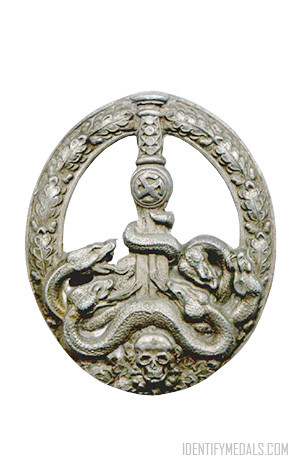
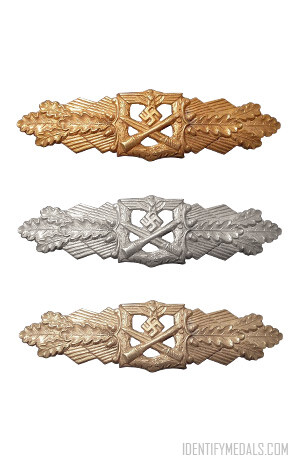
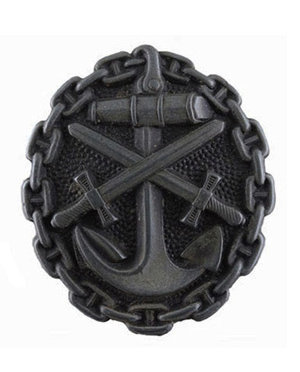
The Naval Wound Badge (or Verwundetenabzeichen für Angehörige der Marine in German) is a badge from IMperial Germany established on 24 June 1918 by Emperor Wilhelm II in the same classes and under the same regulations as the Army badge.

The Wound Badge in Silver was awarded for three or four wounds to members of the Imperial Navy, which were wounded at a sea-fight. Although it was introduced at the closing stage of the Great War, since 1936 all the veterans who were wounded but never received a badge were eligible for that award upon presentation of a documented proof. Another step forward was made on April 20, 1939, when the Ministry of Interior Affairs applied the same procedure to the former military personnel wounded in action during the Great War who were permanent residents of Austria, Sudetenland and Memel, annexed by that time. Thus Army and Naval Wound Badges (model 1918) were presented to veterans until late 1941.

The Naval Wound Badge Design

The badge has the shape of a vertical oval, but unlike the Army Wound Badge it was formed by an anchor chain.

The obverse bears an anchor with two superimposed crossed swords pointing upwards and situated in the middle of the badge. Issued pieces were seamless with a pebbled surface, while privately purchased badges in most cases had elegant cut-out design.