The Queen Elizabeth II Golden Jubilee Medal

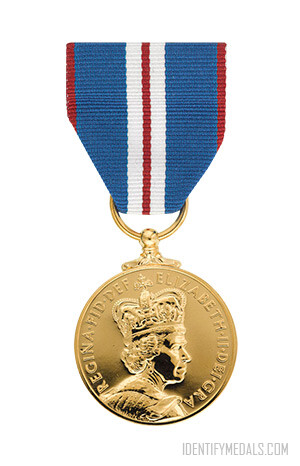
The Queen’s Golden Jubilee Medal is a commemorative medal created in 2002 to mark the 50th anniversary of Queen Elizabeth II’s accession.

The Queen Elizabeth II Golden Jubilee Medal (or Médaille du jubilé d’or de la Reine Elizabeth II in French), also known as the Queen’s Golden Jubilee Medal, was created in 2002 to commemorate the 50th anniversary of Queen Elizabeth II’s accession in 1952.

In Canada, the medal was awarded to individuals who made significant contributions to public life. In the UK, the Queen’s Golden Jubilee Medal was given to active personnel in the British Armed Forces and emergency personnel who had completed five years of qualifying service.

The Queen Elizabeth II Golden Jubilee Medal Design

The Canadian and British medals had different designs:

United Kingdom

The medal is made of cupronickel with a gilt finish. The obverse depicts the Queen wearing St. Edward’s Crown, surrounded by the inscription “ELIZABETH • II • DEI • GRA • REGINA • FID • DEF.” The reverse features the shield of the Royal coat of arms of the United Kingdom, flanked by the years 1952 and 2002.

Canada

The medal is a gold-plated bronze with a thin raised edge. The obverse features an effigy of Queen Elizabeth II, crowned with the George IV State Diadem, circumscribed by the words “QUEEN OF CANADA • REINE DU CANADA.” The reverse displays a stylized maple leaf with “CANADA” at the bottom and the years 1952 and 2002 on either side of the Royal Cypher and crown.

Both medals were issued unnamed and are suspended from the same broad royal blue ribbon with red outer stripes and, at the center, double white stripes with a red stripe between.
The Queen Elizabeth II Silver Jubilee Medal

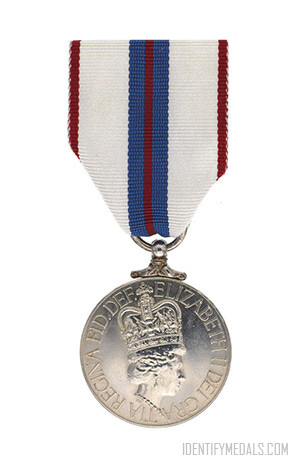
The Queen Elizabeth II Silver Jubilee Medal was established in 1977 to commemorate the 25th anniversary of Queen Elizabeth II’s accession.

The Queen Elizabeth II Silver Jubilee Medal (or Médaille du jubilé d’argent de la reine Elizabeth II in French) was created in 1977 to commemorate the 25th anniversary of Queen Elizabeth II’s accession in 1952.

The medal is identical across all realms where it was awarded, with the exception of Canada, which features unique elements. As an internationally distributed award, the Queen Elizabeth II Silver Jubilee Medal occupies a distinct position in each country’s order of precedence for honors.

The Queen Elizabeth II Silver Jubilee Medal was established by a Royal Warrant from the Queen.

Prior to 1977, the practice for coronation and jubilee medals involved the United Kingdom authorities deciding on the total number of medals to be produced and then allocating quantities to each Dominion and possession across the British Empire, and later, to each Commonwealth country. Starting in 1977, the distribution of the medals was at the discretion of each national government. Consequently, 30,000 medals were distributed in Britain, 1,507 in New Zealand, 6,870 in Australia, and 30,000 in Canada.

The Queen Elizabeth II Silver Jubilee Medal Design

The Queen Elizabeth II Silver Jubilee Medal in the UK was designed by David Wynne. It is a 32 millimeter (1.3 inch) diameter silver disc.

The obverse features the inscription “ELIZABETH II DEI GRA. REGINA FID. DEF.” (Latin for “Elizabeth II, by the Grace of God, Queen, Defender of the Faith”) surrounding an effigy of Queen Elizabeth II, symbolizing her role as the fount of honor. The reverse side displays a crown atop a wreath containing the words “THE 25th YEAR OF THE REIGN OF QUEEN ELIZABETH II 6 February 1977” arranged in six lines.

The Queen Elizabeth II Coronation Medal

The medal, established in 1953, was given as a personal memento from the Queen to members of the Royal Family and selected officers of state.

The Queen Elizabeth II Coronation Medal is a commemorative medal established on 2 June 1953 and instituted to celebrate the coronation of Queen Elizabeth II.

This medal was given as a personal memento from the Queen to members of the Royal Family and selected officers of state, including members of the Royal Household, government officials, mayors, public servants, local government officials, and members of the navy, army, air force, and police in Britain, as well as her colonies and Dominions. It was also awarded to members of the Mount Everest expedition, two of whom reached the summit four days before the coronation. The medal was struck at the Royal Mint and distributed immediately after the coronation.

For Coronation and Jubilee medals, up until 1977, the practice was for the authorities in the United Kingdom to decide on the total number to be produced and then allocate a proportion to each of the Commonwealth countries, Crown dependencies, and other possessions of the Crown. The government of each territory had the discretion to decide who would receive a medal and for what reasons.

In total, 129,051 medals were awarded, including:

  • 11,561 to Australians.
  • 12,500 to Canadians.

The Queen Elizabeth II Coronation Medal Design

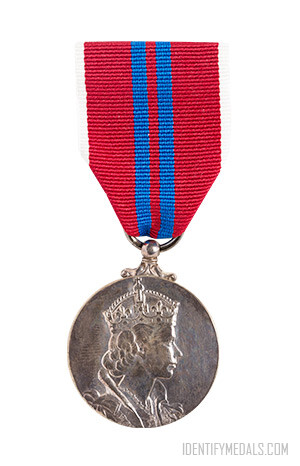
The Queen Elizabeth II Coronation Medal is a silver disk measuring 1.25 inches in diameter. The obverse features a crowned effigy of Queen Elizabeth II, facing right, adorned in a high-collared ermine cloak and wearing a Tudor Crown along with the Collar of the Garter and Badge of the Bath. It lacks a raised rim and any inscriptions.

The reverse displays the Royal Cypher “EiiR” topped by a large crown, with the inscription “QUEEN ELIZABETH II CROWNED 2nd JUNE 1953” around the edge. The medal was designed by Cecil Thomas.

The dark red ribbon is 1.25 inches (32 mm) wide, featuring 2 mm wide white edges and two narrow dark blue stripes in the center, each 2 mm wide and 1.6 mm apart.

The Police Long Service and Good Conduct Medal

The Police Long Service and Good Conduct Medal was instituted in 1951 and is awarded for twenty aggregate years of service in the police.

The Police Long Service and Good Conduct Medal is an honor bestowed upon police officers in the United Kingdom. Established in 1951, it is awarded to individuals who have completed twenty aggregate years of service in the UK police forces.

The criteria for receiving this medal were established by Royal Warrant under King George VI in June 1951. It is presented as a token of appreciation from the Sovereign for long and meritorious service provided by members of the UK Police Forces. To be eligible for this award, an officer must be recommended by the Chief Constable to the Home Secretary. The recommendation must confirm the following:

  • The officer has served as a member of a Police Force.
  • The officer has demonstrated efficient service for the qualifying period.
  • The officer’s character has been exemplary.

The Police Long Service and Good Conduct Medal Design

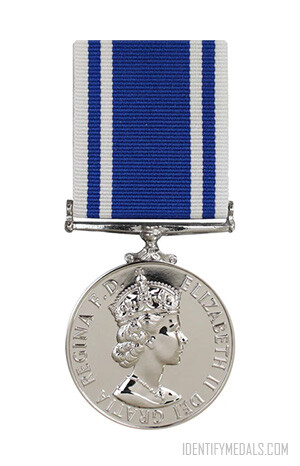
The Police Long Service and Good Conduct Medal is a circular decoration, measuring 1.4 inches (36 mm) in diameter. Originally crafted from cupro-nickel, modern versions are rhodium plated.

The obverse side displays the effigy of the reigning monarch. On the reverse side, there is an image of Justice holding scales in her left hand and a wreath in her right, encircled by the inscription ‘FOR EXEMPLARY POLICE SERVICE’.

The suspender comes in both swivelling and non-swivelling formats and is straight in shape. Recipients’ ranks and names are engraved on the rim using impressed capital letters.

The medal is suspended from a dark blue ribbon, 1.25 inches (32 mm) wide, with two thin white stripes on each edge. Bars for additional service of 30 and 40 years were authorized on March 11, 2022. 

The King’s Police Medal

The King’s Police Medal is an award of the United Kingdom given to police in the United Kingdom for gallantry or distinguished service.

The King’s Police Medal (or KPM) is bestowed upon police officers in the United Kingdom in recognition of acts of gallantry or distinguished service. Initially established on 7 July 1909, its creation was prompted by the need to honor the bravery exhibited by police officers during the Tottenham Outrage.

Originally, the medal was awarded across the wider British Empire, including Commonwealth nations. However, many of these countries now have their own systems of honors.

In 1940, the medal was renamed the King’s Police and Fire Services Medal (KPFSM), and it was later replaced by the Queen’s Police Medal (QPM) on 19 May 1954, coinciding with the establishment of a separate Queen’s Fire Service Medal. Following the passing of Queen Elizabeth II in 2022 and the ascension of King Charles III to the throne of the United Kingdom, the award reverted to its original name, the King’s Police Medal.

From 1909 to 1979, the medal was conferred a total of 4,070 times for acts of gallantry and distinguished service, including awards across dominions and the empire. During this period, 54 bars and one second bar were awarded in recognition of multiple acts of gallantry or service.

The King’s Police Medal Design

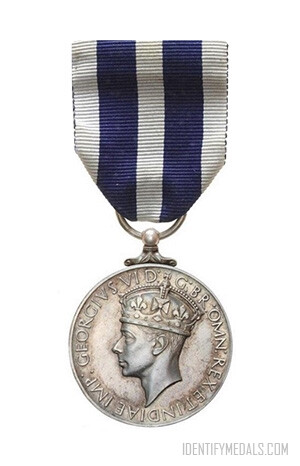
The medal is circular silver and measures 36 mm in diameter. The ribbon is suspended from a ring.

The obverse of the medal features the profile of the reigning monarch, accompanied by an inscription denoting the specific period of their reign. The reverse side depicts Saint Michael, the patron saint of police officers, holding a sword and shield at rest, symbolizing preparedness for peace.

Although the basic design has remained consistent since its inception in 1909, over time, the exergue of the medal underwent changes, with the addition of inscriptions such as “For Distinguished Police Service” or “For Gallantry.” Recipients’ names, ranks, and forces are inscribed on the rim of the medal.

The ribbon, originally dark blue with silver stripes at each edge, was later amended to include a central silver stripe and, for gallantry awards, a thin red stripe down the middle of each silver stripe from 1933 onwards.

The King Charles III Coronation Medal

The King Charles III Coronation Medal is a commemorative medal that celebrates the coronation of King Charles III and Queen Camilla in 2023.

The King Charles III Coronation Medal was crafted as a commemorative token to honor the crowning of King Charles III and Queen Camilla on May 6, 2023.

In the United Kingdom, recipients of the medal included:

  • Individuals who actively contributed to the official Coronation events in Westminster Abbey and processions, as well as other officially recognized ceremonial Coronation events.
  • Serving members of the Armed Forces who had completed five full calendar years of service by May 6, 2023, or who participated in Armed Forces Coronation events throughout 2023.
  • Frontline emergency personnel who had served in a paid, retained, or voluntary capacity, dealing with emergencies as part of their service conditions, and who had completed five full calendar years of service by May 6, 2023.
  • Publicly employed prison services personnel who had completed five full calendar years of service by May 6, 2023.
  • Living individual recipients of the George Cross and the Victoria Cross.

In total, over 400,000 medals were awarded.

The King Charles III Coronation Medal Design

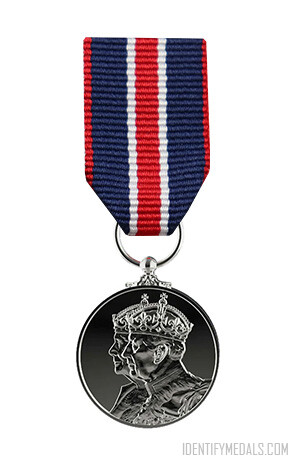
The medals are crafted from nickel silver. On the obverse side, there is a crowned effigy of the King and Queen facing left. The reverse side displays the Royal Cypher CiiiR surmounted by the Tudor Crown, a laurel wreath, and the date of the coronation, which is May 6, 2023.

Worcestershire Medal Service issues the medals, with the effigy on the obverse face modeled by Martin Jennings. The reverse was designed by Phil McDermott of the Worcestershire Medal Service.

Find This Medal Online

Right Now on eBay 
Clicking a link to eBay may result in a referral commission being paid if a purchase is made.
Loading...

The Operational Service Medal for Congo

The Operational Service Medal for Congo was awarded to all British personnel that served between June and September 2003 on Operation Coral.

The Operational Service Medal for the Democratic Republic of Congo is a campaign medal conferred upon all British personnel who served during the period of June to September 2003 as part of Operation Coral. This operation marked the British contribution to the multinational peacekeeping effort led by France in the Democratic Republic of Congo, occurring during the latter phases of the Second Congo War.

The Operational Service Medal (also known as OSM) was established in 1999 to replace the General Service Medal (1962) for all new operations. A separate medal of the same design is awarded for each campaign, differentiated by a distinct ribbon. 

The General Service Medal for Congo Qualifying Criteria

The medal with a clasp is conferred for either 25 days of continuous service in Bunia, located in the Ituri Province of the Congo, or completion of five round-trip operational flights between Entebbe and Bunia. This service must have taken place between June 14 and September 10, 2003, as part of Operation Coral.

There is no specific minimum duration required for individuals who were killed, wounded, or disabled during operations, or for those who received decorations for their operational service, including commendations and mentions in dispatches.

The service that qualifies for the Operational Service Medal also contributes towards the period necessary to receive the Accumulated Campaign Service Medal.

British military personnel who served with United Nations forces in the Congo from November 30, 1999, for a minimum of 90 days as part of the MONUC or MONUSCO missions are eligible to wear the United Nations Medal with the appropriate ribbon.

The General Service Medal for Congo Design

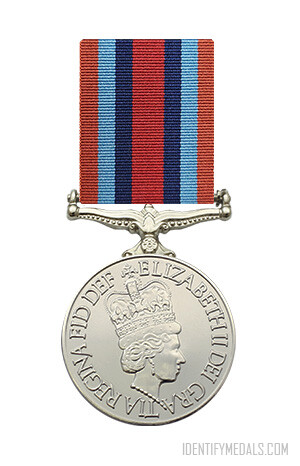
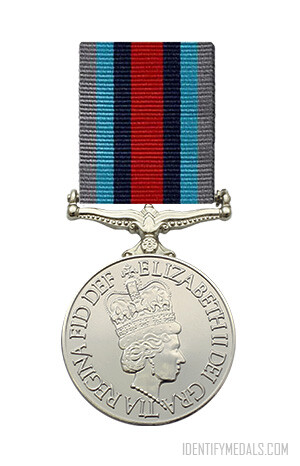
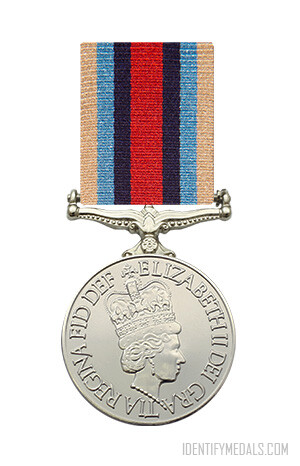
The Operational Service Medal for the Democratic Republic of Congo features a silver circular design.

On the obverse side, it displays the crowned effigy of Queen Elizabeth II along with the inscription ELIZABETH II DEI GRATIA REGINA FID. DEF.

The reverse side showcases the Union Flag encircled by the inscription FOR OPERATIONAL SERVICE, with the four primary compass points depicted alongside four Coronets: Royal (top left), Naval (top right), Mural-Army (bottom left), and Astral-Royal Air Force (bottom right).

Its ribbon consists of a wide central red stripe flanked by navy blue and light blue stripes, symbolizing the three services, and an outer stripe of ochre representing the Congolese landscape.

Each medal is accompanied by a DROC clasp, with a silver rosette indicating the clasp when worn on the ribbon bar.

The General Service Medal Variants

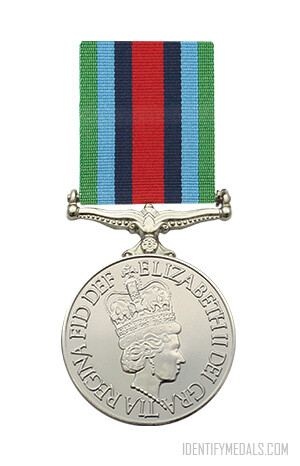
The OSM has been awarded for four separate campaigns, each with a distinctive ribbon. The other three are:

Buy an OSM Medal Online

Right Now on eBay 
Clicking a link to eBay may result in a referral commission being paid if a purchase is made.
Loading...

The WW1 Royal Tank Corps Cap Badge

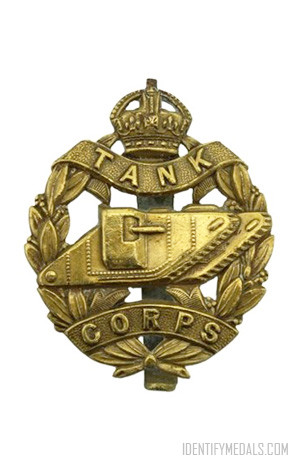
The Royal Tank Corps Cap Badge is a First World War brass King’s crown cap badge for members of the Tank Corps.

The Royal Tank Corps Cap Badge is a First World War brass King’s crown cap badge for members of the Tank Corps.

The Royal Tank Regiment (RTR) is a division of the British Army specializing in armored warfare. Previously referred to as the Tank Corps and the Royal Tank Corps, it operates under the Royal Armoured Corps. On July 5, 2012, plans were announced to merge the operational regiments—1st Royal Tank Regiment (1RTR) and 2nd Royal Tank Regiment (2RTR)—into a unified regiment named The Royal Tank Regiment, effective 2014.

Tanks made their debut at the Battle of Flers-Courcelette in September 1916, part of the larger Battle of the Somme in World War I. During this period, the six tank companies were organized under the Heavy Section of the Machine Gun Corps (MGC).

The Royal Tank Corps Cap Badge Design

The cap badge measures 48 millimeters by 40 millimeters and is stuck in brass. The obverse features a Mark I tank and the words “Tank” and “Corps”. The reverse has a slider.

The Royal Tank Regiment Cap Badge

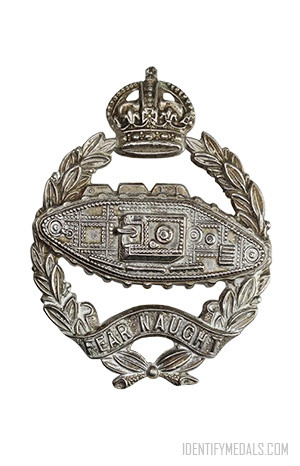
The Royal Tank Regiment Cap Badge is a WW2 badge given to members of the Royal Tank Regiment (previously known as Tank Corps).

The Royal Tank Regiment Cap Badge is a WW2 badge given to members of the Royal Tank Regiment (previously known as Tank Corps).

The badge is struck in white metal and depicts a WW1 tank in the center, surrounded by a laurel wreath and surmounted by a King George V crown. Under the tank is the inscription “Fear Naught”.

The badge measures 3.5 centimeters by 4.5 centimeters.

The Most Venerable Order of the Hospital of St. John of Jerusalem

The Most Venerable Order of the Hospital of St. John of Jerusalem is a working order of charitably minded men and women established in 1888.

The Most Venerable Order of the Hospital of St. John of Jerusalem, and also known as the Order of St John or St John International, is a British royal order of chivalry constituted in 1888 by Queen Victoria and dedicated to St John the Baptist, an itinerant preacher in the early 1st century AD.

The order can be tracked back to the Knights Hospitaller in the Middle Ages. The Knights Hospitalle were a medieval and early modern Catholic military order, later known as the Order of Malta. A faction moved to Britain in the early 1830s and became associated with the founding in 1882 of the St John Ophthalmic Hospital near the old city of Jerusalem and the St John Ambulance Brigade in 1887.

The Order of St John is also known for the health organizations it has founded, such as St John Ambulance and St John Eye Hospital Group. 

The Order of the Hospital of St. John of Jerusalem Design

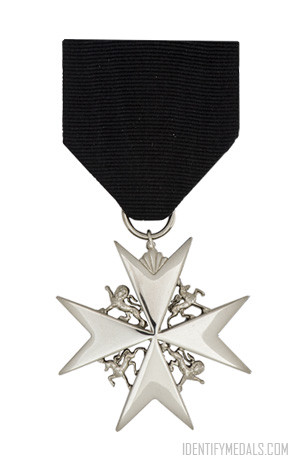
The insignia of the Order is a Maltese cross, or eight-pointed cross in white enamel set in silver-colored metal. The cross is embellished in each of its main angles with lions and unicorns, with a lion in the top left and bottom right angles. 

The insignia of a Bailiff or Dame Grand Cross consists of a breast star and a sash badge. The insignia of a Knight or Dame of Justice or of Grace is a breast star and a neck badge. The insignia of a Commander is a neck badge, the Officer insignia is silver and enameled white, and he insignia of a Member is also worn on the left breast but is bright silver without enamel.

The badges have a ring attached to the top through which the ribbon passes. The ribbon for all grades is black watered.