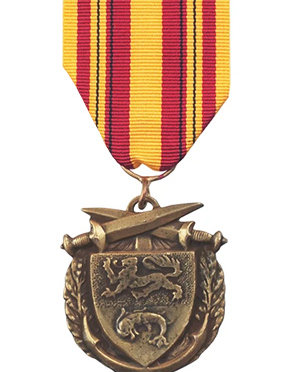
The Dunkirk Medal

The Dunkirk Medal is an unofficial commemorative medal established om 1 May 1960 and created by the town of Dunkirk for the area’s defense.

The Dunkirk Medal is an unofficial commemorative medal established on 1 May 1960 and created by the town of Dunkirk to commemorate the defense of the area during May and June 1940.

The allocation of the award was managed by the French National Association of Veterans of the Fortified Sector of Flanders and Dunkirk (and later administrated by the now-disbanded Dunkirk Veterans Association).

The award was initially awarded to only French service personnel (with approximately 30,000 medals issued). In 1970 it was also awarded to any Allied member involved in Operation Dynamo, the evacuation of Allied forces from the Dunkirk area between 29 May and 3 June and those soldiers evacuated from the beaches.

All British servicemen from the Royal Navy, Royal Air Force, Merchant Navy, and the civilian little ship volunteers were eligible to receive the award. For citizens of the United Kingdom, the medal may be worn on the right breast, but as it is not designated an official medal it is not to be mounted with other British official medals and awards.

The History of the Dunkirk Medal

The Dunkirk evacuation, also known as Operation Dynamo, took place between May 26 and June 4, 1940. During this operation, a vast number of British, French, and other Allied troops were evacuated from the French coast as they faced encirclement by German forces. The operation involved a large-scale mobilization of various naval vessels, merchant ships, and civilian boats that braved enemy fire to rescue the stranded troops.

The unofficial Dunkirk Medal was created by private organizations or individuals to recognize the courage and sacrifice of those involved in the evacuation. These commemorative medals are often privately produced and are not officially sanctioned or recognized by the UK government. They may be available for purchase or awarded by certain veterans’ organizations as a way to honor the memory of the Dunkirk evacuation and the servicemen and civilians involved.

A Note About Unofficial Medals

It’s important to note that unofficial commemorative medals do not hold the same status as official military awards and decorations. They do not carry the same level of recognition or entitlements as official honors, such as the campaign medals and service medals awarded by the UK government.

The Dunkirk Medal Design

The Dunkirk Medal is struck in bronze and is 44mm high and 36mm wide.

The medal’s obverse depicts a shield bearing the arms of Dunkirk (a fish and in chief, a lion passant) superimposed on an anchor and laurel wreath, crossed swords above. The reverse features a burning oil lamp over a tablet with the inscription: DUNKERQUE 1940.

Beneath the ribbon suspension of the medal are crossed swords. A named certificate was issued with each medal though the medal itself was not inscribed. The medal ribbon measures 36mm wide and has a wide central chrome yellow stripe with one wide and one thin red stripe each side with two further chrome yellow bars and two very thin black stripes.

Right Now on eBay 
Clicking a link to eBay may result in a referral commission being paid if a purchase is made.
Loading...
]

The Queen’s Gallantry Medal

The Queen’s Gallantry Medal (QGM) is a UK decoration awarded for exemplary acts of bravery by civilians, and by members of the Armed Forces.

The Queen’s Gallantry Medal (or QGM) is a United Kingdom decoration awarded for exemplary acts of bravery by civilians, and by members of the Armed Forces “not in the face of the enemy”, where the services were not so outstanding as to merit the George Cross or the George Medal.

The medal was instituted on 20 June 1974 to replace the Order of the British Empire for Gallantry and the British Empire Medal for Gallantry. The QGM ended the anomaly where the Order of the British Empire for Gallantry was awarded for lesser acts of bravery than the George Medal but took precedence over it in the Order of Wear.

The QGM has been awarded posthumously since 30 November 1977.

The Queen’s Gallantry Medal Design

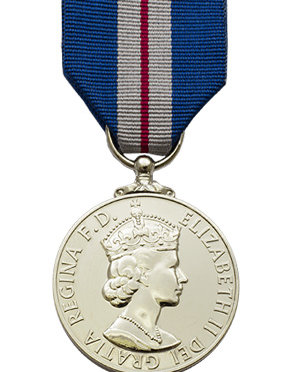
The medal is circular, struck in silver, and measures 36 millimeters in diameter.

The obverse shows the crowned effigy of the Queen, with the inscription “ELIZABETH II DEI GRATIA REGINA F.D.”. The reverse bears the image of a St Edward’s Crown above the words ‘The Queen’s Gallantry Medal’ in four lines, flanked by laurel sprigs.

The ribbon measures 32 mm wide and consists of three equal stripes of dark blue, pearl grey, and dark blue with a narrow rose pink stripe in the center. While awards to women generally have the ribbon fashioned into a bow, female recipients in the armed forces or civilian uniformed services have the medal presented with the ribbon in the same style as for male recipients.

The name of the recipient is impressed on the rim of the medal. If awarded to members of the Armed Forces, service number, rank, and unit are also included.

The Military Medal (MM)

The Military Medal (or MM) was a military decoration established in 1916 and awarded for bravery in battle to personnel of the British Army.

The Military Medal (or MM) was a military decoration established in 1916 and awarded for bravery in battle on land. The award is given to personnel of the British Army and other arms of the armed forces, and to personnel of other Commonwealth countries, below commissioned rank.

The award had retrospective application to 1914, and was awarded to other ranks for “acts of gallantry and devotion to duty under fire“. It was discontinued in 1993 when it was replaced by the Military Cross, which was extended to all ranks, while other Commonwealth nations instituted their own award systems in the post-war period.

When the medal was first introduced, it was unpopular among regular soldiers wrote MM and DCM recipient Frank Richards who stated “the Military Medal, which without a shadow of a doubt had been introduced to save awarding too many DCMs. The old regular soldiers thought very little of the new decoration“.

Since 1918 recipients of the Military Medal have been entitled to the post-nominal letters “MM”.

The Military Medal Design Design

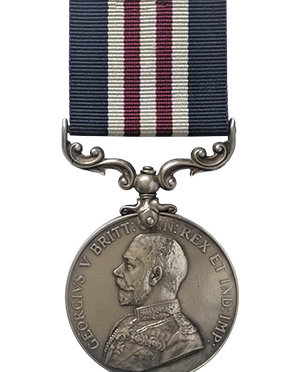
The medal is circular, struck in silver and measures 1.4 inches (36 mm) in diameter.

The obverse bears the effigy of the reigning monarch and an appropriate inscription. The reverse shows the inscription “FOR BRAVERY IN THE FIELD” in four lines, surrounded by a laurel wreath, and surmounted by the Royal Cypher and Imperial Crown.

The ribbon is dark blue, 1.25 inches wide with five equal center stripes of white, red, white, red, and white, each 0.125 inches wide. The suspender is of an ornate scroll type and the name and service details of the recipient were impressed on the rim of the medal, although honorary awards to foreign recipients were issued unnamed. Silver, laurelled bars were authorized for subsequent awards, with a silver rosette worn on the ribbon bar to indicate the award of each bar.

The Distinguished Service Cross (UK)

The Distinguished Service Cross (DSC) is a military decoration awarded to officers for acts of gallantry during active operations at sea.

  • Time Period: Pre-WW1
  • Year of Institution: 15 June 1901 (as Conspicuous Service Cross, renamed 1914)
  • Country: Great Britain

The Distinguished Service Cross (or DSC) is a third level military decoration awarded to officers in recognition of an act or acts of exemplary gallantry during active operations against the enemy at sea. Ranks included officers of the British Armed Forces, Royal Fleet Auxiliary and British Merchant Navy, and formerly also of other Commonwealth countries.

The award was created in 1901 as the Conspicuous Service Cross and awarded to warrant and subordinate officers, including midshipmen, ineligible for the Distinguished Service Order. In October 1914, the award was renamed the Distinguished Service Cross and eligibility was extended to all naval officers (commissioned and warrant) below the rank of lieutenant commander. In August 1916, bars were introduced to reward further acts of gallantry meriting the Cross.

In December 1939 eligibility was extended to Naval Officers of the rank of Commander and Lieutenant-Commander, in April 1940 to equivalent ranks in the Royal Air Force serving with the Fleet, and in November 1942 to those in the Army aboard defensively equipped merchant ships.

Recipients are entitled to the post-nominal “DSC”. Since 1979, the Distinguished Service Cross can be awarded posthumously.

The Distinguished Service Cross Design

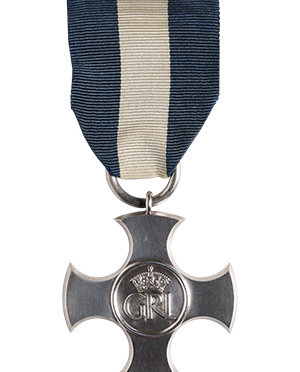
The medal is a plain silver cross with rounded ends with a width of 43 millimeters (1.7 in).

The obverse has a circular center containing the Royal Cypher of the reigning monarch at the time of award surmounted by a crown. The reverse is plain apart from the hallmark, and the ribbon is attached via a hall-marked silver ring. From 1940, the year of issue was engraved on the lower limb of the cross, and since 1984 it has been awarded named to the recipient.

The ribbon has three equal stripes of dark blue, white, and dark blue. The ribbon bar denoties a further award is plain silver, with convex ends and a central crown.

The King Hussein Medal

The King Hussein Medal is a medal awarded to British and American personnel involved in relief operations codenamed Operation Shoveller during and after the Civil War of September 1970. All personnel was presented with the medal by King Hussein at the end of the deployment.

Permission to wear this medal was never issued for Great Britain.

The King Hussein Medal Design

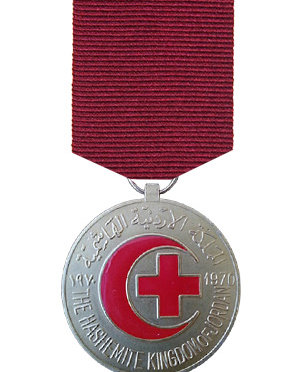
The medal is circular and struck in silver with a red enamel emblem.

The obverse bears the emblem of the Red Cross and Red Crescent and the inscription “THE HASEMITE KINGDOM OF JORDAN” and its Arabic equivalent, with the date 1970 and Arabic equivalent on both sides. The reverse has a seven-line inscription across the center.

The ribbon is plain crimson.

The Pingat Jasa Malaysia Medal

The Pingat Jasa Malaysia Medal (or Malaysian Service Medal) is a medal given by the King and Government of Malaysia and established 3 March 2004. The award is in recognition of “distinguished chivalry, gallantry, sacrifice, or loyalty” in contributing to the freedom of independence of Malaysia.

The medal recognizes service by members of the Malaysian Armed Forces during the Malayan EmergencySecond Malayan Emergency, and the Indonesia–Malaysia confrontation. The medal was also offered for award to members of the Commonwealth forces from Australia, Fiji, India, Nepal, New Zealand, and the United Kingdom who served in Malaysia during the Malayan Emergency and the Indonesia–Malaysia confrontation.

The medal can be conferred and accepted posthumously by next of kin.

The Pingat Jasa Malaysia Medal Design

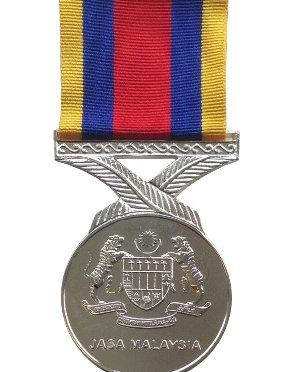
The medal is circular, made of base metal (brass)-coated nickel silver, and measures 38 mm in diameter.

The obverse bears the Coat of arms of Malaysia with the inscription “JASA MALAYSIA” beneath it. The reverse shows a map of Malaysia and the initials P.J.M underneath.

The ribbon is a 35 mm corded ribbon and has five colored vertical stripes. The colors are those of the Malaysian flag. The individual colors and widths of the five vertical stripes are as follows: 4.5 mm yellow, 7 mm blue, 12 mm red, 7 mm blue, and 4.5 mm yellow. The medal is suspended by two crossed palas palm fronds which are attached to a straight suspension bar covered in a decorative pattern.

No clasps or bars were issued for this medal.

The Soviet 40th Anniversary Medal

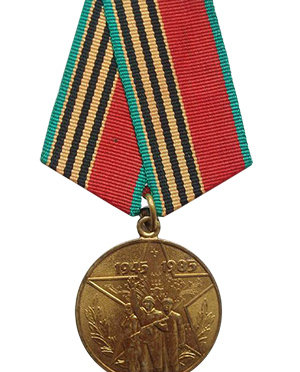
The Soviet 40th Anniversary Medal was established on 12th April 1985 and awarded to British and Canadian forces who served mainly in RN or MN ships on Arctic Convoys. The medal was approved in 1994 by Her Majesty the Queen and first awarded by the Soviet Government to selected ex-Servicemen – in particular surviving veterans of the Arctic Convoys of World War II.

Similar medals were issues for the 50th and subsequent five year anniversaries as well. However, those for the 55th anniversary and above have not been authorized for wear.

The Soviet 40th Anniversary Medal Design

The medal is circular, struck in bronze, and measures 32 mm in diameter.

The obverse features a group of servicemen and women in front of a five-pointed star and flanked by oak leaves and the dates 1945-1985 above. The reverse has the inscription “40th Anniversary of the Victory in the Great Patriotic War 1941-1945” in Russian.

The ribbon is one-half red and the other orange with three black stripes, edged with pale blue. Later issues of the medal have no blue edges.

The medal is worn in the Russian style.

The Rhodesia Medal

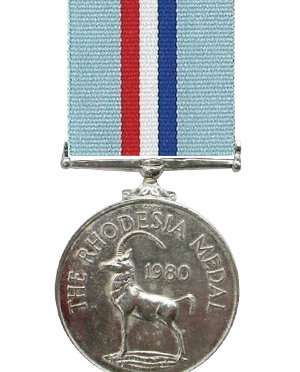
The Rhodesia Medal was initiated by the British Government in consultation with Australia, New Zealand, Fiji, and Kenya, whose forces took part in Operation AGILA, (Operation MIDFORD for the New Zealand forces). The medal was awarded for service of at least 14 days between 1 December 1979 and 20 March 1980, to members of the military and police forces, as well as eligible civilians, who participated in monitoring the ceasefire and supervising the elections in the lead-up to Zimbabwean independence.

The role of the multi-national force was to keep the peace between 22,000 guerrilla fighters and the Rhodesian forces during the ceasefire and run-up to the 1980 elections. There was no minimum qualifying period for those killed, wounded or disabled due to service, or where a recipient was decorated for gallantry.

Each country treats the medal as part of its own honors system. Recipients of the Rhodesia Medal also received the Zimbabwean Independence Medal in either silver or bronze, although British personnel did not have permission to wear it in uniform, while New Zealand granted approval for restricted wear only.

The Rhodesia Medal Design

The medal is circular, made of rhodium-plated cupro-nickel, and measures 36 mm in diameter. It was issued by the Royal Mint.

The obverse features the crowned effigy of Queen Elizabeth II with the inscription ELIZABETH II DEL GRATIA REGINA FID.DEF. The reverse depicts a sable antelope surrounded by the inscription THE RHODESIA MEDAL’ and ‘1980‘. The medal was issued named to British armed forces personnel, but unnamed to police officers.

The medal is suspended from a 32 mm sky-blue ribbon with three central stripes of red, white, and blue. No clasps were awarded.

The South Vietnam Campaign Medal

The Republic of Vietnam Campaign Medal (or Chiến Dịch Bội Tinh), is a South Vietnamese military campaign medal created in 1949.

The Republic of Vietnam Campaign Medal (or Chiến Dịch Bội Tinh in Vietnamese), is a South Vietnamese military campaign medal created in 1949 and awarded for two different periods of service in Vietnam.

The medal was first awarded to French military personnel during the First Indochina War (from 8 March 1949 to 20 July 1954). During the Vietnam War (Second Indochina War), the South Vietnamese government awarded the Republic of Vietnam Campaign Medal with Device (1960– ) to members of the South Vietnamese military for wartime service and on March 24, 1966, to members of the U.S. military for support of operations in Vietnam. In May 1966, other allied foreign military personnel became eligible for the award.

On 30 April 1975, Saigon was captured by the North Vietnamese army and South Vietnam surrendered and disbanded. The medal was not awarded after 28 March 1973, when the last U.S. troops left South Vietnam in accordance with the Paris Peace Accords.

In the United States, Public Law 88–257 permits military personnel to accept the medal for service performed in Vietnam from 1 March 1961 to 28 March 1973, inclusive. Since March 1966, the medal may also be awarded to any service member who, while serving outside the geographical limits of the Republic of Vietnam, contributed direct combat support to the Republic of Vietnam Armed Forces for six months.

The Republic of Vietnam Campaign Medal was awarded to Australian military personnel for service in South Vietnam during the period 31 July 1962 to 28 March 1973. The medal was awarded to New Zealand Forces for service in Vietnam for six months between 1964 (arrived Vietnam June 1964) and 1973 (left Vietnam 22 December 1972).

The South Vietnam Campaign Medal Design

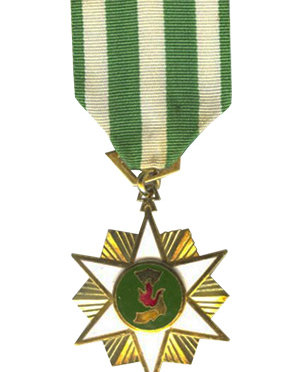
The medal is made of a gold-colored metal in the shape of a 36 mm wide six-pointed white enameled star with six-pointed gold rays between the arms of the star. During the Vietnam War, the Republic of Vietnam Campaign Medal with Device (1960–) was manufactured in the United States.

In the obverse, in the center of the star is an 18 mm green colored disc bearing a gold-colored map of Vietnam with three painted flames in red between North and South Vietnam, signifying the three regions of Vietnam. On the reverse of the medal is a circle bearing the inscription Chiến Dịch (Campaign) above and Bội Tinh (Medal) below the word VIET-NAM in the center.

The suspension ribbon and service ribbon of the medal is stripes in green (to represent freedom) with three vertical white (to represent purity).

Find This Medal Online

Right Now on eBay 
Clicking a link to eBay may result in a referral commission being paid if a purchase is made.
Loading...

The Vietnam Medal (1968)

The Vietnam Medal is a joint Australian and New Zealand campaign medal awarded for service in the Vietnam War. It was jointly developed by the two countries, although there were separate Royal authorization warrants for each one.

Australia

Qualifying service for the Vietnam Medal includes 28 days in ships or craft on inland waters or off the coast of Vietnam, one or more days on the posted strength of a unit or formation on land, one operational sortie over Vietnam or Vietnamese water by aircrew on the posted strength of a unit, official visits either continuous or aggregate of 30 days, or one day or more by members of accredited philanthropic organizations attached to Australian forces in an official capacity for full-time duty – all between 29 May 1964 and 27 January 1973.

New Zealand

The medal was awarded to all members of the New Zealand armed forces who, between 29 May 1964 and 27 January 1973, either served for 28 days, continuous or aggregated, in ships or craft employed in operations on inland waters or off the coast of Vietnam; served for one day or more on the posted strength of a unit or formation on land in Vietnam; conducted one operational sortie over Vietnam or Vietnamese waters by aircrew on the posted strength of a unit allocated for direct support of operations in Vietnam; served for 30 days or more, continuous or aggregated, on official visits, inspections or other occurrences of a temporary nature on duty in Vietnam, or in ships or craft engaged in operations off the Vietnamese coast. Service terminated by death or wounds, or the award of decoration for gallantry, led to the immediate award of the medal, regardless of whether the qualification period had been fulfilled.

The Vietnam Medal Design

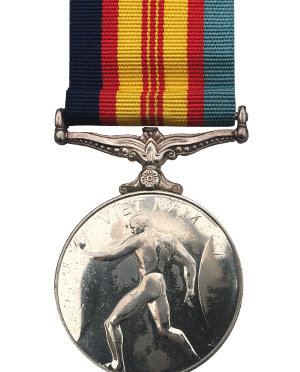
The medal is circular, struck in nickel-silver, and measures 36 mm in diameter.

The obverse bears the crowned effigy of Queen Elizabeth II with the inscription ‘ELIZABETH II DEI GRATIA REGINA F.D.’. The reverse of the medal has the word ‘VIETNAM‘ at the top center above a depiction of a man standing between two symbolic spheres, “in representation of the ideological war in Vietnam“.

The recipient’s name, rank, and serial number are engraved on the edge of the medal.

The ribbon contains a broad central stripe of bright yellow surmounted by three thin red stripes (representing the Republic of Vietnam). The ribbon also has a blue stripe to represent the Navy, two red stripes for the Army, and a light blue stripe for the Air Force.