The South African Medal for War Services

The South African Medal for War Services is a service medal for voluntary unpaid service in support of the war effort during WW2.

The South African Medal for War Services is a South African service medal for voluntary unpaid service in support of the war effort during the Second World War (between 6 September 1939 and 15 February 1946). The South African Medal for War Services was instituted by a Royal Warrant dated 29 December 1945, countersigned and sealed at Cape Town on 6 February 1946.

Altogether 17,500 medals were awarded to people of both sexes, irrespective of whether or not they were British subjects. The requirement was a minimum of two years service, of which at least one year was continuous, rendered voluntarily and without pay within or outside the borders of the Union of South Africa, in one or more of the officially recognized voluntary non-military organizations, such as the Red Cross and the Governor-General’s War Fund, with the proviso that five or more hours were worked every week.

The South African Medal for War Services Design

The medal is circular, struck in silver and measures 36 millimeters in diameter and 3 millimeters thick at the raised rim.

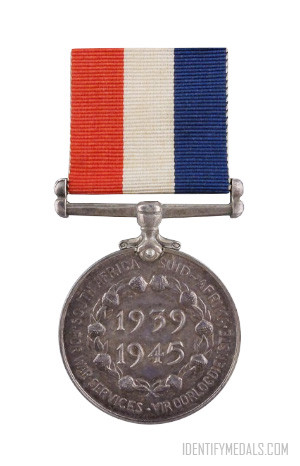
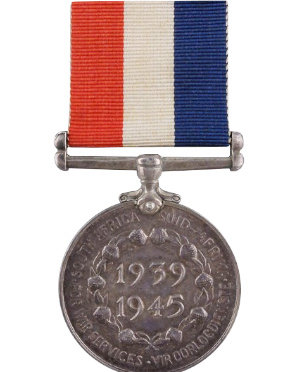
The obverse shows the years “1939” over “1945”, encircled by a wreath of protea flowers, all of which are surrounded by the name of the medal in English and Afrikaans, “SOUTH AFRICA” and “SUID-AFRIKA” above and “FOR WAR SERVICES • VIR OORLOGDIENSTE” below. The reverse bears the Coat of Arms of the Union of South Africa, with the medal number impressed at the bottom on the rim.

The ribbon has three equal stripes of red, white and blue (the national South African colors). The medal is affixed to the suspender by means of claws and a pin through the upper edge of the medal.

More Union of South Africa Medals

The New Zealand Memorial Cross

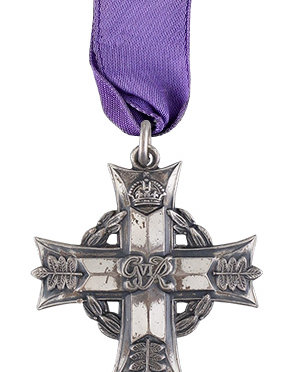
The New Zealand Memorial Cross is awarded to the next of kin of New Zealand service personnel killed on active service or who died of wounds.

The New Zealand Memorial Cross is a campaign medal awarded to the next of kin of New Zealand service personnel who, since September 1939, have been killed on active service or later died of their wounds. Up to two crosses could be awarded to the family of each individual, and was intended primarily for widows and mothers.

The cross was formally instituted, and full regulations published, in September 1947. Eligibility included both those serving with New Zealand forces and New Zealanders serving with other British Commonwealth forces, including the merchant navy.

In September 1960, further regulations were published extending eligibility to conflicts since the Second World War. Awards have since been made relating to service in Korea, Malaya, Vietnam, East Timor and Afghanistan. In September 1995 relatives of those killed during peacekeeping operations became eligible.

The New Zealand Memorial Cross Design

The medal is a cross patoncé struck in dull silver and measures 32 millimeters (1.3 inches) in diameter.

The obverse shows a laurel wreath between the arms of the cross. At the top of the vertical arm is a St. Edward’s Crown, with a fern leaf at the end of each of the other arms. At the center is the reigning monarch’s Royal Cypher.
The reverse is plain, with most crosses engraved with the name, rank and service number of the person commemorated.

The ribbon measures 12 millimeters wide and is royal purple.

The Canadian Memorial Cross

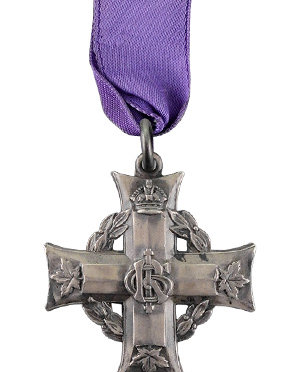
The Canadian Memorial Cross was first instituted in 1919 and awarded to mothers and widows of Canadian soldiers who died on active duty.

The Canadian Memorial Cross was first instituted by Order-in-Council 2374, dated December 1, 1919, and awarded to mothers and widows of Canadian soldiers who died on active duty or whose death was consequently attributed to such duty.

This gift of Canada was issued as a memento of personal loss and sacrifice on the part of widows and mothers of Canadian sailors, soldiers and airmen who died for their country during the war.

The crosses could be worn by the recipients anytime and were engraved with the name, rank and service number of the son or husband.

The Canadian Memorial Cross Design

The medal is in the form of a cross pattee, struck in silver and measures 32 millimeters in diameter.

The obverse shows, at the end of the upright, a crown. At the foot and the end of either arm is a maple leaf and in the center, within a wreath of laurel, is the royal cipher of the reigning monarch: GRI for King George the Fifth, GVIR for King George the Sixth, or EIIR for Elizabeth the Second. The reverse of the Cross is engraved with the name and service number of the individual commemorated.

The medal is suspended by a bar brooch, although prior to 1945 it was suspended from a light purple ribbon 11 mm wide.

The King’s Badge

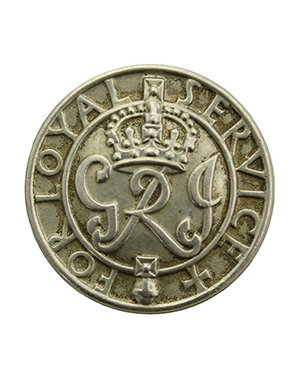
The King’s Badge is a lapel badge issued to servicemen who, as a result of their injuries, had been discharged from active service.

The King’s Badge is a lapel badge authorized by the Ministry of Pensions in the early part of the Second World War and initially issued to servicemen who, as a result of their injuries, had been discharged from active service.

Its basic purpose was to show that the wearer was a veteran. As well as members of the armed services, merchant navy and fishing fleets qualifying, by late 1944, it was also awarded to the coastguards, police, members of the Civil Defence Services, and the Home Guard. The badge was to be worn only on civilian clothing and by the end of 1941 over 8,000 had been awarded.

Three versions of the badge were produced.

The King’s Badge Design

The badge is struck in silver and measures 26 millimeters in diameter.

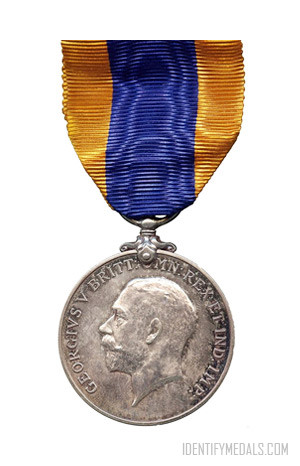
The obverse shows the initials “GRI” for Georgius Rex Imperator, in this case referring to King George VI. The earlier badge was in the name of his father, George V. The wording around the initials read “For King and Empire Services Rendered to For Loyal Service”.

The reverse is plain and the badges are not numbered or named.

The Sudan Defence Force General Service Medal

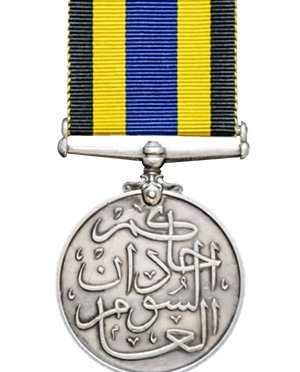
The Sudan Defence Force General Service Medal is a campaign medal awarded for service in minor operations within the Anglo-Egyptian Sudan.

The Sudan Defence Force General Service Medal is a campaign medal instituted in 1933 and awarded for service in minor operations within the Anglo-Egyptian Sudan.

The medal superseded the Khedive’s Sudan Medal (1910) and was awarded on the recommendation of the Commandant of the Sudan Defence Force (SDF) to locally recruited personnel of the SDF, police and other approved Sudanese who served in minor operations classed by the Governor-General as of sufficient importance to warrant the grant of the medal.

About 9,000 SDF General Service Medals were issued. No further awards were made after 1945, with the medal becoming obsolete with Sudanese independence in 1956.

The Sudan Defence Force General Service Medal Design

The medal is circular, struck in silver and measures 36 millimeters in diameter.

The obverse shows the seal of the Governor-General of Sudan. The reverse bears a stationary group of Sudanese soldiers, with “The Sudan” in Arabic below.

The ribbon has a central stripe of royal blue, edged by two yellow stripes and two black stripes at the edges.

The India General Service Medal 1936-39

The Indian General Service Medal is a campaign medal approved in 1938 for issue to men of the British and Indian armies and of the RAF.

The Indian General Service Medal (or 1936 IGSM) is a campaign medal approved on 3 August 1938, for issue to officers and men of the British and Indian armies, and of the Royal Air Force.

The medal was awarded for minor military campaigns on the North-West Frontier of India between 1936 and 1939. Each campaign covered by the medal was represented by a clasp on the ribbon; two were sanctioned, both relating to operations in Waziristan:

  • North West Frontier 1936–37
  • North West Frontier 1937–39

Following the grant of Indian Independence in 1947 the medal became obsolete, although it could still to be worn in uniform by British, Indian and Pakistani servicemen.

The India General Service Medal 1936-39 Design

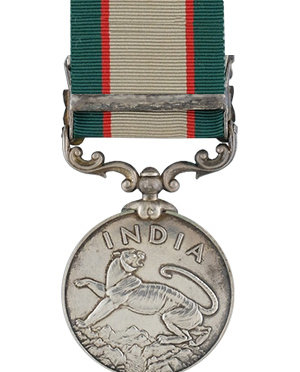
The medal is circular, struck in silver and measures 36 millimeters in diameter.

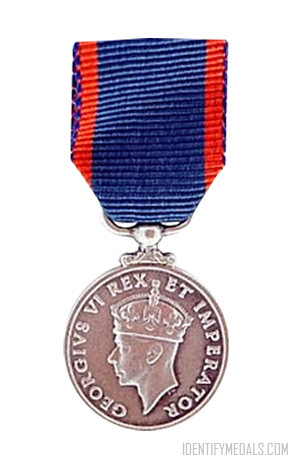
The obverse shows a crowned effigy of King George VI. The reverse bears a tiger with the word INDIA across the top.

The ribbon is stone colored flanked by narrow red stripes, with broad green stripes at the edges.

The Iraq Active Service Medal

The Iraq Active Service Medal, also known as the King Faisal’s War Medal, is a British campaign medal established in May 1926. 

The Iraq Active Service Medal, also known as the King Faisal’s War Medal, is a British campaign medal established in May 1926.

The medal was awarded to British Army and RAF personnel stationed in Iraq or serving with the Iraq Levis. It was originally issued without a clasp, but clasps denoted subsequent actions or periods of service.

From 1931 on, medals were issued with appropriate clasps from the outset.

The Iraq Active Service Medal Design

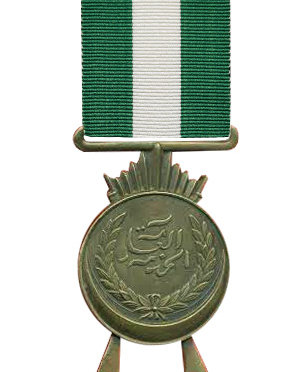
The medal is circular, struck in bronze and measures 38 millimeters in diameter.

The obverse shows a crescent forming the lower part, with an Arabic inscription above signifying “General Service” in two laurel branches. The medal is superimposed on crossed rifles, with rays in the arc between the muzzles.

The reverse bears the name of King Faisal I in Arabic and the date (AH) 1344 (1926).

The ribbon measures 31 millimeters and has equal stripes in green, white and green. The suspension is a flattened loop suspender.

The General Service Medal 1918-62

The General Service Medal (1918 GSM) was instituted in 1923 to recognize service in certain minor Army and Royal Air Force operations.

The General Service Medal (1918 GSM) was instituted in 1923 to recognize service in minor Army and Royal Air Force operations for which no separate medal was intended.

Local forces, including police, qualified for many of the clasps, as could units of the Indian Army prior to 1947.

A total of eighteen clasps were awarded, the medal never being awarded without a clasp. The clasps are:

  • S. Persia
  • Kurdistan
  • Iraq
  • N.W. Persia
  • Southern Desert Iraq
  • North Kurdistan
  • Palestine
  • S.E. Asia 1945–46
  • Bomb and Mine Clearance 1945–49
  • Bomb and Mine Clearance 1949–56
  • Palestine 1945–48
  • Berlin Airlift
  • Malaya
  • Canal Zone
  • Cyprus
  • Near East
  • Arabian Peninsula
  • Brunei

The General Service Medal 1918-62 Design

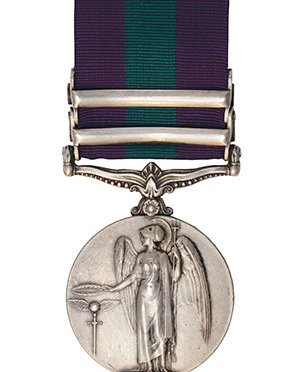
The medal is circular, struck in silver and measures 36 millimeters (1.4 in) in diameter. It was designed by E Carter Preston.

The obverse bears the crowned effigy of the reigning monarch: George V coinage head (1918-30), George V crowned and robed bust (1931-36), George VI Ind Imp (1937-49), George VI Fid Def (1949-52), ELizabeth II Br Omn (1952-54) and Elizabeth II Dei Gratia (1955-62).

The reverse shows the standing winged figure of Victory in a Corinthian helmet and carrying a trident, bestowing a wreath on the emblems of the Army (the sword) and the RAF (the wings).

The ribbon is 32 mm (1.3 in) wide and has three equal stripes of purple, dark green and purple.

The service number, rank, name and regiment or corps of the recipient are impressed on the rim of the medal in small block capitals. A bronze oak leaf emblem is worn on the ribbon of the medal to signify a mention in dispatches or King’s/Queen’s Commendation for a campaign for which the GSM was awarded.

The clasps consist of silver bars bearing the name of the relevant campaign or theatre of operations. They are attached to the medal’s suspension bar.

The Naval General Service Medal 1909-62

The Naval General Service Medal was instituted in 1915 to recognize service by the Royal Navy and Royal Marines in certain minor campaigns.

The Naval General Service Medal was instituted in 1915 to recognize service by the Royal Navy and Royal Marines in minor campaigns that would not otherwise earn a specific campaign medal.

The Army/Air Force equivalent was the General Service Medal (1918). Both these medals were replaced by the General Service Medal in 1962.

The medal was awarded with the following clasps:

  • MALAYA
  • BOMB & MINE CLEARANCE 1945-46
  • CANAL ZONE

The Naval General Service Medal 1909-62 Design

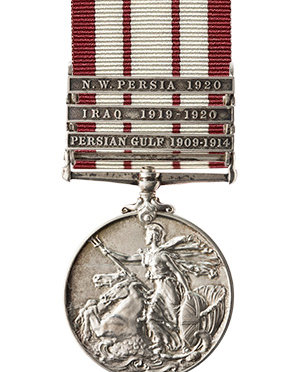
The medal is struck in silver and measures 36 millimeters in diameter.

It was awarded with one of five obverse designs:

  • George V (1915-36)
  • George VI Ind Imp (1936-49)
  • George VI Fid Def (1949-52)
  • Elizabeth II Br Omn (1952-53)
  • Elizabeth II Dei Gratia (1953-62)

The ribbon is white with broad crimson edges and two narrow crimson stripes towards the center.

The Ceylon Volunteer Service Medal

The Ceylon Volunteer Service Medal is a non-wearable campaign medal awarded by the Government of Ceylon during World War I.

The Ceylon Volunteer Service Medal is a non-wearable campaign medal awarded by the Government of Ceylon to all members of the Ceylonese armed forces that volunteered for overseas service during World War I.

The medal was the only one of its kind, Ceylon being the only British crown colony to issue a medal of its own for its citizens’ service in the war. Those awarded the medal were servicemen of either the Ceylon Defence Force, including the all-European Ceylon Planters’ Rifle Corps, or the Ceylon Royal Naval Volunteer Reserve.

Although the exact number of medals struck is disputed, sources cite numbers between 450 and 3000. 

The Ceylon Volunteer Service Medal Design

The medal is cast in bronze and measures 45 by 52 by 3 millimeters.

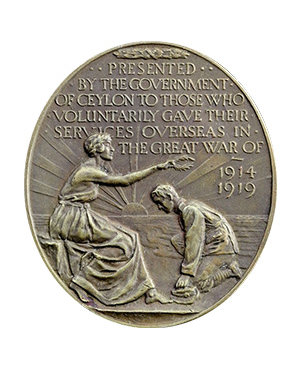
The obverse bears the personification of Ceylon- a seated, right-facing robed, and laureate female figure placing, with her right hand, a laurel wreath crown on the bowed head of a left-facing soldier kneeling on his left knee. The soldier rests his cap on the ground with his right hand, while the background depicts a multi-rayed sun setting into the sea behind them. An inscription above the scene reads: “PRESENTED BY THE GOVERNMENT OF CEYLON TO THOSE WHO VOLUNTARILY GAVE THEIR SERVICES OVERSEAS IN THE GREAT WAR OF 1914 – 1919“. Above the words is a short piece of laurel wreath, bound.

The reverse shows a front-facing illustration of a winged, robed and laureate Victory seated on a throne. Her right hand is raised aloft, holding a laurel wreath, while her left holds a shield emblazoned with the coat of arms of Ceylon. A plaque inscribed with the recipient’s name is located at the figure’s feet, above a skull and spiked helmet obscuring a horizontal scythe.

The medal was awarded without a ribbon.