The Padma Vibhushan Award

  • Time Period: Post-WW2
  • Institution: 2 January 1954
  • Country: India

The Padma Vibhushan Award (“Lotus Decoration“) was established on 2 January 1954 and is the second-highest civilian award of the Republic of India, the first one being the Bharat Ratna.

The award is given for “exceptional and distinguished service” and be give to people of any race, occupation, position or sex (excepting government servants). A committee submits their recommendations to the Prime Minister and the President of India for the further approval.

The award was briefly suspended twice in its history. First in July 1977 when Morarji Desai deemed it “worthless and politicized”, and the second in mid-1992, when two Public-Interest Litigations were filed in the High Courts of India questioning the civilian awards being “titles” per an interpretation of Article 18 (1) of the Constitution of India.

The Padma Vibhushan Design

The original award from 1954 was specified as a circle made of gold gilt 35 mm (1 38 inches) in diameter, with rims on both sides.

The obverse had the lotus flower embossed in the center and the inscription “Padma Vibhushan” in Devanagari script inscribed above along the upper edge. The bottom edge had an embossed floral wreath. The reverse had the Emblem of India in the center and the inscription “Desh Seva” in Devanagari Script on the lower edge. The ribbon was pink. 

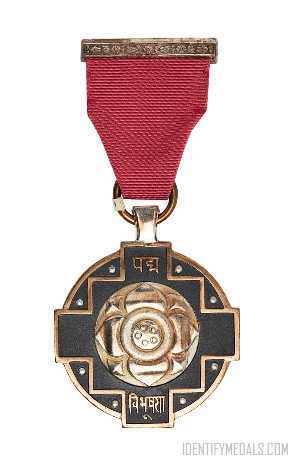
In 1955, the design was modified. The current decoration is a circular-shaped bronze toned medallion measuring 44 mm (34 inches) in diameter. The obverse has a central pattern and a knob carved within each of the outer angles of it. There is also an embossed lotus flower in the center, with the inscription “Padma” written in Devanagari script above and “Vibhushan” below it. The reverse keeps the emblem of India and the national motto “Satyameva Jayate” (“Truth alone triumphs”), in Devanagari Script below. 

The ribbon or riband is pink and measures 32 mm wide. 
The Bharat Ratna Award

The Bharat Ratna Award is the highest civilian award of the Republic of India, given for exceptional service. It was established in 1954.

The Bharat Ratna Award is the highest civilian award of the Republic of India. It was established on 2 January 1954 and it is awarded for exceptional service or performance of the highest order.

Although the honor was originally limited to achievements in the arts, literature, science, and public services, in 2011 the Indian government expanded the criteria to include “any field of human endeavor“. People of any race, occupation, position, or sex can receive this award.

The recommendations for the Bharat Ratna award are made by the Prime Minister to the President. There’s a maximum of three nominees awarded per year. Several bestowals of the award, such as that of K. Kamaraj (1976) and M. G. Ramachandran (1988) have met with criticism.

The Bharat Ratna Design

The original award (1954) was specified as a circle measuring 35 mm (1 38 inches) in diameter and made of gold.

The obverse has a sun burst design, the text “Bharat Ratna“, in Devanagari Script inscribed on the upper edge in silver gilt, and a wreath set along on the lower edge. The reverse bears the platinum State Emblem of India in the center as well as the national motto, “Satyameva Jayate” in Devanagari Script (सत्यमेव जयते in Sanscrit; lit. “Truth alone triumphs“) inscribed in silver-gilt on the lower edge.

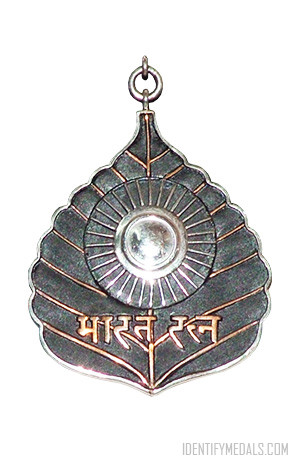
This design was modified in 1955. The current medals has the shape of a peepal leaf, measures approximately 59 mm (2 516 inches) long, 48 mm (1 78 inches) wide and 3.2 mm (18 inches) thick and it’s rimmed in platinum. 

The obverse has an embossed sun burst design made of platinum, with rays spreading out, and the words “Bharat Ratna”. The reverse bears the sane design as the 1954 version and the inscription “Satyameva Jayate”.

The ribbon is white.

The 1957 Texas Rangers “Blue Bottle Cap” Badge

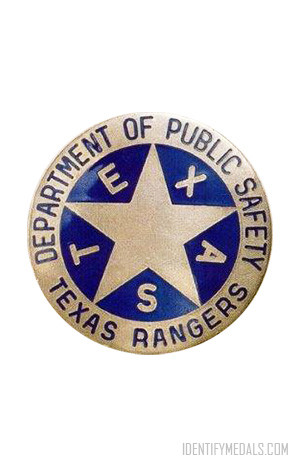
The 1957 Texas Rangers “Blue Bottle Cap” Badge was issued to the Rangers and featured blue enamel paint on polished metal.

The 1957 Texas Rangers “Blue Bottle Cap” Badge was issued to the Rangers and featured blue enamel paint on polished metal. The badge was created by the Texas Department of Public Safety. 

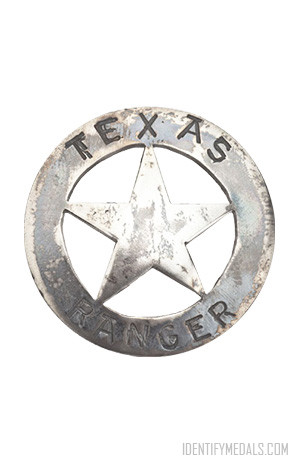
It’s said that most Rangers were not happy with the result because it was too severe a break from the traditional frontier designs. That’s probably why it was soon replaced by the 1962 Texas Rangers badge, which is actually based on a Cinco Peso Mexican silver coin. 

Other Texas Rangers Badges

Find Texas Rangers Badges Online

Right Now on eBay 
Clicking a link to eBay may result in a referral commission being paid if a purchase is made.
Loading...

Further Reading About the Texas Rangers

The 1962 Texas Rangers Badge

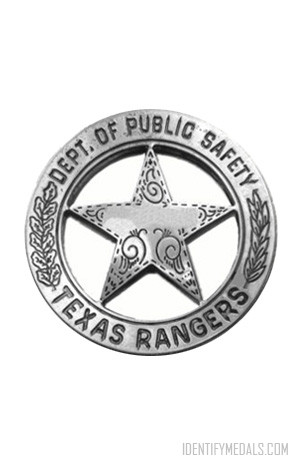
The 1962 Texas Rangers Badge was designed in 1961-62 and is a five-pointed star symbolizing the “Lone Star” of Texas.

The 1962 Texas Rangers Badge was designed in 1961-62 and is a five-pointed star symbolizing the “Lone Star” of Texas. The badge was created by Ranger Hardy L. Purvis in honor of his late father, Ranger Captain Hardy B. Purvis, and his mother. When Purvis presented the badge to the Texas Department of Public Safety, he also gave the Dept enough Cinco Peso Mexican silver coins for the sixty-two rangers at the time. 

Colonel Homer Garrison, Jr., Director of the Texas Department of Public Safety and Chief of the Texas Rangers, announced in October 1962, that the Texas Rangers are going back to the tradition steeped in history of a Mexican silver badge worn by their predecessors during frontier days. The new official Ranger badge, issued to each of the 62 members of the Force, is a replica of the historic original badge which old-time Rangers carved out of a Mexican five-peso silver dollar.

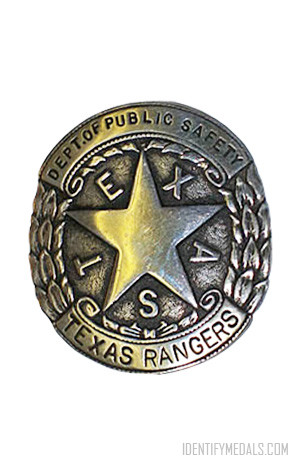
Modern Texas Rangers receive two badges when they are promoted to the Ranger Service. The first is the silver badge made from a Mexican Cinco peso coin. The second a bronze, silver-plated badge to carry in their identification case. 

Other Texas Rangers Badges

Find Texas Rangers Badges Online

Further Reading About the Texas Rangers

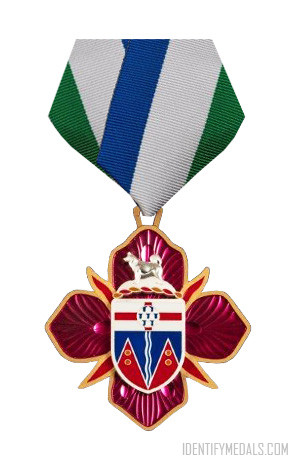
The Order of Yukon

The Order of Yukon (Ordre du Yukon in French), instituted on 1 January 2020, is a civilian honor for merit in the Canadian territory of Yukon. It is the highest honor which can be bestowed by the Government of Yukon. 

The Order is intended to honor current and former residents of the territory for significant contributions to the advancement of Yukon society. The Order of Yukon was first proposed in 2016, following public consultation and created by the passage of the Order of Yukon Act in 2018. 

Inductees are entitled to use the postnominal letters OY.

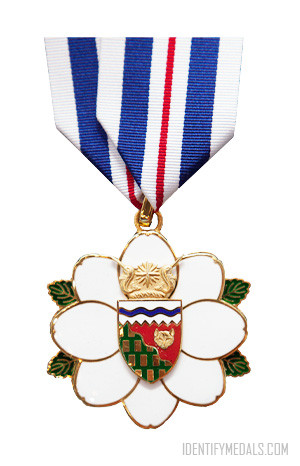
The Order of the Northwest Territories

The Order of the Northwest Territories (Ordre des Territoires du Nord-Ouest in French), instituted on 7 October 2015, is a civil honor for merit in the Canadian territory of the Northwest Territories. 

The Order It is intended to honor current and former residents of the territory who have served with the great distinction and excelling in any field of endeavor for the benefit the people of the Northwest Territories and others. The order may be awarded to no more than three persons annually.

The Order of Nunavut

The Order of Nunavut (Ordre du Nunavut in French, ᓄᓇᕗᒻᒥ ᐃᓕᓴᖅᓯᔾᔪᑦ ᐅᔭᒥᒃ / Nangariyauyunut Nunavunmi in Inuktitut), instituted in 2010, is a civilian honor for merit in the Canadian territory of Nunavut.

The Order was created by the passage of the Order of Nunavut Act and is intended to honor current and former residents of the territory (or the territory which became Nunavut) for outstanding contribution to the cultural, social, or economic well-being of Nunavut. A maximum of three individuals may be inducted by the Commissioner of Nunavut each year. 

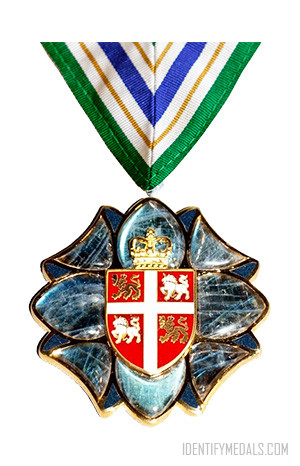
The Order of Newfoundland and Labrador

The Order of Newfoundland and Labrador (Ordre du Terre-Neuve-et-Labrador in French), instituted in 2001, is a civilian honor for merit in the Canadian province of Newfoundland and Labrador. It is the highest honor amongst all others conferred by the Newfoundland and Labrador Crown.

The Order of Newfoundland and Labrador is intended to honor any current or former longtime resident of Newfoundland and Labrador who has demonstrated a high level of individual excellence and achievement in any field, having “demonstrated excellence and achievement in any field of endeavor benefiting in an outstanding manner Newfoundland and Labrador and its residents.

The Order of Newfoundland and Labrador Design

New Members are presented with an insignia. The badge consists of a gold medallion in the form of a stylized sarracenia purpurea (or purple pitcher plant)—the official provincial flower.

The obverse is made in marbleized green enamel with gold edging, and bearing at its center the escutcheon of the arms of Newfoundland and Labrador, all surmounted by a St. Edward’s Crown symbolizing the Canadian monarch’s role as the fount of honor.

The ribbon is patterned with vertical stripes in blue, white, and two shades of green; men wear the medallion suspended from this ribbon at the collar, while women carry theirs on a ribbon bow at the left chest. 

The Order of Nova Scotia

The Order of Nova Scotia (Ordre de la Nouvelle-Écosse in French), instituted on 2 August 2001, is a civilian honor for merit in the Canadian province of Nova Scotia. The Order the highest honor amongst all others conferred by the Nova Scotia Crown.

The Order of Nova Scotia is intended to honor any current or former longtime resident of Nova Scotia who has demonstrated a high level of individual excellence and achievement in any field, having “distinguished themselves in many fields of endeavor and having brought honor and prestige to themselves and to Nova Scotia.” Canadian citizenship is a requirement, and those who are elected or appointed members of a governmental body are ineligible as long as they hold office.

The Order of Nova Scotia Design

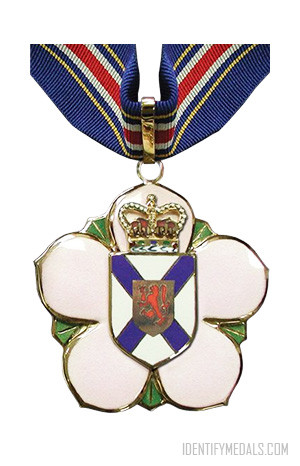
New Members are presented with an insignia. The badge consists of a gold medallion in the form of a stylized epigaea repens (or mayflower)—the official provincial flower.

The obverse is made in white enamel with gold edging, and bearing at its center the escutcheon of the arms of Nova Scotia, surmounted by a St. Edward’s Crown symbolizing the Canadian monarch’s role as the fount of honor.

The ribbon is patterned with vertical stripes in red, blue, gold, and white; men wear the medallion suspended from this ribbon at the collar, while women carry theirs on a ribbon bow at the left chest. 

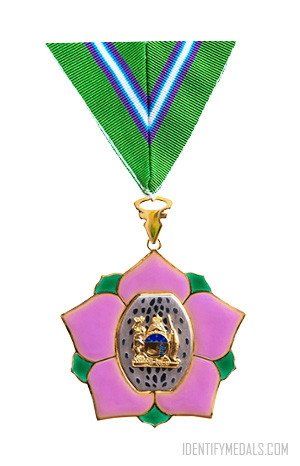
The Order of New Brunswick

The Order of New Brunswick (Ordre du Nouveau Brunswick in French), instituted in 2000, a civilian honor for merit in the Canadian province of New Brunswick. The Order is described as the highest honor amongst all others conferred by the New Brunswick Crown.

The Order of New Brunswick is intended to honor any current or former longtime resident of New Brunswick who has demonstrated a high level of individual excellence and achievement in any field, having made “outstanding contributions to the social, cultural or economic well-being of New Brunswick and its residents“. Canadian citizenship is a requirement, and those who are elected or appointed members of a governmental body are ineligible as long as they hold office.

The Order of New Brunswick Design

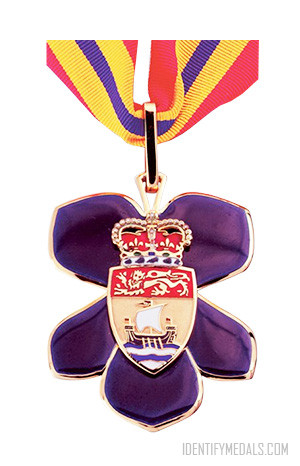
New Members are presented with the order’s insignia. The badge consists of a gold medallion in the form of a stylized viola cucullata (or purple violet)—the official provincial flower.

The obverse is made in violet enamel with gold edging, and bearing at its center the escutcheon of the arms of New Brunswick, surmounted by a St. Edward’s Crown symbolizing the Canadian monarch’s role as the fount of honor.

The ribbon is patterned with vertical stripes in blue, red, and gold. Men wear the medallion suspended from this ribbon at the collar, and women carry theirs on a ribbon bow at the left chest.