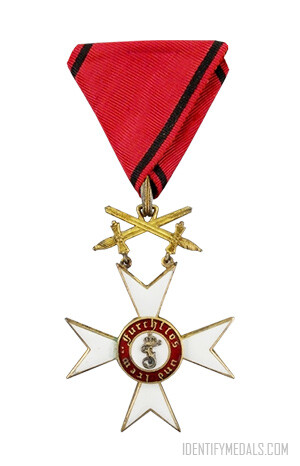
The Württemberg Order of the Crown

The Order of the Crown was initially established in 1702 as the St.-Hubertus-Jagdorden (Hunting Order of St Hubert) but renamed in 1807.

The Order of the Württemberg Crown (or Orden der Württembergischen Krone in German) was a prestigious chivalric order in the Kingdom of Württemberg.

Initially established in 1702 as the St.-Hubertus-Jagdorden (Hunting Order of St Hubert), it was renamed the Ritterorden vom Goldenen Adler (Knightly Order of the Golden Eagle) by Frederick I in 1807.

On September 23, 1818, King William I renewed and restructured the order, naming it the Order of the Württemberg Crown and initially organizing it into three classes: Grand Cross, Commander, and Knight. The order underwent further expansions and modifications in 1889 and 1892.

The Order of the Crown Criteria and Classes

The motto of the order was ‘Furchtlos und treu’ (‘Fearless and Loyal’). Until 1913, the higher ranks of the order were restricted to the nobility. The ranks, in descending order, were:

  1. Knight Grand Cross, Special Class (for sovereigns)
  2. Knight Grand Cross
  3. Knight Commander (since 1889)
  4. Commander
  5. Cross of Honour (Ehrenkreuz; since 1892)
  6. Knight (since 1892 with golden lions, and since 1864 also with a crown, as a special honour)
  7. Gold service medal (Verdienstmedaille)
  8. Silver service medal (Verdienstmedaille, abolished in 1892)

The Order of the Crown Design

The order’s cross was a white enameled Maltese cross with gold lions in its four angles. The lions were standard for the Grand Cross and Commander but were a special honor on the Knight’s crosses. A golden crown was secured on the upper arm by two gold bands, from which the cross hung, except in the case of the Honor Cross in its fixed form. The medallion featured the golden initials of King Frederick I and a crown on the front, and a golden crown on red on the back. Since 1866, all grades could be awarded with swords, and after 1890, swords were only granted in awards of a higher class. From 1892, the lowest grades also featured the special honors of a golden lion and, since 1864, a lion added.

The Grand Cross featured a silver 8-pointed star with a reduced cross in a medallion at its center, surrounded by the circular motto. Sovereigns received the star in gold. The Commander had a 4-pointed silver star with rays extending through the cross angles.

The ribbon was carmine red with black stripes and carmine borders. Members of reigning houses received the Grand Cross insignia with a scarlet ribbon.

Buy This Medal Online

Right Now on eBay 
Clicking a link to eBay may result in a referral commission being paid if a purchase is made.
Loading...

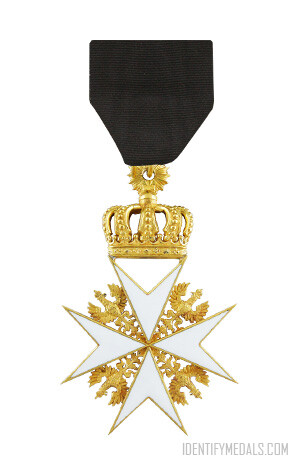
The Order of Saint John (Bailiwick of Brandenburg)

The Order of Saint John (Bailiwick of Brandenburg) was established as the Order of Saint John or the Johanniter Order in 1099.

The Bailiwick of Brandenburg of the Chivalric Order of Saint John of the Hospital at Jerusalem (or Balley Brandenburg des Ritterlichen Ordens Sankt Johannis vom Spital zu Jerusalem in German), commonly referred to as the Order of Saint John or the Johanniter Order (Johanniterorden), is the German Protestant branch of the Knights Hospitaller. The order, considered the oldest surviving chivalric order, is believed to have been established in Jerusalem in 1099.

The current leader, or Herrenmeister (Master of the Knights/Grand Master), is Oskar Prince of Prussia. The order comprises approximately four thousand knights globally, classified as either Knights of Justice (Rechtsritter) or Knights of Honour (Ehrenritter). Membership is by invitation only and is not restricted to German nationals or speakers. Though the order no longer requires noble status for membership since 1948, most members still come from the nobility. The order includes seventeen commanderies in Germany and one each in Austria, Finland, France, Hungary, and Switzerland, along with a global commandery with subcommanderies in twelve other countries, including Australia, Belgium, Canada, Colombia, Denmark, Italy, Namibia, Poland, South Africa, the UK, the US, and Venezuela.

The Order of Saint John (Bailiwick of Brandenburg) Design

The cloak of the Order is primarily black, featuring a prominent white, linen eight-pointed cross on the left breast. Most knights wear cloaks made of black wool, while French knights add distinctive white wool collars.

The basic insignia is a white-enamelled Maltese cross. Since 1668, the crosses have featured crowned Brandenburg (later Prussian) eagles between the arms. For Knights of Justice, Honorary Commanders, Commanders, and the Herrenmeister, the eagles are gold, while for Knights of Honour and Honorary Members, the eagles are enamelled black with gold crowns. The cross’s size varies by rank: 5 cm for Knights of Justice, 5.5 cm for Commanders and Honorary Commanders, 6 cm for Knights of Honour, and 7 cm for the Herrenmeister. Each cross is worn on a black-moire ribbon around the neck.

Members may also wear a plain Maltese cross as a star or ‘breast badge,’ typically made of plain linen, with enamelled stars in silver or silver gilt for formal occasions. Additionally, a smaller white-enamelled Maltese cross in gold or silver may be worn on the left lapel of a knight’s suit or sportcoat.

The Ordre de la Sincérité (Order of Sincerity)

The Ordre de la Sincérité was a knighthood order established in 1705 by the House of Hohenzollern in the German Margrave of Bayreuth.

  • Time Period: Pre-WW1
  • Institution: 17 November 1705
  • Country: Germany (German Margrave of Bayreuth)

The Order of Sincerity, originally known as “Ordre de la Sincérité” due to the 18th-century French-speaking courtiers, was a knighthood order established by the German Margrave of Bayreuth.

This order was later renamed the Order of the Brandenburg Red Eagle and eventually became known as the Order of the Red Eagle.

The Order of Sincerity was founded on November 17, 1705, by Margrave George William of Brandenburg-Bayreuth, a member of the House of Hohenzollern. Similar to many knighthood orders of small German courts, it initially fell into disuse. It was revived in 1712 in Brandenburg-Bayreuth and again in 1734 in Brandenburg-Ansbach, where it was renamed the “Order of the Brandenburg Red Eagle.” In 1777, its statutes were revised, and it was referred to as the “Order of the Red Eagle.” This order was limited to fifty knights and was conferred in one class. The church associated with the order was the Ordenskirche St. Georgen in Bayreuth.

In January 1792, the Kingdom of Prussia acquired Brandenburg-Bayreuth and Brandenburg-Ansbach. On June 12, 1792, King Frederick William II revived the order as a Prussian royal order. It became the second-highest order in the kingdom, following the Order of the Black Eagle. Although it was abolished as a state order in 1918, it continues to exist as a House Order of the House of Hohenzollern.

The Ordre de la Sincérité Design

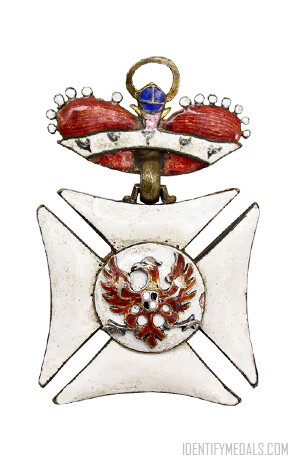
The medal features a white enamel cross with broad arms. The cross is a Maltese cross, characterized by its four equal arms that are narrower at the center and wider at the ends.

At the center of the cross, in the obverse, there is a circular medallion with a red eagle, which is a significant symbol in German heraldry. The eagle is detailed with red enamel and appears to be crowned and holding a scepter and orb, signifying sovereignty and authority.

The top of the medal is adorned with an enameled crown. The crown is red with white and blue details and attached to a loop.

The ribbon of the order is orange. 

Find This Medal

Right Now on eBay 
Clicking a link to eBay may result in a referral commission being paid if a purchase is made.
Loading...

The Southern Cross of Honor

The Southern Cross of Honor a commemorative medal established by the United Daughters of the Confederacy to honor Confederate veterans.

The Southern Cross of Honor was a commemorative medal created in 1899 by the United Daughters of the Confederacy to recognize the service of Confederate veterans.

The idea for the Cross of Honor was conceived by Mary Ann Erwin in 1898 and designed by her and Sarah E. Gabbett. The first medal was issued on April 26, 1900, to Captain Alexander S. Erwin. Initially produced by Charles W. Crankshaw of Atlanta, Georgia, and later by Schwaab Stamp & Seal Co. and Whitehead & Hoag, the medal’s issuance was managed by Anna Davenport Raines until her death in 1913. The program, which began with the intention to end in 1913, continued until 1959, with at least 78,761 medals awarded.

Eligibility and Allocation

The Cross of Honor could only be awarded through the United Daughters of the Confederacy and was not available for purchase.

It was given to living Confederate veterans in recognition of their honorable service in any branch of the Confederate military.

The final medal was awarded posthumously in 1951 to Rear Adm. Raphael Semmes. Wearing the medal without entitlement is a Class 3 misdemeanor in Virginia, punishable by a fine of up to $500. The Cross of Honor, akin to the Union’s GAR Medal, was never authorized for wear on U.S. military uniforms.

The Southern Cross of Honor Design

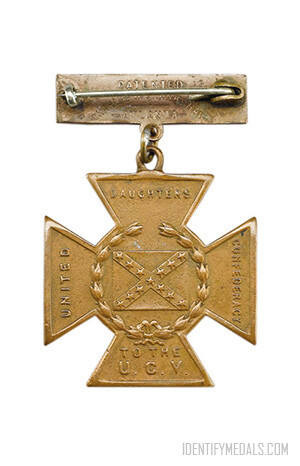
The medal is a cross pattée, suspended from a metal bar designed for engraving, and lacks a cloth ribbon.

The obverse side features the Confederate battle flag at the center, encircled by a wreath. The arms of the cross bear the inscription “UNITED DAUGHTERS OF THE CONFEDERACY TO THE U. C. V.

The reverse displays the Confederate States’ motto “DEO VINDICE” (With God as our Vindicator) and the dates “1861 1865,” surrounded by a laurel wreath. The arms on this side are inscribed with “SOUTHERN CROSS OF HONOR.”

The Mexican Service Medal

The Mexican Service Medal is an American award given for service in Mexico from 1911 to 1919. It was established in 1917.

The Mexican Service Medal is a United States military award recognizing service in Mexico from 1911 to 1919.

The Army version of the Mexican Service Medal was established on December 12, 1917, by General Orders from the United States War Department. The Navy version followed, established by Navy Department General Orders Number 365 on February 11, 1918, and later amended by General Orders No. 464 on April 27, 1919. This medal honors servicemen who participated in military actions against Mexican forces from April 12, 1911, to June 16, 1919.

To receive the Mexican Service Medal, servicemen had to engage in one of the specified military actions:

  • Veracruz Expedition: April 21 to November 23, 1914
  • Punitive Expedition into Mexico: March 14, 1916 to February 7, 1917
  • Buena Vista, Mexico: December 1, 1917
  • Aftermath of Brite Ranch raid, San Bernardino Canyon: December 26, 1917
  • La Grulla, Texas: January 8–9, 1918
  • Aftermath of Neville Ranch raid, Pilares, Chihuahua: March 28, 1918
  • Battle of Nogales, Arizona: November 1–26, 1915, or Ambos Nogales: August 27, 1918
  • Battle of Ciudad Juárez: June 15–16, 1919

The Navy also awarded the medal to those who served on U.S. naval vessels patrolling Mexican waters during the designated periods or who were involved in the above actions.

The medal was awarded only once, with no service stars for multiple engagements. Soldiers cited for gallantry could receive the Citation Star on their Mexican Service Medal. No additional devices were authorized for the Navy version.

The Mexican Service Medal Design

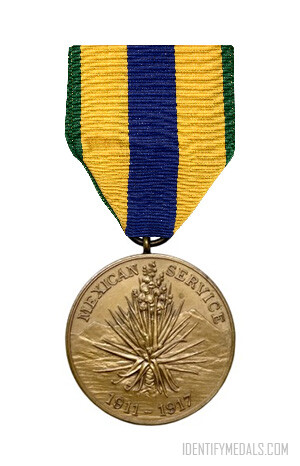
The medal is bronze and includes engravings that signify service and participation in the specified military engagements. The distinct designs for the Army and Navy versions reflect the different branches’ traditions and service contexts.

The designs are:

  • Army Version: Engraved with a yucca plant.
  • Navy Version: Depicts the San Juan de Ulúa fortress in Veracruz harbor. Both versions bear the inscription “1911 – 1917.”

The Permanent Forces of the Empire Beyond the Seas Medal

The Permanent Forces of the Empire Beyond the Seas Medal was established in 1910 to supersede the several local versions of the Army one.

The Permanent Forces of the Empire Beyond the Seas Medal, also known as the Permanent Overseas Forces Long Service and Good Conduct Medal, was established in 1910 to recognize long service and good conduct among other ranks of the Permanent Forces of the Dominions and Colonies of the British Empire.

This medal replaced the various local versions of the Army Long Service and Good Conduct Medal. Superseded in 1930 by the Medal for Long Service and Good Conduct (Military), it continued the tradition of honoring exemplary service.

Commonwealth of Australia Version

The Commonwealth of Australia version of the Army Long Service and Good Conduct Medal emerged following Australia’s federation on 1 January 1901.

The five distinct medals for New South Wales, Queensland, South Australia, Tasmania, and Victoria were unified into a single version with King Edward VII’s effigy and the inscription “COMMONWEALTH OF AUSTRALIA” on the reverse.

These medals retained the same crimson ribbon, but with a distinctive 4-millimeter central band representing the Commonwealth. This version was part of the broader effort to standardize awards across the British Empire’s territories.

The Permanent Forces of the Empire Beyond the Seas Medal Design

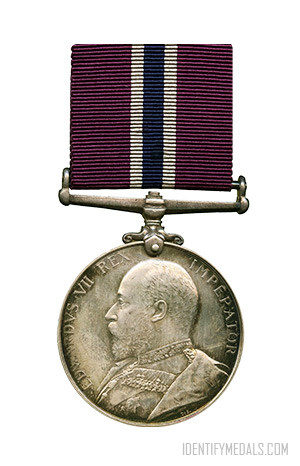
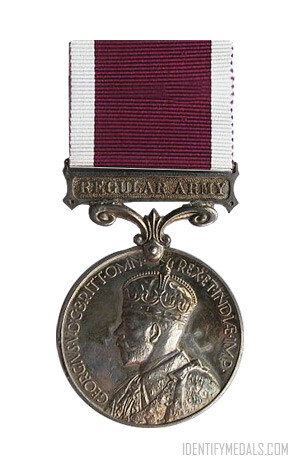
The Permanent Forces of the Empire Beyond the Seas Medal is crafted in silver, with a diameter of 36 millimeters (1.42 inches) and a thickness of 3 millimeters (0.12 inches). It features a single-toe claw mounting, secured to the medal by a horizontal pin through its upper edge, and is supported by double-scroll claws on the rim. The medal is attached to a straight, swiveling suspension bar.

The initial version of the medal’s obverse showcases the effigy of King Edward VII in a Field Marshal’s uniform, facing left, with the inscription “EDWARDVS VII REX IMPERATOR” around the edge. Following the coronation of King George V on June 22, 1911, the obverse was updated to depict his effigy, also in a Field Marshal’s uniform and facing left, with the inscription “GEORGIVS V BRITT: OMN: REX ET IND: IMP:” around the perimeter.

The reverse side of the medal is smooth with a raised rim. It features the inscription “PERMANENT FORCES OF THE EMPIRE BEYOND THE SEAS” around the edge, and “FOR LONG SERVICE AND GOOD CONDUCT” in four lines at the center.

The medal is suspended from a ribbon that is 32 millimeters wide. The ribbon consists of an 11.5-millimeter wide crimson band and a 2.5-millimeter wide white band, repeated in reverse order and separated by a 4-millimeter wide dark blue band.

More British Long Service and Good Conduct Decorations

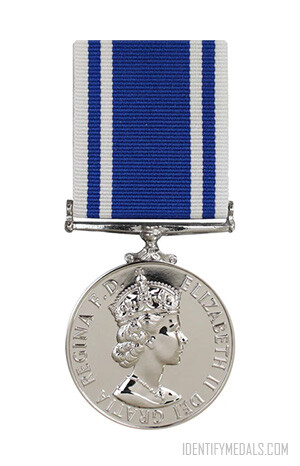
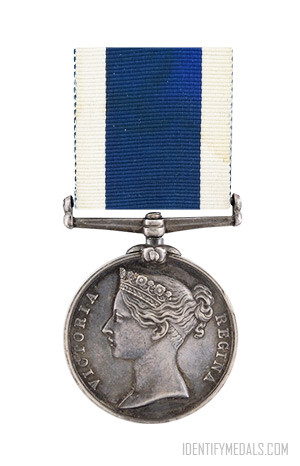
The British military has instituted several Long Service and Good Conduct Decorations, each honoring the dedication and exemplary service of its personnel across different branches. Here are some other ones from different time periods:

Find these medals online:

Right Now on eBay 
Clicking a link to eBay may result in a referral commission being paid if a purchase is made.
Loading...

The Army Long Service and Good Conduct Medal

This Army long service medal was instituted by King William IV in 1830 and remained in use for a hundred years, until 1930.

Instituted by King William IV in 1830, the Army Long Service and Good Conduct Medal was awarded for long service and exemplary conduct. It remained in use until 1930, when it was replaced by the Medal for Long Service and Good Conduct.

On 31 May 1895, Queen Victoria authorized Dominion and Colonial governments to adopt various military medals, including the Army Long Service and Good Conduct Medal, for their local military forces. Territories that utilized this authorization included Canada, Cape of Good Hope, India, Natal, New South Wales, New Zealand, Queensland, South Australia, Tasmania, Victoria, and, from 1901, the Commonwealth of Australia.

Originally awarded for 21 years (infantry) or 24 years (cavalry) of service, the qualifying period was reduced to 18 years in 1870.

The Army Long Service and Good Conduct Medal Design

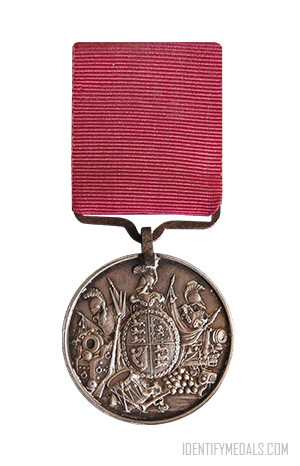
Initially featuring a Trophy of Arms and the Royal Coat of Arms, the medal’s obverse changed with each monarch. The reverse consistently displayed “FOR LONG SERVICE AND GOOD CONDUCT”.

Authorized in 1895 for Dominion and Colonial forces, these medals were similar but included specific territory names and unique ribbon colors. Made of silver, 36mm in diameter, the medal’s suspension evolved over time, with the ribbon changing in 1916 to a crimson or reddish-violet with white edges.

More British Long Service and Good Conduct Decorations

The British military has instituted several Long Service and Good Conduct Decorations, each honoring the dedication and exemplary service of its personnel across different branches. Here are some other ones from different time periods:

Find these medals online:

Right Now on eBay 
Clicking a link to eBay may result in a referral commission being paid if a purchase is made.
Loading...

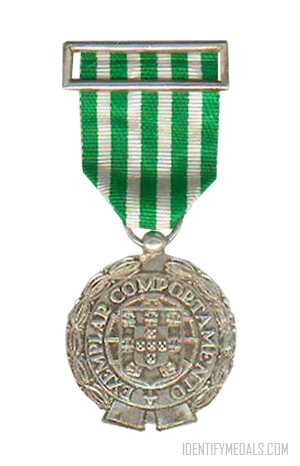
The Exemplary Behavior Medal (Portugal)

The Exemplary Behavior Medal was created on October 2, 1863 and distinguishes military personnel who have served with exemplary moral.

The Exemplary Behavior Medal (or Medalha de Comportamento Exemplar in Portuguese) is a Portuguese military award established on October 2, 1863, by decree of the Secretary of State for the Affairs of War.

The medal is awarded in three grades—gold, silver, and copper—and recognizes military personnel who have demonstrated exemplary moral and disciplinary conduct, as well as a proven spirit of loyalty to the Portuguese Republic throughout their careers.

The Distinguished Service Medal Grades

The Exemplary Behavior Medal is awarded in the following grades:

  • Gold Medal (MOCE): Awarded to military officers with at least thirty years of service, who have never received any criminal or disciplinary punishment, and who have consistently demonstrated a high sense of virtue, obedience, and military discipline.
  • Silver Medal (MPCE): Granted to military officers with at least fifteen years of effective service, who have maintained a spotless record without any criminal or disciplinary punishment.
  • Copper Medal (MCCE): Awarded to officers, sergeants, and enlisted personnel who have completed at least six years of effective service and have never suffered any criminal or disciplinary punishment.

The Distinguished Service Medal (Portugal)

The Distinguished Service Medal is a military decoration that honors effort for the Fatherland or for the country’s military institutions.

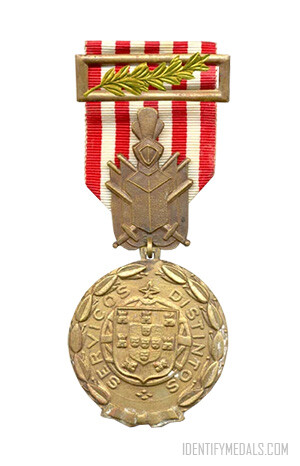
The Military Medal for Distinguished Services is a Portuguese military decoration awarded for outstanding and extraordinary military services or notable acts connected to the Navy, Army, or Air Force.

Originally established on October 2, 1863, by decree of the Secretary of State for War Affairs, the medal was initially named the Military Medal for Good Services. It was the second of three classes of the military medal at the time. Between 1863 and 1919, the Military Medal for Good Services (now Distinguished Services) was available in two classes: gold (MOBS / MOSD) and silver (MPBS / MPSD). By Decree No. 6093 of September 11, 1919, a bronze degree (MBBS / MBSD) was added to make the medal accessible to sergeants and enlisted men who were previously ineligible.

In 1946, through Decree No. 35667 of May 28, the medal was renamed the Military Medal for Distinguished Services and adopted the design it retains today.

The Distinguished Service Medal Grades

The Distinguished Service Medal is awarded in three degrees:

  • Gold Grade (MOSD)
  • Silver Grade (MPSD)
  • Bronze Grade (MBSD)

The degree is granted based on the achievements and not the rank of the recipient.

When awarded for achievements in a military campaign, the Distinguished Service Medal is conferred with a palm:

  • Gold with Palm (MOSD)
  • Silver with Palm (MPSD)
  • Bronze with Palm (MBSD)

The Distinguished Service Medal Design

The medal is circular and typically bears the national coat of arms on the obverse side, symbolizing the honor and service to the nation. Surrounding the emblem are inscriptions denoting the degree of the medal (Gold, Silver, or Bronze) and the purpose of the award. The reverse side may include the recipient’s name and the date of the award.

The medal is suspended from a ribbon whose color scheme may vary according to the degree. When awarded with a palm, the ribbon includes a palm leaf, indicating that the recipient’s actions were performed in the context of a military campaign. This addition highlights the exceptional nature of the recipient’s service in challenging and dangerous circumstances.

The Military Valor Medal (Portugal)

The Military Valor Medal was established on 2 October 1863, it is awarded for heroic deeds of extraordinary selflessness and bravery.

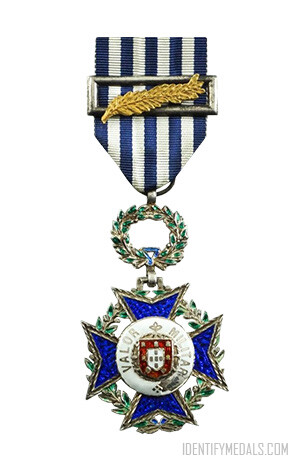
The Military Valor Medal is a distinguished military decoration and the second highest honor in Portugal. Established on 2 October 1863, it recognizes acts of extraordinary bravery, selflessness, and exceptional decision-making in circumstances of proven or suspected danger to life, whether in war or peace.

The Medal is available in three grades:

  • Gold (Ouro): Awarded for exceptional bravery and selflessness characterized by valor, decisiveness, and willingness to risk one’s life.
  • Silver (Prata): Awarded for bravery and selflessness in the face of danger, characterized by valor and decisiveness.
  • Bronze (Cobre): Awarded for courage and decisiveness, characterized by bravery and selflessness.

The Military Valor Medal Design

Gold Grade

  • Obverse: Features a straight-lined patée cross, chiseled in gold, resting on a circular crown of laurel leaves. At the center is the national emblem, consisting of the national coat of arms on a golden armillary sphere, surrounded by a blue border with the inscription “VALOR MILITAR” in gold letters.
  • Reverse: Plain gold, engraved with the recipient’s name, rank, and the year of award.
  • Ribbon: Made of wavy silk with nine longitudinal stripes (five blue and four white) and a central national shield on a golden armillary sphere. The ribbon bar, buckle, and pendant are also in gold. A golden palm is added to the ribbon when awarded for campaign services.

Silver Grade

Similar to the Gold Grade, but the national coat of arms on the ribbon, ribbon bar, buckle, and pendant are in silver.

Bronze Grade

The Bronze Grade features the ribbon bar, buckle, and pendant in bronze and does not include the national coat of arms on the suspension ribbon.