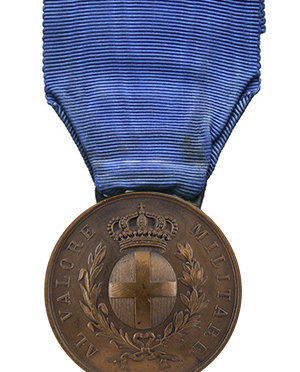
The Bronze Medal of Military Valor

Time Period: Pre World War I, World War I

Institution: 26 March 1833
Country: Italy

The Bronze Medal of Military Valor (or Medaglia di bronzo al valor militare in Italian) is a medal given for gallantry.

It was established by Charles Albert of Sardinia on 26 March 1833, along with the higher ranking Gold and Silver Medals for Military valor. Their purpose is defined as “To distinguish and publicly honor the authors of heroic military acts, even ones performed in time of peace, provided that the exploit is closely connected with the purposes for which the Armed Forces are constituted, whatever may be the condition or quality of the author.”

These medals, as well as the “Croce di Guerra al Valor Militare” (War Cross of Military Valor – which can only be awarded in time of war) are established by the Royal Decree of 4 November 1932.

During the First World War, the medal was given out some 60,244 times for individual acts of heroism (compared to 38,614 Silver medals and 368 Gold Medals).

The Bronze Medal of Military Valor Design

The Bronze Medal of Military Valor is shaped like an oval, with a blue ribbon. The medal is made of bronze.
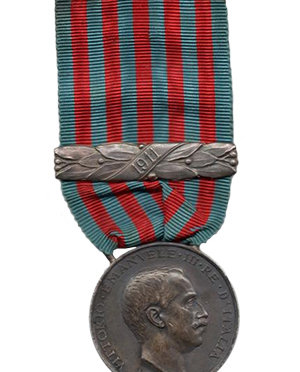
The Commemorative Medal for the Italo-Turkish War 1911-1912

The Commemorative Medal for the Italo-Turkish War 1911-1912 was  instituted by Vittorio Emanuele III of Savoy on 21 November 1912.

The Commemorative Medal for the Italo-Turkish War 1911-1912 was instituted by Vittorio Emanuele III of Savoy on 21 November 1912 for all civilian personnel and Italian and colonial troops who fought against the Ottoman Empire in the Italo-Turkish War of 1911 to 1912.

The Italo-Turkish or Turco-Italian War (or Trablusgarp Savaşı, “Tripolitanian War” in Turkish and Guerra di Libia, “Libyan War” in Italian) was fought between the Kingdom of Italy and the Ottoman Empire from September 29, 1911, to October 18, 1912. As a result of this conflict, Italy captured the Ottoman Tripolitania Vilayet (province), of which the main sub-provinces (sanjaks) were Fezzan, Cyrenaica, and Tripoli itself. These territories together formed what became known as Italian Libya.

The Commemorative Medal for the Italo-Turkish War Design

The medal is shaped like an oval and struck in bronze.

The obverse shows the profile of King Vittorio Emanuele III. The reverse of the Turkey Medal bears the inscription “GUERRA ITALO-TURCA 1911-12”. The reverse of the Libya Medal bears the inscription, “LIBIA”. The medal can have the “1911-12” bar for the Turkish campaign, and a “1912” and/or “1913”, or “1912-13” bar for the Libyan campaign.

The ribbon consists of blue and red stripes.

The Victoria Cross

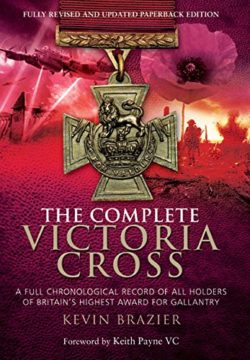
The Victoria Cross (VC) is the highest United Kingdom honors system award. It is given for gallantry in the presence of the enemy.

The Victoria Cross (VC) is the highest award of the United Kingdom honors system. It is awarded for gallantry “in the presence of the enemy” to members of the British armed forces, and it can be awarded posthumously.

Since the first awards were presented by Queen Victoria in 1857, two-thirds of all awards have been personally presented by the British monarch, usually at Buckingham Palace. Before the Crimean War (when it was introduced), there was no official standardized system for recognition of gallantry within the British armed forces.

A single company of jewelers, Hancocks of London, has been responsible for the production of every VC awarded since its inception. 

Since its establishment, the Victoria Cross has been awarded approximately 1,360 times to individuals or groups of recipients. The medal has been awarded for actions in various conflicts and wars, including World War I, World War II, and more recent conflicts. Recipients come from a diverse range of military backgrounds and countries within the Commonwealth. A total of 1,358 Victoria Crosses have been awarded since 1856 to 1,355 men.

The History of the Victoria Cross

The Victoria Cross was established on January 29, 1856, during the reign of Queen Victoria.

It was introduced by a Royal Warrant to recognize acts of valor by members of the British military during the Crimean War (1854-1856). The VC was intended to honor acts of bravery and self-sacrifice in the face of the enemy.

Eligibility of the Victoria Cross

The Victoria Cross is awarded for most conspicuous bravery or acts of valor in the presence of the enemy. It can be awarded to members of the British armed forces, including the Army, Navy, and Air Force, as well as to civilians serving with military forces.

The VC is a rare and prestigious award, with recipients demonstrating exceptional courage and selflessness in combat.

The Victoria Cross Design

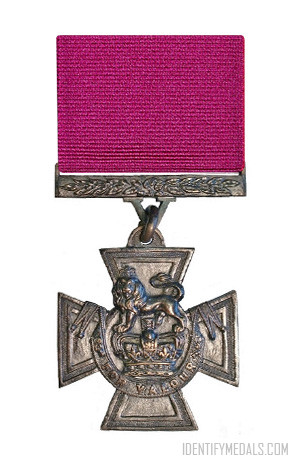
The Victoria Cross is a bronze straight-armed cross pattee measuring 38 mm across, with raised edges.

On the obverse, it bears a lion guardant standing upon the Royal Crown, and below the Crown, a scroll bearing the inscription “PRO VALORE”. On the reverse is the date of the act for which the decoration is bestowed is engraved in a raised circle.

The Cross is suspended by means of a plain link from a V below a straight bar ornamented with laurel leaves.

The ribbon is crimson and measures 38 millimeters in width. 

Further Reading About the Victoria Cross

Products Inspired by the Victoria Cross

Right Now on eBay 
Clicking a link to eBay may result in a referral commission being paid if a purchase is made.
Loading...