The Society of the Army of the Potomac Medal

The Society of the Army of the Potomac was a military society founded in 1869 from officers and enlisted men of the Army of the Potomac.

The Society of the Army of the Potomac was a military society founded in 1869 from officers and enlisted men who served with the Army of the Potomac during the American Civil War.

When the Society of the Army of the Potomac was founded, Lieutenant General Philip Sheridan was elected as its first president. A total of 12 vice presidents were also elected, representing 10 corps which served with the army as well as the artillery and the general staff.

As the Society did not provide for hereditary membership, it gradually diminished as the veterans of the Civil War died off during the early twentieth century. It held its last annual reunion in 1927.

The Society of the Army of the Potomac Medal Design

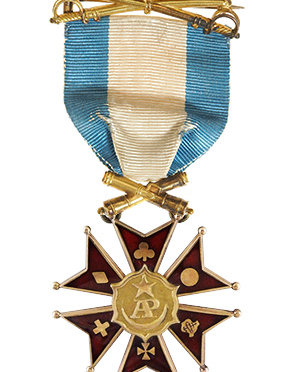
The elaborate insignia was made of gold and manufactured by Bailey, Banks and Biddle jewelers of Philadelphia. It has a top piece of crossed cavalry sabers, a blue and white ribbon, a pair of crossed cannons below the ribbon, and a planchet in the form of a six-armed cross enameled in red with the badges of six of the corps assigned to the army. In the center of the cross is a seal with a crescent moon, a star, and a cipher of the letters A and P.
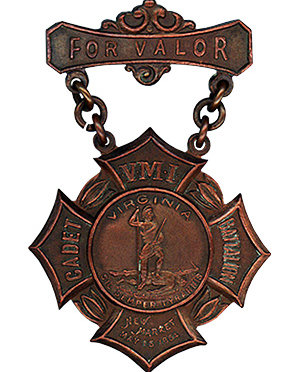
The New Market Cross of Honor

The New Market Cross of Honor is a military decoration issued to cadets of the Virginia Military Institute for their service to the Confederacy.

The New Market Cross of Honor is a military decoration that was issued by the Alumni Association of VMI to cadets of the Virginia Military Institute (VMI) for their service to the Confederacy during the American Civil War. All the cadets had been previously listed on the Confederate Roll of Honor.

The medal was issued in 1904 and presented to the 294 members who marched into combat at the Battle of New Market, which was fought on May 15, 1864 in Virginia during the Valley Campaigns of 1864. A makeshift Confederate army of 4,100 men turned the tide of the battle for the Confederacy, defeating Union Major General Franz Sigel and his Army of the Shenandoah. A notable participant of this battle (and a reci[ient of the medal) was Moses Jacob Ezekiel.

The cadets, numbering 257, were organized into a battalion of four companies of infantry and one of artillery. Ten cadets died as a result of the battle while 45 were wounded and survived. In the case of those killed in battle or no longer living, the medal was given to surviving family members.

The cross was also presented to Eliza Catherine Clinedinst Crim, a New Market resident who had nursed injured cadets after the battle. When she died in 1931, cadets served as her pallbearers and her grave marker said “Mother of the New Market Corps“.

Separately, VMI has awarded a “New Market Medal” to distinguished alumni since 1962.

The New Market Cross of Honor Design

The copper medal measures 1.5″ x 2″ overall. The hanger reads “For Valor“. The drop has the state seal of Virginia and the words: “VMI Cadet Battalion New Market May 15 1864“. The back is marked “V.M.I. Alumni Ass’n” and the name of the recipient.

The Cross of the Mount of Olives

The Cross of the Mount of Olives is a Prussian award founded in 1909 to commemorate the foundation of a hospital on the Mount of Olives.

The Cross of the Mount of Olives (or Ölberg-Kreuz in German) is a Prussian award founded on 24 December 1909 as a decoration to commemorate the foundation of a hospital, the Kaiserin Auguste Victoria-Stiftung on the Biblical Mount of Olives in Jerusalem.

The award was created by Prince Eitel Friedrich of Prussia. His very devout mother, Augusta Victoria of Schleswig-Holstein, was fond of charitable works and built several churches and he and Emperor Wilhelm II of Germany had visited Jerusalem in 1898. They then pledged to build a hospital for Christian pilgrims suffering from malaria.

The Cross of the Mount of Olives was awarded to those who contributed to the Foundation, and the Augusta Victoria Hospital opened its doors in 1910.

The Cross of the Mount of Olives Design

The badge of the decoration is a red-and-black enameled Jerusalem cross, upon which is imposed the white cross of the Johanniterorden, the evangelical noblemen’s society which Prince Eitel Friedrich then headed as Grandmaster.

The badge is suspended from a monogram of the Empress’s initials, “AV”. The ribbon is plain white and the deserving were awarded golden or silver-gilt Crosses.

The Jerusalem Cross

The Jerusalem Memorial Cross is a Prussian decoration established in 1898 and awarded to those who visited Palestine with the King.

The Jerusalem Cross, also known as the Jerusalem Memorial Cross or “Jerusalem-Kreuz; Jerusalem-Erinnerungskreuz” in German, holds historical significance as a Prussian decoration established on October 31, 1898. Its establishment coincided with Emperor Wilhelm II‘s notable visit to Palestine in the same year. This distinguished award was bestowed upon individuals who had the unique privilege of accompanying Emperor Wilhelm II on his pilgrimage to Palestine and participated in the solemn inauguration ceremony of the Lutheran Church of the Redeemer in Jerusalem.

Emperor Wilhelm II’s journey to Palestine and the dedication of the Lutheran Church of the Redeemer marked a significant event in Prussian history, symbolizing the nation’s cultural and religious ties to the Holy Land. The Jerusalem Cross served as a commemorative token of this historic occasion, honoring those who were part of this remarkable pilgrimage. As a testament to their participation in this momentous event, recipients of the Jerusalem Cross were recognized for their role in fostering diplomatic relations, religious unity, and cultural exchange between Prussia and the Holy Land

The Jerusalem Cross Design

The cross is made in the shape of the Jerusalem cross, which consists of a large cross portent with four plain crosslets between the arms. The crosses are red enameled with silver-gilt borders. In the center of the cross is a round gold colored medallion.

The obverse depicts the Imperial Crown of the Prussian German Emperor surmounting the letters IR (Imperator Rex) over the royal cypher of a stylized W II. The reverse of the medallion bears the date 31 October 1898, which is depicted using a large Roman numeral X in the center for October, and a small Roman numeral XXXI at the top. To the left is MDCCC and to the right side IIC for the year 1898.

The Lifesaving Medal

The Lifesaving Medal was a civil decoration of the Kingdom of Prussia awarded to those who had saved a person’s life at risk to their own.

The Lifesaving Medal (on Rettungsmedaille am Band” in German) was a civil decoration of the Kingdom of Prussia.

Established 1 February 1833, it was awarded to individuals who had saved another person’s life, at risk to their own.

This medal is referred to as the Lifesaving Medal on Band to differentiate it from a previous non-portable award established in 1802. Otto von Bismarck received it for rescuing a drowning man.

The Lifesaving Medal Design

The medal is circular and struck in silver. The obverse presents the head of King Friedrich Wilhelm III in relief, facing left, in the center.

Around it is circumscribed FRIEDRICH WILHELM III KÖNIG VON PREUSSEN. The reverse has inscribed FÜR RETTUNG AUS GEFAR (FOR RESCUE FROM DANGER) within an oak leaf wreath, measuring 24.79 mm in diameter, on loop for suspension from the period original ribbon, and in fine condition.

The Prussian Red Cross Medal

The Red Cross Medal was set up in 1898 by Emperor Wilhelm II and awarded to those who did great service to the sick in peace or wartime.

The Red Cross Medal was set up on 1 October 1898 by Emperor Wilhelm II and awarded to all those who carried out great service to the sick in peace or wartime, or for special achievement in the service of the German Red Cross. This was a peacetime award, as opposed to the Order of the Crown and general honor decorations with the Red Geneva Cross.

The Red Cross Medal was awarded in three classes, the Second and Third classes being worn as circular medals suspended from a red ribbon with white and black stripes.

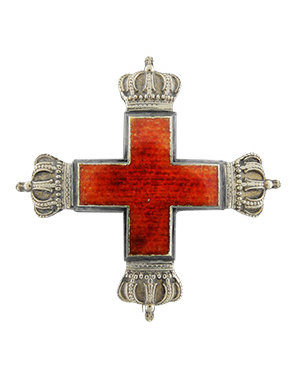
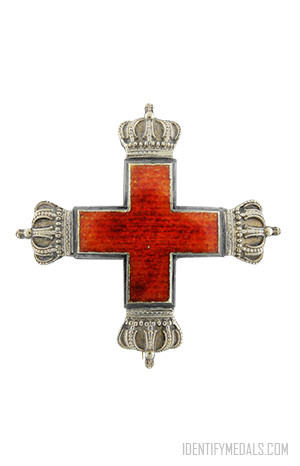
The First Class was a red enameled Geneva Cross with gilded Prussian Royal Crowns at the ends of the arms. This award was worn as a steckreuz on the breast like the Iron Cross. Recipients could be promoted to the next class of the medal with five years time in service, with the first level anyone could be initially appointed to being the Second Class.

Find Red Cross Medals Online

Right Now on eBay 
Clicking a link to eBay may result in a referral commission being paid if a purchase is made.
Loading...

More Red Cross Medals

The Red Crescent Medal

The Red Crescent Medal was instituted in 1912 to reward services to the Red Crescent (the equivalent of the Red Cross in Islamic countries).

The Red Crescent Medal was instituted in 1912 by the 35th Sultan of the Ottoman Empire Mehmed V Reshad to reward services to the Red Crescent (the equivalent of the Red Cross in Islamic countries). It was issued to Red Crescent members and volunteers regardless of their gender for merits in care of sick and wounded.

This medal came in three classes: Gold, silver and bronze. Recommendations for award of the two lower classes were made by the Executive Committee of the Red Crescent, but only the Sultan himself could recommend a recipient of the first class.

This medal continued to be awarded after World War I, until the establishment of the Republic.

The Red Crescent Medal Design

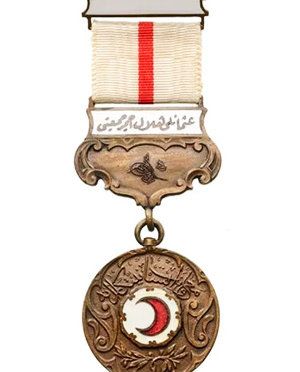
The Red Crescent medal is round, 29 mm in diameter. The obverse bears a red crescent facing left on a white field enameled in the center. Below it is a sprig of laurel, and above it the inscription “Humane Assistance“. The suspension bar bears the tughra of Sultan Mehmed Reshad V below a white enameled bar reading “Ottoman Red Crescent Association.” There is also a bar at the top of the ribbon, enameled white, which is sometimes seen with year designations on the bar, indicating years served with the Red Crescent.

The medal was worn suspended from a silk white ribbon with a central vertical red stripe. Women recipients wore decoration on a traditional bow.

The Liyakat Medal

The Liyakat Medal (Liyakat Madalyasi) was a decoration of the Ottoman Empire established in 1890 and awarded in two classes: gold or silver.

The Liyakat Medal (or Liyakat Madalyasi in Turkish) was a decoration of the Ottoman Empire established in 1890 and awarded in two classes: gold or silver. The medal was not strictly a military award and could be awarded for general merit in society such as to civilians for general merit to society.

The medal was a common military decoration through the end of the First World War. In 1905 the statutes were amended to allow women to receive the medal for charitable work, service to mosques or schools, and other decidedly civilian merits.

The Liyakat Medal Design

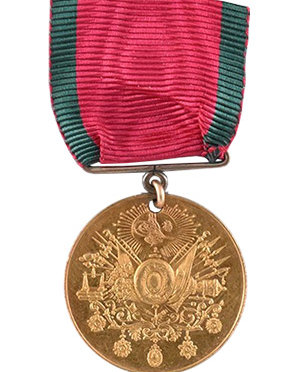
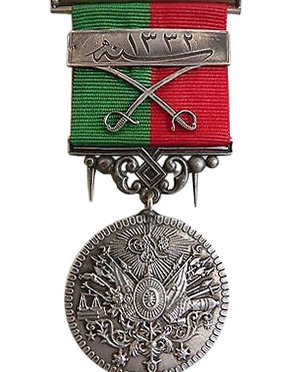
The medal measured 25 mm in diameter came in both gold and silver classes. It’s suspended from a red ribbon with narrow green side stripes.

The obverse bears the ottoman trophy of arms with the sultan’s cipher above it. The reverse bears the inscription “Medal of Merit Especially for Those Who Have Shown Loyalty and Bravery” and the date AH 1308 (1890 AD).

During World War I a clasp of two crossed swords was attached to the ribbon with the date AH 1333 (1915) inscribed upon them. Copies of the Liyakat medal made in Germany and Austria around the First World War are sometimes found with and without the crossed sabers device.  These copies are rarer than original pieces, and command a premium among collectors.

The Imtiyaz Medal

The Imtiyaz Medal (İmtiyaz Madalyası), also known as Nishan-i-Imtiaz (Nişan-ı İmtiyaz) is an Ottoman military decoration instituted in 1882.

The Imtiyaz Medal (or İmtiyaz Madalyası in Turkish), also known as Nishan-i-Imtiaz (Nişan-ı İmtiyaz) is an Ottoman military decoration that was instituted in 1882.

The gold Imtiyaz medal was the highest-ranking military decoration of the Ottoman Empire while the silver one ranked above the silver Liyakat Medal, but below the gold Liyakat.

A few examples of this medal are known to have been struck with the name of the recipient in raised letters, usually given to the heads of state of Turkey’s allies during World War I.

The Imtiyaz Medal Design

The medal is presented in two classes: gold and silver. The medal measures 37 mm and bears the Ottoman military coat of arms on the obverse, with its inscription “Relying on Divine Guidance and Assistance, Abdulhamid Khan, Sultan of the Ottoman Empire“. The tughra of Sultan Abdulhamid II is at the top.

The reverse has an inscription in Ottoman that translates roughly as “Medal for Those That Have Shown Exceptional Loyalty and Bravery for the Ottoman Empire“. Below that is a curved rectangular area where the name of the recipient could be engraved, and at the bottom is the date 1300 (1882).

The ribbon of this medal is half red, half green. Awards dating from World War I have a ribbon device, in the same material as the medal itself, consisting of a bar with the year 1333 (1915) above a pair of crossed sabers.

The Turkish Medal for the Siege of Silistria

The Turkish Medal for the Siege of Silistria is a campaign medal issued to British personnel present during the period of the Crimean War.

The Turkish Medal for the Siege of Silistria (or Silistre Madalyası in Turkish) is a campaign medal issued to the handful of British personnel who were present during the period of the Crimean War (28 March 1854 to 30 March 1856).

During the battle, Russian forces besieged the Ottoman fortress of Silistra. If the Russians were to make a success of their campaign on the Danube, they needed to capture the stronghold of Silistria, but the successful resistance mounted by the Turks during the course of a two month siege (April-June 1854) was unexpected by the Russians. While initially successful, the Russians were forced after several weeks to abandon the siege and retreat due to political pressure. The failure of the siege signaled a general withdrawal by Russia from the Principalities, which was largely completed by September 1854.

The Medal for the Siege of Silistria Design

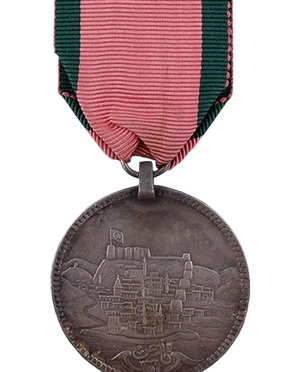
The medal is made in silver and measures 36.5 mm.