The Iftikhar Sanayi Medal

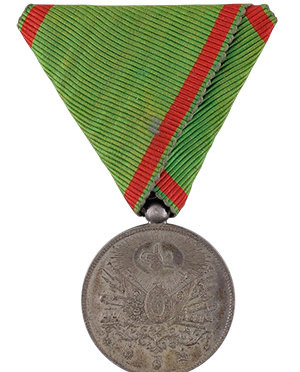
The Iftikhar Sanayi Medal is a medal made of gold or silver awarded by the Ottoman Empire and first granted by Sultan Abdulhamid II.

The Iftikhar Sanayi Medal (also known as Medal of Iftikhar or Medal of Sanayi) is a medal made of gold or silver awarded by the Ottoman Empire and first granted by Sultan Abdulhamid II.

The medal was generally awarded for loyalty, valor, heroism, and accomplishments in various fields such as agriculture, arts, and crafts. These medals were also used as war medals by attaching inscribed clasps to their ribbons. The name of this medal was originally “Iftihar Madalyasi“, which was used earlier for the General Service Medal, but was later changed to “Sanay-i Nefise Madalyasi” which translates roughly as “Medal of Beautiful Arts“.

Most of the recipients were artists and artisans such as personnel of the Yildiz porcelain factory, or performers at the private theater of Sultan Abdulhamid II at the palace.

The medal was awarded in two classes: Gold and Silver.

The Iftikhar Sanayi Medal Design

The obverse of the Sanayi medal features an Ottoman trophy of arms and on the reverse side has a laurel wreath in the center, leaving a blank space for the awardee’s name to be engraved.
The Gallipoli Star or 1915 Turkish Campaign Star

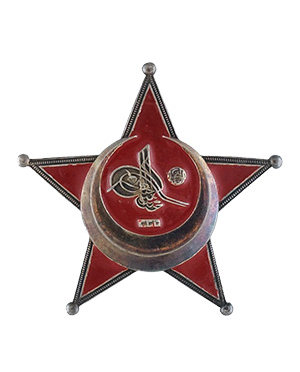
The Gallipolli Star or Ottoman War Medal is a military decoration awarded by the Ottoman Empire and instituted in 1915 for gallantry in battle.

The Gallipolli Star or Ottoman War Medal (Harp Madalyası in Turkish) is a military decoration awarded by the Ottoman Empire and instituted by Sultan Mehmed V on 1 March 1915 for gallantry in battle. This was the “entry level” gallantry award of the Turkish military in World War I, ranking below the silver Liyakat Medal.

The decoration was awarded to Ottoman and other Central Powers troops, primarily in Ottoman areas of engagement. It wasn’t a campaign medal, but a medal for military merit.

The decoration is the only Ottoman one which not awarded by authority of the Sultan, but rather was authorized by Enver Pasha, the Commander-in-Chief of the Ottoman military.

The Gallipoli Star Design

The Gallipoli Star is made of nickel-plated brass and measures 56 mm across the diagonal span of the arms. The tips of the star are capped by ball finials and enclosed in a raised silver edge with the field in red lacquer or enamel. A raised crescent, open at the top, encircles the center of the badge.

Inside the crescent on the obverse is the tughra or cipher of the decoration’s creator, Sultan Mehmed V Reşâd, over the date 1333 AH (AD 1915). The reverse is flat, unadorned and has a straight pin.

The original issue pieces of this award came in two varieties: silvered brass with red enamel and white metal with thin red lacquer. Those medals issued to officers were enameled and manufactured by a company that used the mark “BB&Co.“, a maker reputedly located in Berlin.

The award includes a badge, ribbon and campaign bar.

The Order of Osmanieh

The Order of Osmanieh or Osmaniye is a civil and military decoration of the Ottoman Empire created in January 1862 by Sultan Abdülaziz.

The Order of Osmanieh or Osmaniye (or Osmanlı Devlet Nişanı in Turkish) is a civil and military decoration of the Ottoman Empire created in January 1862 by Sultan Abdülaziz.

It was awarded by the Sultan to Ottoman civil servants and military leaders for outstanding services to the state.

The order was originally established in three classes (expanded to four in 1867):

  • First class (50 members)
  • Second class (200 members)
  • Third class (1000 members)
  • Fourth class (2000 members)

The Order of Osmanieh Design

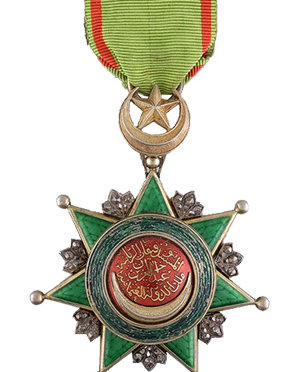
The badge of the order is a seven-pointed star in dark green enamel, with three short silver rays between each point of the star. In the obverse, the center medallion is in gold, with a red enameled field surrounded by a green enameled band. In the red central portion is a raised gold crescent, and a calligraphic inscription reading “Relying on the Assistance of Almighty God, Abdulaziz Khan, Sovereign of the Ottoman Empire“.

The reverse center medallion is silver, bearing a trophy of arms and the year AH. 699, the year of the creation of the Ottoman Empire.

The badge is suspended by a gold crescent and star, facing upwards.

The Order of the Medjidie

The Order of the Medjidie is a military and knightly order of the Ottoman Empire instituted in 1851 by Sultan Abdülmecid I.

The Order of the Medjidie (or Mecidiye Nişanı in Turkish) is a military and knightly order of the Ottoman Empire instituted in 1851 by Sultan Abdülmecid I. It was given as a reward for distinguished service to members of the British Army and the Royal Navy and the French Army who came to the aid of the Ottoman Empire during the Crimean War against Russia.

The Order was issued in considerable numbers and awarded in five classes, with the First Class being the highest. It was usually conferred on officers although there have been cases of a few enlisted soldiers receiving it as well, and during World War I it was also awarded to a number of German and Austrian officers.

Among notable recipients are Napoleon III Emperor of France and Pedro II of Brazil Emperor of Brazil.

Owners of the order:

  • First Class Order – 50 people (Given by Sultan)
  • Second Class Order – 150 people (Given by Sultan)
  • Third Class Order – 800 people
  • Fourth Class Order – 3,000 people
  • Fifth Class Order – 6,000 people

The Order of the Medjidie Design

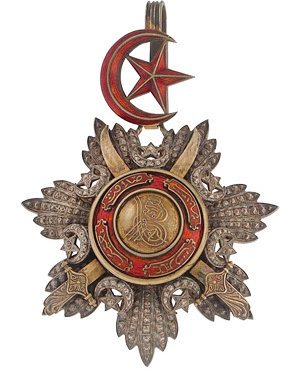
On the obverse of the star is Sultan Abdul Mejid’s royal cipher measuring 75.3 mm and surrounded by an inscription on a gold-bordered circle of red enamel. The star has seven triple quills with small crescents and five-pointed stars between them, suspended from a red enameled crescent and star suspender with green enameled edges.

First, second, third and fourth classes are gold. Fifth (lower) class is silver.

The Doggersbank Medal

The Doggersbank Medal was awarded to the officers who took part in the battle of Doggersbank, a naval battle that took place in 1781.

The Doggersbank Medal was awarded to the officers who took part in the battle of Doggersbank, a naval battle that took place on 5 August 1781 during the Fourth Anglo-Dutch War.

Both sides claimed victory although no ships were captured and both convoys escaped. Casualties were high on both sides, considering the number of ships involved. Because the Dutch merchantmen reached the harbor and the British fleet first left the battlefield, it was a victory in the eyes of the Dutch.

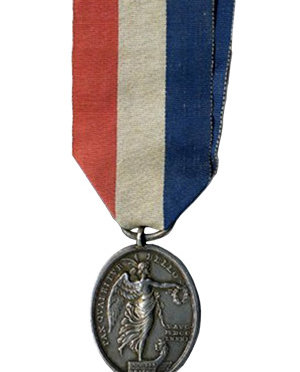
The Netherlands honored the fleet with numerous parades, receptions, poems and plays. As well as receiving a monetary reward, surviving officers, midshipmen and non-commissioned officers weew awarded a commemorative medal, the Doggersbank Medaille. Nineteen gold medals with a red, white and blue ribbon were awarded to Admiral Zoutman, his first officer (Van Kinsbergen) and the 17 captains of the escorting fleet. Willem V personally hung them around the neck of the flag and supreme officers.

The Doggersbank Medal Design

The Doggersbank medal is oval in shape and thirty-six millimeters high.

On the obverse, the winged Goddess Victoria is depicted on the bow of a warship. In her right hand she holds a wreath of leaves and on the hull of the ship is written “DOGGERSBANK“. Beginning at her right foot and ending at the wreath of  foliage, the left side of the medal reads “PAX QVAERITVR BELLO” (Latin for: “Peace is achieved through war“). The date of the battle “V AVG MDCCLXXXI” (August 5, 1781) is indicated on the right side of the medal.

The reverse of the medal features the text “EXI MIÆ VIRTU TIS PRÆM IVM” (“As a reward for outstanding prowess“) in a wreath of orange tree leaves.

The senior officers received silver medals on the same ribbon. The lieutenants received a silver medal on an orange ribbon.

The Königgrätz Commemorative Cross

The Königgrätz Commemorative Cross is a Prussian medal instituted in 1866 by Wilhelm I and awarded to officers, NCOs and officials.

The Königgrätz Commemorative Cross is a Prussian medal instituted on September 20, 1866 by the King of Prussia Wilhelm I. The medal was awarded to Prussian officers, NCOs and other ranks as well as to military officials following the Prussian victory in the Austro-Prussian War (June 17 – July 26, 1866).

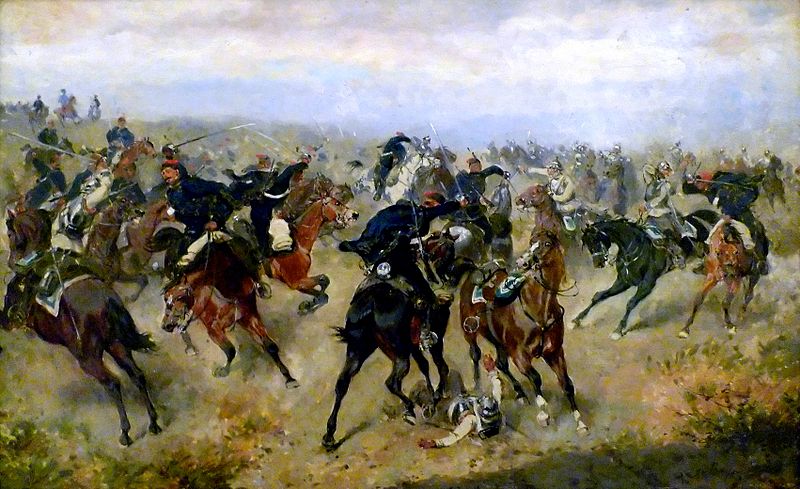
This award was named after the Battle of Königgrätz (Schalcht bei Königgrätz, also referred to as the Battle of Sadowa) that took place on July 03, 1866 and  involved the largest number of troops in Europe until that time. The battle ended with one of the highest casualties for a major battle: Austrians and their Saxon allies lost 44,000 men killed in action, wounded and missing in action including 22,000 being held prisoners while Prussians had 360 officers and 8,812 men killed.

A total of 144,000 “combat” crosses and 1,200 non-combatant versions were issued.

The Königgrätz Commemorative Cross Design

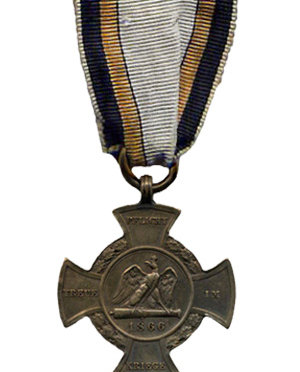
The medal has the shape of a cross pattée with a round medallion superimposed on its center and a round wreath between its arms and is made of bronze from captured Austrian cannons. It was designed by the Prussian court medalist Friedrich Wilhelm Kullrich (1821-1887) and the Prussian royal mint engraver Emil Weigand (1837-1906) and measured 34,5 x 34,5 mm.

A central medallion on its obverse has an image of a crowned Prussian eagle leaning against a captured Austrian cannon (with some variations). There were four different crosses instituted to commemorate “1866 victorious campaign”. All the four crosses share the same reverse design, a crowned cipher of the Prussian king Wilhelm I.

  • Königgrätz Cross: For the military personnel who participated directly in the Battle of Königgrätz. Inscription: “König-Grätz” – “Den 3.” – “Juli” – “1866”.
  • “Main Army” Cross: For the military personnel of a Main army who fought under command of General Eduard Vogel von Falckenstein against troops from Hannover, Hessen, Bavaria, Baden and Wurttemberg. Inscription “Der” – “Main” – “Armee” -“1866”.
  • “Loyal Fighters” Cross: For military personnel who hadn’t participated in the Battle of Königgrätz and were not attached to the Main army. Inscription “Treuen” – “Krie-” – “Gern” – “1866”.
  • “Loyal to its duty in times of war” Cross: For non-combatants. Round wreath is made of oak leaves. Inscription “Pflicht” – “Treue” – “Im” – “Kriege”.

Like other Imperial awards, the Cross was worn either obverse or reverse outwards. The silk ribbon of the first three versions of a Königgrätz Commemorative Cross was black with two yellow-orange and white vertical stripes closer to its edges.

Related Article:

The 1900 Boxer War Medal (Japan)

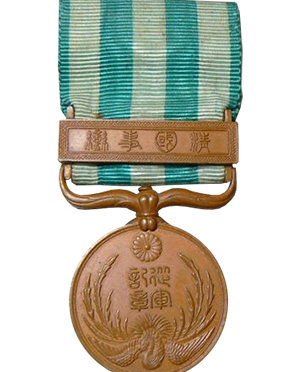
The 1900 Boxer War Medal was a Japanese medal created by Imperial Edict in 1901 to commemorate those that fought during the Boxer Rebellion.

The 1900 Boxer War Medal was a Japanese medal created by Imperial Edict No. 142 and issued on April 21, 1901. It’s a commemorative medal for those who had participated in the relief of the Beijing legations during the Boxer Rebellion.

The Military Medal of Honor (or 従軍記章 jugun kisho in Japanese) was a military decoration for meritorious service to the Empire of Japan, formerly awarded to all military personnel who participated in battles in a war and effectively abolished during the Allied Occupation of Japan in the post-war years (1945–1951).

The plausible re-institution of a modern equivalent was made unlikely by the adoption of Japan’s post-war Constitution which disavows the right of the state to engage in aggressive war.

The 1894-95 Sino-Japanese War Medal

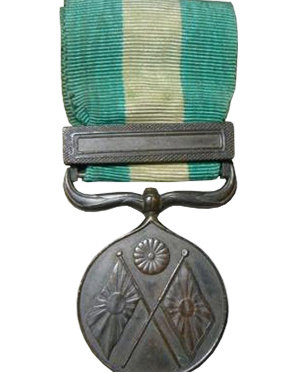
The 1894-95 Sino-Japanese War Medal was awarded in commemoration of the First Sino–Japanese War, which lasted from 1894 to 1895.

The 1894-95 Sino-Japanese War Medal was awarded in commemoration of the First Sino–Japanese War, which lasted from 1 August 1894 to 17 April 1895.

The war was fought between Qing Dynasty China and Meiji Japan, primarily over control of Korea. After more than six months of continuous successes by the Japanese army and naval forces, as well as the loss of the Chinese port of Weihai, the Qing leadership sued for peace in February 1895.

The Military Medal of Honor (or 従軍記章 jugun kisho in Japanese) was a military decoration for meritorious service to the Empire of Japan, formerly awarded to all military personnel who participated in battles in a war and effectively abolished during the Allied Occupation of Japan in the post-war years (1945–1951).

The plausible re-institution of a modern equivalent was made unlikely by the adoption of Japan’s post-war Constitution which disavows the right of the state to engage in aggressive war.

The 1874 Formosa Expedition War Medal

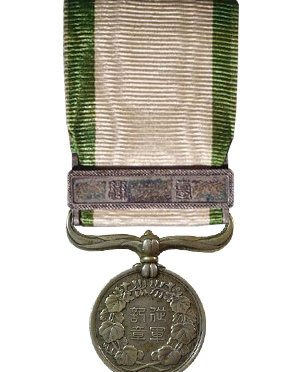
The 1874 Formosa Expedition War Medal was established in 1875 to commemorate the 3000 Japanese warriors who went to Formosa.

The 1874 Formosa Expedition War Medal was established by Daijou-kan Law #54 on April 10, Meiji 8 [1875]. Revised (Law #141) on November 15, 1876.

The Japanese expedition of 1874 to Taiwan Province, also referred to as the Taiwan Expedition of 1874, was in response to the Mudan Incident of 1871. Fifty-four shipwrecked Ryukyuan sailors were killed by Paiwan aborigines in December 1871 in southern Taiwan. In seeking restitution from Qing China, Japan reached an impasse when the Chinese claimed that they were not responsible for the actions of the aborigines in territory that was nominally under Chinese sovereignty.

The Japanese government sent an expedition of 3,600 soldiers led by Saigō Tsugumichi in May 1874. The Japanese won a decisive victory at the Battle of Stone Gate on 22 May 1874. Thirty aborigines were either killed or mortally wounded in the battle, and a great number wounded. Japanese casualties were six killed and thirty wounded.

In November 1874 the Japanese forces withdrew from Taiwan after the Qing government agreed to an indemnity of 500,000 Kuping taels.

The Military Medal of Honor (or 従軍記章 jugun kisho in Japanese) was a military decoration for meritorious service to the Empire of Japan, formerly awarded to all military personnel who participated in battles in a war and effectively abolished during the Allied Occupation of Japan in the post-war years (1945–1951).

The plausible re-institution of a modern equivalent was made unlikely by the adoption of Japan’s post-war Constitution which disavows the right of the state to engage in aggressive war.

The 1874 Formosa Expedition War Medal Design

The obverse of the medal bears branches of Imperial Paulonia Leaves. Inscribed ‘War Medal.’ The reverse is inscribed ‘Meiji 7 [1874] Year of the Dog.’ The latter refers to the Chinese Sexagenary Cycle.

The Order of the Precious Crown

The Order of the Precious Crown (Hōkan-shō) is an Order from Japan established in 1888 by Emperor Meiji and usually reserved for females.

  • Time Period: Pre-WW1
  • Institution: 4 January 1888
  • Country: Medals from Japan Japan

The Order of the Precious Crown (or 宝冠章 Hōkan-shō in Japanese) was established on January 4, 1888, by Emperor Meiji. It’s the lowest ranking of the Japanese orders currently awarded and conventionally reserved for female recipients (such as female members of the royal family).

Until 2003, the Order of the Precious Crown ranked below the Order of the Rising Sun but above the Order of the Sacred Treasure, and was bestowed as a female-only version of the Order of the Rising Sun. The Order of the Precious Crown is now only bestowed upon female members of the Imperial Family and foreign ladies of distinction.

Originally the order had five classes, but on April 13, 1896, the sixth, seventh, and eighth classes were added. Unlike many European counterparts can be awarded posthumously. 

The Order of the Precious Crown is given by the Emperor of Japan at the monarch’s pleasure and, since 2003, no longer uses numbers to represent rank.

The Classes of the Order of the Precious Crown

The Order of the Precious Crown had eight classes (today, it has six. The 7th and 8th classes were abolished in 2003). The First Class is usually awarded to female royalty or, occasionally, to the royal family in foreign countries. This typically happens when necessary for diplomatic ceremonies. 

These are the ribbon bars of the order:

  • JPN Hokan-sho 1Class BAR.svg Grand Cordon, Paulownia 
  • JPN Hokan-sho 2Class BAR.svg Second Class, Peony
  • JPN Hokan-sho 3Class BAR.svg Third Class, Butterfly
  • JPN Hokan-sho 4Class BAR.svg Fourth Class, Wisteria
  • JPN Hokan-sho 5Class BAR.svg Fifth Class, Apricot
  • JPN Hokan-sho 6Class BAR.svg Sixth Class, Ripples
  • JPN Hokan-sho 7Class BAR.svg Seventh Class, Medal
  • JPN Hokan-sho 8Class BAR.svg Eighth Class, Medal 

The Order of the Precious Crown Badge Design

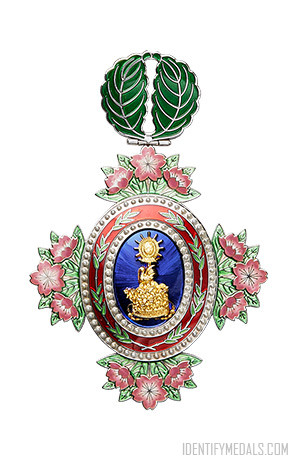
The badge of the order is a gold oval medallion with floral designs at its four ends. Aat the centre is an ancient Japanese crown on a blue background, surrounded by a red ring. It is suspended from a smaller badge, its design varies according to class. 

The ribbon of the Order of the Precious Crown is yellow with red stripes near the borders. For the 1st class, a sash is worn on the right shoulder (all other classes use a bow on the left shoulder).

The star of the order is worn only by the first class and has five rays studded with pearls, with floral designs between the rays. The central disc features a Ho-o or phoenix on a blue background, surrounded by a red ring emblazoned with a laurel wreath.

The medal for the 6th and 7th classes is golden bronze. The face presents the crossed flags of Japan and the Emperor, both surmounted by the Rising Sun. The obverse presents a conventional monumental shaft flanked by a branch of laurel and a palm branch.