The Wound Medal (Austria-Hungary)

The Wound Medal (Austria-Hungary) a decoration of the Empire of Austria-Hungary established on August 12, 1917 by Emperor Karl I.

The Wound Medal is a decoration of the Empire of Austria-Hungary established on August 12, 1917 by Emperor Karl I.

The medal was awarded to service members of the Austro-Hungarian armed forces and to persons attached to the Austro-Hungarian armed forces who were wounded as a result of combat operations. It could also be awarded to persons who were disabled or suffered serious damage to their health in connection with military actions.

The Wound Medal Design

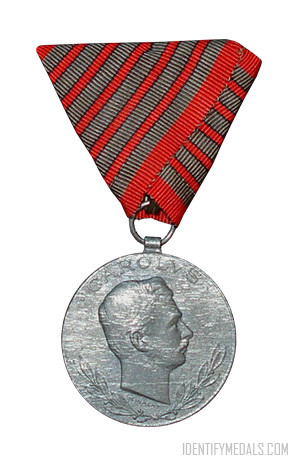
The Wound Medal is made of zinc and measures 38-mm in diameter. There are variations with both a dull gray and with a polished surface.

The obverse features a bust of Emperor Karl with his name in Latin “CAROLUS” above and a wreath of laurels below. Between the bust and the laurels in smaller letters was the name of the designer of the medal, R.(Richard) PLACHT, 1880 Kratzau – 1962 Vienna. The reverse featured the words LAESO MILITI (“to the wounded soldier”) and the date in Roman numerals “MCMXVIII” (1918).

The medal is suspended from an Austrian-style trifold ribbon, 39-mm in width, gray-green with 4-mm wide red edge stripes. The number of wounds was indicated by narrower 2-mm wide red stripes, edged in black, centered on the ribbon. No stripes indicated an award for someone invalided out of service. One stripe indicated a single wound, two stripes two wounds, etc.
The Karl Troop Cross

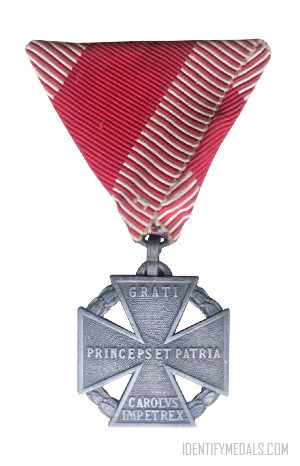
The Karl Troop Cross is a medal of Austria-Hungary created on 13 December 1916 and awarded for service up to the end of the First World War.

The Karl Troop Cross (or Karl-Truppenkreuz in German) is an Austro-Hungarian medal instituted on 13 December 1916 by Emperor Karl I.

The medal was awarded for service up to the end of the First World War to soldiers and sailors of all arms of the Austro-Hungarian armed forces, regardless of rank, who had been with a combatant unit for at least twelve weeks and who had participated in at least one battle. Members of the air service who made ten flights over enemy lines were also eligible.

The Karl Troop Cross Design

The medal is cross pattée resting on a laurel wreath made of zinc.

The obverse shows the Latin inscription “GRATI PRINCEPS ET PATRIA, CAROLVS IMP.ET REX“, (A grateful prince and country, Karl, Emperor and King). The reverse bears the Austrian Imperial and Hungarian Royal crowns above the letter “C” (for Carolus) with the inscription “VITAM ET SANGVINEM“, (“With life and blood“) and the date MDCCCCXVI, (1916).

The cross was worn on the left chest from a red ribbon with alternate red-white side strips towards each edge.

The Finnish Liberation War Medal 1918

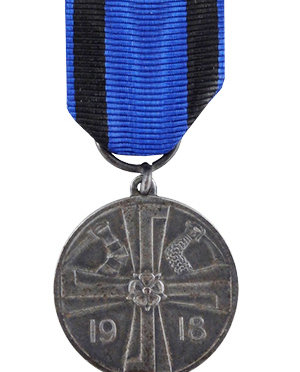
The Finnish Liberation War Medal 1918 is a Finnish medal from WW1. The medal was instituted 1918 for participants in the Liberation War, fighting against the Finnish and Soviet Bolsheviks. It was awarded to Soldiers of the Finnish Army, as well to German soldiers of the Baltic Division and foreign volunteers (Polish, Swedish, and Estonian).

The Finnish Liberation War Medal 1918 Design

The medal is struck in silver and measures 30 mm.

The Lorenz Lindelöf Scientific Award Medal

Time Period: Pre-WW1
Institution: Pre-WW1
Country: Finland

The Lorenz Lindelöf Scientific Award Medal is a finish medal established before WW1.

Finland had been ceded to Russia in 1809. At the time that time, Leonard Lorenz Lindelöf (November 13, 1827 – March 3, 1908)’s father was appointed professor of mathematics at the university, the main building of the university on Senate Square had recently been completed. Lindelöf spent the year 1891 in Stockholm, and the years 1893-94 in Paris returning to Helsingfors where he graduated in 1895. He then taught there as a docent, visiting Göttingen in 1901. Helsinki was still under Russian control and indeed the Russians had implemented a policy of Russification, in reply to the national movements which had arisen.

Lindelöf remained as a professor of mathematics in Helsinki until he retired in 1938. It was a time of rapid economic growth for the new country and the university flourished and rapidly expanded. Lindelöf supported his new country undertaking his university duties with great enthusiasm. Later in his life, Lindelöf gave up research to devote himself to teaching and writing textbooks.

For his outstanding contributions to Scandinavian mathematics, he was honoured by the universities of Uppsala, Oslo, Stockholm, and Helsinki.

The Lorenz Lindelöf Scientific Award Medal Design

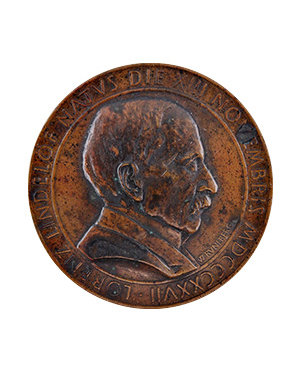
The medal is struck in bronze and measures 56.5 mm. The obverse illustrates the right-facing bust of Lorenz Lindelöf, surrounded by the inscription “LORENZ LINDELÖF NATVS DIE XII NOVEMBRIS MDCCCXXVII” (1827).

The reverse illustrates a branch of laurel leaves at the left and a branch of oak leaves at the right, inscribed in the centre is “SECRETARIO SVO QVADRAGENARIO SOCIETAS SCIENTIAS FENNIAE / DIE XIII NOVEMBRIS MCMVII” (1907).

The Kindred Nations War Cross 1918-1922

The Kindred Nations War Cross 1918-1922 (Heimosotaristi) is a Finnish medal established in 1922 to reward Finnish volunteer participants in the campaigns in Estonia, Eastern Karelia, Aunus and Ingria (Kindred Nations) against Soviet Russia in the years from 1918 to 1922.

The number of volunteers involved in the nine campaigns was small, making the cross rare. These were campaigns by the Finnish volunteers  in the War of Independence in Estonia and during various campaigns in Karelia and other border areas in Russia.

The Kindred Nations War Cross 1918-1922 Design

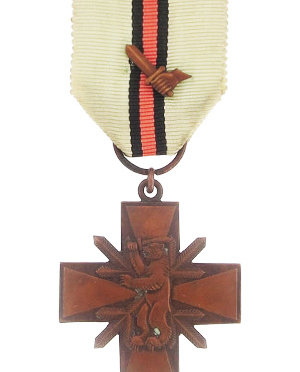
The medal is struck in bronze and measures 39.8 mm x 40 mm. A sword device on the ribbon was awarded for participation in one campaign.

The Finnish Homeguard Volunteer Service Cross

The Finnish Homeguard Volunteer Service Cross was first established after WW1 and used also during WW2.[/vc_column_text][vc_column_text]

The Finnish Homeguard Volunteer Service Cross Design

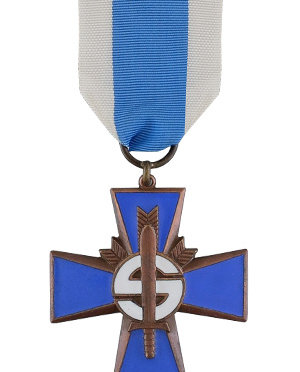
The medal is struck in bronze gilt with white and blue enamels and measures 41.7 mm wide. The obverse of the medal shows a white S with a sword superimposed over it, over a blue cross, with some fern leaves.

The Order of the White Rose

The Order of the White Rose of Finland was established by Gustaf Mannerheim on January 28, 1919 and is one of Finland’s three Orders.

The Order of the White Rose of Finland (or Suomen Valkoisen Ruusun ritarikunta in Finnish) is, along with the Order of the Cross of Liberty, and the Order of the Lion of Finland, one of Finland’s three Orders. The President is the Grand Master of all three. The order’s rules and regulations were confirmed on May 16, 1919, and its present rules date from June 1, 1940.

The Order of the White Rose of Finland was established by Gustaf Mannerheim on January 28, 1919. The name comes from the nine roses argent in the coat of arms of the country. Generally, the Grand Cross with Collar is awarded only to foreign heads of state, e.g. to King Fuad I of Egypt (1935), Charles de Gaulle (1962), Josip Broz Tito (1963) and King Birendra of Nepal (1988).

The honor can be granted for military as well as civilian merit.

The classes of the Order of the White Rose are:

  • FIN Order of the White Rose Grand Cross BAR.png Grand Cross of the White Rose of Finland with Collar
  • FIN Order of the White Rose Grand Cross BAR.png Grand Cross of the White Rose of Finland
  • FIN Order of the White Rose Commander 1st Class BAR.png First Class Commander of the White Rose of Finland
  • FIN Order of the White Rose Commander BAR.png Commander of the White Rose of Finland
  • FIN Order of the White Rose Knight 1st Class BAR.png First Class Knight of the White Rose of Finland
  • Order of the White Rose Ribbon.PNG Knight (Chevalier) of the White Rose of Finland
  • FIN Cross of Merit of the Order of the White Rose BAR.png Cross of Merit of the White Rose of Finland
  • FIN Medal 1st Class of the Order of the White Rose BAR.png First Class Medal of the White Rose of Finland with golden cross
  • FIN Medal 2nd Class of the Order of the White Rose BAR.png First Class Medal of the White Rose of Finland
  • FIN Medal 3rd Class of the Order of the White Rose BAR.png Medal of the White Rose of Finland

The Order of the White Rose Design

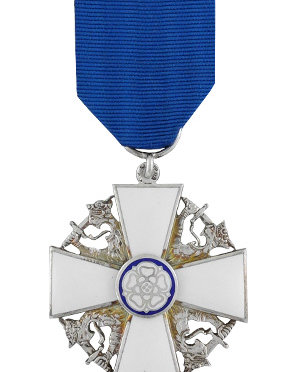
The original decorations were designed by Akseli Gallen-Kallela. The swastikas of the collar were replaced by fir crosses in 1963, which were designed by heraldic artist Gustaf von Numers. The ribbon for all classes is ultramarine. The motto of the Order appears on the medallion and is Isänmaan hyväksi, which means “For [the well-being or benefit or advantage of] the Fatherland“.

The President of Finland wears the Grand Cross of the White Rose of Finland with a Collar or neck chain. The Collar is worn four centimetres from either side and hangs at equal distances at the front and back. The Grand Cross and Commander marks are awarded with a breast star.

The Order of the Cross of Liberty

The Order of the Cross of Liberty or Vapaudenristin Ritarikunta was established in 1918 and is one of three official state orders in Finland.

The Order of the Cross of Liberty or Vapaudenristin Ritarikunta was established on March 4, 1918 and is one of three official state orders in Finland.

The Grand Master of the Order of the Cross of Liberty is the President of Finland (he is also the Grand Master of the Order of the White Rose of Finland and of the Order of the Lion of Finland. All of these orders are administered by boards consisting of a chancellor, a vice-chancellor and at least four members.

At its foundation there were seven classes:

  • Grand cross
  • Cross of liberty (1st to 4th class)
  • Medal of liberty (1st and 2nd class).

The decorations of the Order of the Cross of Liberty were initially conferred only in times of war. A decree was issued on 18 August 1944 enabling the decorations to be awarded in peacetime. Decorations of the order were awarded in great numbers during World War II, partly due to Marshal Mannerheim having issued an order that wounded soldiers were to be awarded for their sacrifice, and Finland has no separate decoration for wounded.

The Order of the Cross of Liberty Design

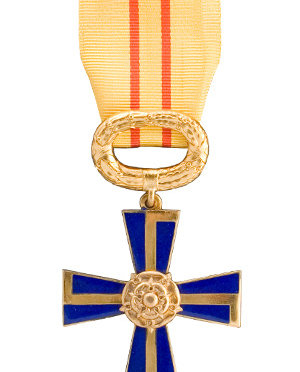
The Finnish artist Akseli Gallen-Kallela was commissioned to design the Order’s insignia with the Old-Scandinavian Fylfot, a cross with perpendicular extensions, usually at 90° or close angles, radiating in the same direction.

The awards given for civilian accomplishments are signaled by the color blue in the 3rd and 4th classes. In peacetime, by a yellow ribbon. Awards for military accomplishments in the 3rd and 4th classes have a dark gray color replacing the blue, and are awarded with a red ribbon in wartime.

The Royal Household Order for Ladies

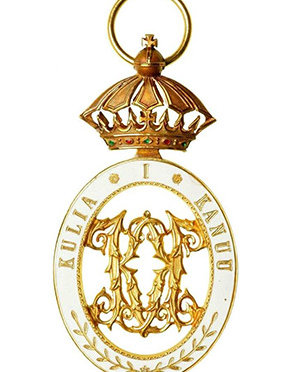
The Royal Household Order for Ladies is a Hawaiian order is awarded by Princess Owana Ka’ohelelani in honor of her mother.

The Royal Household Order for Ladies is a Hawaiian order is awarded by Princess Owana Ka’ohelelani in honor of her mother.

As senior heir to the ruling House of Keoua Nui, Princess Owana has placed the royal orders under her patronage. Because these orders were never nationalized, they are recast as House Orders and awarded at the pleasure of its head.

Princess Owana has established the House Order of Ka’ohelelani in honor of her mother.  It exists in seven classes and is given only to members of the Royal Family.[

The Royal Order of the Star of Oceania

The Royal Order of the Star of Oceania is a Hawaiian order instituted on 16th December 1886 for the recompense of distinguished services.

The Royal Order of the Star of Oceania was founded by King Kalakaua I on 16th December 1886 and awarded for distinguished services rendered in advancing his plan for a confederation of Polynesian nations, islands of the Pacific and Indian Oceans, and on contiguous Continents. In anticipation of Samoa joining the confederation, King Malietoa was awarded the Grand Cross.

The Royal Order of the Star of Oceania is highly awarded to the head of states/dynasties, also as awards of merit to loyal supporters of the royal family and those who provide excellent services in the field of cultural achievement and education throughout the Pacific.

The Order has five classes:

  • Grand Cross – Limited to 15 recipients at any one time
  • Grand Officer – Limited to 30
  • Commander – Limited to 45
  • Officer – Limited to 60
  • Companion (gold and silver medals)

It was re-established and amended by HRH Princess Owana Ka`ohelelani La`anui Salazar,  the “de jure” and “fons honorum” head of the royal house and Grandmaster of the order.

The Royal Order of the Star of Oceania Design

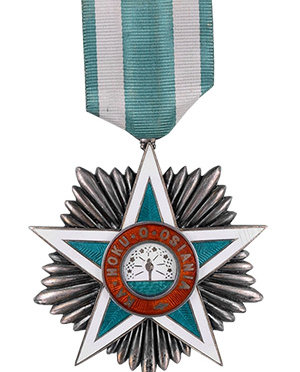
The Grand Cross Star is worn on the breast and the design speaks elements of the sea and sky. It is worn on a cordon or sash of pale green with a white stripe near each edge.

The Commander insignia is suspended from the bow of the cordon. KA HOKU O OSIANIA is inscribed around the shield, translating to ‘The Star of Oceania.’