The Imperial Order of Saint Prince Vladimir

The Order of Saint Vladimir is an Imperial Russian order established by Empress Catherine II in memory of the deeds of Saint Vladimir.

The Order of Saint Vladimir (or орден Святого Владимира in Russian) is an Imperial Russian order established between September and October 1782 by Empress Catherine II in memory of the deeds of Saint Vladimir, the Grand Prince and the Baptizer of the Kievan Rus’. The order was awarded in four degrees for continuous civil and military service.

According to Russian laws on nobility, people who were awarded the Order of Saint Vladimir had the rights of hereditary nobility until the Emperor’s decree of 1900 was issued. After this, only three first classes of the Order gave this right.

Grand Duchess Maria Vladimirovna, pretender to the Russian throne, and Head of the Russian Imperial House continued to award the Russian Imperial Order of Saint Vladimir, but this is disputed by historians and by some members of the Romanov Family Association.

In 1957, in commemoration of the 40th anniversary of the Patriarch of Moscow’s restoration in Russia, an Order of Saint Vladimir was created by the Russian Orthodox Church. The order is to be awarded to priests and nuns of the Orthodox church for their service to the Soviet Union and later Russia.

The Imperial Order of Saint Prince Vladimir Design

The insignia of the Order is a red enameled cross pattée with black enameled borders, and a black enameled central disc bearing a crowned red and ermine mantle with the monogram of Saint Vladimir. The insignia is worn on a sash by the first degree, on a necklet by the second and third degrees, and on a chest ribbon by the fourth degree.

A four-pointed star is superimposed upon a four-pointed gold star, with a golden cross pattée and the letters “CPKB” between the arms of the cross on a black enamel background at the center surrounded by the motto of the order “Benefit, Honour and Glory“.

The Imperial Order of Saint Alexander Nevsky

The Imperial Order of Saint Alexander Nevsky was an order of chivalry of the Russian Empire created in memory of Saint Alexander Nevsky.

The Imperial Order of Saint Alexander Nevsky was an order of chivalry of the Russian Empire first awarded by Empress Catherine I of Russia on 1 June 1725 and created in memory of the deeds of Saint Alexander Nevsky, patron Saint of Saint Petersburg to award to distinguished Russian citizens who had served their country with honor, mostly through political or military service.

The introduction of the Order was envisioned by Emperor Peter I of Russia (r. 1682–1721) for rewarding military bravery in battle, however he died before he could create it. It was first awarded on the occasion of the wedding of Grand Duchess Anna Petrovna of Russia and Charles Frederick, Duke of Holstein-Gottorp in 1725.

The Order of Saint Alexander Nevsky was abolished after the 1917 Russian Revolution, along with all other orders and titles of the Russian Empire. It was revived in 1942 by the Soviet Union as a purely military decoration and renamed it the more secular Order of Alexander Nevsky. The heads of the Russian Imperial House in exile have continued to award the Order of St. Alexander Nevsky.

The Imperial Order of Saint Alexander Nevsky Design

The star of the Order is an eight-point silver star, each arm composed of clusters of five individual smooth rays with braided borders. It measures 92 mm (w) x 92 mm (h) and weighs 80.6 grams. Its obverse features, in the center, the crowned Latin monogram of St. Alexander on a white enamel roundel, surrounded by the Order’s motto “ZA TRUDY I OTECHESTVO” (or “For Labours and Fatherland“) on a red enamel background with two green laurel branches crossed and crowned. The reverse bears a central pin assembly.

The badge of the order is a Maltese cross with red enamels and finely detailed Romanov imperial eagles in each quadrant. It measures 54.35 mm (w) x 60.31 mm (h) and weighs 31.6 grams. The obverse bears a central applique with an expertly hand-painted depiction of Alexander Nevsky mounted on a white horse, inside a stylized, hand-etched Gold ring. The reverse has central applique consisting of a white enameled medallion bearing a hand-painted monogram of Alexander Nevsky.

The ribbon is a red silk sash.

The Mobilization Cross 1912/13

The Mobilization Cross 1912/13 was awarded to military personnel who served with a mobilized unit in response to the Balkan crisis.

The Mobilization Cross 1912/13 was founded on 9 July 1913 by Emperor Franz Joseph I of Austria-Hungary and was awarded to all military personnel who served at least four weeks with a mobilized unit in response to the Balkan crisis in late September 1912.

Austro-Hungarian forces that had been mobilized as a precautionary measure during the Balkan Wars between an alliance of Bulgaria, Greece, Montenegro, and Serbia on the one hand and Ottoman Turkey on the other. Austria did not intervene in the wars but they led to Turkey being largely thrown out of Europe and a much-strengthened of Serbia, making Austria more nervous of her Slav neighbor and laying the ground for the outbreak of World War I.

The Mobilization Cross 1912/13 Design

The medal is a gilt Leopold cross, the ends of which are slightly curved inwards, with an eyelet and loop for ribbon suspension.

The obverse shows a circular central medallion bearing the dates ‘1912 1913’ in two lines. The reverse is plain.

The ribbon is yellow with two black stripes on the edges.

The Civilian Wartime Merit Cross

The War Cross for Civil Merits is a civil award of Austria-Hungary awarded in recognition of civilian war service during World War I.

The War Cross for Civil Merits (or Kriegskreuz für Zivilverdienste in German) is a civil award of Austria-Hungary established on 16 August 1915 by Emperor Franz Joseph I of Austria to recognized civilian war service during World War I.

The cross could also be awarded to military officers for their contributions to the war when they were not directly involved in combat operations – for example when they had shown outstanding zeal and willingness to make sacrifices, and have given special support to the Austro-Hungarian government.

The Civilian Wartime Merit Cross Design

The medal has the shape of a Cross pattée and measures 55 mm high and 55 mm across. The first and second Class crosses are gilded, the third class is silver, and the fourth class is bronze. The first through third classes had white enamel on the arms of the cross.

The obverse shows a laurel wreath surrounding the center medallion, passing under the horizontal arms of the cross, and in front of the vertical arms. The center medallion, also enameled white, bears the Emperor’s monogram FJI (Franz Joseph Imperator), surrounding the letters is the inscription “Merito Civili tempore belli MCMXV” (or “Civil merit in time of war 1915“).

The cross was worn as a breast cross directly on the coat or uniform.

The Merit Cross for Military Chaplains

The Merit Cross for Military Chaplains was awarded to military chaplains for outstanding acts in wartime and meritorious service in peacetime.

The Merit Cross for Military Chaplains was instituted on 23 November 1801 and awarded to military chaplains for outstanding acts in wartime and for meritorious service in peacetime.

The cross was awarded in two classes:

  • Gold
  • Silver

The Merit Cross for Military Chaplains Design

The medal is a Latin cross struck in gold or silver and decorated with enamels. It measures 51.75 mm (w) x 63.22 mm (h) and weighs 22.1 grams.

The obverse and reverse have a central blue enameled medallion with the inscription “PIIS MERITIS”.

The ribbon is a red and white striped triangle for wartime merits and white for peacetime merits. The suspension is a loop. From 13 December 1916, the award for brave and successful conduct was awarded with swords on the ribbon.

The New Zealand Memorial Cross

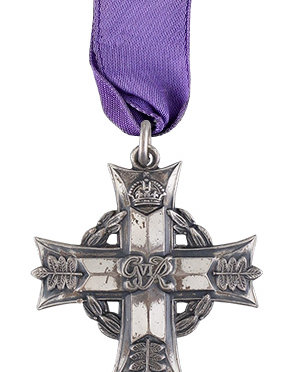
The New Zealand Memorial Cross is awarded to the next of kin of New Zealand service personnel killed on active service or who died of wounds.

The New Zealand Memorial Cross is a campaign medal awarded to the next of kin of New Zealand service personnel who, since September 1939, have been killed on active service or later died of their wounds. Up to two crosses could be awarded to the family of each individual, and was intended primarily for widows and mothers.

The cross was formally instituted, and full regulations published, in September 1947. Eligibility included both those serving with New Zealand forces and New Zealanders serving with other British Commonwealth forces, including the merchant navy.

In September 1960, further regulations were published extending eligibility to conflicts since the Second World War. Awards have since been made relating to service in Korea, Malaya, Vietnam, East Timor and Afghanistan. In September 1995 relatives of those killed during peacekeeping operations became eligible.

The New Zealand Memorial Cross Design

The medal is a cross patoncé struck in dull silver and measures 32 millimeters (1.3 inches) in diameter.

The obverse shows a laurel wreath between the arms of the cross. At the top of the vertical arm is a St. Edward’s Crown, with a fern leaf at the end of each of the other arms. At the center is the reigning monarch’s Royal Cypher.
The reverse is plain, with most crosses engraved with the name, rank and service number of the person commemorated.

The ribbon measures 12 millimeters wide and is royal purple.

The Canadian Memorial Cross

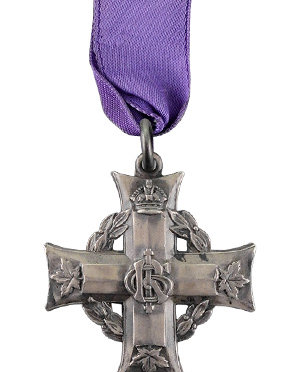
The Canadian Memorial Cross was first instituted in 1919 and awarded to mothers and widows of Canadian soldiers who died on active duty.

The Canadian Memorial Cross was first instituted by Order-in-Council 2374, dated December 1, 1919, and awarded to mothers and widows of Canadian soldiers who died on active duty or whose death was consequently attributed to such duty.

This gift of Canada was issued as a memento of personal loss and sacrifice on the part of widows and mothers of Canadian sailors, soldiers and airmen who died for their country during the war.

The crosses could be worn by the recipients anytime and were engraved with the name, rank and service number of the son or husband.

The Canadian Memorial Cross Design

The medal is in the form of a cross pattee, struck in silver and measures 32 millimeters in diameter.

The obverse shows, at the end of the upright, a crown. At the foot and the end of either arm is a maple leaf and in the center, within a wreath of laurel, is the royal cipher of the reigning monarch: GRI for King George the Fifth, GVIR for King George the Sixth, or EIIR for Elizabeth the Second. The reverse of the Cross is engraved with the name and service number of the individual commemorated.

The medal is suspended by a bar brooch, although prior to 1945 it was suspended from a light purple ribbon 11 mm wide.

The Austrian Decoration for Services to the Red Cross

The Decoration for Services to the Red Cross was an award instituted in 1914 to mark the 50th anniversary of the Geneva Convention.

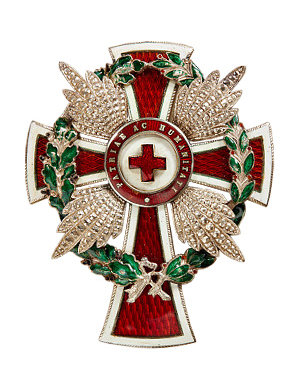
The Decoration for Services to the Red Cross (or Ehrenzeichen für Verdienste um das Rote Kreuz in German) was an Austro-Hungarian award instituted on 17 August 1914 by Emperor Franz Josef I to mark the 50th anniversary of the Geneva Convention.

The award was intended to honor individuals who had worked in the voluntary emergency services of the Red Cross, either in peacetime or in war. The Austrian Red Cross was founded in 1864 and the merit awards were created to mark the 50th anniversary.

The order consists of four classes, as well as an associated medal in two classes:

  • 1st: Star
  • 2nd: Merit Cross, 1st class
  • 3rd: Officer’s Cross
  • 4th: Merit Cross, 2nd class
  • Silver Medal
  • Bronze Medal

Awards for military services were augmented with a war decoration for the ceremony.

The Austrian Decoration for Services to the Red Cross Design

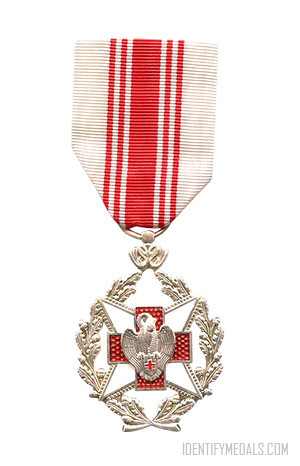
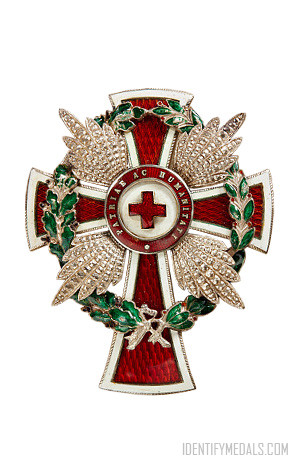
The medal is a silver-edged white enamel cross with silver-edged red enamel inset panels.

The obverse has a central circular white enamel medallion bearing a red enamel Greek (Geneva) encircled by a red enamel ring bearing the inscription in gilt letters ‘PATRIAE AC HUMANITATI’ (“Fatherland and Humanity“), and a green and red enamel wreath imposed indicating a wartime award.

The reverse bears a central circular white enamel medallion bearing the dates in silver ‘1864’ and ‘1914’.

The suspension ring is usually hallmarked and with the maker’s mark. The ribbon is white with red diagonal stripes.

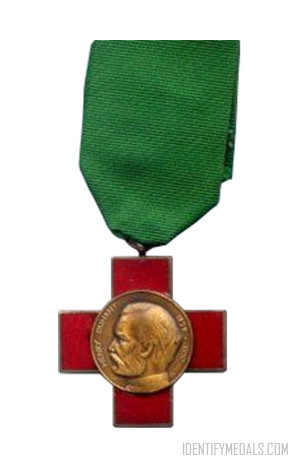
Find Red Cross Medals Online

More Red Cross Medals

The Military Merit Decoration (Austria)

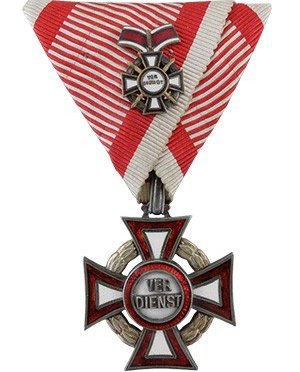
The Austrian Military Merit Decoration (or Militärverdienstzeichen in German) is an Austrian military decoration established on 13 November 1989 to honor the Military of Austria.

The decorations are awarded by the Federal President at the request of the Federal Minister of Defense and after a decision by the Ministerial Council. Ordinance of the Federal Ministry of Defense of November 13, 1989, Federal Law Gazette 551.

Holders of the Military Merit Decoration wear the badge on the left side of the chest.

The Decoration for Services to the Liberation of Austria Design

The badge is a silver-gilt breast star that is worn on the left chest, measuring 30.88 mm (w) x 31.40 mm (h) and weighing 14.3 grams. The cross is 60 mm wide and high and in white enamel, with a red border. Between the arms of the cross are gold crossed swords.

The obverse shows a central white enameled medallion with the Austrian eagle and the inscription “Verdienst” (“Merit” in German). The reverse is decorated with white enamels and has no inscription.

The suspension is a loop from which the ribbon (and sometimes a miniature decoration) is attached. The ribbon is white and red with diagonal lines.

The Austrian Decoration for Science and Art

The Austrian Decoration for Science and Art (or Österreichisches Ehrenzeichen für Wissenschaft und Kunst in German) is a state decoration of the Republic of Austria established in 1955 and part of its national honors system.

The award was established by the National Council as an honour for scientific or artistic achievements by Federal Law of May 1955. At the same time, the National Council also established the “Austrian Cross of Honour for Science and Art”, which is awarded as “Cross of Honour, First Class” (German: Ehrenkreuz 1. Klasse) and “Cross of Honour” (German: Ehrenkreuz). While not technically counted as lower classes of the Decoration for Science and Art, these crosses are nevertheless affiliated with it.

Divisions:

  • Decoration for Science and Art. Limited to a maximum of 72 at any one time (36 recipients for science and 36 for arts). In each of these two groups, there are 18 Austrian citizens and 18 foreign nationals.
  • Cross of Honour for Science and Art, First Class. There are no limits on the number of recipients.
  • Cross of Honour for Science and Art. There are no limits on the number of recipients.

Forfeiture of this honor became possible with Federal Law Gazette I No 128/2001. It allows the government to strip recipients of their honors if deemed unworthy. The best-known example of such a forfeiture is of the Nazi physician Heinrich Gross.

The Austrian Decoration for Science and Art Design

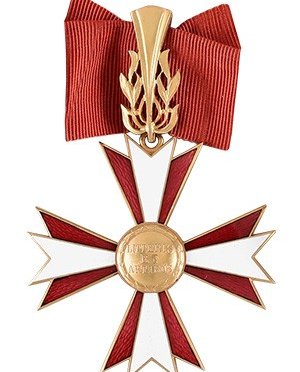
The award consists of a neck badge constructed of gilded bronze with multi-colored enamels, suspended on a loop. It measures 58.09 mm (w) x 59.33 mm (h) and weighs 31.1 grams.

The breast badge is constructed of gilded bronze with multi-colored enamels, consisting of a Maltese Cross.

Its obverse has red enameled arms, in turn, overlaid by a narrow Maltese Cross with white enameled arms, with a central gilt medallion bearing a raised inscription of “LITTERIS ET ARTIBUS” (“LETTERS AND ARTS”), inside f a laurel wreath. The reverse has a central raised medallion bearing the maker’s mark.

The ribbon is red.