The Decoration of Honor for Services to the Republic of Austria

The Decoration of Honour for Services to the Republic of Austria (or Ehrenzeichen für Verdienste um die Republik Österreich in German) is a national honor established by the National Council in 1952 and awarded by the Republic of Austria.

The decoration is conferred by the Republic of Austria to honor people (from Austria and abroad) who have rendered meritorious services to the country.

Recipients are selected by the government and made by the President, who automatically receives the Grand Star of the Decoration for Services to the Republic of Austria by being elected to the office and holds this honor for life.

The decoration is awarded in 15 grades and is Austria’s highest national honor. The grades are:

  1. AUT Honour for Services to the Republic of Austria - 1st Class BAR.png Grand Star 
  2. AUT Honour for Services to the Republic of Austria - 2nd Class BAR.png Grand Decoration of Honour in Gold with Sash 
  3. AUT Honour for Services to the Republic of Austria - 3rd Class BAR.png Grand Decoration of Honour in Silver with Sash 
  4. AUT Honour for Services to the Republic of Austria - 4th Class BAR.png Grand Decoration of Honour in Gold with Star
  5. AUT Honour for Services to the Republic of Austria - 5th Class BAR.png Grand Decoration of Honour in Silver with Star
  6. AUT Honour for Services to the Republic of Austria - 6th Class BAR.png Grand Decoration of Honour in Gold 
  7. AUT Honour for Services to the Republic of Austria - 7th Class BAR.png Grand Decoration of Honour in Silver 
  8. AUT Honour for Services to the Republic of Austria - 8th Class BAR.png Grand Decoration of Honour 
  9. AUT Honour for Services to the Republic of Austria - 9th Class BAR.png Decoration of Honour in Gold 
  10. AUT Honour for Services to the Republic of Austria - 10th Class BAR.png Decoration of Honour in Silver 
  11. AUT Honour for Services to the Republic of Austria - 11th Class BAR.png Decoration of Merit in Gold 
  12. AUT Honour for Services to the Republic of Austria - 12th Class BAR.png Decoration of Merit in Silver
  13. AUT Honour for Services to the Republic of Austria - Gold Medal BAR.png AUT Honour for Services to the Republic of Austria - Life Saving Medal BAR.png Gold Medal 
  14. AUT Honour for Services to the Republic of Austria - Silver Medal BAR.png Silver Medal
  15. AUT Honour for Services to the Republic of Austria - Bronze Medal BAR.png Bronze Medal (no longer awarded)

The Decoration of Honor for Services to the Republic of Austria Design

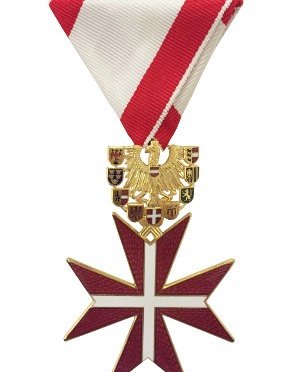
The badge of the Decoration is a Maltese Cross constructed of silvered bronze with multi-colored enamels. It measures 50.02 mm (w) x 50.25 (h).

The obverse has red and white enameled arms, and the reverse is plain. The six o’clock arm has an integral loop connecting to a suspension apparatus in the form of a silvered Republic-style Austrian national eagle surrounded by an enameled shield of the Austrian states, in turn with a suspension ring connecting to a period original neck ribbon.

The ribbon is red and white.

The Imperial Order of Elizabeth (Austria)

The Imperial Austrian Order of Elizabeth was an order created for women in 1898 by Francis Joseph, Emperor of Austria and King of Hungary.

The Imperial Austrian Order of Elizabeth (or Kaiserlich österreichischer Elizabeth-Orden in German) was an order created for women in 1898 by Francis Joseph, Emperor of Austria and King of Hungary.

The order was the namesake of Saint Elisabeth of Hungary, but it was created to honor and memorialize Franz Joseph’s late wife, Empress-Queen Elisabeth. She spent her life giving alms to the poor and sick. After her husband’s death, she gave away the vast majority of his estate to build hospitals and to aid in the relief of her starving subjects and was canonized by Pope Gregory IX in 1235. She is considered the patron saint of bakers, beggars, and charities.

The insignia of the order was to be returned to the state upon the death of the member, or upon the advancement from a lower degree to a higher degree.

The order was divided into three classes:

  • Grand Cross.
  • First Class.
  • Second class.

There were 81 awards of the Grand Cross, 332 awards of the I Degree, 500 awards of the II Degree, and 208 awards of the Elizabeth Medal for merit, between 1898 and 1918 when the Order was disbanded with the collapse of the monarchy.

An Elizabeth Medal for civil merit also existed.

The Order only existed until the end of the monarchy in 1918.

The Order of Elizabeth Design

The order’s badge is a silver Latin cross consisting of red and white enamels, with roses between the arms of the cross. The obverse bears a central white enameled medallion with a rightward facing bust of Elisabeth in gold. The reverse has a central white enameled medallion with a golden royal cipher of Elisabeth and fine hand-engraved detailing.

The ribbon is white and pink and measures 48.57 mm side by 52.40 mm high.

The Order of the Starry Cross

The Order of the Starry Cross (Sternkreuz-Orden) is an imperial Austrian dynastic order founded in 1668 and awarded to Catholic noble ladies.

The Order of the Starry Cross (or Sternkreuz-Orden in German) is an imperial Austrian dynastic order founded in 1668 and awarded to Catholic noble ladies. Only high-born ladies could be invested with the Order, including princesses, countesses, and other high nobility. Once invested, members were to “devote themselves to the service and worship of the Holy Cross, and to lead a virtuous life in the exercise of religion and works of charity.”

The Order was founded in 1668 by Eleonora Gonzaga of Mantua, dowager empress of the Holy Roman Empire and confirmed by Pope Clement IX on 28 June 1668, who placed it under the spiritual management of the Prince-Bishop of Vienna.

According to legend, the Habsburg dynasty owned a piece of the True Cross on which Jesus was crucified. In the aftermath of a fire at the Hofburg on 2 February 1668 the relic was discovered in near-perfect condition. The dowager empress founded the Order in celebration that the relic had survived the fire, believing it to be a true miracle.

The order still exists under the House of Habsburg, though the Austrian Empire no longer exists. It was conceived with only one class.

The Order of the Starry Cross Design

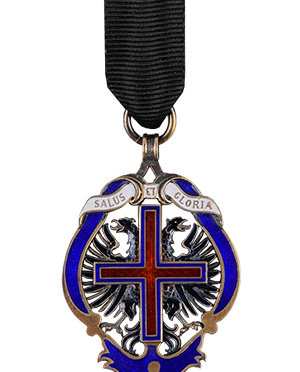
Members of the Order wore en insignia consisting of an oval medallion, with a broad blue enameled border, inclosing a black enameled Eagle with two heads and claws. On it lies a Gold Cross, enameled green, and bordered with brown wood. Over this, on an entwined wreath in black letters, on a white ground, is the motto of the Order, “Salue et Gloria” (“Hail and Glory“).

The insignia was worn, pendent to a strip of black band, on the left breast.

The Order of Franz Joseph

The Imperial Austrian Order of Franz Joseph was founded by Emperor Franz Joseph I on the 1st anniversary of his accession to the throne.

The Imperial Austrian Order of Franz Joseph (or Kaiserlich-Österreichischer Franz-Joseph-Orden in German) was an Order founded by Emperor Franz Joseph I of Austria on December 2, 1849, on the first anniversary of his accession to the imperial throne.

The order was originally awarded in three classes: Grand Cross, Commander’s Cross, and Knight’s Cross. In 1869, the class of Commander with Star was added, which ranked immediately below the Grand Cross. On February 1, 1901, the Officer’s Cross, which ranked between Commander and Knight, was introduced.

The order ceased to exist as a governmental award with the dissolution of the Austro-Hungarian Empire in 1918 and was not re-established with the foundation of the Republic of Austria. However, it remains active as a dynastic order of the House of Habsburg.

The Order of Franz Joseph Design

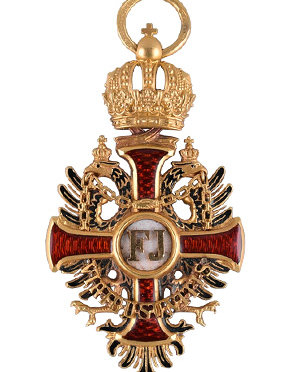
Knights wore the decoration suspended from a triangular ribbon on the left breast. Officers wore it on the left breast without a ribbon. Commanders wore the decoration at the neck, as did Commander with Star, who also wore a breast star. The Grand Cross was worn suspended from the shoulder and also came with a breast star. The ribbon of all classes of the order was plain red.

In common with the other Austro-Hungarian awards of the period, the Franz Joseph Order was further distinguished with the addition of the War decoration and Swords which could be awarded for military merit. However, if soldiers were honored, it was usually for distinguished service as opposed to gallantry in the face of the enemy.

The Austrian Imperial Order of Leopold

The Austrian Imperial Order of Leopold (Österreichisch-kaiserlicher Leopold-Orden) was founded on 8 January 1808 by Franz I of Austria.

The Austrian Imperial Order of Leopold (or Österreichisch-kaiserlicher Leopold-Orden in German) was founded on 8 January 1808 by Franz I of Austria.

The order’s statutes stipulated only three grades: Grand Cross, Commander and Knight. During the war, crossed swords were instituted to reward bravery in the face of the enemy. An Imperial Decree of 1 February 1901 ordered that then onwards, there were four ranks:

  • Grand Cross.
  • First Class.
  • Commander.
  • Knight.

Until 18 July 1884, the award of the order also entitled the recipient, if he was not already of that standing, to be raised to the following appointments and/or ranks of the nobility:

  • Grand Cordon: Privy Councillor.
  • Commander: Baron.
  • Knight: Ritter.

After 1918, the Order was no longer awarded.

The Austrian Imperial Order of Leopold Design

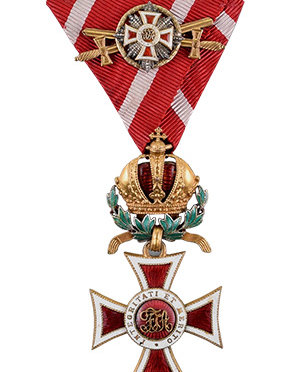
The badge of the Order consists of a red enameled gold cross, with white enamel edging. The obverse displays the initials “FIA” in gold on a red enamel background. The Cross is surmounted by a golden Emperors’ Crown.

The ribbon was red with two narrow white side-stripes. The Grand Cross could also be awarded with diamonds.

Both the Grand Cross and the First Class Members of the Order wore their orders in the form of a sash with the Order attached to the Bow and respectively an eight-pointed and a four-pointed breast Star on formal occasions. The Commanders’ Cross was worn to the neck, suspended from a 52 mm wide ribbon; the Knight wore his Order on a triangular ribbon on the left breast.

The Mottoes of the Order were “INTEGRITATI ET MERITO” and “OPES REGUM CORDA SUBDITORUM“.

The Military Order of Maria Theresa

The Military Order of Maria Theresa was the highest military honor of the Habsburg Monarchy, Austrian Empire and Austro-Hungarian Empire.

The Military Order of Maria Theresa (or “Militär-Maria-Theresien-Orden” in German and “Katonai Mária Terézia-rend” in Hungarian) was the highest military honor of the Habsburg Monarchy, Austrian Empire and Austro-Hungarian Empire. It is considered to be the highest honor for a soldier in the Austrian armed services.

The order was founded on 18 June 1757, the day of the Battle of Kolin, by Empress Maria Theresa, and awarded for especially meritorious and valorous acts by commissioned officers, especially the act of defeating an enemy, and thus “serving” their monarch.

Because the Order was given for “successful military acts of essential impact to a campaign that was undertaken on [the officer’s] own initiative and might have been omitted by an honorable officer without reproach“, this gave rise to a popular myth that it was awarded for (successfully) acting against an explicit order.

The Military Order of Maria Theresa Classes

The Order of Theresa consisted of several classes, each representing a different level of distinction and honor. Originally, the order had two classes: Knight’s Cross and Grand Cross.

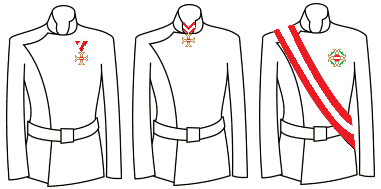
On 15 October 1765, Emperor Joseph II added a Commander’s Cross, and a breast star to be worn by holders of the Grand Cross. The three classes are, then:

The three classes of the Order of Maria Theresa and their insignia.
  1. Knight’s Cross (Ritterkreuz): The lowest class was awarded to officers and soldiers who had displayed acts of bravery, courage, or exceptional service on the battlefield. 

  2. Commander’s Cross (Komturkreuz): The next higher class of the order was awarded to officers who had demonstrated exceptional leadership, strategic skill, or distinguished service in combat. 

  3. Grand Cross (Großkreuz): The highest and most prestigious class of the Military Order of Maria Theresa was reserved for generals, field marshals, and other high-ranking military leaders who had achieved extraordinary accomplishments or held positions of great responsibility. 

The Military Order of Maria Theresa Design

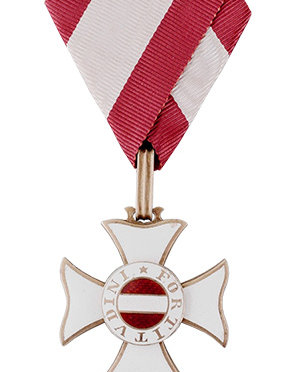
The badge of the order is a gilt, white-enameled cross. The central disc bears the coat-of-arms or national flag of Austria, surrounded by a white ring bearing the motto “Fortitudini” (“For Courage“).

The star of the order is a silver faceted cross of the same shape as the badge, with a wreath of green-enameled oak leaves between the arms of the cross. The central disc is the same as the one on the badge.

The ribbon is red-white-red, inspired by the national flag of Austria.

By class:

  • Recipients of the Knight’s Cross were entitled to wear a medal consisting of a Maltese cross with a central medallion depicting the profile of Empress Maria Theresa surrounded by a laurel wreath.
  • Recipients of the Commander’s Cross wore a larger version of the medal, often with additional embellishments such as oak leaves or swords to denote further acts of valor.
  • Recipients of the Grand Cross wore a significantly larger medal, often adorned with additional decorations and worn around the neck on a ribbon of crimson.
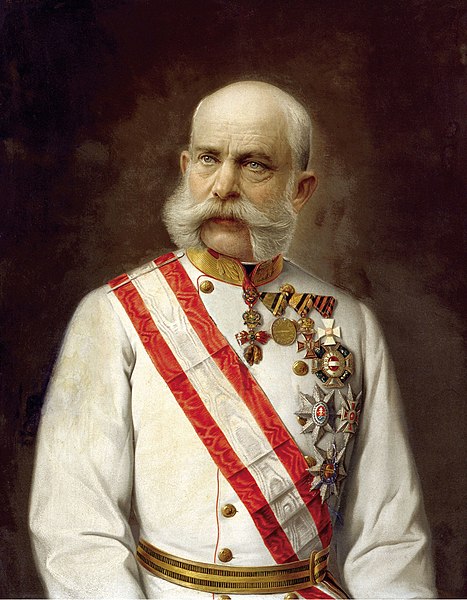
Franz Josef I wearing the Grand Cross sash and star
Franz Josef I wearing the Grand Cross sash and star.

The Portrait Medal of Cosimo de’ Medici

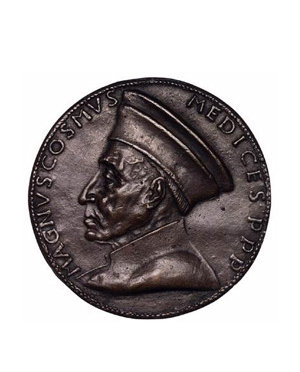
The Portrait Medal of Cosimo de’ Medici celebrates Cosimo I de’Medici and is the earliest example of item created by the Florentine school.

The Portrait Medal of Cosimo de’ Medici celebrates Cosimo I de’Medici (1389-1464) and is the earliest example of a product created by the Florentine school.

Cosimo I was the head of the de’Medici family, a family of bankers who were the de facto rulers of Florence during most of the Italian Renaissance. He was granted the title Pater Patriae by the Florentine Signoria after his death on 1 August 1464.

The idea of a ʽportraitʼ on coins, as well as the title pater patriae, was inspired by the rediscovery of Roman coins in the Renaissance (medieval coinage did not have portraits). Ancient coins were the subject of interest and intense study among scholars from the early fifteenth century onwards, and admired by humanists for their large size, their high relief, and the use of bronze.

The Portrait Medal of Cosimo de' Medici Design

The medal was not produced after 1469, and the effigy on the obverse was copied from the manuscript by Francesco del Chierico (Florence, Biblioteca Medicea Laurenziana, Ms Plut. 84, I, c. 3), and on behalf of Piero di Lorenzo de’Medici. Although many different artists have been proposed for the medal’s creator, for example Niccolò di Forzore Spinelli, Donatello, Michelozzo, Cristoforo di Geremia, and Bertoldo di Giovanni, the question concerning the author’s identity remains a mystery.

The obverse of the medal bears the bust of Cosimo I in profile, facing left. He’s wearing a flat beret (proper for persons of high rank) and a buttoned cloak. A circular legend in Roman capitals reads: “MAGNVS COSMVS MEDICES P(RIMVS) P(ATER) P(ATRIAE).”

The reverse shows a female figure allegoric of Florence (inspired by Graeco-Roman coins depicting Concordia), seated on a throne. The exergue reads “FLORENTIA“. She’s wearing a peplos and is veiled, likely as a sign of mourning for Cosimo. She holds an olive branch in her left hand, and her right is stretching forward and grasping a globe – which might recall the Medici family emblem. The circular legend of the reverse reads “PAX LIBERTASQVE PVBLICA“.

The Order for Civil and Military Merit (Tuscany)

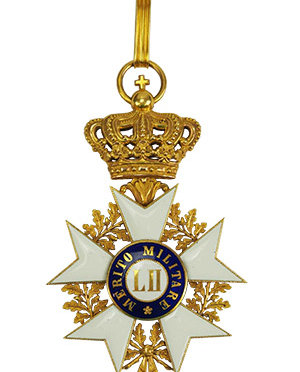
The Order for Civil and Military Merit is a military order of the Grand Duchy of Tuscany. The medal is struck in gold.

The Order for Civil and Military Merit is a military order of the Grand Duchy of Tuscany. 

The Grand Duchy of Tuscany was a central Italian monarchy that existed from 1569 to 1859, succeeding the Duchy of Florence. In the 19th century, it had a population of about 1,815,000 inhabitants.

The order was established to recognize significant contributions in both civil and military fields, reflecting the Grand Duchy’s rich history and commitment to honoring exemplary service and achievements within its territories.

The Long Service Decoration Design

The medal is struck in gold and reads “MERITO MILITARE” (“Military Merit“). The initials in the obverse are those of Leopoldo II. The reverse is plain.

The Order of Saint Stephen (Tuscany)

The Order of Saint Stephen is a Roman Catholic Tuscan dynastic military order created by Cosimo I de’ Medici and approved by Pope Pius IV.

The Order of Saint Stephen (or “Sacro Militare Ordine di Santo Stefano Papa e Martire”, “Holy Military Order of St. Stephen Pope and Martyr“) is a Roman Catholic Tuscan dynastic military order founded in 1561. The order is dedicated to the martyred Pope Stephen I, whose feast day is 2 August – the date that coincides with Cosimo’s victories at the Battle of Montemurlo and the Battle of Marciano (Scannagallo).

The order was created by Cosimo I de’ Medici, the first Grand Duke of Tuscany with the approbation of Pope Pius IV on 1 October 1561. The order was permanently abolished in 1859 by the annexation of Tuscany to the Kingdom of Sardinia, with the last member of the Medici dynasty to be a leader being Gian Gastone de Medici in 1737. 

The objective of the order was to fight the Ottoman Turks and the pirates that sailed the Mediterranean Sea in the 16th century. Cosimo needed a symbolic fight to unite the nobility of the different cities that conformed his new grand duchy, as well as to demonstrate his support of the Roman Catholic Church. It was present at the siege of Malta (1565), the Battle of Lepanto (1571) and the capture in 1607 of Annaba in Algeria.

Initially, the Order was financed by the Grand Duke. Later and thanks to prudent purchases of agricultural estates, it increased its heritage by becoming one of the major wheat producers and merchants of Tuscany. Before being enrolled in the Order, three years of novitiate had to be followed, during which notions of geometry, cosmography, arithmetic, drawing, cartography, history and practice of firearms were taught and tested.

Today, Archduke Sigismund, Grand Duke of Tuscany awards an Order of Saint Stephen which he claims to be a continuation of the order founded by Grand Duke Cosimo I. Some 80 individuals are currently associated with this order.

The Order of Saint Stephen Design

The badge of the order is shaped like a star, struck in silver with a thin sheet of gold (not gold plated), and decorated with red enamels. It’s surmounted by a golden crown.

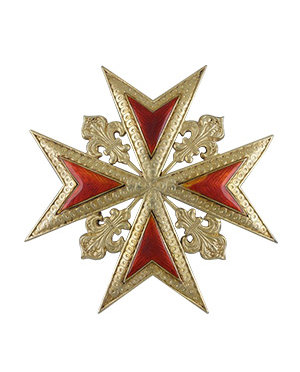
The Second Class Star (pictured above) measures 63mm by 64mm.

The ribbon is red.

The Order of Saint Joseph (Tuscany)

The Order of Saint Joseph was instituted in 1807 by Ferdinand III, Grand Duke of Tuscany and awarded for services towards culture.

The Order of Saint Joseph was instituted in 1807 by Ferdinand III, Grand Duke of Tuscany (during his reign as Grand Duke of Würzburg), and transformed in 1817 into a Tuscan Roman Catholic Dynastic Order. It is awarded for services towards Tuscan culture and civilization and to the Grand Ducal House as a whole.

The order was originally divided into civil and military categories, although these are now defunct. It is now divided into three levels:

  • Knights Grand Cross (30 members),
  • Commander (60 members), and
  • Knights (150 members).

Sovereigns, Heads of State, and Princes of the Grand Ducal House and other Royal Houses, Cardinals of the Holy Roman Church and Tuscan Metropolitan Archbishops were excluded form the count. All members had to be Catholics and the number of women could not exceed fifty (excluding Princesses of the Grand Ducal and other Royal Houses, wives of Heads of State and Dames of the Order of Saint Stephen).

The Order of Saint Joseph Design

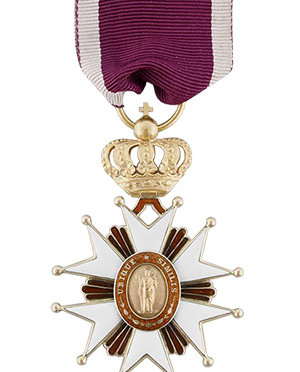
The medal is struck in gold with white enamels. It measures 38.02 mm (w) x 57.01 mm (h – inclusive of ring suspension) and weighs 14.7 g. The shape of the medal is a six-armed cross with ball finials and exhibits three delicate red-enameled gold rays between in each quadrant. The cross is surmounted by a classic royal crown in gold.

The obverse depicts, in gold, a figure of St. Joseph surrounded by the Latin inscription “Ubique Similitus” (or “Everywhere the Same”) with a red-enameled border. The reverse, also in gold, bears the inscription “S J F 1807”(the date of institution).

The ribbon is red with white edges.