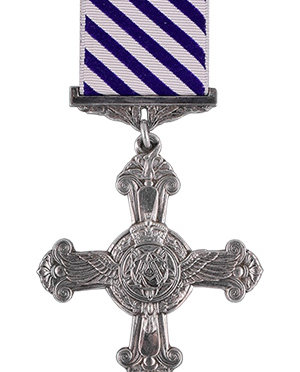
The Distinguished Flying Cross and Medal (UK)

The Distinguished Flying Cross (DFC) was established in June 1918 for officers and warrant officers of the RAF for acts of valor and courage.

The Distinguished Flying Cross (or DFC) was established in June 1918, shortly after the formation of the Royal Air Force (RAF), for officers and warrant officers of the RAF for “an act or acts of valor, courage, or devotion to duty whilst flying in active operations against the enemy“.

The DFC now serves as the third-level award for all ranks of the British Armed Forces for exemplary gallantry in active operations against the enemy in the air, not to the standard required to receive the Victoria Cross or the Conspicuous Gallantry Cross. All awards of the DFC are announced in the London Gazette.

In March 1941 eligibility for the DFC was extended to Naval Officers of the Fleet Air Arm, and in November 1942 to Army officers, including Royal Artillery officers serving on attachment to the RAF as pilots-cum-artillery observers. Posthumous awards were permitted from 1979. The DFC had also been awarded by Commonwealth countries but by the 1990s most had established their own honors systems and no longer recommended British honors.

Recipients are entitled to use the post-nominal letters “DFC”.

The Distinguished Flying Cross and Medal Design

The Cross

The decoration is a cross flory, 2.125 inches (54.0 mm) wide and was designed by Edward Carter Preston. The horizontal and bottom bars are terminated with bumps, the upper bar with a rose.

Its obverse features airplane propellers, superimposed on the vertical arms of the cross, and wings on the horizontal arms. In the center is a laurel wreath around the RAF monogram, surmounted by a heraldic Imperial Crown. The reverse is plain, except for a central roundel bearing the reigning monarch’s cipher and the date ‘1918’. 

The ribbon is 1.25-inch (32 mm) wide. Originally white with deep purple broad horizontal stripes, it was changed in 1919 to the current white with purple broad diagonal stripes. The ribbon bar is silver, with the Royal Air Force eagle in its center. The suspender is straight and decorated with laurel wreaths.

Originally unnamed, the WW2 crosses usually have the year of issue engraved on the reverse of the lower limb.

The Medal

The Distinguished Flying Medal is an oval struck in silver and measures 42 mm tall and 34 mm wide.

The obverse features the sovereign’s effigy, while the reverse shows Athena Nike seated on an aeroplane, with a hawk rising from her hand. The medal was originally undated, but the date 1918 was added to the reverse with the advent of George VI obverse.

The medal is suspended by a pair of wings from a straight bar. The ribbon was originally purple and white with horizontal stripes, but since July 1919 it changed to thirteen diagonal stripes alternating white and purple.

Find This Medal

Right Now on eBay 
Clicking a link to eBay may result in a referral commission being paid if a purchase is made.
Loading...

The New Zealand Cross

The New Zealand Cross is a Great Britain decoration introduced on 10th March 1869 by an Order in Council, Wellington, during the New Zealand Wars, which were fought between natives of New Zealand, the Māori, and forces raised by European settlers known as Pākehā assisted by British troops. The decoration was conferred for bravery.

Because of the mistaken impression that colonial troops were not eligible for the Victoria Cross unless under command of British troops, the Governor of New Zealand, Sir George Bowen, instituted the New Zealand Cross as the highest New Zealand award. Queen Victoria eventually ratified his action.

Only 23 New Zealand Crosses were awarded, the last being authorized in 1910.

The New Zealand Cross Design

The decoration has the form of a silver (with gold apliqué) cross pattée with a six-pointed gold star on each limb. It measures 52 mm high and 38 mm wide.

The obverse bears the words ‘NEW ZEALAND’ in the center, gilded in gold and encircled by a laurel wreath. The reverse has two concentric circles with the name of the recipient engraved between the circles, and the date of the action engraved within the inner circle. For the first 20 medals cast in 1871, the reverse of the suspender clasp contains the cartouche of the goldsmith Messrs Phillips Brothers and Son of Cockspur Street, London. This cartouche was omitted from a further five medals cast in 1886.

The ribbon is crimson and passes through a silver seriffed “V” suspender clasp with small gold laurel leaves. The cross is surmounted by a Tudor Crown.

The Royal Victorian Order

The Royal Victorian Order is a dynastic order of knighthood established in 1896 by Queen Victoria for distinguished service to the monarch.

The Royal Victorian Order is a dynastic order of knighthood established in 1896 by Queen Victoria to recognize distinguished personal service to the monarch of the Commonwealth realms, members of the monarch’s family, or to any viceroy or senior representative of the monarch. There is no limit on the number of individuals honored at any grade, and admission remains at the sole discretion of the monarch.

The reigning monarch is at the apex of the Royal Victorian Order as its Sovereign, followed by the Grand Master. The Order has five grades and one medal with three levels representing different levels of service. All those honored may use the prescribed styles of the order. The order’s motto is Victoria, and its official day is 20 June and its chapel is the Savoy Chapel in London.

The grades are as follows:

  • Knight / Dame Grand Cross.
  • Knight / Dame Commander.
  • Commander.
  • Lieutenant.
  • Member.

The Royal Victorian Order Design

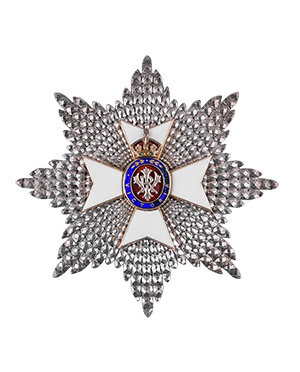
The badge of the Order is a Maltese cross with a central medallion depicting on a red background the Royal Cypher of Queen Victoria, surrounded by a blue ring bearing the motto of the order—VICTORIA—and surmounted by a Tudor crown and worn on a sash depending on the grade. For Knights and Dames Grand Cross, Commanders, and Lieutenants, the Maltese cross is rendered in white enamel with gold edging, while that for Knights and Dames Commander and Members is in silver. The size of the badge also varies by rank, that for the higher classes being larger.

The medal bears the effigy and name of the reigning sovereign at the time of its awarding, as well as the phrase DEI • GRATIA • REGINA (or REX) • F.D. (by the grace of God, Queen (or King), Defender of the Faith), and on the reverse is the Royal Cypher upon an ornamental shield within a laurel wreath.

The ribbon is blue with red-white-red stripe edging, and at formal events, or collar days, Knights and Dames Grand Cross wear the Royal Victorian Order’s livery collar, consisting of an alternating string of octagonal gold pieces.

The Order of St Michael and St George

The Order of Saint Michael and Saint George is an order of chivalry founded in 1818 in honor of military saints St. Michael and St. George.

The Most Distinguished Order of Saint Michael and Saint George is a British order of chivalry founded on 28 April 1818 in honor of two military saints, St. Michael the Archangel, and St. George, patron saint of England. The Order was established by George, Prince Regent (later King George IV) as acting as regent for his father, King George III.

The Order was originally awarded to those holding commands or high position in the Mediterranean territories acquired in the Napoleonic Wars. It was later extended to holders of similar office or position in other territories of the British Empire. Today, it’s awarded (or rather, people are appointed to it) to men and women who hold high office or who render extraordinary or important non-military service in a foreign country and can also be conferred for important or loyal service in relation to foreign and Commonwealth affairs.

The Order includes three classes:

  • Knight Grand Cross or Dame Grand Cross (GCMG)
  • Knight Commander (KCMG) or Dame Commander (DCMG)
  • Companion (CMG)

The Order of St Michael and St George Design

The mantle is made of Saxon blue satin lined with crimson silk and bound with two large tassels. It’s worn only by Knights and Dames Grand Cross. The collar is made of gold, with alternating crowned lions, Maltese Crosses, and the ciphers “SM” and “SG”. In the center are two winged lions, each holding a book and seven arrows. The collar is worn only by Knights and Dames Grand Cross.

The star is worn pinned to the left breast only by Knights and Dames Grand Cross and Knights and Dames Commanders. The Knight and Dame Grand Cross’ star includes seven-armed, silver-rayed ‘Maltese Asterisk’, with a gold ray in between each pair of arms. The Knight and Dame Commander’s star is a slightly smaller eight-pointed silver figure formed by two Maltese Crosses and no gold rays. In all cases, the star bears a red cross of St George with a dark blue ring bearing the motto of the Order and a representation of St Michael trampling on Satan.

The badge is used by all members of the Order and is suspended on a blue-crimson-blue ribbon. It’s a seven-armed, white-enameled ‘Maltese Asterisk’. Its obverse shows St Michael trampling on Satan, while its reverse shows St George on horseback killing a dragon, both within a dark blue ring bearing the motto of the Order.

The Royal Guelphic Order

The Royal Guelphic Order (or the Hanoverian Guelphic Order), is a Hanoverian order of chivalry instituted on 28 April 1815 by King George IV. 

The Royal Guelphic Order (or the Hanoverian Guelphic Order), is a Hanoverian order of chivalry instituted on 28 April 1815 by King George IV. It takes its name from the House of Guelph, of which the Hanoverians were a branch.

Because Hanover and the United Kingdom shared a monarch until 1837, the order was frequently bestowed upon British subjects, usually to officers in the British Navy and Army. However, it was still classed as a foreign order, with British members of the order not entitled to style themselves as “Sir”. When Hanover was annexed by the Kingdom of Prussia in 1866, the order continued as a house order of the Royal House of Hanover.

The Order includes two divisions: Civil and Military. From 1815 to 1841, the classes were:

  • Knight Grand Cross (GCH)
  • Knight Commander (KCH)
  • Knight (KH).

After 1841, the classes became:

  • Grand Cross
  • Commander 1st Class
  • Commander 2nd Class
  • Knight
  • Cross of Merit.

The Royal Guelphic Order Design

The collar chain is made in gold, with alternating lions and crowns linked by scrolled royal ciphers. The collar badge is an eight-pointed Maltese cross with balls on each point and a lion in each angle. The obverse bears, in the center, a white horse of Hanover on a red enamel background, surrounded by a blue enameled circle reading “NEC ASPERA TERRENT” (or “Difficulties do not terrify” in Latin). The reverse has the monogram GR in gold letters, surmounted by the British crown and surrounded by a gold circle with the date of institution inscribed: MDCCCXV. The Military Division is indicated by crossed swords on both the badge and star.

The star has rays grouped into eight points and shares the same design in the center as the badge. The ribbon measures 44 millimeters and is made of light blue watered silk.

The Escapees’ Cross 1940-1945

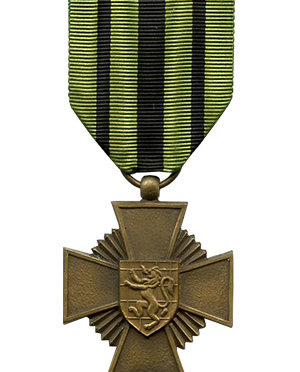
The Escapees’ Cross 1940–1945 (Croix des Évadés 1940–1945 / Kruis der Ontsnapten 1940–1945) is a Belgian war service medal established by the Belgian government in exile in London on 25 February 1944.

The medal was awarded to all Belgian citizens who, during the Second World War escaped from occupied Belgium (or from another occupied land or Germany) and that, following it, had proven their patriotism by joining and serving with a resistance group. It was also awarded for being imprisoned for a minimum of three months following an act of patriotism, or for having traveled clandestinely to participate in a Belgian action aimed at promoting the war against the enemy. 

The medal’s statute was later amended to include those who had escaped also from non-occupied territories and made their way to the United Kingdom in order to continue fighting the enemy (such as those that left the beaches of Dunkirk, non-occupied France or French North Africa).

The Escapees’ Cross 1940-1945 Design

The medal is a cross pattée measuring 39mm wide, with four 7mm long rays radiating outwards between its arms.

The obverse bears a 14mm wide by 18mm high shield bearing a lion rampant superimposed over prison bars. The medal is a single face, and the reverse is bare.

The ribbon is 37mm wide green silk moiré, with a longitudinal 6mm wide central black stripe and narrow 3mm black stripes 6mm from the ribbon edges. The award was suspended by a ring through a suspension loop.

The Political Prisoner’s Cross 1940-1945

The Political Prisoner’s Cross 1940–1945 (Croix du Prisonnier Politique 1940–1945, / Politieke Gevangenkruis 1940–1945) is a Belgian war medal established on 13 November 1947 by royal decree of the Regent and awarded to Belgian citizens arrested and interned by the Germans as political prisoners during the Second World War.

The award’s statute also included provisions for posthumous award should the intended recipient not survive detention, and the right of the widow (the father or the mother of the deceased) to wear the cross.

The Political Prisoner’s Cross 1940-1945 Design

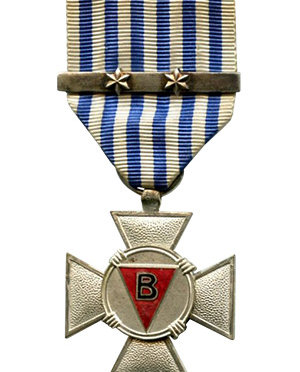
The medal is a cross pattée measuring 37mm wide and is struck in silver.

Its obverse bears a 2 cm in diameter central medallion surrounded by barbed wire with an inverted red enameled triangle with a black capital “B” at its center, representing the insignia internees had to wear on their prisoners’ uniforms that identified them as Belgian political prisoners. The reverse also bears a central medallion but enameled in black and bearing the years “1940 1945” in silver numerals.

The ribbon is 38mm wide white silk moiré with six 3mm wide longitudinal blue stripes 3mm apart from each other, the colors representing the striped prisoners’ uniforms. The cross was suspended by a ring through a suspension loop.

Silver bars with up to four small five or six-pointed stars on them could be worn on the ribbon, each one denoting a period of six months of internment. Many veterans opted instead for small individual silver stars directly affixed to the ribbon. In the case of a posthumous award, a black enameled bar was worn on the ribbon above the others.

The 1940-1945 Military Combatant’s Medal

The 1940–1945 Military Combatant’s Medal (Médaille du Combattant Militaire de la Guerre 1940–1945 / Medaille van de Militaire Strijder 1940–1945) is a Belgian war medal established on 19 December 1967 by royal decree and awarded to all members of the Belgian Armed Forces who fought from England during the Second World War.

The 1940-1945 Military Combatant’s Medal Design

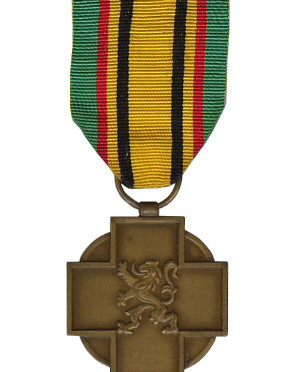
The medal measures 38mm wide is Greek cross struck in bronze, with semi-circular protrusions filling the gaps between the arms up to 3mm from the cross arms’ ends.

The obverse bears the relief image of a lion rampant at the center of the cross. The reverse bears a vertical broadsword bisecting the years “1940” and “1945” inscribed in relief.

The ribbon is 36mm wide silk moiré with the colors divided as follows from the left to the right edge: 6mm green, 2mm red, 3mm yellow, 2mm black, 1 cm yellow, 2mm black, 3mm yellow, 2mm red, 6mm green. The medal is suspended by a ring through a suspension loop.

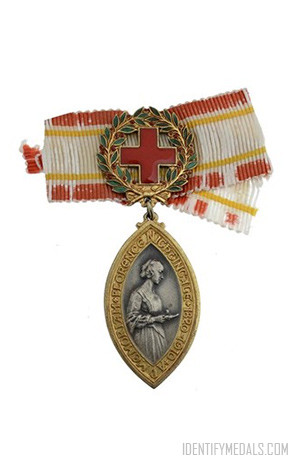
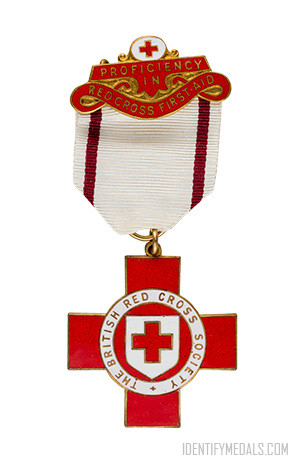
The Order of the Belgian Red Cross

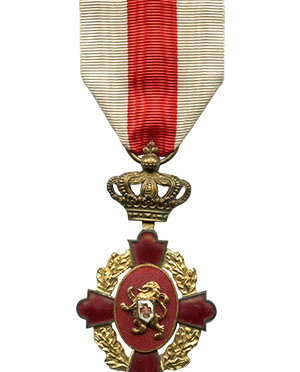
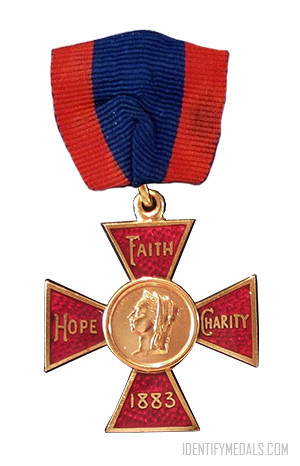
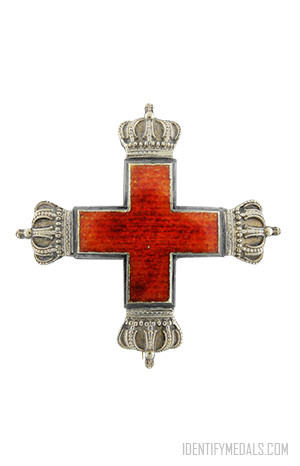
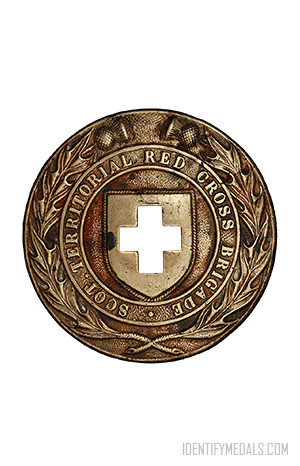
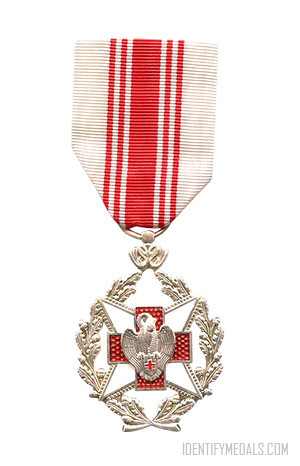
The Order of the Belgian Red Cross (Ordre de la Croix Rouge Belge / Orde van het Belgische Rode Kruis) was established in 1880.

The Order of the Belgian Red Cross (Ordre de la Croix Rouge Belge / Orde van het Belgische Rode Kruis) was established in 1880.

The award was produced in two classes: 1st class (gilt finish), and 2nd class (silver finish).

The Order of the Belgian Red Cross Design

The medal is a red enamel cross patonce 37mm wide with an oak wreath set within the arms. The obverse bears a vertically elongate oval central medallion in red enamel bears the Belgian lion, with the red cross emblem on a small white shield superimposed. The reverse is similar, but with a plain central medallion in gilt or silver, suitable for engraving of the recipient’s details.

The ribbon measures 37 mm wide with a 12mm wide red central stripe for the 1st class award, or with two narrow red central stripes for the 2nd class award.

Find Red Cross Medals Online

More Red Cross Medals

The Military Cross (Belgium)

The Military Cross (Croix Militaire / Militair Kruis) is a military long service decoration of Belgium established on 11 February 1885 by Royal Decree and awarded to commissioned officers in the Belgian Armed Forces for loyal and uninterrupted service or to Non-Belgian military officers for distinguished service in favor of the Military of Belgium.

The Military Cross, second class is awarded to Belgian military officers after 25 years of service. The Military Cross, first class is awarded to Belgian military officers after 25 years of service as a commissioned officer.

The award may be awarded to Commissioned Officers of non-Belgian armed forces for distinguished service towards the Belgian Defence. In such a case, the second class is awarded to officers below the rank of brigadier general. The first class is awarded to general officers.

The Military Cross Design

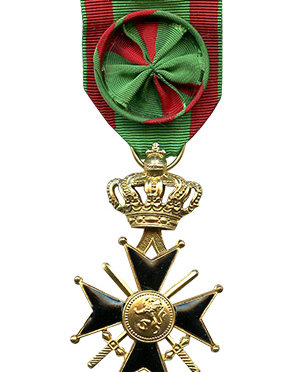
The award is a black enameled Maltese cross with a 1 mm gilt edge. The aarms end in eight 2 mm in diameter gilt spheres and gilt crossed swords pointing up are positioned between the arms of the cross.

The obverse central medallion bears the Belgian lion rampant, pre-1952, while the reverse bears the royal cipher of the reigning monarch. After 1952, the reverse is identical to the obverse.

The ribbon is green silk moiré and has two 5 mm wide red stripes set 1 mm from the ribbon’s edges. There’s a suspension ring passing through the orb of a pivot mounted crown.  The Military Cross First Class differs only from the second class award in the form of a rosette on the ribbon in the same colors as the ribbon.