Imperial Order of the Rose

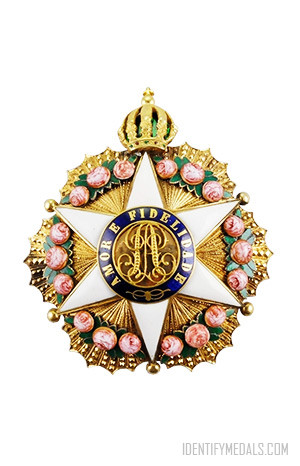
The Imperial Order of the Rose was a Brazilian order of chivalry created by Emperor Pedro I of Brazil in 1829 to commemorate his marriage.

The Imperial Order of the Rose was a Brazilian order of chivalry created by Emperor Pedro I in 1829 to commemorate his marriage to Amélie of Leuchtenberg. 

The order was canceled in 1890 by the interim government of the First Brazilian Republic. When Emperor Pedro II was deposed in 1889, the order continued as a house order being awarded by the Heads of the House of Orleans-Braganza (pretenders of the throne). 

Today, the Grand Mastership of the Order is disputed between the two branches Petrópolis and Vassouras of the Brazilian Imperial family. 

Classes of the Order of the Rose

The Order of the Rose had six degreed:

  • Grand Cross: Limited to 16 recipients and styled “Excellency”.
  • Grand Dignitary: Limited to 16 recipients and styled “Senhor”.
  • Dignitary: Limited to 32 recipients and styled “Senhor”.
  • Commander: With an unlimited number of recipients and styled “Senhor”
  • Official: With an unlimited number of recipients and styled “Honorary Colonel”.
  • Knight: With an unlimited number of recipients and styled “Honorary Captain”.

The Order of the Rose Medal Design

The obverse of the insignia consists of a white star with six-pointed tips joined by a garland of roses. In the center is a medallion with the interlaced letters P and A embossed and surrounded y a blue ferret border that rad “Love and Fidelity”. 

The reverse is the same but with the inscription “2-8-1829” and the legend “PEDRO AND AMÉLIA”.
Order of the Southern Cross

The Order of the Southern Cross is a Brazilian order of chivalry established in 1822 for the coronation of Pedro I.

The Order of the Southern Cross (or Ordem Nacional do Cruzeiro do Sul in Portuguese) is a Brazilian order of chivalry established on 1 December 1822 for the coronation of Pedro I of Brazil, the empire’s first monarch. 

The order is awarded “as a token of gratitude and recognition for those who have rendered significant service to the Brazilian nation”. The Grand Master of the Order of the Southern Cross is the President of Brazil. 

Originally known as the Imperial Order of the Cross (or Ordem Imperial do Cruzeiro in Portuguese), the first knights were also appointed when the monarch was crowned. Although Brazil had shared orders of chivalry with Portugal before the country’s independence, the Order of the Cross was the first purely Brazilian order.

From the proclamation of the Republic until the revolution of 1930 (what’s known as the Old Republic), national orders ceased to exist. This changed when, in 1832, the Order of the Southern Cross was the first to be re-established. Today, it’s considered the senior Brazilian National Order. 

The order continues to be used by both branches of the Brazilian Imperial family, but it’s no longer recognized by the Republic of Brazil. 

Classes of the Order of the Southern Cross

In 1932, the republican version of the Order had the same five grades as the old imperial version. The Order of the Southern Cross is now awarded in six classes:

  • BRA - Order of the Southern Cross - Grand Cross BAR.svg Grand Collar: The highest rank, usually restricted to foreign Heads of State.
  • BRA - Order of the Southern Cross - Grand Cross BAR.svg Grand Cross
  • BRA - Order of the Southern Cross - Grand Officer BAR.svg Gand Officer
  • BRA - Order of the Southern Cross - Commander BAR.svg Commander
  • BRA - Order of the Southern Cross - Officer BAR.svg Officer
  • BRA - Order of the Southern Cross - Knight BAR.svg Knight

The Order of the Southern Cross Medal Design

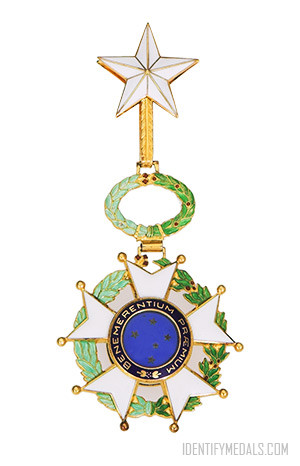
The insignia of the Order of the Southern Cross is a five-point white enamelled star edged with golden silver. It seats on a crown and is surmounted by a garland made of coffee and tobacco leaves. In the obverse, in the center is a blue sky field with the constellation of the Southern Cross, and in the circumference is the inscription “Benemerentium Premium” (“an award for merit”). The reverse shows the effigy of the Republic in gold and the inscription “Federative Republic of Brazil” (Art. 2 of the Regulations).

The Grand Collar of the Order of the Southern Cross is a chain from which the badge of the order is suspended.

The Star of the Order is a plaque modelled after the badge of the Order and is worn on the left breast.

The Order of King Abdulaziz

The Order of King Abdulaziz is a Saudi Arabian order instituted by King Faisal on 20 March 1971 (and formerly called Great Chain of Badr).

The Order of King Abdulaziz is an Order of merit of Saudi Arabia named after Abdulaziz Al Saud, the founder of the modern Saudi state. The order was introduced by decree on 20 March 1971 by King Faisal, although the order had been awarded before – albeit unsystematically. Then, it was usually referred to as the Great Chain of Badr.

The order is awarded to both citizens of Saudi Arabia and foreigners that have shown meritorious service to the Kingdom. The nominations are made by the Council of Ministers, although it’s the King that confers awards himself when he determines it appropriate.

The number of Saudi conferments is limited annually. There can be no more than 20 grand sashes of the distinguished class. Up to 40, 60, 80 and 100 awards can be granted to members of the 1st, 2nd, 3rd and 4th classes, respectively.

The collar of the order is regarded as a distinct honor but confers the highest rank in the Order of Abdulaziz Al Saud.

Classes of the Order of King Abdulaziz

There are six classes to the Order of King Abdulaziz. These are:

  • Special Class: A sash with a pendant is worn on the right shoulder and a star on the left chest.
  • Distinguished First Class: The insignia is worn on a necklet, plus a golden star on the left chest.
  • First Class: Worn on a necklet, plus a silver star on the left chest.
  • Second Class: Worn on a necklet;
  • Third Class: A badge is worn on a ribbon with a rosette on the left chest;
  • Fourth Class: A badge is worn on a ribbon on the left chest.
The Order of King Abdulaziz Medal Design

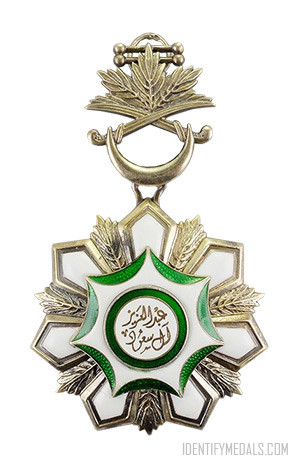
The Order of King Abdulaziz is a seven-pointed gold star with lozenge-shaped arms and white enamel panels with gold laurel branches. 

The suspension is a gold crescent with crossed swords and laurel spray. 

In the center, on the obverse, is a circular white enamel medallion with an inscription in gilt Arabic letters reading ‘Abdul-Aziz al-Saud’ and a gold-edged green enamel ring. 

The reverse is plain gold. 

Earlier versions of the Order of King Abdulaziz were typically produced by Bichay in Cairo, Egypt.

Medal of Bravery (Canada)

The Medal of Bravery (Médaille de la Bravoure in French) is a decoration given to Canadian citizens (civilians or members of the forces) for acts of bravery in hazardous circumstances. The medal is within the Canadian system of honors and is the third-highest award for bravery. It was created in 1972 and can be presented to both living and deceased individuals. Recipients the ability to use the post-nominal letters MB.

The Medal of Bravery Design

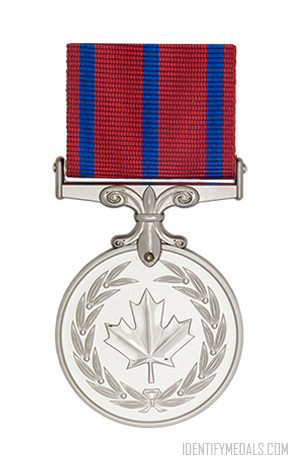
The Medal of Bravery is a silver medal measuring 31.8 millimetres (1.25 in) in diameter.

The obverse of the medal bears a maple leaf surrounded by a laurel wreath. On the reverse is the Royal Cypher of the reigning monarch, a St. Edward’s Crown, and the inscription BRAVERY • BRAVOURE. The name and rank of the recipient is engraved on the medal’s edge.

The insignia is worn on the left chest, on a 31.8mm wide red with three vertical blue stripes ribbon.

For men, the medal hungs from a bar, and for women, on a ribbon bow.

Individuals already possessing a Medal of Bravery can be awarded the decoration again (for subsequent acts of bravery), in which case a silver medal bar bearing a maple leaf is added on the original ribbon. 

The Order of Princess Olga

The Order of Princess Olga (Орден княгині Ольги) is a Ukrainian civil decoration bestowed to women for personal merits.

The Order of Princess Olga (Орден княгині Ольги) is a Ukrainian civil decoration bestowed to women for personal merits. It was established by Presidential Decree № 827/97 of 15 August 1997 and features Olga of Kiev.

The award is given for “personal merits in state, production, scientific, educational, cultural, charity and other spheres of social activities, for upbringing children in families”. It has three grades or classes, the first being the highest. 

Both Ukrainian citizens and foreigners are eligible for the order. The order can be rescinded by the President of Ukraine if a bearer is convicted of a serious crime.

The Order of Princess Olga Design

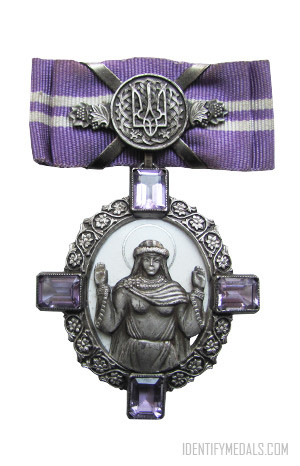
The 1st grade medal is adorned with four rectangular amethysts and features a gilded ornament with silver parts. The two other grades also feature precious stones.

The Order of Prince Yaroslav the Wise

The Order of Prince Yaroslav the Wise (Орден князя Ярослава Мудрого) is awarded for distinguished services to the state and people of Ukraine.

The Order of Prince Yaroslav the Wise (Орден князя Ярослава Мудрого) is awarded for distinguished services to the state and people of Ukraine in the field of state building, strengthening the international prestige of Ukraine, development of economy, science, education, culture, art, health care, for outstanding charitable, humanistic and public activities. The motto of the Order of Prince Yaroslav the Wise – “Wisdom, honor, glory.

The Order was instituted on 23 August 1995 by the Ukrainian President, Leonid Kuchma. It is awarded in five classes (I, II, III, IV and V degree). 

The Order of Prince Yaroslav the Wise can be awarded to citizens of Ukraine, foreign citizens, and stateless persons. Those awarded the Order of any degree and is called a Knight of the Order of Prince Yaroslav the Wise.

Order of Prince Yaroslav the Wise Design

The insignia of the order was designed by sculptor and professor of the National Academy Of Fine Arts And Architecture, Valeriy Shvetsov.

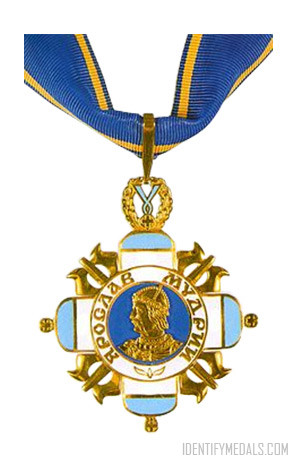
The Order has a blue ribbon with a yellow stripe on each edge.The badge of the Order of Prince Yaroslav the Wise I degree is worn on the chain of the Order, one star of the Order – on the left side of the chest, the other – on the ribbon over the right shoulder below the bow. The insignia of the Order of the I degree is made of silver and is an equilateral cross with rounded ends, topped with miniature crosses. 

The star of the Order of Prince Yaroslav the Wise is made of silver and has the shape of an octagonal convex star with gilded and silver diverging rays.

The Bharat Ratna Award

The Bharat Ratna Award is the highest civilian award of the Republic of India, given for exceptional service. It was established in 1954.

The Bharat Ratna Award is the highest civilian award of the Republic of India. It was established on 2 January 1954 and it is awarded for exceptional service or performance of the highest order.

Although the honor was originally limited to achievements in the arts, literature, science, and public services, in 2011 the Indian government expanded the criteria to include “any field of human endeavor“. People of any race, occupation, position, or sex can receive this award.

The recommendations for the Bharat Ratna award are made by the Prime Minister to the President. There’s a maximum of three nominees awarded per year. Several bestowals of the award, such as that of K. Kamaraj (1976) and M. G. Ramachandran (1988) have met with criticism.

The Bharat Ratna Design

The original award (1954) was specified as a circle measuring 35 mm (1 38 inches) in diameter and made of gold.

The obverse has a sun burst design, the text “Bharat Ratna“, in Devanagari Script inscribed on the upper edge in silver gilt, and a wreath set along on the lower edge. The reverse bears the platinum State Emblem of India in the center as well as the national motto, “Satyameva Jayate” in Devanagari Script (सत्यमेव जयते in Sanscrit; lit. “Truth alone triumphs“) inscribed in silver-gilt on the lower edge.

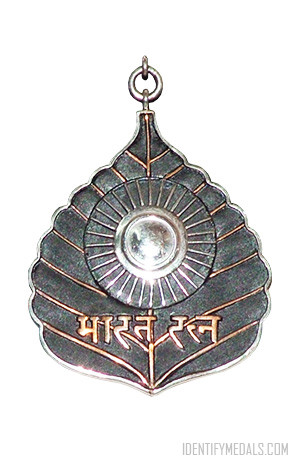
This design was modified in 1955. The current medals has the shape of a peepal leaf, measures approximately 59 mm (2 516 inches) long, 48 mm (1 78 inches) wide and 3.2 mm (18 inches) thick and it’s rimmed in platinum. 

The obverse has an embossed sun burst design made of platinum, with rays spreading out, and the words “Bharat Ratna”. The reverse bears the sane design as the 1954 version and the inscription “Satyameva Jayate”.

The ribbon is white.

The Order of Yukon

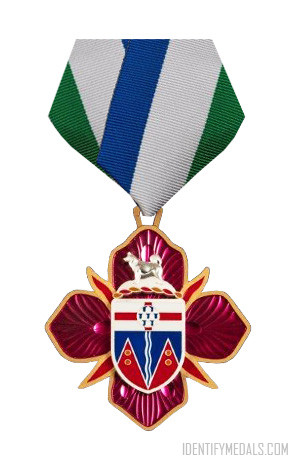
The Order of Yukon (Ordre du Yukon in French), instituted on 1 January 2020, is a civilian honor for merit in the Canadian territory of Yukon. It is the highest honor which can be bestowed by the Government of Yukon. 

The Order is intended to honor current and former residents of the territory for significant contributions to the advancement of Yukon society. The Order of Yukon was first proposed in 2016, following public consultation and created by the passage of the Order of Yukon Act in 2018. 

Inductees are entitled to use the postnominal letters OY.

The Order of the Northwest Territories

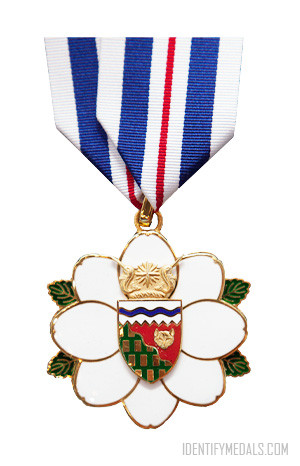
The Order of the Northwest Territories (Ordre des Territoires du Nord-Ouest in French), instituted on 7 October 2015, is a civil honor for merit in the Canadian territory of the Northwest Territories. 

The Order It is intended to honor current and former residents of the territory who have served with the great distinction and excelling in any field of endeavor for the benefit the people of the Northwest Territories and others. The order may be awarded to no more than three persons annually.

The Order of Nunavut

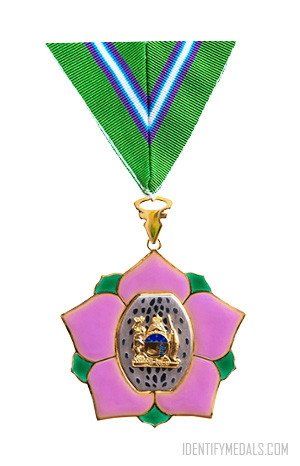
The Order of Nunavut (Ordre du Nunavut in French, ᓄᓇᕗᒻᒥ ᐃᓕᓴᖅᓯᔾᔪᑦ ᐅᔭᒥᒃ / Nangariyauyunut Nunavunmi in Inuktitut), instituted in 2010, is a civilian honor for merit in the Canadian territory of Nunavut.

The Order was created by the passage of the Order of Nunavut Act and is intended to honor current and former residents of the territory (or the territory which became Nunavut) for outstanding contribution to the cultural, social, or economic well-being of Nunavut. A maximum of three individuals may be inducted by the Commissioner of Nunavut each year.